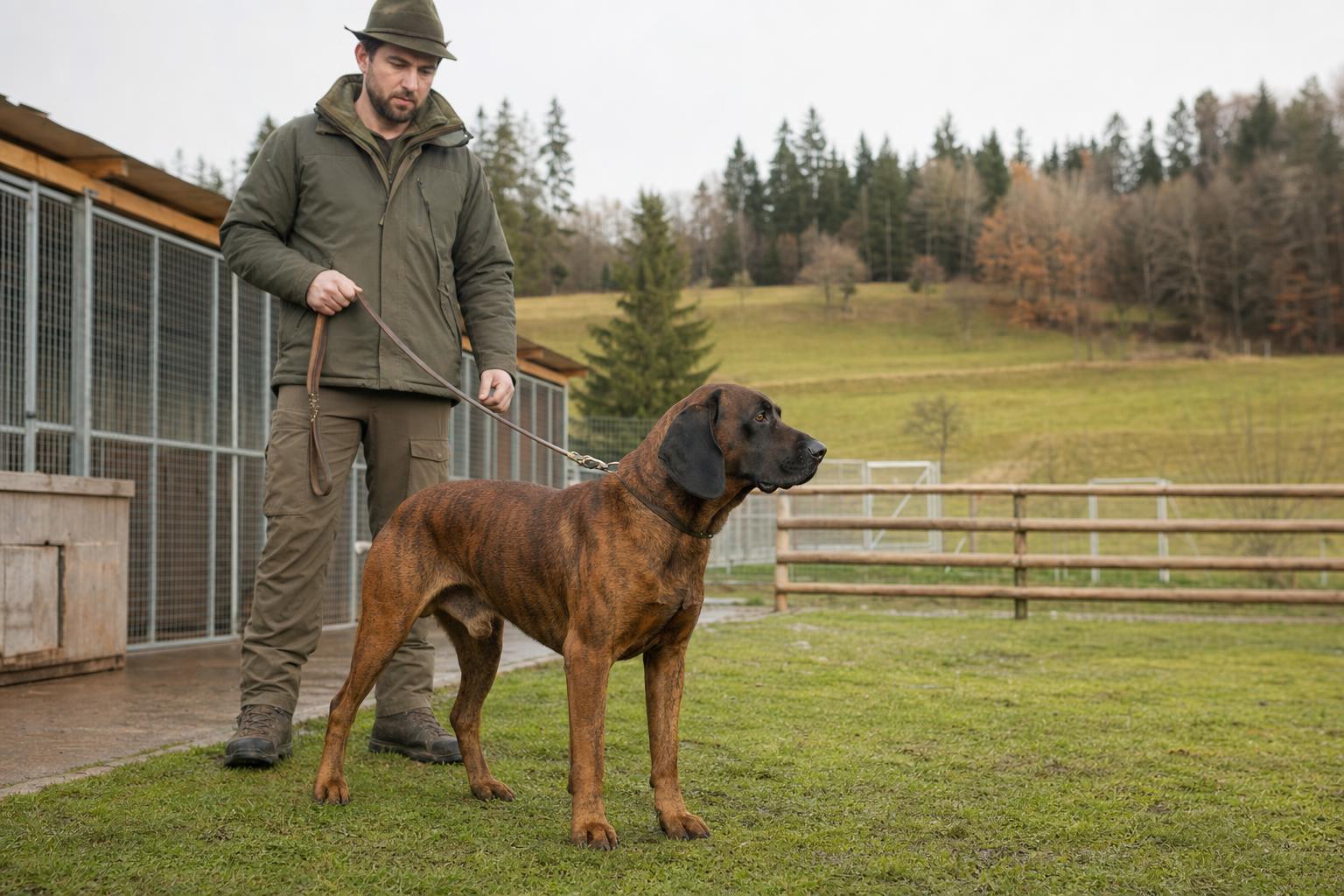
Choosing a Bavarian Mountain Hound stud dog is not just a matter of finding a handsome hound with an impressive pedigree. This is a specialist scent hound, developed in southern Germany to track wounded game over difficult mountain country, and the right breeding choice should protect the qualities that make the breed useful: endurance, sound movement, steady temperament, devotion to the handler, and a serious nose. Whether you are planning a working litter, evaluating a potential outcross, or trying to understand what responsible stud service should look like, the best decisions start with proof rather than promises.
The Bavarian Mountain Hound is a medium-sized, athletic dog with a dense close coat, a calm but determined nature, and a strong work mindset. Many are reserved with strangers while remaining loyal and affectionate with their own people. Because the breed is still uncommon in many areas, buyers and breeders may find fewer local stud options than they would in more common gun dog or hound breeds. That makes careful verification even more important. A distant stud may look ideal online, but his health records, temperament, working ability, fertility history, and contract terms still need to be reviewed in detail.
This guide is written for practical buyers and breeders who want to evaluate Bavarian Mountain Hound stud dogs responsibly. It does not assume that every registry, test, reproductive service, or performance venue applies to every dog. Instead, it shows what to ask, how to verify claims, and how to compare a stud dog against the purpose of the planned litter.
Health Clearances for Bavarian Mountain Hound Stud Dogs
Health clearances are the foundation of any serious stud dog evaluation. The breed is built for endurance, sure-footed movement, and long hours following scent, so sound structure matters. The selector facts for this breed note that hip health is a common focus in many kennel club recommendations, and prospective owners should ask about screening results and the health history of close relatives. That advice applies even more strongly when choosing a stud.
Ask the stud owner for copies of health documentation, not just a statement that the dog is “vet checked” or “healthy.” A routine veterinary exam is useful, but it is not the same as formal screening. You should also ask how old the dog was when tested, whether results are final or preliminary, and whether close relatives have known orthopedic, reproductive, ear, temperament, or working-soundness issues. In a breed used for tracking wounded deer and wild boar in rugged terrain, a dog should not only look fit in photographs; he should have a documented history that supports a physically durable breeding decision.
- Request written health results from recognized screening bodies when available.
- Ask about hip screening and the health history of parents, siblings, and previous offspring.
- Discuss any ear, skin, orthopedic, fertility, or temperament concerns honestly before breeding.
- Confirm that the dog is in appropriate body condition and fit for breeding work.
OFA and Other Orthopedic Verification
OFA records are commonly used in the United States for orthopedic and other health screening, but the relevance of OFA depends on the country, registry, and screening system used by the breeder. Bavarian Mountain Hounds with European backgrounds may have records through other kennel club or veterinary schemes. Do not assume that a lack of OFA automatically means a dog is unscreened, and do not assume that the presence of one certificate answers every question.
If the stud dog is advertised with OFA results, verify the registered name, registration number, microchip or tattoo if listed, date of evaluation, and final rating. If the dog has non-OFA hip or elbow results, ask for the equivalent documentation and, when possible, have a knowledgeable veterinarian or experienced breeder help interpret the record. Because this breed should move efficiently and remain agile on rough ground, orthopedic history deserves careful attention. A breeding dog should contribute to the long-term soundness of the litter, not simply meet the minimum paperwork requirement.
DNA Testing and Genetic Claims
DNA testing can be valuable, but it must be understood correctly. Some tests verify parentage, some identify genetic diversity markers, and others screen for specific inherited conditions. The important question is not “Has the dog been DNA tested?” but “What was tested, why was it relevant, and how do the results affect this breeding?” For a less common breed such as the Bavarian Mountain Hound, buyers should ask which DNA panels are recognized by the relevant breed club, registry, or veterinary genetics laboratory.
Be cautious with vague advertising. A stud listed as “DNA clear” may only be clear for the conditions included on a particular panel, and those conditions may or may not be central to this breed. Ask for laboratory reports, confirm the dog’s identity on the paperwork, and review whether the planned dam has compatible results. DNA testing is a tool for reducing avoidable risk; it is not a guarantee of perfect health, temperament, or working ability.
- Ask which laboratory performed the test and what conditions or markers were included.
- Confirm whether the test is recommended for Bavarian Mountain Hounds by a breed club, registry, or veterinarian.
- Compare the stud’s results with the dam’s results before making breeding decisions.
- Avoid relying on broad phrases such as “fully tested” without seeing the actual reports.
Frozen Semen for Bavarian Mountain Hound Stud Dogs
Frozen semen can make a rare or distant stud more accessible, but it adds cost, planning, and technical risk. For Bavarian Mountain Hound breeders, it may be useful when the ideal male is in another region or country, or when preserving genetics from a proven older dog. However, frozen semen is not something to assume is available. Some stud owners collect and store semen; others only offer natural breeding or fresh chilled shipments, and some do not offer outside stud service at all.
If frozen semen is advertised, ask when it was collected, where it is stored, how many breeding units are available, what motility information is documented, and whether prior pregnancies have resulted from the stored semen. Work with a reproductive veterinarian before committing. Timing is critical, and the dam’s ovulation testing, shipping logistics, storage transfer, insemination method, and contract language all affect the outcome. A responsible stud owner should be transparent about semen quality and should not promise a litter as if biology were guaranteed.
Live Cover vs AI
Live cover and artificial insemination each have advantages and drawbacks. Live cover may be simpler when both dogs are local, physically compatible, healthy, and experienced. It still requires supervision, timing, and a clear plan for safety. Artificial insemination can be helpful when distance, dog behavior, disease management, or semen shipment makes natural breeding impractical. Depending on location and registry rules, AI may require specific veterinary documentation or paperwork.
For Bavarian Mountain Hounds, the right choice should be based on the dogs, the owners, and the reproductive advice available, not on convenience alone. If the stud dog is reserved with unfamiliar people or has a very focused working temperament, introductions should be handled calmly. If AI is used, confirm whether fresh, chilled, or frozen semen is being used and who is responsible for collection, shipment, veterinary appointments, and failed timing. Buyers should also verify registry rules before breeding, especially if the litter will be registered with an organization that has strict requirements for semen collection or parentage verification.
Stud Contracts
A stud contract protects both sides and helps prevent misunderstandings. It should be written before any breeding takes place. A handshake agreement may feel friendly, but it is not enough when travel, semen shipment, veterinary timing, fertility questions, litter registration, and money are involved. The contract should identify the stud dog and dam, list the fee or pick-puppy arrangement, define what counts as a successful breeding, and explain what happens if the dam does not conceive or produces a very small litter.
For Bavarian Mountain Hound stud service, the contract should also address the purpose of the breeding. If the litter is intended for working tracking homes, the stud owner may have expectations about buyer screening, placement priorities, or follow-up on offspring. That is not unreasonable, but it should be clear. The contract should also state who pays for progesterone testing, collection, shipping, boarding, veterinary care, semen storage, and registration-related paperwork.
- Identify both dogs by registered name, microchip or registration number when available, and owner information.
- State the stud fee, due date, refund or repeat-breeding terms, and any pick-puppy agreement.
- Clarify responsibility for veterinary costs, shipping, boarding, semen collection, and storage fees.
- Include health documentation, registration requirements, and litter paperwork obligations.
- Put any fertility guarantee or no-guarantee language in plain writing.
Pedigree Analysis
Pedigree analysis is more than counting champions or importing an impressive name. The Bavarian Mountain Hound was developed for specialized scent work, and a useful pedigree should be evaluated for working suitability, temperament, soundness, and consistency. Look for dogs that have produced the traits you want, not merely dogs with attractive photos or distant famous ancestors. If the breed is rare in your area, maintaining genetic diversity can also be an important concern.
Verify reported working titles and test results with the issuing organisation. Confirm that the programme applies to the breed and ask what the result demonstrates about the individual dog.
Working Ability and Temperament Fit
A good Bavarian Mountain Hound stud should reflect the breed’s purpose. The selector facts describe a calm, devoted, self-assured dog that can be reserved with strangers and deeply focused on scent. That combination can be excellent in experienced hands, but it requires thoughtful breeding. Ask to see the dog working if possible, or request references from handlers who have hunted, tracked, trained, or lived with him. A dog that is productive in real work and stable in daily life is more useful than one promoted only by marketing language.
Temperament should be evaluated honestly. The breed should not be shy or aggressive, and a stud dog should not pass on avoidable instability. Because many Bavarians are sensitive and independent when following scent, buyers should ask how the dog handles pressure, new places, strange people, other dogs, and downtime in the home. Match the stud to the dam with the future owner in mind. Puppies from a high-drive breeding may be excellent for tracking homes but difficult for casual families who only want a quiet pet.
Questions to Ask Before Booking a Bavarian Mountain Hound Stud Dog
- What health clearances are complete, and may I see copies?
- What hip screening results are available for the stud and close relatives?
- Has any DNA testing been done, and is it relevant to this breed?
- What litters has this stud produced, and what are the offspring like as workers and companions?
- Is semen available by live cover, fresh chilled, or frozen, and what veterinary timing is required?
- What registry or breed club rules apply to this breeding?
- What are the stud contract terms if the dam does not conceive?
- How does the stud’s temperament compare with the dam’s strengths and weaknesses?
Buyer-Focused Conclusion
The best Bavarian Mountain Hound stud dog is not necessarily the closest, the most advertised, or the one with the longest list of vague credentials. He is the dog whose health records, structure, scenting ability, temperament, fertility history, contract terms, and pedigree make sense for the dam and the intended homes for the puppies. Verify every claim, especially when records involve OFA, DNA testing, frozen semen, AI, performance results, or registry status. Some tools may be essential in one country or breeding program and irrelevant in another.
For this breed, responsible stud selection should honor the Bavarian Mountain Hound’s original purpose as a steady, athletic, determined tracking hound. Take your time, ask for documentation, involve qualified veterinarians and experienced breed people, and choose a breeding that improves the odds of sound, capable, well-matched dogs. That is better for the breeder, better for buyers, and most importantly, better for the dogs themselves.
Explore Bavarian Mountain Hound on Working Dog Central
View the Bavarian Mountain Hound breed profile or browse Bavarian Mountain Hound listings.


