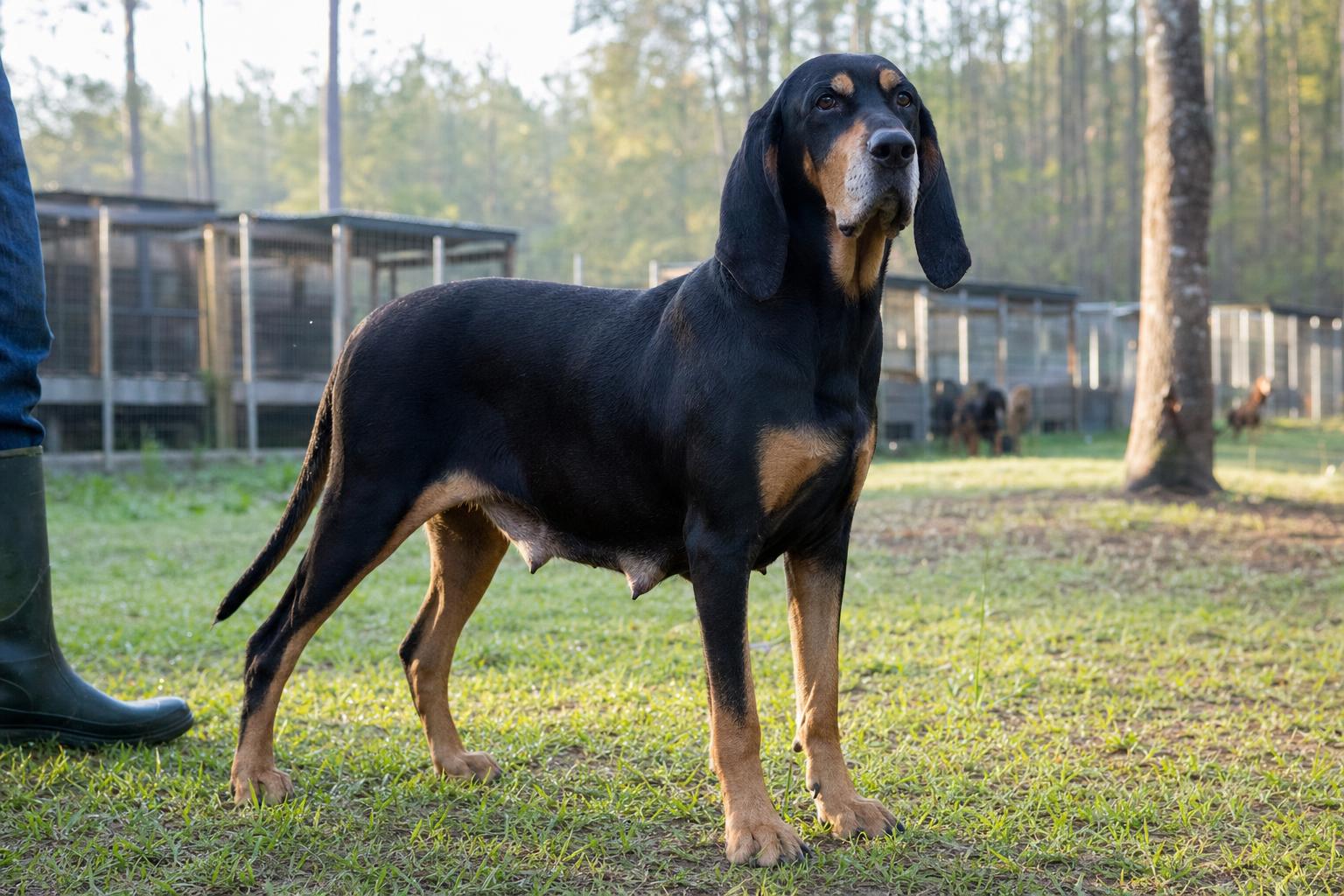
A proven female Black and Tan Coonhound can be a valuable purchase for a serious hound breeder, hunting kennel, or buyer looking for an adult female with documented ability and reproductive history. “Proven” should mean more than simply having produced puppies. A buyer should be able to review her prior litters, assess the quality and consistency of her offspring, understand her health background, and see how her temperament and working instincts fit the goals of the breeding program.
The Black and Tan Coonhound is an American scent hound developed for trailing and treeing raccoon and other game, often at night and across difficult country. The breed is known for endurance, a strong nose, a deep carrying bay, independence on track, and a generally loyal, affectionate nature at home. Those traits make the female herself important, but they also make her production record important. A good brood female should pass along useful hound qualities, not just produce large litters.
Production Record in a Proven Black and Tan Coonhound Female
Start with the production record. Ask how many litters the female has had, when they were born, how many puppies were whelped, how many survived, and where those pups are now. A responsible seller should be willing to discuss the strengths and weaknesses seen in past puppies. For this breed, useful questions include whether offspring show nose, voice, track persistence, tree interest, stamina, sound feet and legs, manageable temperament, and the ability to settle when not working.
Look for evidence, not slogans. Photos, references from puppy buyers, hunting reports, competition results where relevant, and adult offspring you can see in person are all more meaningful than a vague claim that she “throws good pups.” Because Black and Tan Coonhounds may mature at different rates, ask how her pups look as adults, not only how they looked at eight weeks.
- How many litters has she had, and at what ages?
- Were litter sizes and puppy survival rates normal for her and her veterinary history?
- Are previous puppies being hunted, shown, tracked, used in search work, or kept as companions?
- Do owners describe consistent traits, or do reports vary widely from pup to pup?
Prior Litters and Offspring Quality
Prior litters tell you what a female has actually produced with specific males. Review each cross separately. One strong litter may reflect an excellent pairing; one weak litter may reflect a poor match rather than the female alone. Still, patterns matter. If several litters show the same strengths, such as strong scenting desire, big hound voice, durability, and social temperament, that information has value. If several litters show the same issues, such as weak structure, extreme shyness, poor handling, or inconsistent working drive, take that seriously.
For a Black and Tan Coonhound, buyer goals vary. Some buyers want a hard-going night hunter. Others want a trail dog, a family companion with hound type, or a dog for organized coonhound events. Evaluate whether her previous offspring match your intended purpose. A female that produces bold, vocal, independent hunters may be excellent for one buyer and too much dog for another.
Maternal Ability and Whelping History
Maternal ability is part of fair evaluation. Ask whether the female settled easily, carried normally, whelped naturally or required assistance, accepted her puppies, kept them clean and warm, and maintained condition while nursing. None of these points should be exaggerated into a medical guarantee, but they help you understand the practical side of owning or breeding her.
Ask for veterinary records related to pregnancies and whelping if the seller has them. A single complication does not automatically disqualify a female, but repeated trouble, poor mothering, or unclear records should slow the sale down. Good maternal ability includes more than nursing. A steady, attentive dam often gives puppies a better early start through calm handling, clean living conditions, and predictable human interaction.
Age and Breeding History
Age matters when buying a proven female. A young adult with one good litter may have future breeding potential, while an older female may be more valuable for her companionship, hunting experience, or proven bloodline than for additional litters. Ask the exact birth date, breeding dates, litter dates, rest periods between litters, and whether a veterinarian has commented on her current breeding fitness.
Do not assume that every proven female should be bred again. Responsible evaluation includes body condition, recovery from prior litters, temperament, soundness, and veterinary guidance. If you are buying her for future breeding, put expectations in writing and have her examined by your own veterinarian before relying on her fertility or safety for another litter.
- Confirm her age and number of previous litters.
- Review the spacing between litters and whether she was given enough recovery time.
- Ask whether she cycles normally and whether any fertility concerns have been documented.
- Use a veterinary exam rather than seller confidence as your final check.
Health Clearances for Black and Tan Coonhound Proven Females
Health documentation should be specific and verifiable. The Black and Tan Coonhound is a large, deep-chested scent hound, and responsible screening commonly focuses on structural and inherited concerns. Breed-club CHIC/OFA guidance for Black and Tan Coonhounds includes hips, an eye exam by a veterinary ophthalmologist, and a cardiac evaluation, with elbows and thyroid often recommended. Buyers should verify current recommendations through OFA, the breed club, or their veterinarian rather than assuming every seller has completed every test.
Ask for registered names, registration numbers where applicable, and links or copies for health results. “Vet checked” is not the same as hip, eye, cardiac, thyroid, or other formal screening. If AKC registration, coonhound event records, or specific registry paperwork are part of the sale, verify them directly with the registry or issuing organization. Do not rely only on screenshots or verbal claims.
Temperament in the Kennel, Home, and Field
A proven female’s temperament affects her value as much as her pedigree. Black and Tan Coonhounds are often affectionate with family and social with people, but they can also be independent, vocal, and intensely focused on scent. Ask how she behaves in the house, kennel, truck, around children, with other dogs, and when loose in a secure yard. A female that is stable and manageable is easier to live with and often easier to place responsibly if breeding plans change.
In the field, ask for an honest description of her working style. Does she open freely on track? Is she cold-nosed? Does she stay treed? How does she handle pressure from other dogs? Is she safe around livestock and small animals, or does she need strict management? Strong prey drive is normal in the breed, but buyers need to know what level of management the individual dog requires.
Pedigree Strength and Working Proof
Pedigree analysis should support, not replace, direct evaluation. Study the female’s sire, dam, grandparents, siblings, and previous offspring. Look for dogs that consistently show the qualities you want: scenting ability, voice, endurance, structure, biddability, and sound temperament. If titles, hunt tests, trial records, or organized coonhound event wins are mentioned, verify them with the relevant registry or event organization. Not every good Black and Tan Coonhound will have formal titles, and not every titled dog is the right breeding match.
Working proof can be as simple as seeing the female hunt or reviewing credible references from people who have hunted behind her. For buyers who are not hunters, working proof still matters because it explains drive, energy, soundness, and behavior. A female bred from generations of active hounds may need more exercise and scent work than a casual household expects.
Fertility Considerations and Veterinary Verification
Fertility should never be assumed. Ask whether prior breedings were natural, whether timing was managed by progesterone testing, whether artificial insemination was used, and whether any missed breedings occurred. If frozen semen, live cover, or AI are discussed in connection with future plans, verify what is realistic for this individual female, the breed, and your veterinarian’s services. Those options may not apply in every sale and should not be treated as automatic.
If the female is being sold as breedable, a pre-purchase veterinary exam is a sensible step. Depending on her age and history, your veterinarian may suggest a general exam, reproductive evaluation, weight and body-condition review, parasite screening, or other checks. Avoid any agreement that promises exact future litter size, guaranteed conception, or perfect health. Fair contracts describe what is known, what is unknown, and what remedies apply if a stated fact turns out to be incorrect.
Fair Purchase Evaluation and Red Flags
Pricing a proven Black and Tan Coonhound female depends on age, health documentation, pedigree, working ability, production history, temperament, and whether she is being sold with breeding rights. Exact prices vary by region and market, so compare similar adult females and focus on value rather than hype. A female with transparent records, quality offspring, and a stable temperament is usually worth more than one sold only on famous names in the pedigree.
Red flags include pressure to buy immediately, missing litter records, refusal to share health documentation, vague claims about “champion blood” without proof, poor body condition, repeated close litters without recovery time, and unwillingness to let you speak with past puppy buyers. Also be cautious if the seller guarantees results that no breeder can honestly guarantee, such as exact puppy count, future titles, or a specific level of hunting ability in every pup.
- Verify identity, registration, health results, and ownership before payment.
- Use a written contract that explains breeding rights, known history, and return terms.
- Speak with owners of previous offspring whenever possible.
- Make sure the female’s drive and voice fit your home, kennel, and neighbors.
Conclusion: Buying a Proven Black and Tan Coonhound Female Wisely
A proven female Black and Tan Coonhound should be evaluated as a whole dog: producer, hunter or worker, companion, mother, and genetic contributor. The best purchase is not always the most famous pedigree or the lowest price. It is the female whose records are clear, whose health and temperament can be verified, whose previous offspring match your goals, and whose future use is realistic and humane. Take your time, ask practical questions, verify claims, and choose the female that strengthens your program rather than simply filling a kennel space.
Explore Black and Tan Coonhound on Working Dog Central
View the Black and Tan Coonhound breed profile or browse Black and Tan Coonhound listings.


