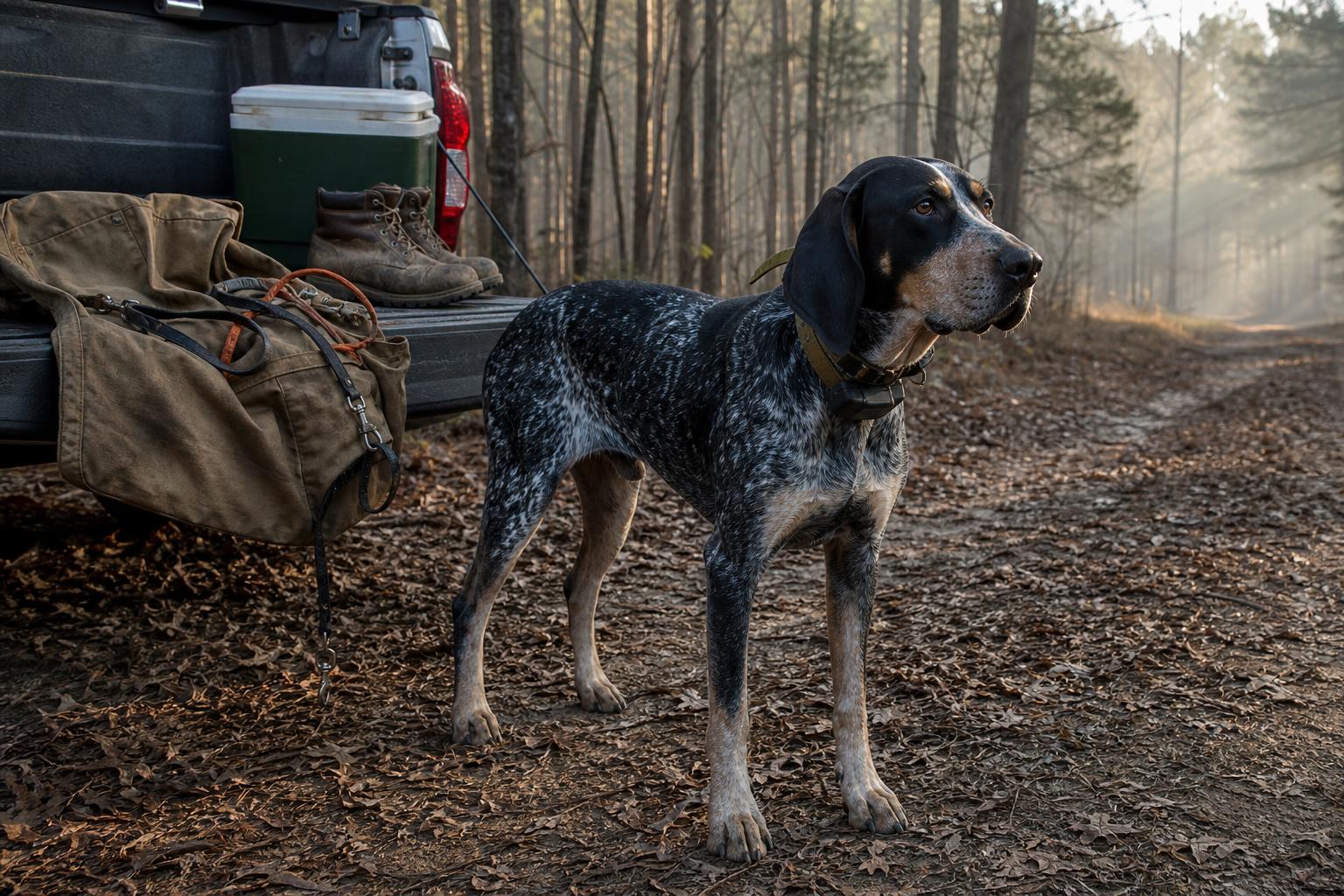
A finished Bluetick Coonhound can be a smart choice for a hunter who wants a coonhound that is already past the guesswork of puppy raising and early exposure. This breed was developed in the southern United States as a persistent, cold-nosed scenthound with the endurance to trail and tree raccoons and other game through rough cover. A good finished dog should show that heritage in a practical way: honest trailing ability, a recognizable locate, tree power, stamina, and enough handle to be enjoyable rather than exhausting.
Buying any finished dog requires more diligence than buying a young puppy because you are evaluating both the dog and the training history behind it. With a Bluetick Coonhound, that means looking beyond a pretty blue-ticked coat or a big voice. The right dog should fit your hunting style, terrain, schedule, and tolerance for normal hound traits such as independence, vocal enthusiasm, and intense interest in scent. The goal is not to find a perfect dog on paper; it is to find a proven, healthy, honest dog whose strengths and limitations are clearly understood before money changes hands.
What makes a finished dog
For a Bluetick Coonhound, the phrase “finished dog” should mean more than simply old enough to hunt. A finished coonhound should consistently hunt, trail, locate, and tree the intended game with minimal help from the handler. The dog should be able to work in real hunting conditions, not just perform in one familiar woodlot on one easy track. Finished does not always mean flawless, but it should mean the dog has a known pattern, dependable strengths, and enough experience that a buyer can watch the dog work and understand what they are getting.
Ask the seller to describe the dog’s normal hunt: how far it ranges, whether it opens freely on track, how it handles a cold trail, what its locate sounds like, and whether it stays treed under pressure. Blueticks are often valued for methodical, persistent tracking rather than only raw speed. That can be an advantage for hunters who appreciate a hound that works out older scent, but it may not suit someone who wants a very fast, competition-style dog. Make sure the seller’s definition of finished matches yours.
- Will the dog hunt alone and with company?
- Does it tree its own game, or does it mostly cover other dogs?
- How does it handle rough terrain, water, heat, and long nights?
- Is it accurate on trees, and how does the seller define accuracy?
- What faults has the seller seen: slick trees, trash running, leaving trees, excessive babbling, or poor handling?
Hunt tests
Hunt tests and organized evaluations can add useful context, but buyers should verify which programs are relevant to the individual dog and to the breed’s working purpose. Bluetick Coonhounds may be seen in coonhound events, bench shows, field trials, or other scent-hound venues depending on the owner’s interests and registry involvement. A title or pass record can show that the dog performed under rules and in front of other people, but it is not a substitute for watching the dog hunt in conditions similar to your own.
If a seller mentions hunt test results, ask for the registry or organization, the exact title or score, the date earned, and what the test measured. Some events emphasize treeing ability, some reward speed or accuracy, and some include handling or conformation components. Confirm records directly when possible rather than relying on abbreviations in an advertisement. If the dog has no formal test record, that is not automatically a problem. Many capable coonhounds spend their lives as practical hunting dogs. In that case, your evaluation should rely more heavily on live demonstration, references, and a clear trial period if one is offered.
Verify working records and breed eligibility
Verify reported working titles and test results with the issuing organisation. Confirm that the programme applies to the breed and ask what the result demonstrates about the individual dog.
For this breed, practical coonhound evidence is usually more relevant than a score from a venue designed around a different hunting tradition. Look for proof that fits the job: reliable track work, tree accuracy, soundness, stamina, and honest behavior around other hounds. If your goals include nontraditional activities such as scent sports, tracking games, or family companionship with occasional hunting, discuss those goals openly. The best finished dog for you is the one whose demonstrated abilities match your real life, not the one surrounded by the most impressive but unrelated terminology.
Trial records
Trial or competition records can be helpful when they are specific and verifiable. In coonhound circles, records may come from registry events, nite hunts, bench shows, or local club competitions. These can reveal how a Bluetick Coonhound performs around unfamiliar dogs, under pressure, and away from home ground. They may also show whether the dog has been campaigned enough to demonstrate consistency.
At the same time, trial success should be interpreted with care. A dog that wins in one format may not be the best pleasure-hunting hound for your woods. Some buyers want a wide-ranging, hard-driving dog. Others want a closer-working hound that checks in, handles easily, and suits smaller properties. Ask for the dog’s strengths outside the scorecard. Does it load and haul well? Can it be called off? Does it kennel quietly? Is it manageable around children, livestock, or other dogs when supervised? These practical traits often matter as much as a win slip.
- Request copies or links for any claimed titles, wins, or registry numbers.
- Ask whether the dog was handled by the owner, a trainer, or a professional handler.
- Find out how recently the dog competed or hunted hard.
- Compare trial style with the type of hunting you actually do.
Age expectations
Finished Bluetick Coonhounds are often mature enough to have a stable hunting pattern, but age alone does not define quality. A very young dog may be promising and well started, yet still lack the experience to be called finished. A mature adult may have thousands of hours in the woods and a reliable routine, but buyers should still evaluate conditioning, teeth, joints, hearing, vision, and overall soundness. The breed is a medium to large working hound, commonly athletic and durable, but active dogs need sensible care and honest assessment.
Ask how many seasons the dog has hunted, how often it has been hunted recently, and whether it has had any long layoffs. A dog that has been sitting in a kennel for months may need reconditioning before it can work long nights safely. Also ask about health screening, veterinary history, ear care, parasite prevention, and any previous injuries. Because long, low-set ears can trap moisture and debris, regular ear checks are especially important. Deep-chested dogs may have bloat risk, so discuss feeding routines and veterinary guidance without accepting blanket medical claims from a seller.
Investment value
A finished Bluetick Coonhound often costs more than a puppy or started dog because the buyer is paying for time, exposure, training, and proof. The value is not simply the dog’s age or pedigree; it is the confidence that the dog can do the work now. That said, avoid treating any finished dog as a guaranteed shortcut. Even a proven hound needs time to adjust to a new handler, new kennel, new country, and new expectations.
Fair value depends on ability, health, age, temperament, records, and honesty of representation. A dog with verified competition success, consistent accuracy, good manners, and current conditioning may command more than a dog with informal hunting experience only. But the best investment is the dog you can personally verify. Whenever possible, watch the dog hunt more than once, preferably in different conditions. If distance makes that impossible, request recent unedited video, references, veterinary records, and a written bill of sale that clearly states what is and is not promised.
Questions to ask before buying
- Why is the dog being sold?
- What game has the dog been hunted on, and how often?
- Has the dog shown interest in off-game, and how was it handled?
- Can the dog be demonstrated alone, not only with a strong pack?
- What registration, hunt records, or pedigree information can be verified?
- Are there known health, behavior, kennel, or handling issues?
- Is there a trial period, return agreement, or written guarantee? Do not assume one exists unless it is in writing.
Conclusion: buying the right finished Bluetick Coonhound
A finished Bluetick Coonhound should give you more than potential. It should give you evidence: real hunting performance, clear temperament, known strengths, and honest disclosure of faults. Use the breed’s background as a practical scenthound to guide your questions, then verify every claim that matters. The right finished dog can be a rewarding partner for a hunter who appreciates a loud, persistent, scent-driven hound and is prepared to manage it with secure containment, regular work, and fair handling.
Explore Bluetick Coonhound on Working Dog Central
View the Bluetick Coonhound breed profile or browse Bluetick Coonhound listings.


