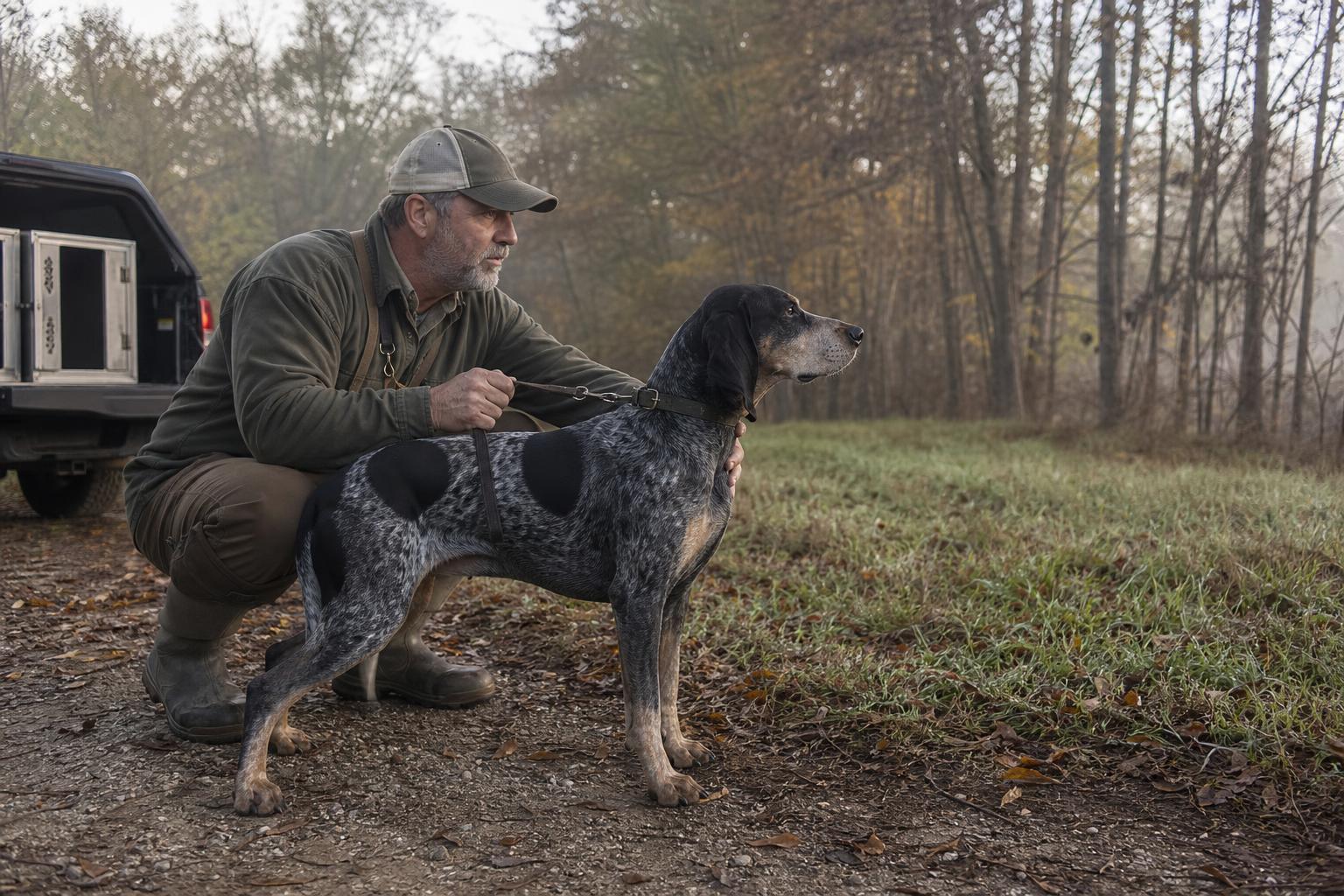
A Bluetick Coonhound started dog can be a practical choice for a hunter or active hound owner who wants to skip the earliest puppy stage and evaluate a dog that has already shown some maturity, drive, and trainability. Because this breed was developed as an American scenthound for trailing and treeing raccoon and other game, the most useful started dog is not simply older than a puppy. It should show enough exposure, handling, and field experience to help a buyer make a fair judgment about fit.
Blueticks are known for endurance, scenting ability, a deep baying voice, and an independent streak that is valuable in the woods but can challenge a casual owner. The right started prospect should be friendly and manageable around people, physically sound, comfortable with ordinary kennel or household routines, and interested in using its nose. Buyers should ask for honest demonstrations instead of relying only on labels such as “lightly started,” “green broke,” or “ready to hunt.”
What qualifies as “started” in a Bluetick Coonhound
For a Bluetick Coonhound, “started” should mean the dog has moved beyond basic socialization and has received some breed-appropriate field exposure. It does not have to mean finished, competition-proven, or fully reliable alone on every track. A started Bluetick may still need many miles, but it should have enough foundation for a buyer to see what the dog knows and how it learns.
- Age and maturity appropriate for regular training, usually past the youngest puppy stage.
- Comfort with leash handling, loading, kenneling, and being handled by people.
- Interest in scent, tracking, woods, and game-related situations.
- Some response to basic commands and correction without shutting down.
- Enough exposure that the seller can explain what the dog has actually done.
Ask whether the dog has trailed with experienced hounds, hunted alone, or only been introduced in controlled settings. Those are very different levels of preparation. A dog that has merely followed an older hound may still be promising, but it should be priced and represented as a prospect, not as a dependable hunting dog.
Birds introduced or breed-appropriate game exposure
Unlike pointing dogs and retrievers, a Bluetick Coonhound is typically evaluated through breed-appropriate game exposure rather than bird work. For this breed, that usually means scent trails, raccoon work, woods time, and exposure to the sights and sounds of a night hunt. Some individual Blueticks may be used around other legal game depending on the region and handler, but buyers should verify exactly what the dog has seen and under what conditions.
Useful questions include: Has the dog opened on track? Has it located a tree? Has it shown interest in a cage, drag, released game, or naturally encountered scent? Has it hunted with company, alone, or both? Was the dog corrected for trash running, and if so, how? The answer matters because a young hound can look exciting in one setup and still be very green in real hunting conditions.
Do not assume a started Bluetick has been exposed to every form of hunting. A buyer who wants a raccoon dog should ask for evidence related to raccoon. A buyer interested in tracking, pleasure hunting, or competition-style hound work should make sure the exposure matches that goal.
Gun introduction when relevant
Gun introduction may be relevant for some Bluetick Coonhound buyers, but it should be discussed in the context of how the dog is hunted. Many hound hunts involve firearms at the tree, while the dog’s primary job is scenting, trailing, and treeing. A started dog should not be described as gun-broke unless it has been introduced calmly and responsibly to the sounds it will encounter during actual use.
Ask the seller how the introduction was done. Was the dog exposed at a distance first? Was it paired with positive experiences? Has it heard shots in the woods, at the tree, or only around the kennel? A dog that ignores a distant sound may still react differently when excited, tired, or close to the source. Buyers should avoid sellers who brag about “seeing if the dog could take it” through sudden, careless noise exposure.
If gun use is not part of the buyer’s plan, the same principle still applies to other noises: trucks, other hounds, doors, ATVs, and busy kennels. Blueticks can be bold working dogs, but each individual should be evaluated for confidence and recovery.
Obedience level
A started Bluetick Coonhound does not need polished obedience like a formal companion dog, but it should have enough manners to be handled safely. Because the breed is scent-driven and independent, basic obedience should be realistic rather than overstated. A good started prospect should lead, load, accept restraint, come in controlled settings, and settle reasonably after exercise.
- Leash manners: the dog can be moved from kennel to truck to woods without constant struggle.
- Recall foundation: the dog shows some response, especially on a long line or in fenced areas.
- Kennel routine: the dog can crate, load, or kennel without panic.
- Handling: the dog allows ears, feet, mouth, and body to be checked.
- House exposure: if advertised as suitable for a home, the seller can describe real indoor habits.
Be cautious with any seller who promises perfect off-leash control in open country. The Bluetick Coonhound’s nose is one of its greatest strengths, and even well-trained individuals may need leashes, long lines, tracking collars, and secure fencing. Obedience should support the dog’s work; it should not erase the hound traits that make the breed what it is.
Evaluating training
The best way to evaluate a Bluetick Coonhound started dog is to see the dog work and handle in conditions close to your intended use. A short video may help, but it does not replace direct questions, references, and if possible, an in-person demonstration. Watch how the dog leaves the box, how it searches, how it reacts to other hounds, and how the handler communicates with it.
Ask for specifics rather than adjectives. “Has been hunted six nights this season” is more useful than “doing great.” “Will go with older dogs and has opened on track” is different from “will strike and tree alone.” If competition or registry paperwork is mentioned, verify it directly with the appropriate organization. AKC, UKC, hunt tests, and trial records may not all apply to every dog or seller, and titles should be checked rather than assumed.
Health and soundness also belong in the evaluation. Blueticks are generally sturdy working hounds, but buyers should ask about hip soundness, ear care, weight, conditioning, parasite prevention, and any veterinary history. For a started dog, feet, joints, stamina, and recovery after work matter because the buyer is purchasing both training and usable physical ability.
Red flags when shopping for Bluetick Coonhound started dogs
- The seller cannot explain the dog’s actual training history.
- The price is based on vague claims instead of demonstrated skills.
- The dog is advertised as finished, started, and family-perfect with no limitations.
- No one can show how the dog handles, loads, or responds after being turned loose.
- The seller discourages veterinary checks, references, or verification of records.
- The dog appears fearful, overly thin, unsound, or shut down during handling.
A green hound is not a bad hound. The problem is when a green dog is sold as something more. Honest sellers can describe strengths and gaps clearly, including whether the dog needs solo time, more exposure, improved recall, trash-breaking, or confidence building.
Is a started Bluetick Coonhound right for you?
A started Bluetick can be a smart purchase for someone who understands hounds and wants to evaluate natural ability before investing in more training. It can also be too much dog for someone expecting a quiet, handler-focused pet with minimal exercise needs. This breed thrives with secure containment, outdoor time, scent work, and patient handling.
Before buying, decide what you need: a pleasure hunting prospect, a competition candidate, a family companion with hound instincts, or a tracking partner. Then compare the individual dog to that goal. The best started Bluetick Coonhound is not necessarily the flashiest dog in a video; it is the one whose exposure, temperament, health, and training stage honestly match the life you can provide.
Buyer-focused conclusion
When shopping for Bluetick Coonhound started dogs, reward transparency. Ask what the dog has done, what it has not done, how it handles, and what kind of buyer will help it succeed. Verify paperwork and records when they are part of the sale, but put the most weight on the individual dog in front of you. A well-matched started Bluetick Coonhound gives you a head start without pretending the work is finished, and that honest middle ground is often where the best buying decisions are made.
Explore Bluetick Coonhound on Working Dog Central
View the Bluetick Coonhound breed profile or browse Bluetick Coonhound listings.


