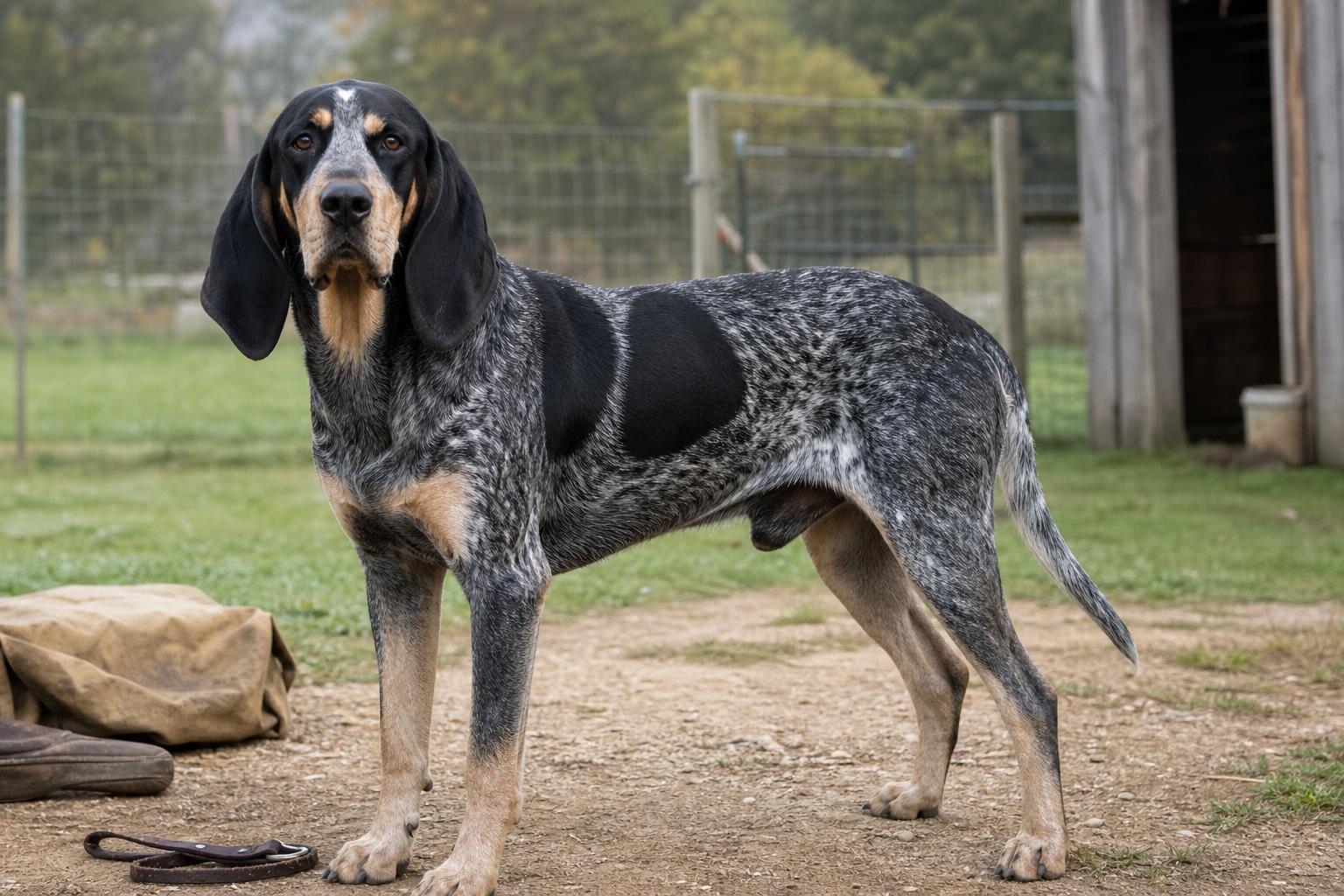
Choosing a Bluetick Coonhound stud dog is not just about finding a handsome hound with a loud voice and a good photo. This breed was developed as a persistent American scenthound, valued for cold-nosed tracking ability, endurance, a distinctive bay, and the grit to trail and tree game through rough country. A useful stud should support those traits while also bringing stable temperament, sound structure, and a record that can be verified.
For breeders, hunters, and serious hound owners, the goal is simple: improve the next litter instead of merely producing puppies. That means looking past advertising language and asking specific questions about health, pedigree, work, reproductive terms, and the female being bred. A Bluetick Coonhound may be affectionate and family-oriented at home, but its field strengths are deeply tied to nose, stamina, independence, and voice. The right stud choice should match the dam in a way that balances those traits rather than doubling up on problems.
Health clearances
Health clearances are the starting point for any Bluetick Coonhound stud dog discussion. They do not guarantee perfect puppies, and they should never be presented as a cure-all, but they show that the owner is willing to document risk and make breeding decisions responsibly. Because Blueticks are medium to large athletic hounds, buyers should ask about orthopedic soundness, long-term working durability, ear health, general veterinary history, and any breed or line concerns the owner has seen.
- Ask for copies of health results rather than relying on verbal claims.
- Confirm that the name or registration number on each result matches the stud being offered.
- Ask how old the dog was when testing was completed and whether final results are available.
- Discuss relatives, not just the stud: parents, siblings, previous offspring, and repeat crosses can reveal patterns.
A responsible stud owner should be comfortable explaining both strengths and limitations. If a listing says only “healthy” or “vet checked,” treat that as incomplete information, not a full breeding evaluation.
OFA
OFA records may be relevant for a Bluetick Coonhound stud, especially where breeders are documenting hips, elbows, eyes, cardiac status, or other screenings. Do not assume every advertised stud has OFA results, and do not assume every OFA listing means the same thing. Buyers should verify results directly when possible and understand whether the record is preliminary, final, public, or part of a broader health plan.
For this breed, hip soundness matters because Bluetick Coonhounds are built to cover ground for long periods. A dog that hunts hard, moves cleanly, and stays lean is encouraging, but performance does not replace documented screening. Ask whether the stud owner has OFA numbers, what tests were performed, and whether the dam has comparable documentation. A strong stud choice can be weakened by an untested or poorly matched female, so evaluate the planned cross as a whole.
DNA testing
DNA testing can help confirm parentage and may identify inherited risks depending on the test panel used. However, DNA panels vary, and not every result is meaningful for every breed. When reviewing Bluetick Coonhound stud dogs, ask what company performed the testing, what conditions were included, and whether results are clear, carrier, or affected for any relevant markers.
It is important not to overread a generic DNA panel. A “clear” marketing statement may only apply to the conditions on that panel, not to every possible health issue. Parentage DNA can be useful when multiple males are present, when frozen semen is used, or when buyers want stronger documentation for registration records. If a DNA claim is part of the advertisement, ask to see the report and confirm how it applies to the planned breeding.
Frozen semen
Frozen semen can make a valuable Bluetick Coonhound stud available to approved females at a distance, but it adds cost, coordination, and veterinary timing. Do not assume frozen semen is offered just because a dog is advertised as a stud. Ask whether semen has been collected, where it is stored, how many breedings or straws are available, and whether there are documented post-thaw motility reports.
Frozen semen can be especially attractive for preserving older bloodlines, using a deceased or retired male, or reducing travel. Still, success depends on reproductive veterinary work, timing of the female, shipping arrangements, and contract terms. Clarify who pays collection, storage, shipping, progesterone testing, insemination, and any repeat breeding provisions. A good stud owner will define those details before money changes hands.
Live cover vs AI
Live cover and artificial insemination both have practical pros and cons. Live cover may be straightforward when both dogs are healthy, experienced, and close enough to meet safely, but it requires careful supervision and honest discussion of temperament, infection risk, timing, and liability. Artificial insemination may be preferred for distance, safety, or use of chilled or frozen semen, but it normally requires more veterinary involvement.
With Bluetick Coonhounds, also consider the realities of managing strong, athletic hounds. Secure handling, clean facilities, and calm supervision matter. Ask whether the stud has produced litters before, whether he is collected or bred naturally, and whether the owner requires brucellosis testing or other veterinary documentation before breeding. If live cover is offered, the contract should explain boarding, missed timing, injury risk, and what happens if the female does not settle.
Stud contracts
A stud contract protects both sides and prevents many misunderstandings. It should identify the stud and female, list the fee or puppy-back arrangement, state what counts as a successful breeding, and explain whether a return service is offered if no litter results. It should also cover registration expectations, health testing requirements, payment timing, travel or shipping costs, and any limits on how the stud owner’s name may be used in advertising.
- Confirm the stud fee and whether it is due before breeding, at first tie, at shipment, or when pregnancy is confirmed.
- Define what counts as a litter for guarantee purposes.
- Ask whether the agreement includes a repeat breeding and under what conditions.
- Clarify whether the stud owner must approve the female before accepting the breeding.
- Keep written copies of all health records, registration documents, and semen shipment paperwork.
Be cautious with vague handshake deals, especially when shipping semen or breeding across state lines. A plain, fair contract is not a sign of distrust; it is a sign that both parties take the litter seriously.
Pedigree analysis
Pedigree matters in Bluetick Coonhounds because traits such as nose, track style, tree style, voice, independence, size, temperament, and endurance often run through families. A famous name in the pedigree can be useful context, but it should not replace evaluation of the actual dog. Ask what the stud himself has done, what his close relatives are known for, and what previous offspring are showing in the woods and at home.
Verify reported working titles and test results with the issuing organisation. Confirm that the programme applies to the breed and ask what the result demonstrates about the individual dog.
Pedigree analysis should also include the dam. A stud that throws big voice and hard tree power may be a poor match for a female that already produces too much intensity for typical buyers. A stud with strong independence may not be ideal for a line that needs more handle. Conversely, a steady, balanced male may help tighten up a breeding program that has drifted toward extremes. The best breeders can explain why the cross makes sense, not just why the stud is impressive.
Temperament, structure, and working proof
A Bluetick Coonhound stud should be evaluated as a whole dog. Temperament matters because puppies may go to hunters, families, or dual-purpose homes. Look for confidence, recoverability, social stability, and manageable drive. A dog can be intense in the woods without being unsafe or chaotic around people. Structure matters because a hound that is expected to work long hours needs efficient movement, feet, legs, chest, and conditioning that support endurance.
Working proof should be specific. “Great hunter” is less useful than details about the type of game, terrain, track age, accuracy, independence, handling, and consistency. Blueticks are known for scenting ability and a loud bay, but individual dogs vary. If you cannot see the stud hunt, ask for references from people who have hunted behind him or raised his offspring.
Final thoughts for Bluetick Coonhound stud dog buyers
The best Bluetick Coonhound stud dog for your female is the one that strengthens the litter on paper, in health, in temperament, and in the field. Verify health clearances, understand OFA and DNA records, clarify frozen semen or live cover logistics, insist on a written stud contract, and study the pedigree with the dam in mind. A careful breeding decision takes more time than answering an ad, but it gives the next generation of Blueticks a better chance to be sound, useful, and true to the breed.
Explore Bluetick Coonhound on Working Dog Central
View the Bluetick Coonhound breed profile or browse Bluetick Coonhound listings.


