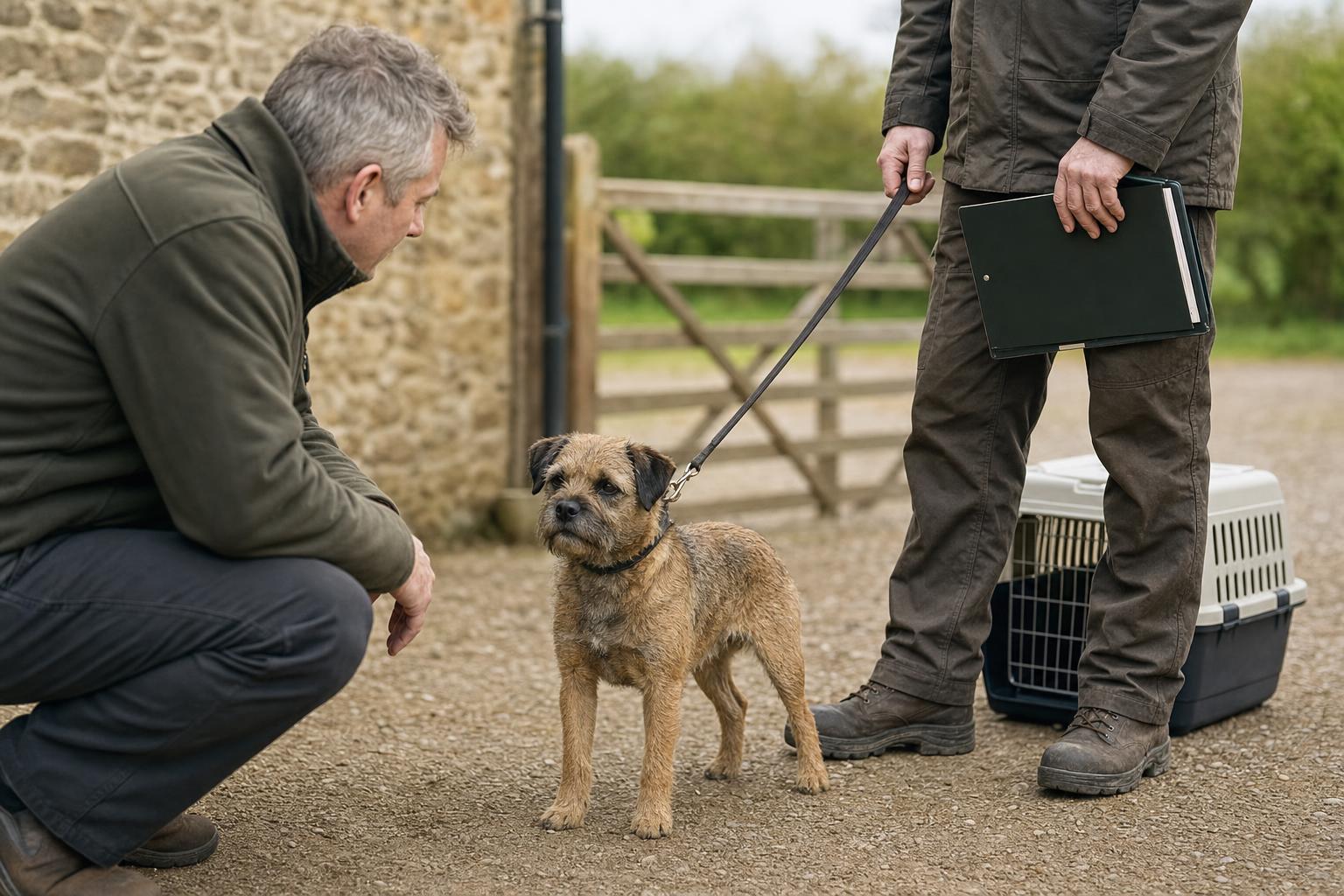
A finished Border Terrier is not simply an older dog with a few obedience lessons behind it. For this small, hard-working terrier, “finished” should mean the dog has proven manners, reliable handling, and a clear record of the type of work it has been prepared to do. Border Terriers were developed on the border of England and Scotland to hunt fox and small game in rough country. They are compact, durable, quick to investigate scent, and often bold enough to work independently when the situation calls for it. Those same traits can make a well-trained adult a pleasure for the right buyer, but they also mean you should evaluate training honestly instead of buying on a label.
This guide is written for buyers comparing Border Terrier finished dogs on Working Dog Central and similar marketplaces. Use the seller’s description as a starting point, then ask for proof: video, references, veterinary records, competition records where relevant, and a realistic explanation of the dog’s daily routine. The best purchase is not always the flashiest dog. It is the Border Terrier whose experience, temperament, health, and expectations match your home, hunting style, and management plan.
What makes a finished dog
A finished dog should be steady, understandable, and repeatable in the work the seller claims. With a Border Terrier, that may mean a seasoned earthdog or vermin-control partner, a terrier with practical farm exposure, a dog polished for barn hunt or scent work, or a versatile companion with strong off-switch and obedience. Because Border Terriers are not a conventional pointing or retrieving gun dog breed, buyers should be careful about generic sporting-dog language. Terms like “finished,” “broke,” and “ready to hunt” need to be tied to specific behaviors and settings.
Ask the seller to define the dog’s finished standard in plain terms. Can the dog walk politely on lead around other dogs? Will it recall away from distraction in a fenced or controlled space? Has it been worked around livestock, horses, kennels, children, or small animals? Does it enter cover confidently? Is it quiet in a crate and settled in the house? Has it hunted or trained alone and with other dogs? A finished Border Terrier should have more than enthusiasm; it should have usable self-control.
- Request recent video showing the dog doing the exact work being advertised.
- Ask whether the dog has been handled by more than one person or only by the trainer.
- Confirm how the dog behaves when corrected, redirected, crated, loaded, or asked to quit.
- Find out whether the dog has a history of fence testing, nuisance barking, digging, or chasing household pets.
Hunt tests
Hunt test relevance depends on the venue and the individual Border Terrier. Unlike pointing breeds or retrievers, Border Terriers are more commonly associated with terrier work, earthdog-style tests, barn hunt, scent work, and practical pest control than with standard upland or waterfowl hunt-test programs. That does not make records unimportant; it means buyers should verify which organization issued the title and what the title actually required.
If a listing mentions hunt tests, ask for the full registered name, registration number if applicable, organization, level earned, date earned, and whether the dog qualified under multiple judges. For an earthdog or terrier-focused event, learn whether the test evaluated willingness to enter, locate quarry scent, work with voice, stay engaged, and remain manageable afterward. For any other hunt-test claim, ask how the test connects to the work you expect from a Border Terrier. A title can be useful evidence, but it is not a substitute for seeing how the dog behaves in everyday conditions.
How to verify hunt-test claims
Request copies of score sheets or title certificates when available, and cross-check with the registry or event organization. If the seller cannot provide documentation, treat the claim as anecdotal. That does not automatically mean the dog is poor quality, but it does mean the price should reflect what can be verified rather than what is implied.
Verify working records and breed eligibility
Verify reported working titles and test results with the issuing organisation. Confirm that the programme applies to the breed and ask what the result demonstrates about the individual dog.
Verify reported working titles and test results with the issuing organisation. Confirm that the programme applies to the breed and ask what the result demonstrates about the individual dog.
Trial records
Trial records can add value when they are genuine, current, and connected to the work you want. A Border Terrier may have records from terrier trials, earthdog events, barn hunt, agility, obedience, rally, scent work, or breed-club activities. Some finished dogs are sold because they have aged out of a program, because the owner is changing direction, or because the dog is better suited to a different home. The record should help you understand the dog, not distract you from temperament and fit.
Ask for official results rather than relying on phrases like “trial bred,” “champion lines,” or “proven worker.” A pedigree may show ancestry, but it does not prove the individual dog’s training. Likewise, one ribbon does not guarantee steadiness in your yard, kennel, truck, or hunting ground. Review what the dog has done recently. A record from several years ago is still interesting, but a finished dog should be able to demonstrate current condition and current manners.
- Verify names, dates, classes, and organizations directly when possible.
- Ask whether results were earned by the current handler or a professional trainer.
- Compare competition behavior with practical behavior: crate manners, recall, dog tolerance, and household stability.
- Watch for exaggerated claims that cannot be matched with documents or video.
Age expectations
Most finished Border Terrier dogs will be mature adults rather than puppies. That can be an advantage. A dog between two and six years old usually gives a buyer a clearer picture of size, coat, temperament, prey drive, and energy level. The dog may already be house trained, crate trained, traveled, socialized, and conditioned for work. Older dogs can also be excellent buys when they are healthy, honest, and suited to the buyer’s lifestyle.
Age should be evaluated alongside mileage. A young dog advertised as finished may be talented but still mentally immature. A middle-aged dog may have the best balance of experience and durability. A senior Border Terrier may offer wonderful companionship and practical knowledge, but the price and expectations should reflect remaining working years. Ask about veterinary history, dental care, weight, endurance, injury history, medications, and any limitations. Border Terriers are generally sturdy, but responsible buyers should still review records and schedule an independent veterinary exam when possible.
Temperament at maturity
One advantage of buying an adult Border Terrier is that temperament is easier to read. You can see whether the dog is friendly, pushy, shy, noisy, dog-social, or intense around small animals. Because the breed was developed with strong prey drive, do not assume a finished adult will be safe loose around cats, poultry, rabbits, or other small pets. Ask direct questions and manage accordingly.
Investment value
A finished Border Terrier often costs more than a puppy because someone has invested time, training, feed, veterinary care, travel, event fees, and hands-on experience. The value is highest when the work is documented and transferable. A dog that performs beautifully only for one trainer may require a transition period before it works reliably for a new owner. Build that transition into your decision and your budget.
Fair value depends on health, temperament, training level, age, documentation, and the seller’s support after the sale. Exact prices vary by region and by the individual dog, so be cautious of anyone who insists there is one standard finished-dog price. Instead, compare what is included: registration paperwork when applicable, health records, training notes, equipment, trial or title documentation, a written bill of sale, return terms, and post-sale guidance. A cheaper dog with unclear behavior can become expensive quickly. A higher-priced dog with honest documentation and a good seller may be the better long-term investment.
Health, registration, and paperwork
Before committing to a finished Border Terrier, review health and identity records. The breed has recognized health considerations, and responsible sellers should be willing to discuss screening, family history, and veterinary care without overpromising. If DNA testing is mentioned, ask which condition was tested and request documentation. In some regions, testing for SLEM, spongiform leucoencephalomyelopathy, may be relevant to breeding programs. If OFA, kennel club registration, or other registry paperwork is advertised, verify it directly with the issuing organization. Do not assume every finished Border Terrier will have the same registry status or the same health clearances.
For buyers who plan to breed later, paperwork matters even more. Confirm breeding rights, registration transfer, limitations, and whether the dog is intact. If you are buying strictly as a working companion or family dog, temperament and health may matter more than breeding paperwork, but the seller should still be transparent. Avoid vague assurances such as “healthy lines” without records to support the claim.
Evaluating a Border Terrier finished dog before purchase
Whenever possible, meet the dog in person. Watch the Border Terrier before it knows you are paying attention. How does it act in a crate, on lead, around other dogs, and when the handler is not actively managing it? Ask to see a normal routine rather than only a polished demonstration. A finished dog should not need a perfect stage to show useful training.
If distance makes an in-person visit difficult, ask for unedited video clips. Good clips include loading into a vehicle, walking on lead, recall in a controlled area, working or training footage, handling around feet and mouth, and quiet time in a crate. For a terrier, also ask about digging, barking, fence behavior, and response to wildlife. You are not looking for a robot; you are looking for an honest picture of the dog you will actually live with.
- Ask why the dog is being sold and what type of home the seller believes is best.
- Confirm whether the dog has lived indoors, in a kennel, or both.
- Discuss feeding, grooming, hand-stripping or coat care, and exercise requirements.
- Get all promises in writing, including trial period, return policy, and included records.
Buyer-focused conclusion
Verify reported working titles and test results with the issuing organisation. Confirm that the programme applies to the breed and ask what the result demonstrates about the individual dog.
Explore Border Terrier on Working Dog Central
View the Border Terrier breed profile or browse Border Terrier listings.


