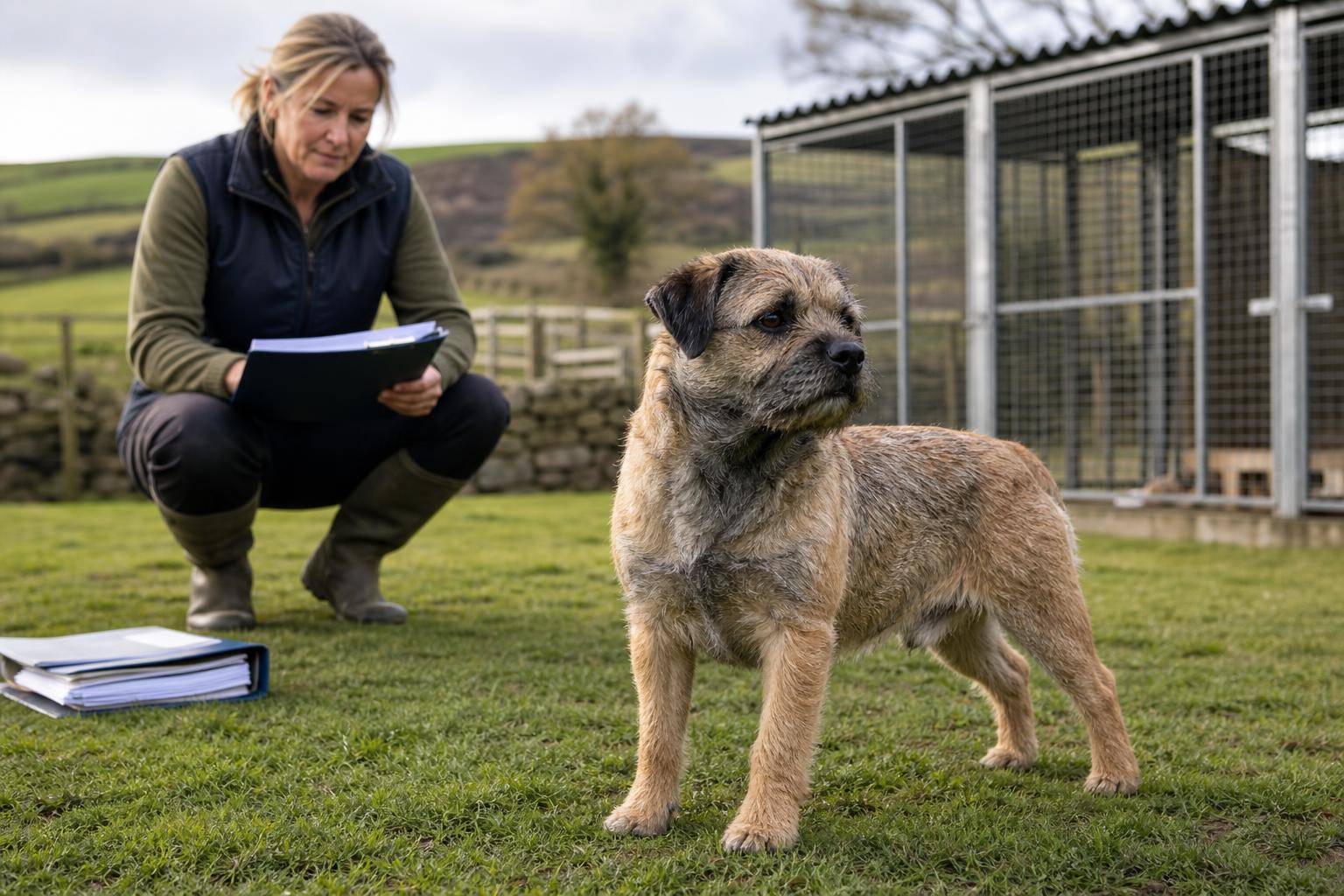
Choosing a Border Terrier stud dog is not simply a matter of finding a male with a pleasant photograph or a familiar kennel name. The Border Terrier is a small, rugged working terrier developed along the England and Scotland border country to follow horse hunts, go to ground after fox, and work with determination in rough cover. That background still matters. A useful stud prospect should preserve the breed's compact toughness, harsh weather-resistant coat, confident temperament, and practical working instincts while also fitting the goals of the female being bred.
This guide is written for breeders, hunters, active families, and serious buyers who are evaluating Border Terrier stud dogs on Working Dog Central. It does not replace a veterinarian, breed mentor, registry office, or contract attorney. Instead, it gives you a clear checklist for comparing stud listings, asking better questions, and avoiding claims that cannot be verified.
Start With the Breed Purpose
The Border Terrier is affectionate and friendly in the home, but it remains a terrier at heart: alert, game, curious, and often independent. The breed's narrow, deep body, moderate bone, and leggy outline were intended for endurance and the ability to work tight spaces. When reviewing a stud dog, look beyond showy presentation. Ask whether the dog demonstrates the sound structure, stable temperament, and useful instincts that make the breed recognizable.
- Does the dog have the harsh, wiry outer coat and dense undercoat described in breed materials?
- Is his temperament confident without being difficult to handle?
- Has he been socialized around people and other dogs in a way that reflects the breed's pack-working history?
- Does he show appropriate energy, curiosity, and prey interest without being unsafe or unmanageable?
Health Clearances Matter
Responsible stud selection begins with health documentation. Border Terriers are generally sturdy dogs, but that does not remove the need for screening. Ask the stud owner what health clearances have been completed, when they were done, and whether copies are available for review. Do not rely on phrases such as "vet checked," "healthy lines," or "never had a problem" as substitutes for records.
Health clearances should be matched to the breed, the individual family, and the breeding goals. If a listing mentions clearances, request the registered name or number needed to verify them with the appropriate database or registry. If a clearance is not applicable, unavailable, or not customarily used by that breeder, the stud owner should be able to explain their reasoning clearly rather than dismissing the question.
OFA and Other Public Records
The Orthopedic Foundation for Animals, commonly called OFA, is one place buyers may be able to verify certain health screening results. Not every Border Terrier stud dog will have every possible OFA listing, and a missing record does not automatically mean a dog is unsuitable. It does mean you should ask direct questions. Which tests were performed? Were results public? Are certificates available? Do the results identify the same dog being advertised?
Public databases are useful because they reduce guesswork. They also help you compare the stud dog with his relatives. When possible, review not only the male's own results but also information on parents, siblings, previous offspring, and close relatives. Patterns across a family can be more informative than a single isolated claim.
DNA Testing and SLEM Verification
Breed information for the Border Terrier notes that DNA testing is available in the UK for spongiform leucoencephalomyelopathy, often abbreviated SLEM, a serious neurological disease. Because testing availability, registry requirements, and regional practices can vary, buyers should verify current expectations with the breeder, breed club resources, and their veterinarian. If a stud owner states that a dog is clear, carrier, or tested for a condition, ask to see the laboratory report and confirm that it matches the dog's identity.
DNA results should be used as breeding tools, not marketing slogans. A carrier result may or may not remove a dog from responsible breeding depending on the female's status and the condition involved. What matters is that the breeder understands the inheritance pattern, pairs dogs responsibly, and is transparent with puppy buyers.
Pedigree Analysis
A pedigree is more than a list of names. For a Border Terrier stud dog, pedigree analysis should consider structure, temperament, working ability, coat quality, size, health history, and consistency of type. Ask the stud owner why this dog should complement your female. A thoughtful answer should mention strengths, weaknesses, and the kind of puppies the breeding is intended to produce.
- Look for repeated traits in close relatives, not just famous ancestors several generations back.
- Ask what the male has produced in prior litters, if he has been used before.
- Compare the stud's strengths against the female's needs rather than doubling up on the same faults.
- Verify titles, working records, and registry details instead of assuming pedigree abbreviations are accurate.
For working terrier buyers, performance context is especially important. A dog may be a wonderful companion yet not the right match for a breeder trying to maintain field drive and functional terrier character. Likewise, a high-drive male may be a poor choice for a female line that already produces excessive intensity for typical homes. Balance matters.
Frozen Semen, Live Cover, and Artificial Insemination
Stud listings may mention frozen semen, chilled semen, live cover, or artificial insemination. Do not assume any option is available unless the stud owner specifically confirms it. Reproductive services depend on the male's collection history, semen quality, veterinary support, shipping logistics, the female's timing, and the contract between both parties.
Frozen Semen
Frozen semen can make a valuable male available across distance or after his prime breeding years, but it requires careful documentation. Ask who collected and stored the semen, how many breeding units are available, whether post-thaw quality has been evaluated, and which veterinarian or storage facility controls release. Also confirm whether the stud owner has the legal right to sell or authorize use of that semen.
Live Cover
Live cover may be practical when both dogs are local and healthy, but it still needs planning. The female should be current on veterinarian-recommended care, and both owners should discuss disease prevention, timing, supervision, housing, and what happens if the mating does not occur. Never ship or travel a female without clear written expectations.
Artificial Insemination
Artificial insemination may be used when distance, safety, timing, or reproductive history makes live cover less practical. If AI is proposed, ask which reproductive veterinarian will be involved, how ovulation timing will be confirmed, who pays for collection and shipping, and what documentation will be supplied for registration if a registry is involved.
Stud Contracts
A handshake agreement is not enough. A Border Terrier stud contract should identify the male and female, ownership, fees, timing, health requirements, method of breeding, registration expectations, and what counts as a successful breeding. It should also explain whether a return service is offered if no pregnancy results and what proof is required.
- Confirm the stud fee, due date, and whether it is refundable.
- Define who pays veterinary, collection, shipping, boarding, and progesterone testing costs.
- State whether the litter is expected to be registered and which paperwork will be provided.
- Clarify limits on use of semen, repeat breedings, or transfer of breeding rights.
- Include disclosure of known health information and any required testing for the female.
If the contract references AKC registration or another registry, verify that both dogs are eligible before breeding. The American Kennel Club recognized the Border Terrier in 1930, but individual eligibility depends on the actual dogs, paperwork, ownership, and registry rules. Do not treat breed recognition as proof that a specific litter can be registered.
Evaluating Temperament and Trainability
Because Border Terriers are intelligent, energetic, and sometimes stubborn, temperament should be a central part of stud selection. A good stud dog should be manageable, people-oriented, and stable in normal situations. Ask how he behaves with children, other dogs, travel, grooming, veterinary handling, and new environments. If possible, watch him away from the show pose or advertisement setting.
Terrier traits are not faults when they are balanced. Prey drive, curiosity, vocal excitement, and determination are part of the breed's history. The concern is whether those traits are paired with sound nerves and reasonable biddability. Breeders should be honest about what the dog is likely to pass on.
Questions to Ask Before Committing
- What are this stud dog's strongest qualities, and what would you improve?
- What health testing has been completed, and can I verify the results?
- Has DNA testing relevant to Border Terriers, including SLEM where applicable, been considered or completed?
- Has the dog produced litters before? If so, what are the puppies like as adults?
- What breeding method is available: live cover, chilled semen, frozen semen, or AI?
- What does the stud contract provide if the female does not conceive?
- What registry paperwork, if any, will be supplied?
Red Flags in Stud Dog Listings
Be cautious of any listing that promises perfect puppies, guarantees specific temperament outcomes, or avoids health and pedigree questions. Exact medical outcomes cannot be guaranteed by a stud owner. Likewise, a low stud fee can become expensive if documentation is poor, semen logistics are unclear, or the match produces puppies that do not suit the breeder's goals.
Other warning signs include pressure to decide immediately, refusal to provide copies of records, vague claims about champion bloodlines, no written contract, or unwillingness to discuss the female's suitability. A responsible stud owner wants the breeding to make sense; they are not simply selling access to a male.
Buyer-Focused Conclusion
The right Border Terrier stud dog should bring more to a breeding than convenience. He should represent the breed's durable working roots, affectionate but game temperament, practical structure, and honest health documentation. Before you commit, verify records, study the pedigree, understand the contract, and make sure the dog complements the female in front of you. A careful choice protects the breeder, the stud owner, the future puppies, and the long-term quality of the Border Terrier.
Explore Border Terrier on Working Dog Central
View the Border Terrier breed profile or browse Border Terrier listings.


