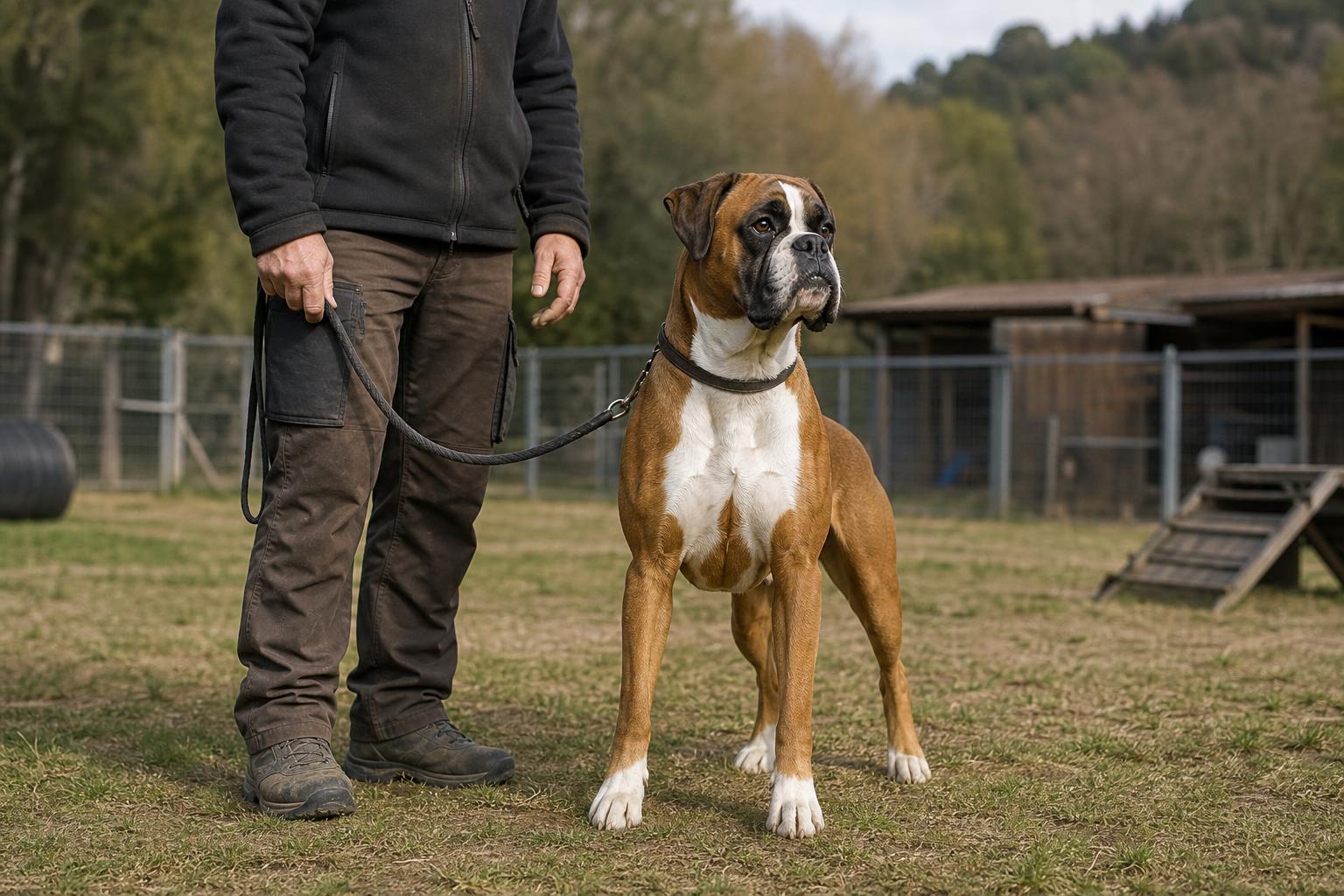
A finished Boxer is not the same kind of purchase as a young pet prospect or a lightly trained adolescent. The Boxer is a muscular, energetic working breed with a history in utility, guarding, and service roles, and a finished dog should show more than enthusiasm. Buyers should be looking for a mature, steady dog with reliable manners, clear training, an understandable performance background, and a temperament that fits the household or working role being considered.
Verify reported working titles and test results with the issuing organisation. Confirm that the programme applies to the breed and ask what the result demonstrates about the individual dog.
What makes a finished dog
A finished Boxer should be dependable in the specific work being advertised. For a family companion, that may mean polite leash walking, crate comfort, reliable house manners, calm behavior around guests, and appropriate social behavior around children and other dogs. For a working or sport home, it may mean titled obedience, rally, scent work, protection-sport foundations, public access manners where legally appropriate, or a documented history of training under distraction.
The word finished should never be treated as a magic label. Ask for a practical demonstration. A good seller should be able to show the Boxer responding to commands in a normal environment, not only in a familiar training yard. Watch whether the dog can settle after excitement, recover from distractions, greet politely, and work without constant equipment pressure. Boxers are intelligent and people-focused, but they can be bouncy, strong, and impulsive if their training has not been generalized.
- Ask which commands are reliable and in what environments.
- Confirm whether the dog is house trained, crate trained, and vehicle trained.
- Watch the dog work for someone other than the trainer when possible.
- Look for emotional stability, not just flashy obedience.
- Request health and veterinary records before making a deposit.
Hunt tests
Hunt tests may be central for many sporting breeds, but they may not be relevant to a Boxer. The breed's history includes hunting and utility work, yet modern Boxers are usually evaluated through companion, working, obedience, protection, scent, or performance venues rather than mainstream retriever, pointing, or spaniel hunt-test programs. If a seller advertises a Boxer as a finished hunting dog, ask for specific evidence of the work: what game was involved, how the dog was introduced, whether the dog is steady around gunfire if relevant, and whether the work is repeatable in realistic conditions.
Do not penalize a Boxer simply because it lacks hunting titles that are not commonly used for the breed. At the same time, do not accept vague claims like “fully trained” or “great in the field” without proof. A buyer should verify whether the training matches the intended use and whether any club, test, or trainer involved is appropriate for that specific type of work.
Verify working records and breed eligibility
Verify reported working titles and test results with the issuing organisation. Confirm that the programme applies to the breed and ask what the result demonstrates about the individual dog.
The better question is whether the Boxer has objective proof of training in the area that matters to you. For a performance buyer, that might be obedience titles, scent work records, protection-sport scorebooks, temperament tests, or references from trainers. For a family buyer, the strongest evidence may be a calm in-person evaluation, veterinary history, and a trial period or written agreement that clearly explains expectations.
Trial records
Trial records can be useful, but only if they are relevant and verifiable. Boxers may compete in obedience, rally, agility, scent work, tracking, protection sports, barn hunt, or other activities depending on the individual dog and the trainer's goals. Ask for copies of scorebooks, title certificates, event records, or registration numbers. If the seller cites private training achievements instead of formal titles, ask for trainer references and videos showing the dog performing under distraction.
When reviewing records, look beyond the title name. A dog that earned a beginner title years ago but has not practiced since may not be finished today. A Boxer with fewer formal titles but excellent current manners, strong handler focus, and a stable temperament may be the better purchase for many homes. The record should support the dog in front of you; it should not replace your evaluation of the dog's health, behavior, and fit.
Age expectations
Most finished Boxers will be adults rather than young puppies. The exact age depends on the type of training. Basic household and obedience reliability may be realistic in a young adult, while higher-level sport, public manners, or advanced working skills often require more maturity. Because Boxers are energetic and can be slow to settle mentally, buyers should be cautious about a very young dog being marketed as fully finished.
Age should be evaluated together with health, condition, and training history. Boxers have breed-specific health concerns, especially cardiac issues, so responsible sellers should be willing to discuss veterinary care and any screening that has been completed. For breeding-age or working prospects, ask about cardiac evaluations, orthopedic checks, thyroid testing, and DNA testing where relevant. Do not assume every Boxer has every clearance; verify records and discuss them with your veterinarian when needed.
Investment value
A finished Boxer usually costs more than a puppy or a green started dog because the seller has invested time, training, care, and evaluation. The value is not only in commands. It is in the reduction of uncertainty. A buyer can see the dog's adult size, temperament, drive level, manners, and real behavior before committing. For the right household, that can be worth a significant premium.
Still, higher price does not automatically mean higher quality. Compare the asking price against the dog's age, health documentation, training level, titles or records, included support, contract terms, and suitability for your goals. Avoid any seller who pressures you to buy quickly, refuses to demonstrate training, withholds veterinary information, or uses “finished” as a sales phrase without details.
Evaluating a finished Boxer before purchase
Plan the evaluation like a working interview. See the Boxer in motion, at rest, around normal household distractions, and in the specific task being advertised. If the dog is promoted as family-ready, watch polite greetings, leash manners, crate behavior, and recovery after excitement. If the dog is promoted for sport or working use, ask to see the relevant routine and ask what maintenance training will be required after purchase.
- Bring a written list of the behaviors you need the dog to perform.
- Ask what equipment, commands, and routines the dog already understands.
- Review the sales contract before paying a deposit.
- Confirm whether follow-up training support is included.
- Have an independent veterinarian review medical records when possible.
Buyer-focused conclusion
Verify reported working titles and test results with the issuing organisation. Confirm that the programme applies to the breed and ask what the result demonstrates about the individual dog.


