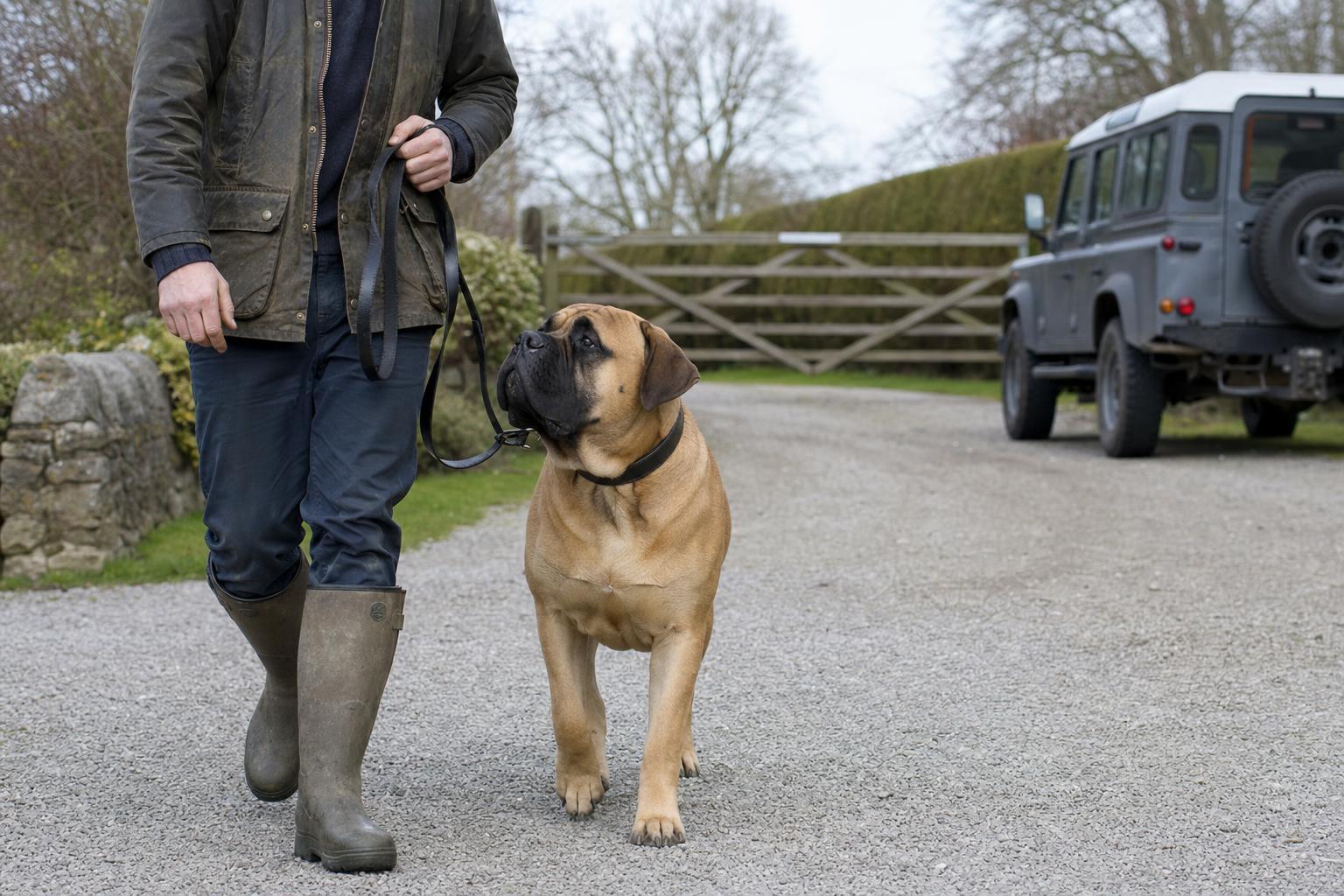
A Bullmastiff started dog is usually a young or adolescent dog that has moved beyond the blank-slate puppy stage but is not yet a fully mature, fully proven adult. For buyers, that can be appealing. You may be able to see more of the dog’s size, confidence, manners, and guardian instincts than you could in an eight-week-old puppy. At the same time, a started Bullmastiff should be evaluated with clear expectations. This is a large, powerful breed developed as a steady estate guardian, not a high-mileage upland or retriever specialist. The right started dog can become a loyal family companion and reliable watchdog, but the wrong match can be difficult to manage simply because of the breed’s strength and maturity.
Use this guide to ask better questions, compare dogs fairly, and avoid being impressed by vague claims. The selector facts for the breed describe the Bullmastiff as calm, loyal, protective, affectionate with family, and often reserved with strangers when properly socialized. Those qualities are valuable, but they must be paired with early training, controlled exposure, and a temperament that fits your home. A started dog should make your decision clearer, not murkier.
What qualifies as “started”
For a Bullmastiff, “started” should mean the dog has received meaningful foundation work and has shown enough maturity for the seller to describe its temperament honestly. It should not simply mean “older puppy.” A started Bullmastiff may be house-acclimated, crate trained, leash introduced, accustomed to routine handling, and exposed to normal household or kennel activity. The dog may know basic commands and may have begun learning how to behave around visitors, gates, vehicles, livestock, or other dogs depending on the setting.
Because the Bullmastiff is a guardian breed, the most important started work is often social stability. Ask how the dog reacts to unfamiliar people, children, delivery drivers, guests entering the home, veterinary handling, and calm strangers in public. A good started Bullmastiff prospect should not need to be everyone’s best friend, but it should show self-control and recover well from new situations. Nervousness, uncontrolled lunging, or a seller who avoids letting you see the dog handled in ordinary situations are reasons to slow down.
- Ask the dog’s exact age and how long the seller has worked with it.
- Request a plain description of daily routine, housing, exercise, and social exposure.
- Have the seller demonstrate what the dog actually knows instead of relying on labels.
- Clarify whether “started” refers to obedience, guardian manners, show preparation, or general family training.
Birds introduced or breed-appropriate game exposure
On a gun dog marketplace, buyers may be used to seeing started dogs described in terms of birds, bumpers, pointing, retrieving, tracking, or field exposure. With a Bullmastiff, those categories may not apply in the same way. The breed’s history is tied to estate protection and the “Gamekeeper’s Night Dog,” a dog expected to track, quietly confront, and hold poachers rather than work birds like a traditional sporting breed. That history does not make every modern Bullmastiff a hunting dog, and buyers should not assume bird work is relevant unless the seller can show a specific, honest purpose.
For this breed, breed-appropriate exposure may mean calmness around rural property, livestock at a safe distance, kennel traffic, vehicles, gates, nighttime sounds, wildlife scent, and people entering or leaving the property. If a seller advertises birds or game exposure, ask what that actually involved. Was the dog merely near birds in a yard, or was there a structured training plan? Did the dog remain calm and controllable? Was any exposure safe and appropriate for a giant guardian breed?
The key is relevance. A Bullmastiff buyer looking for a family guardian may care more about neutrality around visitors and livestock than whether the dog has seen pigeons. A buyer wanting a property dog may care about confidence in the dark, calm leash control, and the ability to settle after alerting. Avoid paying extra for field claims that do not match the dog’s realistic job.
Gun introduction when relevant
Gun introduction is not automatically relevant for every Bullmastiff. If the dog is being sold as a companion guardian, household protector, or estate watchdog, a full gun dog-style introduction may not be necessary. However, if the dog will live on a hunting property, around shooting preserves, near training grounds, or in a rural home where firearms are used safely and legally, noise tolerance may matter.
Do not accept “gun broke” as a casual claim. Ask how the introduction was done, at what distance, with what type of sound, and how the dog responded. A careful program generally starts with distance, low pressure, and positive associations rather than surprising the dog at close range. For a Bullmastiff, the goal should be steadiness and recovery, not high-drive excitement. You want to know whether the dog can remain manageable and confident when unexpected noise occurs.
If gun exposure has not been done, that is not automatically a fault. It may simply be irrelevant to the dog’s intended role. What matters is that the seller is honest and that you do not assume the dog will tolerate gunfire without proper conditioning. If your home or work setting includes loud noises, ask to see evidence of the dog’s reaction to controlled, safe noise exposure or plan to hire a trainer experienced with large guardian breeds.
Obedience level
Obedience is one of the biggest reasons to consider a started Bullmastiff. This breed is intelligent, strong, and sometimes independent, so early manners matter. A started dog should show some practical skills: walking on leash without dragging the handler, entering and exiting crates or vehicles calmly, waiting at doors or gates, responding to its name, accepting basic handling, and settling after activity. Formal precision is less important than real-world control.
Ask the seller to demonstrate commands in more than one location if possible. A dog that sits in a quiet kennel aisle may behave differently near a driveway, visitor, food bowl, or another dog. Because Bullmastiffs mature into powerful adults, loose-leash walking and controlled greetings are especially important. If the dog is already difficult for the seller to handle, assume it will not magically become easier after a stressful move to a new home.
- Look for calm leash manners, not just brief compliance for treats.
- Watch whether the dog can disengage from distractions.
- Ask about crate training, house training, vehicle rides, and vet handling.
- Confirm what corrections or training methods have been used.
- Make sure all family members who will handle the dog can safely manage it.
Positive, consistent training generally suits the breed well. Harsh handling can create conflict, while inconsistent rules can allow pushy behavior to grow. The best started Bullmastiff is not necessarily the flashiest dog. It is the one whose foundation, temperament, and management needs fit your life.
Evaluating training
Evaluate a started Bullmastiff in person when possible, and try to see ordinary behavior rather than a polished sales routine. Watch the dog before it knows it is being demonstrated. Does it settle? Does it scan calmly? Does it bark and recover, or does it escalate? Does the handler seem relaxed and fair, or are they constantly bracing against the leash? A giant guardian breed should be confident and controllable, not frantic or shut down.
Ask direct questions about socialization. Bullmastiffs are often loyal and affectionate with their own people while being reserved with strangers. That can be appropriate, but the dog should still be safe to manage. Ask whether the dog has been around children, other dogs, cats, livestock, delivery activity, grooming, and veterinary visits. Do not assume compatibility; verify it based on the dog in front of you and the seller’s records.
Health and structure matter too. Started dogs are old enough that buyers should ask about veterinary history, weight, growth, orthopedic concerns, eye issues, and any cardiac screening or evaluations the breeder considers appropriate. The breed is associated with topics such as hips and elbows, heart conditions, and certain eye issues, so responsible sellers should be open about what has and has not been checked. Avoid sellers who turn health questions into vague reassurance.
Finally, match the dog to the job. A Bullmastiff that is too suspicious for a busy home may be a poor choice for a family with constant visitors. A very soft dog may not suit someone seeking a confident property guardian. A high-energy adolescent may overwhelm an owner expecting a couch companion. Started dogs reveal more truth than puppies, but only if you take time to observe it.
Questions to ask before buying a started Bullmastiff
- Why is this Bullmastiff being sold as a started dog rather than kept or sold earlier?
- What commands does the dog know, and can I see them demonstrated?
- How does the dog behave with strangers entering the property?
- Has the dog lived in a home, kennel, or both?
- What health records, vaccinations, deworming, and veterinary notes are available?
- Has the dog had any orthopedic, cardiac, or eye evaluations, and are documents available?
- What is the dog’s daily exercise routine?
- What situations make the dog difficult to handle?
- What support is available after purchase?
Buyer-focused conclusion
A started Bullmastiff can be a smart choice for a buyer who wants more information than a puppy can provide. You can often see temperament, size, confidence, manners, and early guardian instincts more clearly. Still, the word “started” only has value when the seller can explain and demonstrate the work behind it. Focus on controllability, social stability, health transparency, and a realistic match for your household. If the dog is calm, well-handled, honestly represented, and suited to your goals, a started Bullmastiff may become the steady, loyal companion and guardian this breed is known to be.
Explore Bullmastiff on Working Dog Central
View the Bullmastiff breed profile or browse Bullmastiff listings.


