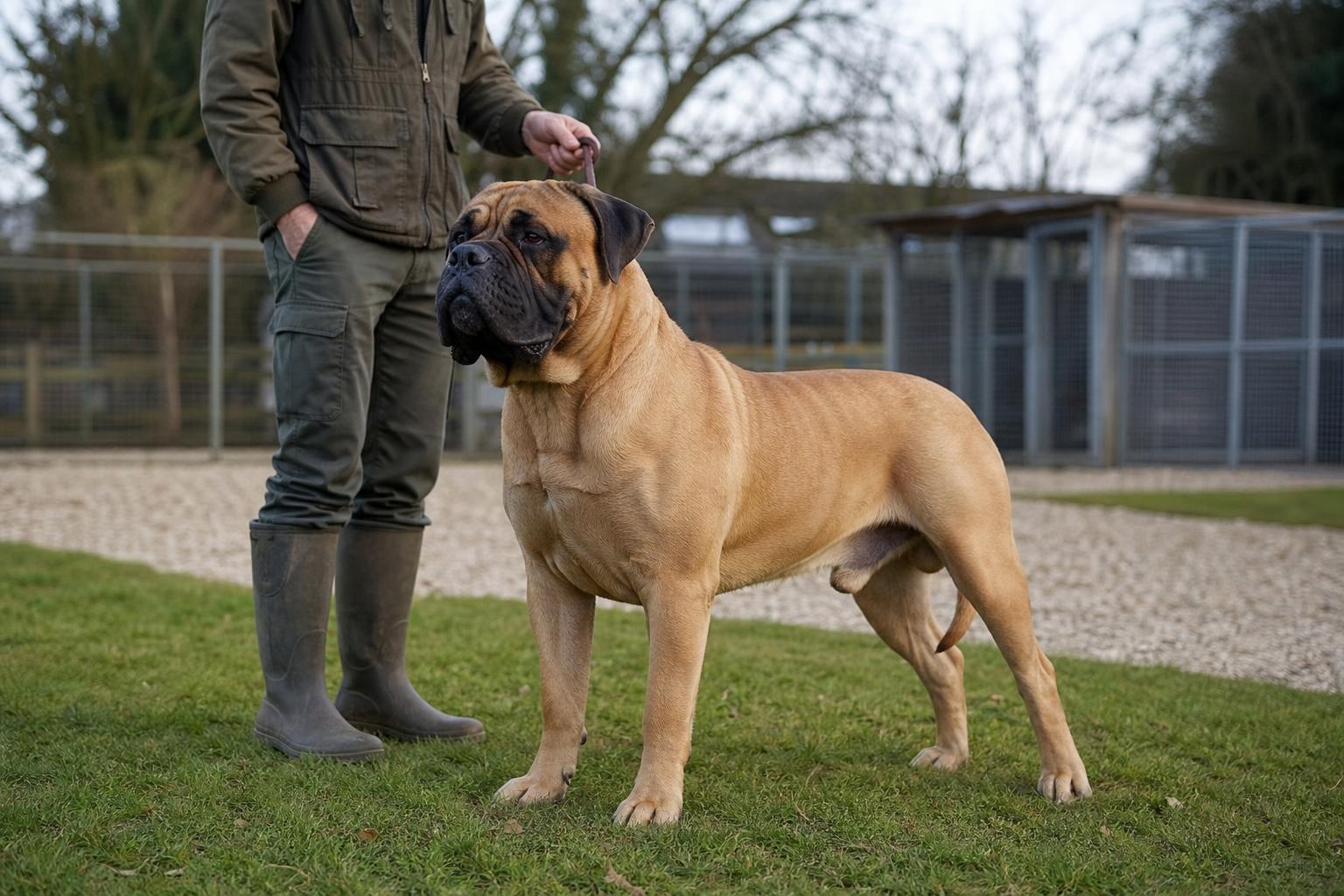
Choosing a Bullmastiff stud dog is not just a pedigree decision. It is a decision about structure, temperament, health transparency, and whether a particular male is a responsible match for the female and the goals of the litter. The Bullmastiff is a giant guardian breed developed in England from Mastiff and Old English Bulldog ancestry, and today the breed is valued for its power, loyalty, calm confidence, and protective nature. Those same traits make careful stud selection especially important.
A good Bullmastiff stud should offer more than size or an impressive head. Buyers and breeders should look for a male that represents the breed’s steady temperament, sound movement, manageable guardian instinct, and documented health background. Because the breed can face orthopedic, cardiac, eye, and giant-breed management concerns, responsible breeding requires more than a handshake and a photo. It requires records, honest conversation, and a clear contract.
Health Clearances for Bullmastiff Stud Dogs
Health clearances are one of the first things to discuss when evaluating Bullmastiff stud dogs. They do not guarantee that every puppy will be free of health problems, but they show that the stud owner is taking known breed risks seriously. For Bullmastiffs, common health topics include hip and elbow dysplasia, cardiac conditions such as dilated cardiomyopathy or subaortic stenosis, and eye issues such as entropion or inherited retinal disease. Because this is a large, deep-chested breed, buyers should also be aware of bloat and other giant-breed care issues, even though those are not solved by a single test.
Ask the stud owner for copies of health documentation rather than accepting vague statements like “vet checked” or “healthy lines.” A useful stud file may include orthopedic evaluations, heart screening information, eye exam records, and any DNA test results that are relevant to the breed or the individual line. If a registry, breed club, or veterinary database is used, verify the dog’s registered name, registration number, date of birth, and ownership details so you know the records actually match the stud being offered.
- Confirm that the stud is old enough for meaningful adult evaluations.
- Ask whether close relatives have had orthopedic, cardiac, eye, temperament, or longevity concerns.
- Review the female’s health records at the same time; the pairing matters, not just the male.
- Be cautious when a stud owner dismisses health questions as unnecessary.
OFA and Orthopedic Evaluation
OFA, the Orthopedic Foundation for Animals, is commonly used in the United States for orthopedic and other health record reporting. For a Bullmastiff stud dog, OFA records may be relevant for hips, elbows, cardiac evaluations, eyes, and other screenings depending on what the breeder has completed. Do not assume every Bullmastiff advertised at stud has complete OFA results. Ask specifically what has been tested, when it was tested, and whether the results are public or can be shared directly.
Hip and elbow information is especially important because Bullmastiffs are heavy, powerful dogs. Poor orthopedic structure can affect comfort, mobility, and quality of life, and breeding decisions should not ignore it. A stud with strong substance should still move soundly and remain functional. If the male is unusually heavy, awkward, or reluctant to move, ask questions rather than being impressed by size alone.
When reviewing OFA or similar records, remember that the result is one piece of the overall picture. A stud with acceptable clearances still needs stable temperament, breed type, fertility, and compatibility with the female. Likewise, a breeder should be willing to discuss why a particular pairing makes sense structurally and genetically, not simply point to a certificate and declare the decision finished.
DNA Testing
DNA testing can be a useful tool, but it should be used correctly. Not every DNA panel is equally relevant to every breed, and a broad commercial panel is not the same as a thoughtful breeding plan. For Bullmastiff stud dogs, ask which DNA tests were performed, which laboratory completed them, and why the results matter for this pairing. If a condition is not known to be relevant to the breed or the family being bred, the stud owner should be able to explain that rather than making sweeping claims.
DNA results are most helpful when they are interpreted alongside pedigree knowledge, health history, and the female’s results. If both dogs are tested for the same condition, the breeder can avoid producing affected puppies for certain recessive diseases. If only one side has been tested, or if the test does not address known concerns in the line, the result has limited value. Be careful with advertisements that use “DNA tested” as a catch-all phrase without naming the tests or showing documentation.
- Ask for the laboratory report, not just a marketing summary.
- Confirm the dog’s identity on the report.
- Ask whether the female has compatible testing.
- Discuss results with a veterinarian or experienced breed mentor if you are unsure what they mean.
Frozen Semen
Frozen semen may be an option for some Bullmastiff stud dogs, but buyers should verify availability rather than assuming it exists. Frozen semen can make it possible to use a male that lives far away, is no longer breeding naturally, or has passed away. It can also preserve valuable bloodlines. However, it requires planning, proper storage, reproductive veterinary support, and clear ownership rights.
If frozen semen is advertised, ask how many breeding units are available, where they are stored, what reproductive clinic collected and evaluated them, and what motility or quality information is available after thaw testing. You should also clarify whether the stud fee includes shipping, storage transfer, insemination support, or only the right to use a unit. Frozen semen breedings can involve extra veterinary costs, timing expenses, and no guarantee of pregnancy, so the contract should be very specific.
For a giant breed like the Bullmastiff, the quality of the planned litter still matters more than convenience. Frozen semen from a famous dog is not automatically a better choice than a living stud with excellent health records, appropriate temperament, and proven compatibility. Evaluate the male as if he were standing in front of you, using records, photographs, video, pedigree review, and honest discussion with people who knew the dog.
Live Cover vs AI
Live cover and artificial insemination both appear in dog breeding, but their relevance depends on the dogs, geography, veterinary support, registry rules, and the preferences of the stud and female owners. With Bullmastiffs, the size and strength of the dogs make safety and supervision important. A natural breeding should never be treated casually; both dogs should be manageable, healthy, and monitored by experienced handlers.
Artificial insemination, often called AI, may be used when distance, timing, safety, or reproductive considerations make live cover impractical. Fresh, chilled, or frozen semen each has different handling requirements. If AI is part of the plan, ask whether the chosen registry accepts the method being used and what paperwork is required. Do not assume AKC or any other registration body will accept every breeding method without documentation. Verify the current rules before the breeding takes place.
- Live cover may reduce shipping logistics but requires safe handling and compatible dogs.
- Fresh or chilled semen can help with distance but depends on timing and semen quality.
- Frozen semen offers long-term storage but often requires more reproductive expertise.
- Registry paperwork should be confirmed before breeding, not after puppies are born.
Stud Contracts
A written stud contract protects both sides and helps prevent misunderstandings. At minimum, a Bullmastiff stud contract should identify the stud dog, the female, the owners, the fee, the breeding method, the timing, and what happens if the female does not conceive. It should also state what documentation will be provided, whether registration paperwork is included, and whether there are any restrictions on puppy placement or future breeding.
Some contracts offer a return service if no pregnancy occurs, while others do not. Some require veterinary proof that the female was not pregnant. Some define a litter as one live puppy, while others use a different standard. Read these terms carefully. If the breeding uses shipped or frozen semen, the contract should also cover shipping costs, storage fees, loss or damage in transit, and who coordinates with the veterinarian.
Be wary of informal arrangements for expensive or high-stakes breedings. A good stud owner should welcome a clear contract because it shows professionalism. The contract should also require truthful information from the female’s owner, including health status, age, registration information if applicable, and any known reproductive issues. Responsible breeding is a two-sided obligation.
Pedigree Analysis
Pedigree analysis is more than counting champions or looking for famous names. In Bullmastiffs, the pedigree should be reviewed for health, temperament, structure, longevity, and consistency. Because the breed was developed as a powerful guardian, stability matters. A pedigree full of impressive dogs is not helpful if it also concentrates fearfulness, poor nerves, severe orthopedic problems, or dogs that could not function comfortably as adults.
Ask the stud owner why the male is a good match for the specific female. The answer should address strengths and weaknesses on both sides. For example, if the female has excellent temperament but needs improvement in movement, the stud should be chosen with that in mind. If the female comes from a line with known health concerns, the stud’s background should be reviewed carefully to avoid doubling up on risk. Linebreeding, outcrossing, and popular-sire influence are not automatically good or bad, but they should be understood before a breeding is planned.
- Look beyond titles and ask what the dogs were actually like.
- Review siblings, offspring, parents, and grandparents when possible.
- Ask about longevity and causes of death in older relatives.
- Consider temperament and manageability as strongly as appearance.
Temperament and Real-World Suitability
The Bullmastiff is often described as loyal, dependable, alert, and affectionate with family while being reserved with strangers. That natural guardian temperament is part of the breed’s identity, but it must be stable and controlled. A stud dog should not be selected because he is reactive, intimidating, or difficult to manage. Confidence, steadiness, and appropriate social behavior are far more valuable than uncontrolled aggression.
Whenever possible, observe the stud in normal situations. Watch how he handles visitors, leash pressure, grooming, veterinary-style handling, and unfamiliar environments. If you cannot meet him in person, ask for current video and references from people who have seen him outside of staged advertising photos. A Bullmastiff’s size means temperament problems are not small problems. Breeding should favor dogs that can live safely and calmly with capable owners.
Buyer-Focused Conclusion
Selecting a Bullmastiff stud dog should be a careful, evidence-based process. Start with the breed’s essentials: a powerful but functional build, a steady guardian temperament, and a history rooted in controlled protection rather than reckless aggression. Then verify the practical details: health clearances, OFA or equivalent records where relevant, DNA documentation, semen availability, breeding method, contract terms, and pedigree fit.
The best Bullmastiff stud choice is not always the most famous dog or the closest dog. It is the male whose health, temperament, structure, pedigree, and owner transparency make sense for the female and for the puppies’ future homes. Take your time, ask direct questions, and be willing to walk away from vague answers. Responsible decisions now help produce Bullmastiffs that are strong, stable, and loved for the right reasons.
Explore Bullmastiff on Working Dog Central
View the Bullmastiff breed profile or browse Bullmastiff listings.


