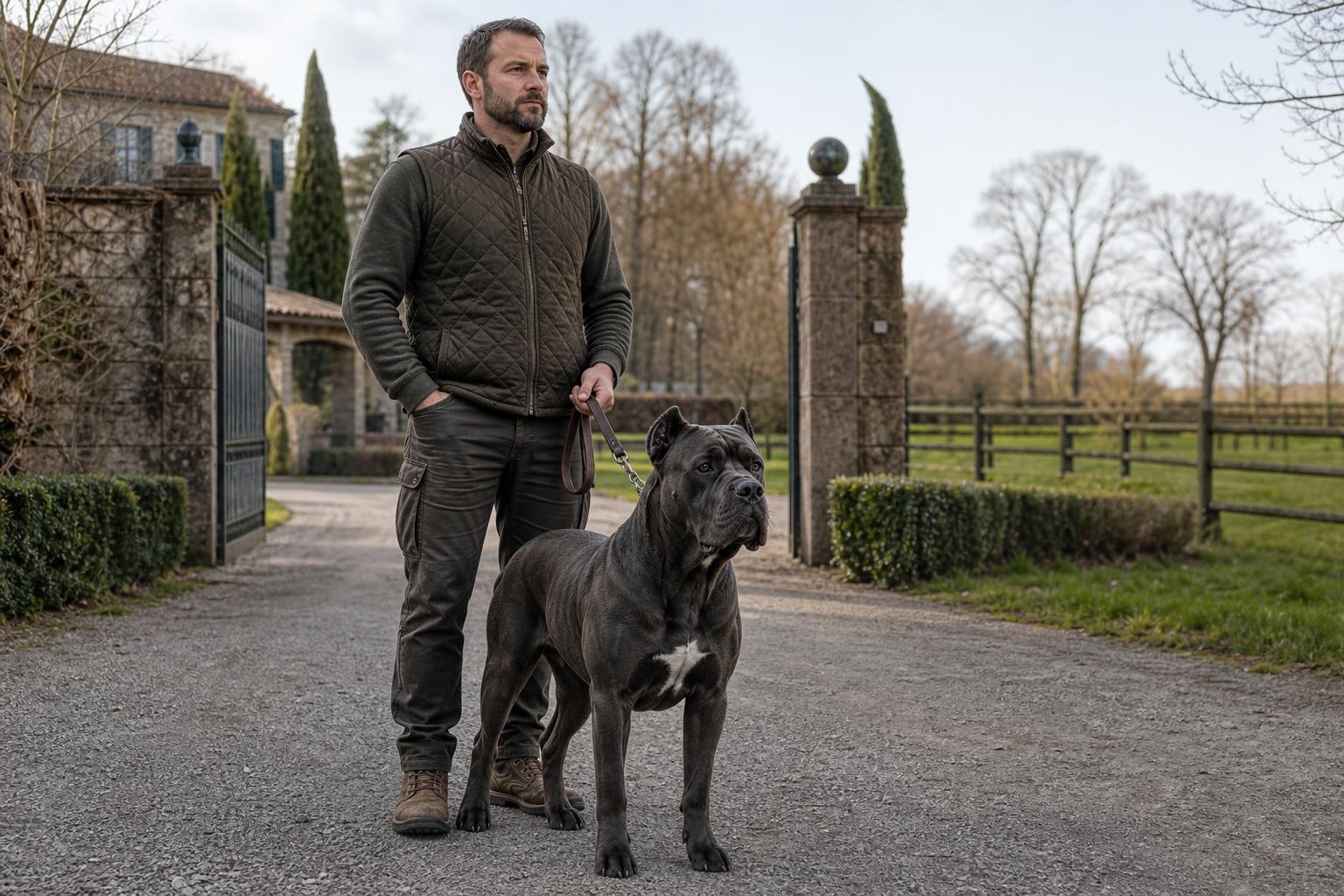
A finished Cane Corso can be a remarkable dog in the right hands: mature, powerful, clear-headed, and already shaped by meaningful training. But finished is also one of the most misused words in dog advertising. For a breed with the Cane Corso’s size, confidence, and natural guarding instinct, buyers should slow down and define exactly what the seller means before money changes hands.
The Cane Corso is an Italian mastiff-type working breed historically associated with property protection, farm work, cattle handling, and large game such as wild boar. Modern Corsos are often family guardians and companion working dogs rather than upland gun dogs. That matters when reading finished-dog listings on Working Dog Central. A finished Cane Corso should not be evaluated by retriever or pointing-dog expectations unless the individual dog has truly been trained for those tasks. Instead, judge the dog against the job it is being sold to do: stable guardian, trained companion, estate dog, sport prospect, protection-trained dog, or breed-appropriate working partner.
What makes a finished dog
In practical terms, a finished Cane Corso should have reliable training, proven temperament, and real-world manners beyond basic puppy obedience. The dog should understand household rules, walk under control, settle when asked, load and unload safely, tolerate routine handling, and respond consistently to the handler in distracting environments. Because Corsos are naturally protective and serious-minded, neutrality is just as important as courage. A finished dog should not be randomly reactive, frantic at the end of a leash, or unable to relax around normal visitors, vehicles, livestock, other dogs, or public activity.
Ask the seller to describe the dog’s finished skills in plain language. Does the Cane Corso hold a place command when guests enter? Can it be crated calmly? Has it lived inside a home? Is the dog safe for veterinary handling, grooming, nail trimming, and transport? If protection, farm, or estate work is part of the claim, ask what scenarios have been trained, who handled the dog, and whether the dog can be demonstrated without intimidation or excuses.
- Look for calm control, not just intensity.
- Ask for demonstrations in a normal environment, not only a staged training field.
- Confirm who trained the dog and whether the seller can transfer handling skills to you.
- Expect written descriptions of commands, equipment, routines, and management needs.
Hunt tests
Hunt tests are valuable for many sporting breeds, but they may not be relevant to most Cane Corso finished-dog listings. The Cane Corso is not primarily a pointing, flushing, or retrieving breed in the way many gun dog buyers expect. If a seller references hunt tests, ask which organization issued the record, what event the dog entered, and whether the test measures skills that apply to the work you need.
For a Corso, breed-appropriate work may involve guardian stability, obedience under pressure, estate manners, farm utility, or controlled exposure to large-game contexts where lawful and appropriate. Do not assume a finished Cane Corso has AKC hunt test credentials or traditional gun dog performance titles unless the seller provides documentation you can verify directly with the issuing organization. A responsible seller should be comfortable explaining what the record proves, what it does not prove, and how the dog behaves outside formal training.
Verify working records and breed eligibility
Verify reported working titles and test results with the issuing organisation. Confirm that the programme applies to the breed and ask what the result demonstrates about the individual dog.
Verify reported working titles and test results with the issuing organisation. Confirm that the programme applies to the breed and ask what the result demonstrates about the individual dog.
Trial records
Trial records can be useful when they are real, relevant, and recent. For Cane Corsos, the likely records may come from obedience, working-dog sports, conformation, temperament testing, protection sport, or other structured venues rather than field trials used for bird dogs. Ask the seller to identify the registry or organization, the dog’s registered name, the title earned, and how that title translates into day-to-day behavior.
A title by itself does not guarantee an easy dog. A Corso may perform well for an experienced trainer yet overwhelm a buyer who lacks structure and confidence. Watch the dog work for its current handler, then ask to handle the dog yourself under supervision. Pay attention to recovery after excitement, response to correction or redirection, leash pressure, focus around unfamiliar people, and whether the dog can disengage. Finished should mean transferable training, not a performance that only exists in the seller’s hands.
Age expectations
A finished Cane Corso is usually not a young puppy. Maturity matters because the breed’s guardian instincts, physical power, and confidence develop over time. Many Corsos continue filling out mentally and physically well past adolescence. A very young dog advertised as finished may simply be started or obedience-trained. That is not necessarily bad, but it should be priced and described honestly.
Adult dogs offer advantages. You can see their size, nerve, temperament, social behavior, bite inhibition, house manners, and real training more clearly than you can in an eight-week-old puppy. You may also avoid some of the uncertainty of raising a powerful guardian breed from scratch. The tradeoff is that habits are already installed. If the dog has been over-managed, poorly socialized, harshly trained, or allowed to make its own rules, those patterns may come with the purchase.
- Ask when training began and what the dog has done consistently for at least several months.
- Review veterinary history, orthopedic concerns, weight management, and exercise routine.
- Ask how the dog behaves with visitors, children, livestock, cats, and other dogs if those situations matter to you.
- Request a trial period or written return terms when possible.
Investment value
A finished Cane Corso should cost more than an untrained prospect because the seller has invested time, skill, food, veterinary care, social exposure, and training. Still, value should come from proof, not adjectives. Strong words like elite, personal protection, estate guardian, imported, fully trained, or turnkey deserve careful verification. For this breed, a poor fit can be expensive in ways that go beyond purchase price: professional retraining, secure fencing, liability concerns, equipment, and management around guests.
Fair value depends on the dog’s temperament, health documentation, training level, breeder reputation, trainer reputation, age, transfer support, and suitability for your actual home. Ask what post-sale help is included. A handler lesson, written command list, feeding and exercise plan, veterinary record packet, and honest discussion of limitations may be more valuable than a flashy video. If the seller cannot name the dog’s weaknesses, be cautious. Every real working dog has limits.
Health claims should be documented rather than assumed. For a large, powerful breed, buyers should ask about veterinary records and any available orthopedic or breed-relevant screening. If OFA, DNA testing, or registry information is mentioned, verify it through the proper database or paperwork instead of relying on a screenshot. Do not assume every finished Cane Corso has the same registry status, health clearances, or competition history.
Questions to ask before buying a finished Cane Corso
- What specific commands does the dog know, and in what language or cue system?
- What environments has the dog worked in: home, town, farm, kennel, training field, public events?
- How does the dog respond to strangers entering the property?
- Can the dog settle quietly after excitement?
- Who trained the dog, and can that person provide a reference?
- Are health records, registration papers, and any titles available for direct verification?
- What equipment, fencing, crate setup, and daily structure does the dog require?
- What are the return terms if the match is not safe or appropriate?
Buyer-focused conclusion
The best finished Cane Corso is not merely impressive; it is understandable, stable, documented, and appropriate for your life. Look for a seller who welcomes questions, demonstrates the dog calmly, explains which claims are breed-relevant, and helps you handle the transition. If you need a serious guardian with training already in place, a finished Cane Corso can be a strong investment. Just make sure the word finished is backed by proof, clear expectations, and a dog you can safely manage every day.
Explore Cane Corso on Working Dog Central
View the Cane Corso breed profile or browse Cane Corso listings.


