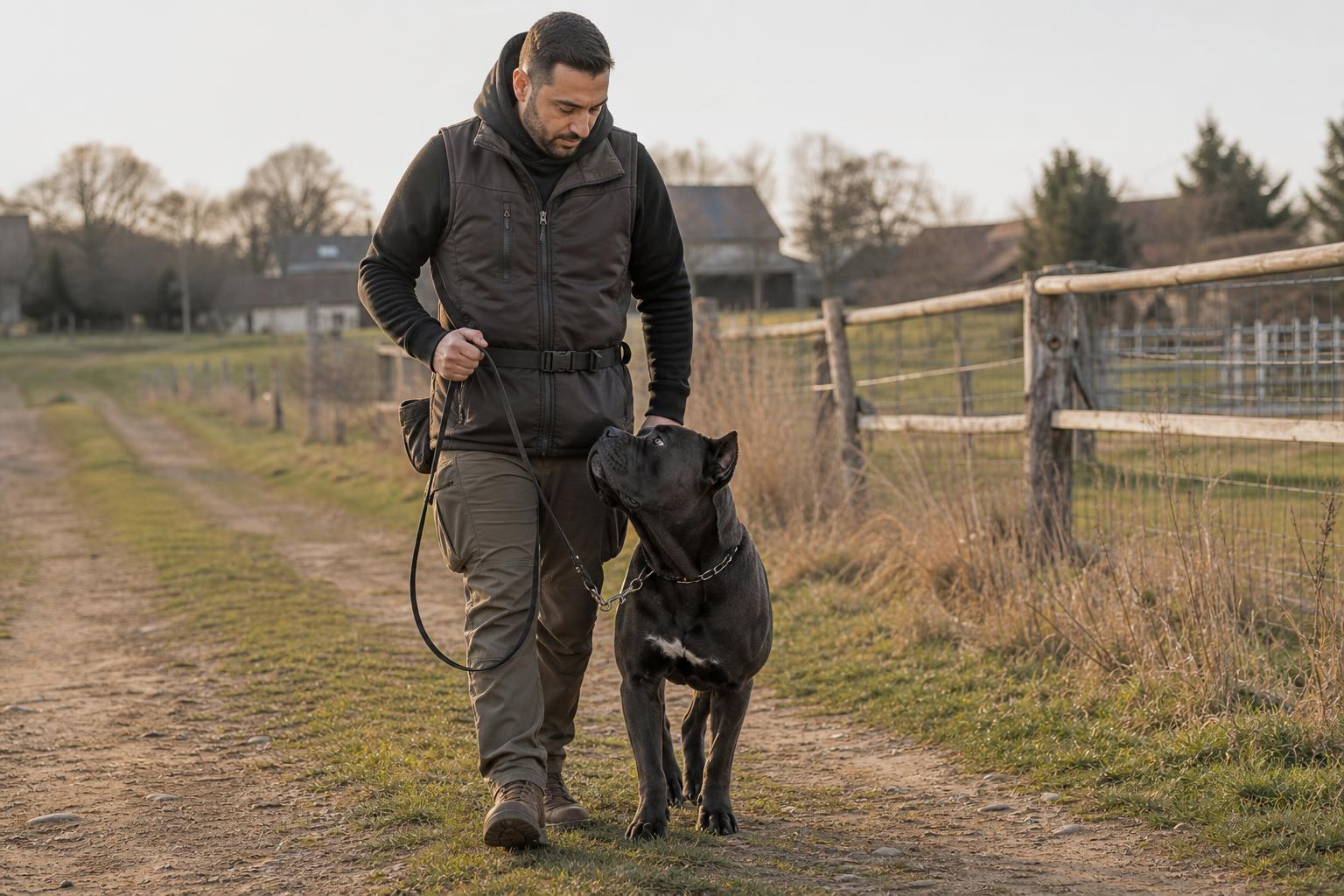
A Cane Corso started dog can be a smart option for the right buyer, but it is not a shortcut around experience. This is a powerful Italian mastiff breed with a long history as a guardian, farm dog, cattle helper, and large-game worker. A started Cane Corso should already show useful foundations: manners, confidence, handler focus, environmental exposure, and an early understanding of the work expected of it. For this breed, that often means guardian-style steadiness, controlled confidence, and breed-appropriate exposure rather than the bird-dog pattern buyers may expect from pointing or retriever breeds.
The best reason to consider a started dog is clarity. Instead of guessing how an eight-week-old puppy may mature, you can evaluate size, temperament, nerve, trainability, and early training in a more developed dog. That said, a started Cane Corso must be judged carefully. Strength, confidence, and protective instinct are only assets when paired with sound judgment, obedience, and a handler who can maintain structure.
What Qualifies as “Started” in a Cane Corso
The word “started” is not a formal guarantee by itself. One seller may use it for a young dog that knows sit and walks on lead. Another may mean a dog that has months of obedience, social exposure, crate training, vehicle manners, and early work around property, livestock, or controlled protection-style scenarios. Before you compare prices or make a deposit, ask the seller to define exactly what started means for that individual Cane Corso.
For a practical buyer, a started Cane Corso should have visible foundations in daily life. The dog should understand basic commands, accept handling, settle in a crate or designated place, walk under control, and recover appropriately after being stimulated. It should not be marketed as “trained” simply because it is older than a puppy. Age alone does not create training.
Questions to ask before you travel
- What commands does the dog know, and under what level of distraction?
- Has the dog lived primarily in a home, kennel, farm, or training facility?
- How does the dog behave around strangers, visitors, vehicles, livestock, and other dogs?
- What equipment has been used in training, and how does the dog respond to corrections?
- Can the seller provide unedited video of the dog working, settling, and being handled?
Because the Cane Corso is a guardian breed, neutrality matters more than flashy intensity. A started dog should not be lunging, unable to disengage, or difficult to physically manage. Confidence should look controlled and thoughtful, not frantic or explosive.
Birds Introduced or Breed-Appropriate Game Exposure
Cane Corsos are not typically purchased as upland bird dogs, retrievers, or traditional gun dogs. Their historic work is more closely tied to property guarding, farm utility, cattle work, and hunting large game such as wild boar. For that reason, buyers should be careful with any listing that describes a Cane Corso using generic bird-dog language without explaining what the dog has actually done.
If the seller mentions birds, ask why birds were used and what the exposure was meant to test. Some trainers use birds, livestock, or other animals to evaluate steadiness, prey interest, obedience, and impulse control. That can be useful, but it does not make the dog a finished hunting dog. Breed-appropriate exposure for a Cane Corso may include calm behavior around livestock, controlled movement around farm equipment, stable reactions to wildlife, or early tracking and large-game exposure where legal and appropriate.
What useful exposure looks like
- The dog can observe animals without losing all handler focus.
- The handler can call the dog away from stimulation.
- The dog shows courage without reckless escalation.
- The dog has been introduced gradually rather than flooded or provoked.
- The seller can explain the purpose of each exposure session.
Do not assume a Cane Corso has been exposed to birds, boar, livestock, or gunfire unless the seller can document it. Ask for dates, settings, video, and a plain description of the dog’s behavior. If you plan to use the dog around livestock or game, be honest about your own setup and confirm the training matches your environment.
Gun Introduction When Relevant
Gun introduction may or may not be relevant for a Cane Corso. It depends on the dog’s intended work, the seller’s program, and the buyer’s lifestyle. Some Corsos may be exposed to distant gunfire as part of farm, hunting, or environmental conditioning. Others may have no reason to be worked around firearms at all. A seller should never imply gun steadiness simply because the dog is bold in other situations.
If gun exposure is part of the listing, ask exactly how it was done. Proper introduction is gradual and tied to confidence, distance, and positive context. Poor introduction can create noise sensitivity or unnecessary stress. You want to know whether the dog remained relaxed, whether it recovered quickly, and whether the handler could maintain obedience before, during, and after the sound.
Verification points
- Was the exposure to starter pistol, shotgun, rifle fire, or general loud noises?
- At what distance did the training begin?
- Was the dog on lead, in a crate, working, eating, or observing?
- Did the dog show avoidance, stress, excitement, or steady neutrality?
- Can the seller demonstrate the dog’s current reaction safely?
For many Cane Corso homes, everyday sound stability is more important than formal gun conditioning. Thunder, vehicles, livestock gates, tools, children playing, and visitors at the door are practical tests. If firearm exposure matters to you, verify it directly. If it does not, focus instead on overall nerve, recovery, and obedience in real-world situations.
Obedience Level
Obedience is the center of a successful started Cane Corso purchase. This breed’s size and protective nature make casual manners insufficient. A started dog should show practical control, not just command recognition in a quiet yard. Buyers should look for obedience that holds up around movement, noise, people, doors, vehicles, and other dogs.
At minimum, expect a useful started Cane Corso to know sit, down, stay or place, recall, leash walking, crate manners, and calm handling. The dog should tolerate examination of ears, mouth, feet, collar, and body. It should load into a vehicle safely and wait at thresholds. For a guardian breed, the ability to disengage on command is especially important.
Commands worth seeing in person
- Loose-leash walking without dragging the handler.
- A reliable place command with duration.
- Recall from mild distraction in a safe area.
- Calm crate entry and exit.
- Doorway control with visitors or movement nearby.
- Handling by the owner and, when appropriate, by a neutral person.
Ask the seller to demonstrate the dog before you handle it. Then, if safe, ask to work the dog yourself. Some dogs perform only for the trainer. That does not make them bad prospects, but it does mean you need transition support and realistic expectations. A powerful dog that ignores a new handler may require more work than a first-time Corso owner should take on.
Evaluating Training Before You Buy
Evaluating a started Cane Corso is partly about the dog and partly about the honesty of the seller. Look for specific claims, calm demonstrations, and a willingness to discuss weaknesses. Every dog has gaps. A responsible breeder or trainer will tell you what still needs work, what situations require management, and what type of home will fit the dog.
Watch the dog’s whole pattern, not just one impressive exercise. Does it recover after excitement? Does it accept direction without conflict? Does it remain aware of the handler? Does it show suspicion that can be managed, or suspicion that takes over the room? A stable Cane Corso should be serious and observant without being impossible to redirect.
Red flags in started Cane Corso listings
- Vague claims such as “fully trained” with no command list or proof.
- Overemphasis on aggression, intimidation, or “protection” without obedience.
- No discussion of socialization, health testing, temperament, or handling.
- Refusal to provide current video or allow a reasonable evaluation.
- A seller who cannot explain the dog’s daily routine or training history.
Also ask about health documentation. The Cane Corso is a large breed, so buyers should discuss orthopedic soundness, conditioning, weight, veterinary history, and any available breeder health information. Do not assume OFA, DNA testing, or other clearances apply to a specific dog unless documents are provided and can be verified with the issuing organization or veterinarian.
Matching a Started Cane Corso to Your Home
A started Cane Corso should be matched to the buyer’s actual life, not an idealized plan. A farm buyer, experienced guardian-breed owner, rural family, or working-dog handler may need different traits than a suburban household with frequent guests. Be clear about children, other dogs, livestock, fencing, visitors, travel, and your training experience.
Transition is also part of the purchase. Ask whether the seller provides handoff lessons, written commands, feeding information, equipment recommendations, and follow-up support. A started dog is not a machine you plug into a new home. It needs time to transfer trust and learn the new rules.
- Plan a calm first week with limited visitors.
- Keep rules simple and consistent from day one.
- Use secure containment, strong leashes, and appropriate supervision.
- Continue training immediately instead of waiting for problems.
- Do not rush dog parks, busy public outings, or off-leash freedom.
Buyer-Focused Conclusion
A Cane Corso started dog can offer a clearer picture than a young puppy, especially when you can see temperament, obedience, and maturity beginning to take shape. The right dog should be steady, manageable, well-exposed, and honestly represented. The wrong dog can be too much power, too much suspicion, or too little foundation for the average home.
Before buying, verify what “started” means, review proof of training, ask about breed-appropriate exposure, and evaluate obedience in real situations. When in doubt, choose the Cane Corso with the clearest training record, the most stable temperament, and the seller who is willing to tell you both the strengths and the limitations. That is the safer, smarter path to a capable companion and serious working guardian.
Explore Cane Corso on Working Dog Central
View the Cane Corso breed profile or browse Cane Corso listings.


