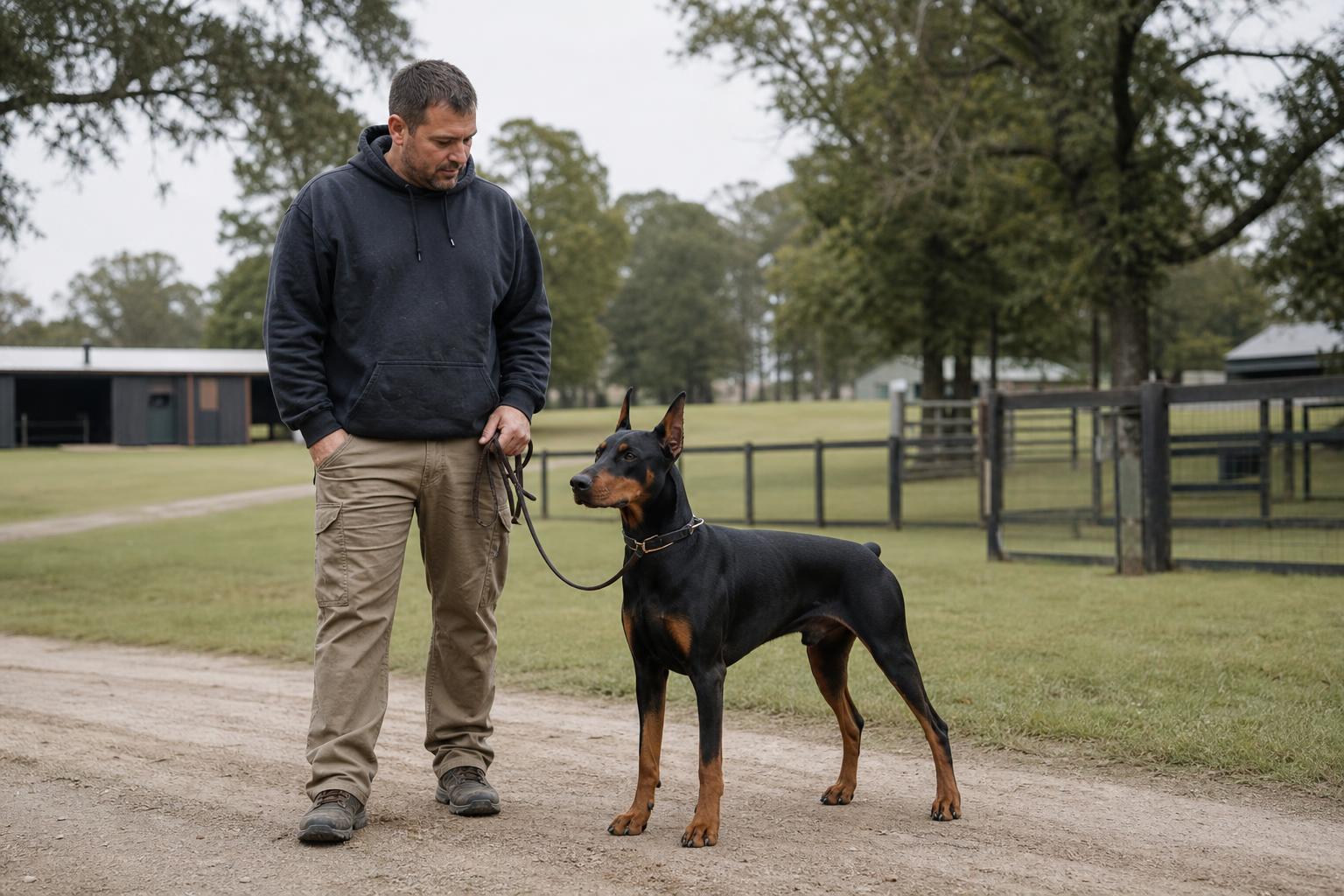
A finished Doberman Pinscher is not simply an older dog with a few commands. For the right buyer, a finished dog should be a mature, stable, well-conditioned working companion whose training has been proven in real environments. Because the Doberman Pinscher was developed as an athletic protection and service-minded breed rather than a traditional pointing or retrieving gun dog, buyers should evaluate finished dogs through the lens of obedience, temperament, control, social stability, and the specific work the dog has actually been trained to perform.
This guide is written for buyers comparing Doberman Pinscher finished dogs on Working Dog Central and elsewhere. Use it to ask better questions, separate real training from marketing language, and decide whether a trained adult Doberman fits your household, work goals, and experience level.
What makes a finished dog
In practical terms, a finished Doberman Pinscher should be reliable beyond the training yard. The dog should respond to known commands around distractions, move calmly in public, accept handling, travel well, and show the kind of mental balance expected of a mature working breed. The exact definition depends on the seller's program. A personal protection prospect, an obedience-titled dog, a farm or property companion, and a sport-trained Doberman may all be called finished, but they are not interchangeable.
Ask the seller to define finished in plain language. What commands are included? Are they verbal, hand-signal, or e-collar conditioned? Has the dog been worked around other dogs, children, traffic, livestock, kennels, vehicles, and unfamiliar people? A Doberman Pinscher can be intensely loyal and naturally watchful, so the difference between trained confidence and unmanaged suspicion matters.
- Request a command list and demonstration video in new locations, not only at the trainer's facility.
- Ask who trained the dog, how long the dog has been in training, and what methods were used.
- Look for calm control, not just flash, speed, or intensity.
- Confirm the dog can settle indoors and is not always in high drive.
Doberman Pinscher hunt tests
Hunt tests are valuable for many sporting breeds, but they may not be relevant to most Doberman Pinscher finished dogs. The breed's history is rooted in protection, police, military, obedience, and companion work, not upland pointing or waterfowl retrieving. If a seller references hunt tests, ask which organization issued the result, what the test measured, and whether the record can be independently verified.
For a buyer, the larger point is proof. A hunt-test title on any dog should connect to the job you need the dog to do. If you are buying a Doberman for general working companionship, obedience, property awareness, or sport foundations, hunt-test language may be less useful than videos, title records, references, and an in-person evaluation. Do not assume a finished Doberman Pinscher has hunting credentials unless the seller can document them.
Verify working records and breed eligibility
Verify reported working titles and test results with the issuing organisation. Confirm that the programme applies to the breed and ask what the result demonstrates about the individual dog.
Most Doberman buyers will be better served by looking at breed-appropriate measures: obedience titles, temperament evaluations, sport records, working certifications where applicable, and real-world handling. If your goal is a trained adult Doberman, the question is not whether every possible registry or hunting organization applies. The question is whether the dog has been fairly tested in the kind of environment where you expect it to live and work.
Trial records
Trial records can be useful, but only when you understand what they prove. For a Doberman Pinscher, trial records may come from obedience, rally, agility, IGP-style sport, protection sport, scent work, or other structured venues. Each venue rewards different traits. A dog with strong sport drive may be impressive, but that does not automatically make the dog easy for a family buyer. A steady, well-socialized obedience dog may be a better fit than a high-pressure competitor.
Ask for the dog's registered name and any title documentation. Then verify with the relevant registry or event organization when possible. If the seller describes the dog as titled, certified, proven, or finished, the paperwork should match the claim. Also ask to see the dog work for someone other than the trainer. Finished training should transfer to the new handler with instruction and reasonable practice.
- Match the trial record to your intended use.
- Ask whether the dog remains clear-headed when pressure increases.
- Confirm the dog has no unmanaged reactivity around people or dogs.
- Budget time for handler lessons after purchase.
Age expectations for a finished Doberman Pinscher
A truly finished Doberman Pinscher is usually not a puppy. Maturity, proofing, and reliable behavior take time. Many buyers should expect a trained adult to be at least two years old, and often older depending on the level of training claimed. Age by itself is not a flaw. In fact, a mature Doberman may give you a clearer picture of temperament, health, nerves, social behavior, and work ethic than an adolescent dog.
That said, age should be evaluated with condition and purpose. A young adult may have more years of active work ahead, while an older trained dog may offer steadier manners and a more predictable personality. Ask about exercise tolerance, veterinary history, daily routine, crate habits, house manners, and how the dog behaves after a day off. Dobermans are athletic and intelligent, but they need structure, mental work, and responsible management throughout life.
Investment value
Finished Doberman Pinscher dogs often cost more than puppies because someone has invested time, training, housing, socialization, and evaluation into the dog. The value is not only the purchase price; it is the reduced uncertainty and the immediate usefulness of a trained adult. A fair price should reflect the dog's age, health information, temperament, training level, documentation, and fit for the buyer's goals.
Avoid listings that rely on vague promises. Terms such as elite, fully trained, protection ready, or turnkey should come with details. What is included after the sale? Will the seller provide transition lessons? Is there a written contract? Are there any restrictions, return options, or support if the dog does not fit? Do not expect health guarantees or exact future performance unless they are clearly written and agreed upon by both parties.
Health, temperament, and paperwork to verify
Doberman Pinscher buyers should take health screening seriously. Breed communities commonly discuss issues such as von Willebrand disease testing and other screening used by responsible breeders, but the buyer should verify current results for the individual dog and its parents rather than relying on general breed claims. Ask for veterinary records, microchip details, registration papers if applicable, and clear explanations of any test results.
Temperament is just as important. A good finished Doberman should be confident, responsive, and controllable. Natural protectiveness should not be used as an excuse for poor nerves or unsafe handling. Meet the dog when possible, watch it around normal distractions, and bring a qualified trainer or experienced Doberman person if you are unsure.
Questions to ask before buying
- What specific behaviors and commands are finished?
- Where has the Doberman Pinscher been trained and proofed?
- What titles, certifications, or records can be verified?
- What health testing or veterinary documentation is available?
- How does the dog behave with strangers, dogs, vehicles, crates, and household routines?
- What transition support is included for the new owner?
Buyer-focused conclusion
A finished Doberman Pinscher can be a remarkable partner for the right buyer: athletic, loyal, intelligent, and ready for structured work. The best purchase is not the dog with the biggest claims; it is the dog whose training, temperament, documentation, and daily behavior match your real life. Verify records, ask for demonstrations, respect the breed's need for leadership and activity, and choose the finished Doberman that is proven in ways that actually matter to you.
Explore Doberman Pinscher on Working Dog Central
View the Doberman Pinscher breed profile or browse Doberman Pinscher listings.


