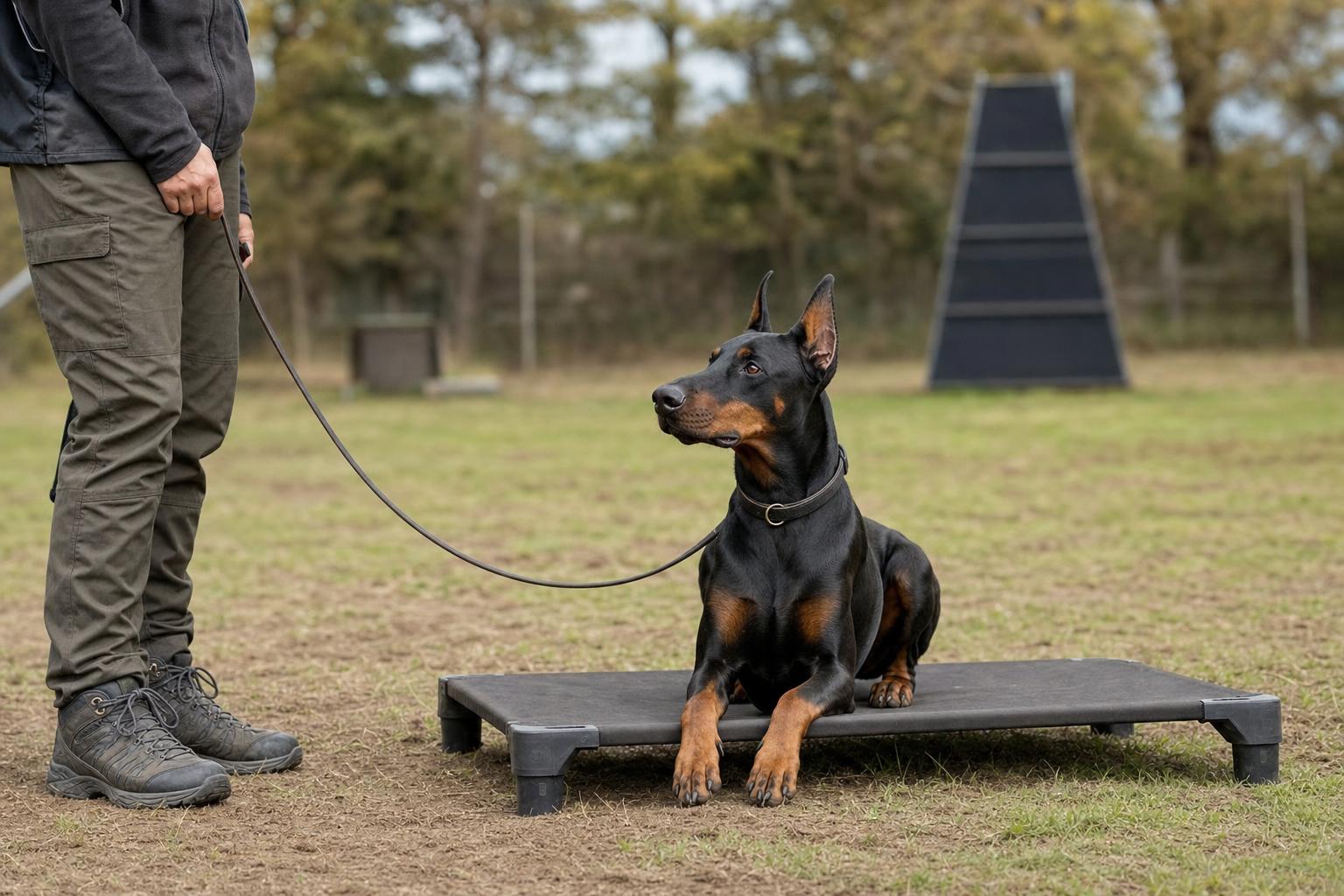
A Doberman Pinscher started dog can be a smart option for buyers who want to skip the earliest puppy stage while still shaping the dog into a reliable companion or working partner. The Doberman was developed in Germany as a personal protection and working breed, and today it is known for intelligence, athletic ability, loyalty, and strong handler focus. Those qualities can make a started Doberman very rewarding, but they also raise the standard for evaluation. A dog that is powerful, quick to learn, and naturally watchful needs clear training, stable temperament, and honest representation from the seller.
In hunting-dog listings, the phrase started dog often means a young dog with early field exposure. For a Doberman Pinscher, the meaning may be broader because the breed is more commonly associated with obedience, protection-oriented work, security roles, sport foundations, and active family companionship than with traditional bird-dog work. Buyers should focus less on labels and more on what the dog can actually do, how it behaves in new situations, and whether its training matches the job you expect it to perform.
What qualifies as “started”
A started Doberman Pinscher should be beyond basic handling but not represented as fully finished. At minimum, the dog should have a foundation in leash manners, crate or kennel routine, name recognition, recall foundations, sit, down, stay or wait, place or settle, and controlled greetings. The dog should be accustomed to regular human handling, basic grooming, vehicle loading, and everyday distractions. A started dog may also have early sport, obedience, tracking, scent work, or protection-sport foundations, but those should be described in plain terms rather than vague claims.
Ask the seller to define started in writing. How old is the dog? Who trained it? How long has it been in training? What commands does it know, and in what language or cue system? Has the dog trained only on the seller’s property, or has it worked in public places with traffic, strangers, other dogs, and household-style distractions? A Doberman can look polished in a familiar training yard but become unsettled if its social exposure has been narrow. The best sellers will show the dog working in multiple settings and will be honest about what still needs development.
- Started should mean demonstrated skills, not just potential.
- The dog should be manageable on leash and responsive to a handler.
- Temperament should be stable, not nervy, frantic, or suspicious without recovery.
- Training should be age-appropriate and clearly explained.
Birds introduced or breed-appropriate game exposure
Because the Doberman Pinscher is not primarily a pointing, flushing, or retrieving breed, buyers should be careful with bird-dog language. Some individual Dobermans may enjoy scent games, tracking, outdoor work, or exposure around birds and livestock, but you should not assume traditional gun dog development applies. If a listing mentions birds introduced, ask exactly what happened. Was the dog calmly exposed to pigeons, quail, ducks, or other birds? Did it show prey drive, curiosity, steadiness, avoidance, or over-arousal? Was the goal retrieving, environmental confidence, impulse control, or simple social exposure?
Breed-appropriate game exposure for a Doberman may include tracking exercises, scent discrimination games, search work, farm or ranch exposure, controlled movement around animals, or confidence-building in fields, woods, and varied terrain. For buyers interested in outdoor partnership, this type of exposure can be valuable, but it should be evaluated realistically. A Doberman that has been introduced to birds is not automatically a hunting dog. A dog that has done tracking or scent work is not automatically suited for every type of field use. Match the dog’s exposure to your intended purpose, and ask to see the behavior rather than relying on broad claims.
Gun introduction when relevant
Gun introduction is only relevant if the Doberman Pinscher has been developed for a setting where gunfire or sharp noise is part of the work. Since the breed is most often used in obedience, companion, sport, protection, security, and active family roles, many started Dobermans will not have formal gun conditioning. That is not a fault if gun exposure is not part of the dog’s expected life. It is a concern only when a seller claims the dog is suitable for hunting, field use, police-style work, or noise-heavy environments without proof of proper conditioning.
If gun introduction has been done, ask how it was done. Proper introduction should be gradual, paired with positive engagement, and matched to the dog’s confidence. It should not be a one-time test where someone fires a gun near the dog to see what happens. Ask about distance, caliber or noise level, the dog’s body language, recovery time, and whether the dog could continue working afterward. If the seller cannot describe the process, treat the claim cautiously. For a Doberman, confidence and recovery matter more than macho language about being fearless.
Obedience level
Obedience is the heart of a good started Doberman Pinscher. This breed tends to be intelligent, fast, athletic, and deeply bonded to its handler. That combination can produce excellent responsiveness, but it can also create pushy behavior if the dog has learned that rules are optional. A started dog should show control without looking shut down. You want engagement, focus, and willingness, not a dog that obeys only because it is intimidated or physically restrained.
Evaluate the basics first. Can the dog walk on a loose leash without constant correction? Will it sit and down on cue? Can it hold a place command while people move around? Does it come when called in a fenced or controlled setting? Can it ignore another dog at a reasonable distance? Does it accept handling of feet, ears, collar, and mouth? How does it load into a crate or vehicle? These everyday behaviors are often more important than flashy demonstrations.
Also ask what training methods were used. Dobermans are sensitive as well as driven. Clear markers, rewards, consistency, and fair corrections when appropriate often produce better long-term stability than harsh or confusing handling. If the dog has been trained with tools such as prong collars, e-collars, or sport equipment, ask for a demonstration of how those tools were introduced and whether the dog responds to voice and leash guidance without relying entirely on equipment.
Evaluating training
The safest way to evaluate a started Doberman Pinscher is to watch the dog perform ordinary tasks in real time. Videos can help, but an edited highlight reel is not enough. Ask to see the dog brought out of a crate or kennel, walked on leash, handled by the trainer, exposed to a new person at a respectful distance, and asked to perform known commands. If possible, watch the dog in a second location, not only the seller’s training field. A started Doberman should show curiosity, self-control, and recovery after mild stress.
Pay close attention to temperament. The breed is naturally watchful and loyal, but a stable Doberman should not be uncontrollably reactive, unable to settle, or unwilling to recover from normal surprises. Some suspicion of strangers may appear, especially in adolescents, but the dog should remain manageable and should look to the handler for direction. Avoid confusing frantic intensity with quality training. Drive is useful only when paired with control.
- Ask for the dog’s age, daily routine, and training history.
- Request clear descriptions of commands and expected responses.
- Watch the dog work before discussing purchase terms.
- Confirm whether the dog has lived indoors, in a kennel, or both.
- Ask about health screening information for the sire and dam where available, including any breed-relevant DNA or veterinary records the seller can document.
Health and documentation questions
Started-dog buyers should not skip health questions. Doberman Pinscher breed communities commonly emphasize transparent health screening, including DNA testing for von Willebrand disease type I and other evaluations used by responsible breeders. Do not assume every started dog has complete testing, and do not treat a verbal claim as proof. Ask for veterinary records, vaccination history, microchip information if available, registration papers if applicable, and any health testing records for the dog or its parents. If a seller mentions AKC registration, OFA results, DNA tests, titles, or sport records, ask to see the documentation and verify what is relevant to this individual dog.
Fit for your home
A started Doberman Pinscher is still a high-responsibility dog. Even with training, the breed needs daily exercise, mental work, consistent rules, and close involvement with its people. Buyers should plan for continued obedience, structured socialization, secure containment, and a lifestyle that gives the dog a job. This is usually not the best choice for someone who wants a low-effort dog or a dog left alone without outlets for long stretches.
Buyer-focused conclusion
The right Doberman Pinscher started dog can offer a valuable head start: maturity, basic obedience, early exposure, and a clearer picture of temperament than an eight-week-old puppy can provide. The key is to verify every claim. Define what started means, watch the dog work, ask how exposure was introduced, review obedience in practical settings, and confirm records instead of assuming they exist. When the dog’s training, temperament, and health documentation all fit your goals, a started Doberman can become a loyal, athletic, and highly capable partner.
Explore Doberman Pinscher on Working Dog Central
View the Doberman Pinscher breed profile or browse Doberman Pinscher listings.


