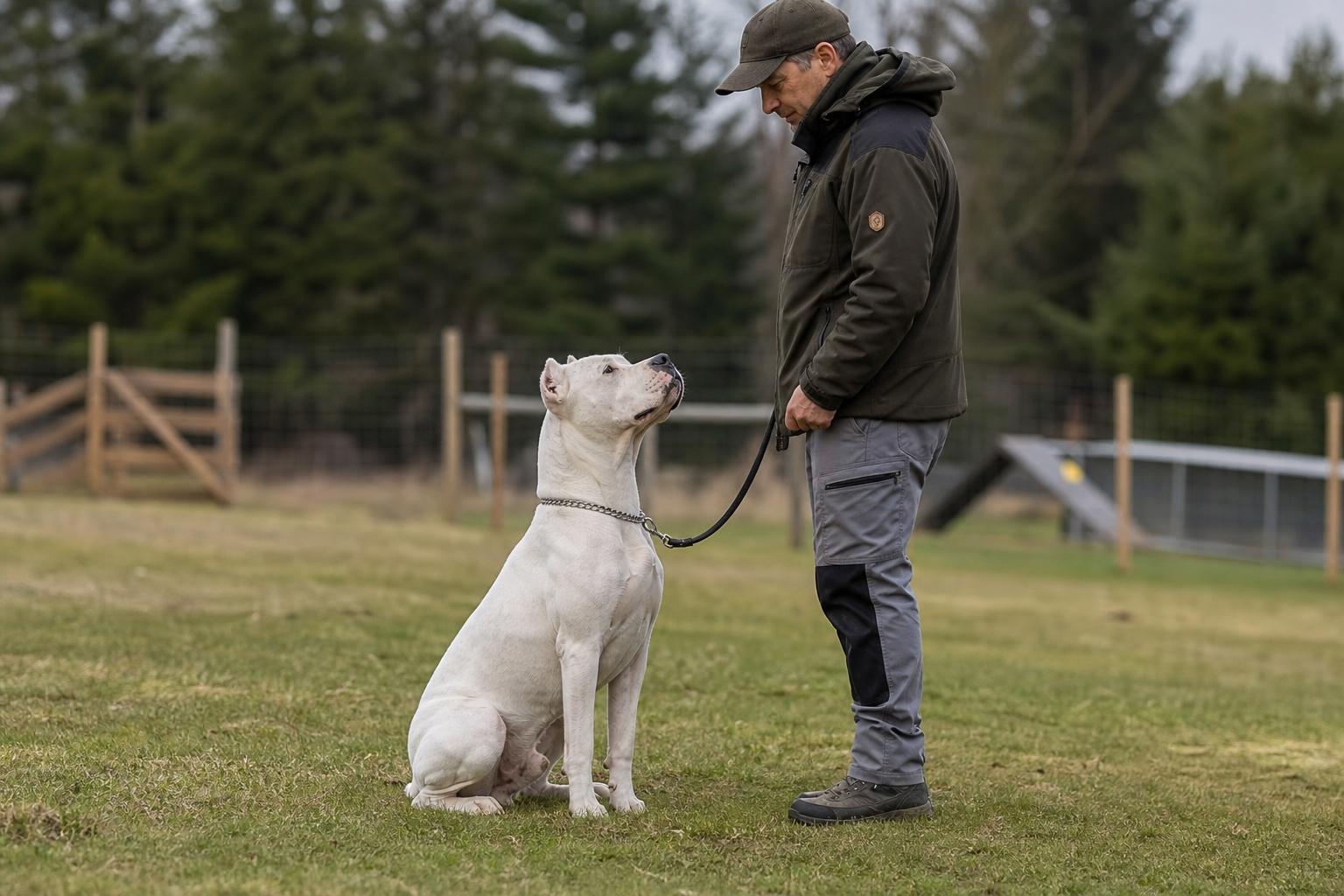
A finished Dogo Argentino is not simply an older dog or a large, impressive athlete with basic obedience. For a serious buyer, finished should mean the dog has been developed far enough that its training, manners, confidence, and working ability can be demonstrated in realistic situations. Because the Dogo Argentino is powerful, courageous, protective, and historically tied to demanding big-game work, proof matters. A polished description is useful, but a calm demonstration, clear handling history, and honest discussion of limitations are far more important.
The breed background gives useful context. Dogos were developed in Argentina as athletic pack-hunting dogs for dangerous game such as wild boar and puma. Good examples are strong, intelligent, loyal, and people-focused, but they also need structure, socialization, and experienced handling. When you look at a finished Dogo Argentino, evaluate the whole dog: physical condition, steadiness around people, response to the handler, recovery from excitement, and whether the dog can work without becoming unsafe or unmanageable.
What Makes a Finished Dog
Finished status should be tied to specific, observable skills. Ask the seller what the dog is finished for. A finished hunting prospect, a finished personal companion with advanced obedience, and a finished working dog are not the same product. The answer should include the dog’s job, the standards used, and what the dog can reliably do without excessive pressure or constant correction.
- Reliable obedience under distraction, including leash manners, recall foundation, place or settle behavior, and calm handling.
- Stable temperament around normal household and public situations, with appropriate management around strangers and other animals.
- Conditioning that matches the dog’s intended work, with a lean, athletic body rather than bulk for appearance alone.
- Clear proof of training through demonstrations, records, videos, references, or trainer notes.
- Honest disclosure of weaknesses, including prey intensity, dog selectivity, visitor management needs, or any handling limits.
For this breed, a finished dog should never mean uncontrolled intensity. A Dogo can be brave and protective while still being responsive, clear-headed, and safe to live with. Buyers should prioritize stability and handler connection over dramatic displays of toughness.
Hunt Tests and Field Proof
Hunt tests may or may not be relevant depending on how the individual Dogo has been developed and what venues are available to the seller. The key is not the label but the proof. If a seller references hunting ability, ask for details: what type of game or training environment, how the dog was handled, whether the dog worked alone or with other dogs, and what control was expected before, during, and after the work.
Because Dogos were created for big-game hunting, practical field evidence can be valuable when it is presented responsibly. Look for steadiness, stamina, handler responsiveness, and safe management. A dog that is physically capable but cannot be called off, settled, transported, or handled around people is not truly finished for most buyers.
Verify working records and breed eligibility
Verify reported working titles and test results with the issuing organisation. Confirm that the programme applies to the breed and ask what the result demonstrates about the individual dog.
For a Dogo Argentino, records that support temperament, obedience, conditioning, and controlled working ability can all matter. Trainer evaluations, structured video, references from handlers, and veterinary or hearing-screening information may be just as important as formal titles, especially for buyers who need a stable family companion with real working structure.
Trial Records and Demonstrations
If trial records are part of the dog’s value, review them carefully. Ask what organization held the event, what class or level the dog competed in, how recently the result was earned, and whether the same handler will demonstrate the dog for you. A record from years ago is not worthless, but it should be weighed against the dog’s current condition and current behavior.
A live or recent video demonstration should show the dog entering and leaving the work, not just the most exciting moment. Watch the transitions. Can the dog load, unload, walk on lead, wait, respond to direction, and settle afterward? Finished dogs earn their value in the boring moments as much as the impressive ones.
Age Expectations for Finished Dogos
Finished Dogo Argentinos are usually mature enough for their training and temperament to be visible. Exact age depends on the work, the trainer, and the individual dog, but buyers should be cautious of very young dogs marketed as fully finished. Large working breeds need time to mature physically and mentally. A young dog may be promising, started, or well-trained for its age without being truly finished.
With an adult Dogo, evaluate durability and lifestyle fit. Ask about daily routine, exercise needs, crate or kennel habits, house manners, social history, and how the dog behaves after several quiet days as well as after heavy activity. A finished dog should come with enough history for you to predict how it will fit your home, not just how it performs during a short sales demo.
Investment Value
A finished Dogo Argentino can represent significant value because the buyer is paying for time, training, maturity, evaluation, and reduced uncertainty. The investment is strongest when the seller can clearly show what has been put into the dog and where the dog is best suited. The value is weaker when the listing relies on size, color, intimidation, or vague claims instead of records and demonstrated skills.
- Ask for health and hearing information when available, especially because deafness is an important concern in the breed.
- Review the dog’s socialization history and management needs with strangers, children, dogs, livestock, and public settings.
- Confirm what transition support is included after purchase, such as handling instruction or follow-up with the trainer.
- Match the dog’s actual temperament and training to your household, experience level, containment, and daily routine.
The best finished Dogo is not the most extreme dog. It is the dog whose ability, temperament, and management needs are honestly represented and compatible with the buyer’s life.
Questions to Ask Before Buying
- What exactly is the dog finished to do, and who trained it?
- Can I see the dog perform the claimed skills in a realistic setting?
- What are the dog’s strongest traits and most important limitations?
- How does the dog handle strangers, other dogs, travel, confinement, and recovery after excitement?
- What health, hearing, veterinary, or conditioning information is available?
- What support is offered during the transition to a new handler or home?
A finished Dogo Argentino should give a buyer confidence, not just excitement. Take your time, verify the proof, and choose the dog whose training and temperament are clear enough to trust beyond the listing page.
Explore Dogo Argentino on Working Dog Central
View the Dogo Argentino breed profile or browse Dogo Argentino listings.


