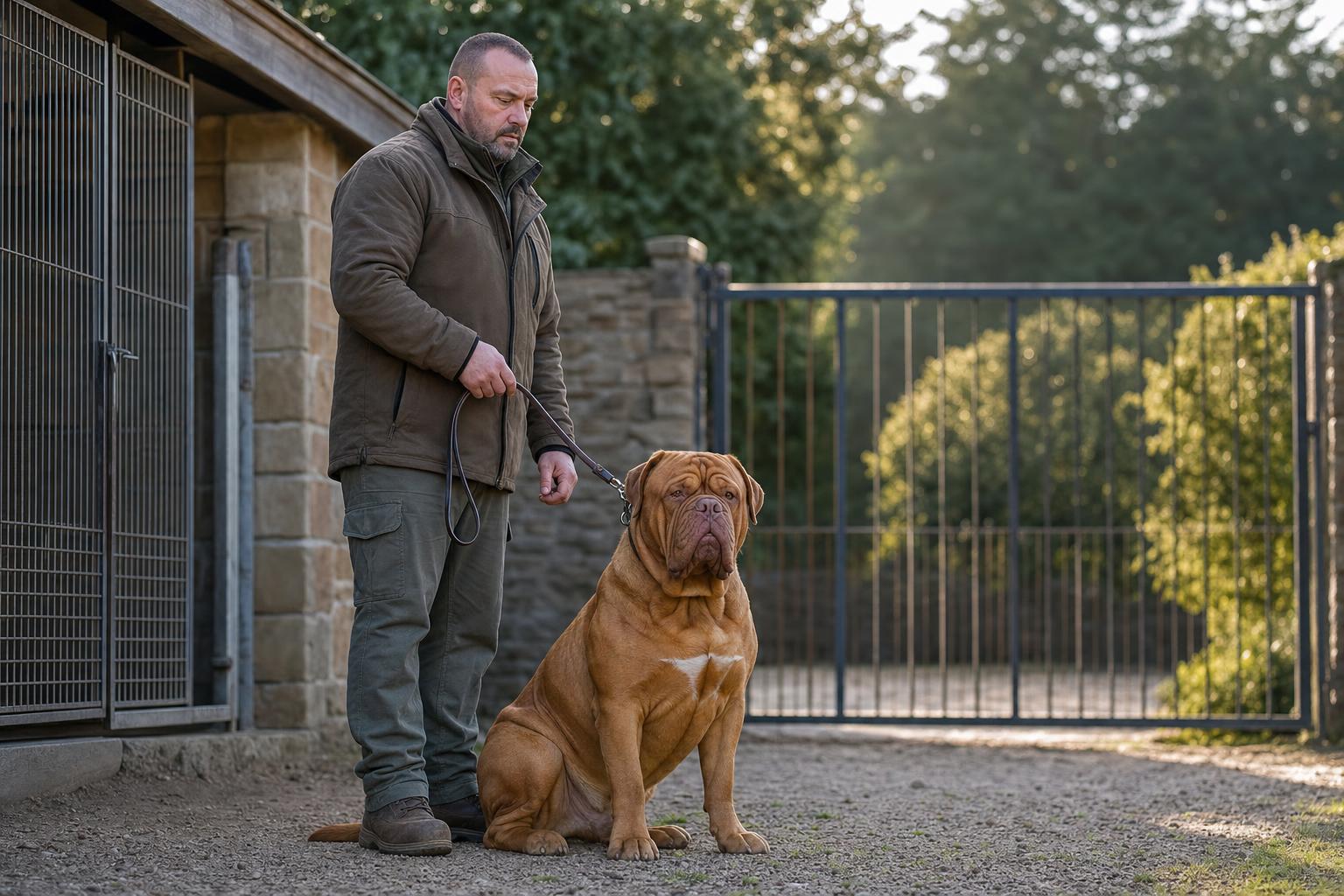
A finished Dogue de Bordeaux is not the same thing as a started young prospect or a big adult dog with a little basic obedience. For buyers on Working Dog Central, “finished” should mean the dog has been developed, evaluated, and proven for the job being advertised. With the Dogue de Bordeaux, that job is usually best understood through the breed’s real history and present-day role: a powerful French mastiff, historically used as a guardian, estate dog, deterrent, and in some older accounts for demanding work such as large-game hunting. Modern buyers should look for a calm, manageable, well-conditioned adult with stable temperament, useful training, and clear evidence behind every claim.
The breed facts matter here. The Dogue de Bordeaux is large, muscular, loyal, protective, and often naturally watchful. That can be a strength in the right home, but it also means a finished dog must be safe to live with, not merely impressive to look at. A good seller should be able to explain the dog’s household manners, leash skills, visitor behavior, conditioning, health screening background, and limitations just as clearly as its strengths.
What makes a finished dog
A finished Dogue de Bordeaux should have moved beyond potential. The seller should be able to demonstrate what the dog does reliably, under what conditions, and with what handler support. For this breed, finished status may involve advanced obedience, reliable home and property manners, steady public behavior, controlled guardian instincts, and a proven ability to settle when nothing is happening. If a seller describes the dog as a finished protection, guardian, farm, estate, or working companion, ask for specific examples rather than broad labels.
Useful finished-dog questions include:
- What commands does the dog know, and are they reliable around distractions?
- How does the dog behave with visitors, children, delivery drivers, livestock, other dogs, and unfamiliar places?
- Has the dog lived in a house, kennel, or mixed environment?
- Can the seller show leash handling, loading, crating, calm greetings, and a settle or place command?
- What situations still require management?
Because the Dogue de Bordeaux is powerful, “mostly trained” is not enough. A mature dog that pulls hard, guards resources, rushes doors, or makes poor decisions around strangers can become a serious liability. The best finished dogs are steady and predictable, not dramatic.
Hunt tests
Hunt tests are a common way to evaluate many sporting breeds, but buyers should not assume they are relevant to every Dogue de Bordeaux listing. The Dogue de Bordeaux has historical references to large-game work, yet it is not typically marketed like a pointing, flushing, or retrieving breed. If a seller mentions hunt tests, field tests, or hunting titles, ask which organization issued them, what standard was met, and whether the test truly measures work that matters for this breed.
For many Dogue de Bordeaux finished-dog buyers, practical evidence may be more useful than a hunt-test title. A calm video showing obedience around livestock, controlled movement near gates and vehicles, polite handling by a knowledgeable adult, and neutral behavior in public can tell you a great deal. If hunting exposure is claimed, verify the exact game, setting, safety practices, and whether the dog’s role was active work, tracking, deterrence, companionship, or simply being present.
Verify working records and breed eligibility
Verify reported working titles and test results with the issuing organisation. Confirm that the programme applies to the breed and ask what the result demonstrates about the individual dog.
Verify reported working titles and test results with the issuing organisation. Confirm that the programme applies to the breed and ask what the result demonstrates about the individual dog.
Trial records
Trial records can be meaningful when they match the breed and the purpose of the dog. With a Dogue de Bordeaux, buyers should be careful not to treat vague phrases such as “champion lines,” “working blood,” or “proven” as proof of finished training. Ask to see records. That may include show records, working evaluations, obedience titles, temperament tests, farm references, breeder documentation, or videos of the dog performing the advertised skills.
Also ask what the record does not show. A dog can be impressive in one setting and difficult in another. A finished guardian-type dog may behave beautifully at home but need careful introductions elsewhere. A dog with a strong protective nature may be unsuitable for a busy household with frequent unstructured visitors. Honest sellers will discuss these details without becoming defensive.
- Confirm registered name and identification when formal records are claimed.
- Ask for current video, not only old photos or puppy pictures.
- Verify who trained the dog and who currently handles it.
- Look for consistency between claims, records, and observed behavior.
Age expectations
A finished Dogue de Bordeaux is usually mature enough to show stable temperament, adult structure, and reliable habits. Because this is a large, slow-maturing mastiff breed, buyers should be realistic about age. A young dog may be promising, social, and started in obedience, but it may not be mentally or physically finished. Many buyers will be better served by an adult whose personality is known and whose training has already been tested in ordinary life.
Age also affects health and long-term planning. Ask about veterinary history, orthopedic concerns, conditioning, weight management, and any breed-relevant screening available from the breeder or owner. The breed information commonly emphasizes hip, elbow, and eye evaluations before breeding; for a finished adult, buyers should still ask what is known about soundness, mobility, breathing comfort, heat tolerance, skin or fold care, and daily maintenance. Do not accept medical guarantees that are not written, specific, and backed by records.
Investment value
A finished Dogue de Bordeaux often costs more than a puppy or started dog because the seller has invested time, food, veterinary care, socialization, equipment, training, and evaluation. The value is not just the dog’s size or pedigree. It is the reduction of uncertainty. You are paying to know more about the dog’s adult temperament, real manners, strengths, and limitations before bringing it home.
That investment is only worthwhile if the dog fits your life. A finished Dogue de Bordeaux may be a wonderful choice for an experienced owner who wants a loyal home companion with guardian presence, but a poor match for someone who wants an off-leash sporting dog, a dog-park social butterfly, or an animal that can be casually handled by everyone. Budget beyond the purchase price for large-breed food, durable equipment, transport, insurance or veterinary reserves, training refreshers, and safe housing.
Fair evaluation includes seeing the dog in real situations whenever possible. Watch how it exits a crate or kennel, walks on leash, responds to correction or redirection, greets known people, ignores neutral strangers, and settles after excitement. A trustworthy seller will not rush you, hide problems, or promise that a powerful adult dog will automatically adapt to any home.
Health, temperament, and paperwork to verify
Before buying a finished Dogue de Bordeaux, collect the basics in writing. That includes the dog’s age, microchip or identification, registration status if any, veterinary history, vaccination records, deworming history, current diet, medications, training history, and reason for sale. If AKC registration, foreign registry paperwork, OFA results, DNA testing, or formal titles are advertised, verify them directly through the appropriate registry or database instead of relying on screenshots.
Temperament deserves the same seriousness as paperwork. This breed is known for loyalty, calm confidence, and protective instincts when well bred and well raised. Ask how the dog has been socialized and managed. A stable dog should not be frantic, uncontrollable, or indiscriminately aggressive. Protective does not mean unsafe; it means discerning, manageable, and responsive to a competent handler.
Conclusion: buying the right finished Dogue de Bordeaux
The right finished Dogue de Bordeaux can offer something a puppy cannot: a clearer picture of adult size, temperament, training, and daily needs. Look for proof, not pressure. Verify records, watch the dog work or live, ask direct questions, and be honest about your handling experience. A finished Dogue de Bordeaux should be calm, capable, structurally sound for its role, and matched to a buyer who understands the responsibility of owning a powerful guardian breed.
Explore Dogue de Bordeaux on Working Dog Central
View the Dogue de Bordeaux breed profile or browse Dogue de Bordeaux listings.


