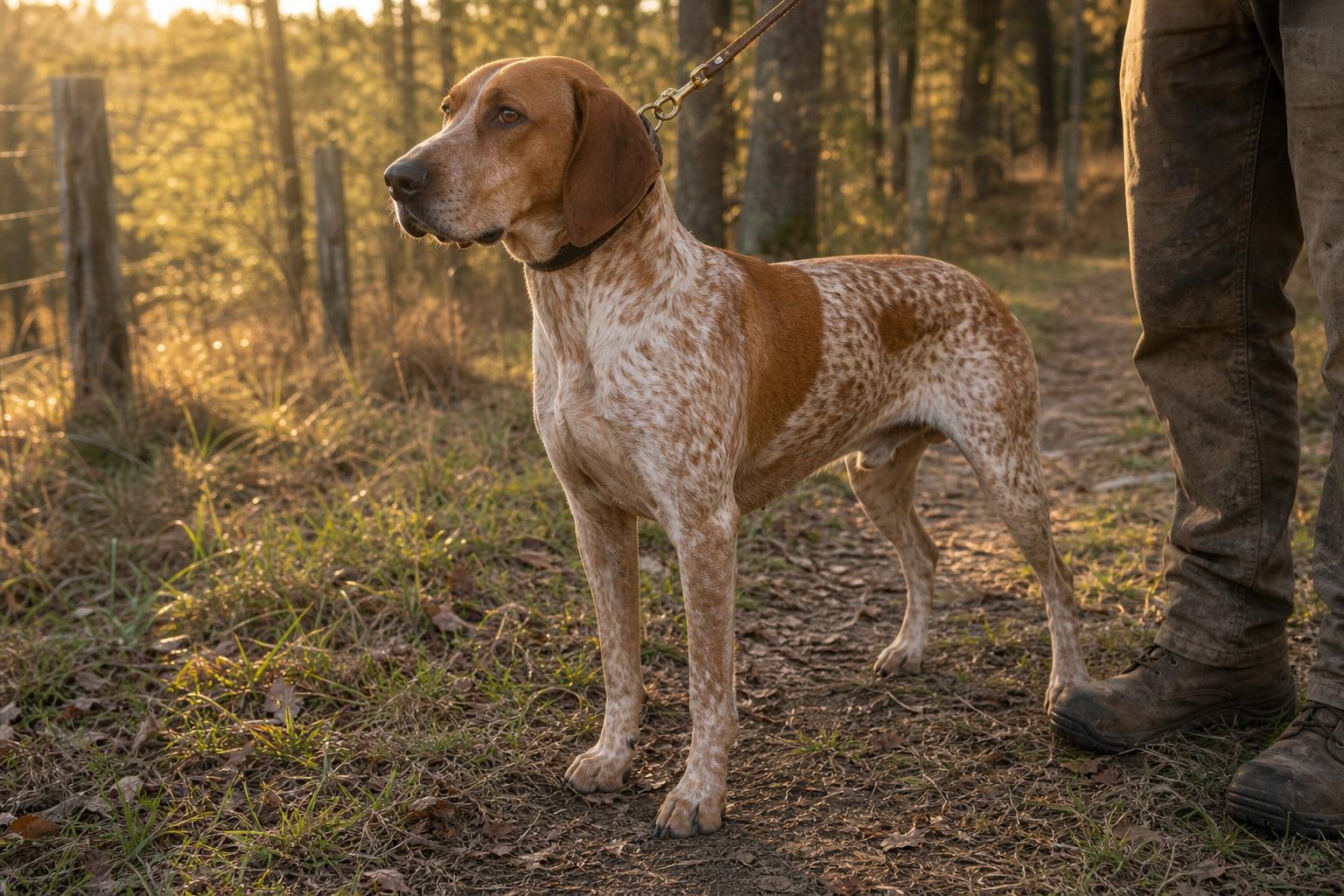
A finished English Coonhound is not just an older hound with time in the woods. For a serious buyer, finished should mean a dog that can consistently do the job it is being sold to do: trail game by scent, locate and stay treed when appropriate, handle reasonably for its training background, and show enough steadiness that the buyer can evaluate the dog under real conditions. Because the English Coonhound was developed as a fast, endurance-minded scent hound for raccoon and other game, a good finished dog should show nose, drive, voice, stamina, and the confidence to work independently without becoming impossible to manage.
The safest way to buy is to treat every claim as something to verify. A seller may honestly describe a dog as finished based on local hunting expectations, while another buyer may expect competition-level polish, reliable solo work, or a dog that can hunt several nights a week in rough country. Before money changes hands, define what finished means for your use, watch the dog work, review any records, and ask direct questions about faults as well as strengths.
What makes a finished English Coonhound
A finished English Coonhound should have a clear, repeatable hunting pattern. In practical terms, that means the dog can strike a track, move it with purpose, open with a recognizable voice, locate, tree, and remain committed long enough for the handler to arrive. It should not need another dog to explain the job every time. Many buyers want a hound that can hunt alone and with company, because a dog that only performs in one setting may be less useful than the description suggests.
Finished does not mean flawless. Coonhounds are independent scent dogs, and even good ones can have off nights when scenting conditions are poor. What matters is the body of evidence. Look for consistency across different woods, different weather, and different company. Ask whether the dog has been hunted mostly at night, whether it has been used on raccoon, larger game where legal, or other local quarry, and how it responds when a track gets difficult.
Key abilities to confirm
- Can the dog start and advance a track without constant help?
- Does the dog have a locate and tree style the handler can read?
- Will it stay treed under normal pressure until handled?
- Can it be caught and led away without excessive struggle?
- Does it hunt at a range that fits your land, terrain, and comfort level?
- Can it work alone, with another hound, or in a cast without changing character?
Also ask about the dog at home and in the kennel. English Coonhounds are often friendly and social, but they are also vocal working hounds. A dog that is excellent in the woods may still be a poor match for a buyer who needs a quiet suburban companion. Finished hunting ability should be evaluated alongside temperament, handling, noise level, and daily management needs.
Hunt tests and performance titles
Hunt tests and organized events can be useful, but buyers should understand what a record does and does not prove. The English Coonhound has recognition in major registries, including UKC history under English Coonhound naming and AKC recognition as the American English Coonhound. Depending on the seller, you may see competition wins, bench show notes, nite hunt records, or other event history. Those records can support a seller's claims, but they should not replace seeing the dog work.
Ask for exact event names, dates, registry numbers, and copies or links when available. A vague statement like "has wins" is less useful than a documented record showing where the dog competed and how it placed. Some finished English Coonhounds are proven pleasure dogs with little formal paperwork, while some titled dogs may not suit your hunting style. Both can be valuable, but the buyer should know which kind of evidence is being offered.
How to use hunt records wisely
- Match the record to your goal: pleasure hunting, competition hunting, breeding, or a combination.
- Verify registry names and numbers rather than relying only on verbal claims.
- Ask whether the dog was handled by the seller, a trainer, or someone else.
- Find out whether the dog still performs at that level today.
- Watch for gaps between a past title and the dog's current conditioning, age, or behavior.
If a seller references AKC, UKC, PKC, or other event systems, verify which organization applies and what the result means. Not every buyer needs a titled hound, and not every excellent hunting dog has been campaigned. The point is to separate proof from promotion.
Verify working records and breed eligibility
Verify reported working titles and test results with the issuing organisation. Confirm that the programme applies to the breed and ask what the result demonstrates about the individual dog.
For this breed, more relevant proof usually comes from hunting demonstrations, coonhound event records, references from people who have hunted with the dog, and clear documentation of pedigree and ownership. If a dog has participated in any nontraditional testing or scent work, treat it as extra context rather than the main evidence of finished coonhound ability.
Trial records and competition history
Trial records can add value when they are current, verifiable, and connected to the way you plan to use the dog. A dog that has competed successfully may show independence, pressure tolerance, and the ability to perform around unfamiliar dogs and handlers. That can matter if you want to hunt in groups or attend events. However, competition style is not always the same as quiet pleasure hunting. Some buyers prefer a balanced, honest dog over a hard-charging hound that is difficult to enjoy on weeknights.
Ask the seller to explain the dog's style in plain language. Does it get deep quickly? Does it check in? Is it accurate at the tree? How does it behave around slick trees, off game, or a dog that covers it? Has it been scratched, corrected, or retired from competition for a reason? Honest answers to these questions matter more than a polished advertisement.
Questions to ask about trial records
- Which registry or organization issued the record?
- What is the dog's registered name and number?
- Were wins earned recently or several years ago?
- Was the dog campaigned heavily, lightly, or only locally?
- Does the dog still hunt the same way after time off?
- Are there handlers or hunting partners who can provide references?
For buyers considering future breeding, records may matter more because they help document ability beyond one person's opinion. Even then, records should be paired with health, temperament, pedigree, and firsthand evaluation.
Age expectations for a finished English Coonhound
Age is one of the biggest factors in both price and suitability. A young finished dog may offer many hunting seasons ahead, but true consistency at a young age is uncommon and should be proven. A mature dog may be more settled, easier to read, and better tested in different conditions. An older hound may be an excellent choice for a buyer who wants a reliable pleasure dog, as long as the price reflects remaining working years and current soundness.
English Coonhounds are athletic dogs built for endurance, but conditioning matters. Ask how often the dog has been hunted recently, whether it is legged up, and whether it has had any injuries that affect performance. Do not accept medical claims without veterinary records, and do not assume that a dog is sound simply because it looks eager at the kennel. Watch movement, feet, breathing, recovery after work, and willingness to load and travel.
Practical age bands
- Two to three years: may be well started or genuinely finished if hunted hard by a skilled trainer, but consistency should be demonstrated.
- Four to seven years: often the prime window for a seasoned, reliable hunting hound if kept fit and sound.
- Eight years and older: may still be valuable for pleasure hunting, training younger dogs, or breeding evaluation, but buyers should price according to current ability and expected use.
Do not dismiss an older dog automatically. For a first-time coonhound owner, a steady older English Coonhound can be a better teacher than a flashy young dog with more drive than manners. The right age depends on whether you need peak performance, a dependable hunting companion, or a dog that can help develop younger hounds.
Investment value and fair pricing
A finished English Coonhound is often priced higher than a puppy or started dog because the seller has already invested time, feed, travel, training, and hunting exposure. The buyer is paying for reduced uncertainty. You should still avoid thinking of the dog as guaranteed performance in a new environment. A hound may need time to bond with a new handler, learn new country, and adjust to different kennel routines.
Fair value depends on current performance, age, health documentation, pedigree, records, temperament, and how closely the dog matches your needs. A dog that is perfect for one hunter may be too wide-ranging, too vocal, or too competition-minded for another. Price should follow fit, not just reputation.
Value factors to weigh
- Reliable solo performance in the woods.
- Accuracy and honesty at the tree.
- Documented competition or registry history, when relevant.
- Current conditioning and soundness.
- Handle, recall, loading, kennel manners, and temperament.
- Pedigree and breeding potential, if that matters to the buyer.
- Seller reputation and willingness to demonstrate the dog.
Be cautious with pressure tactics. A finished dog may sell quickly, but a seller who refuses a reasonable demonstration, avoids direct questions, or will not provide basic documentation is creating unnecessary risk. Deposits, trial periods, and return agreements should be written clearly. If a trial period is offered, define where the dog may be hunted, who carries risk, what happens if the dog is injured, and how quickly a return must occur.
Evaluating a finished English Coonhound before purchase
The best evaluation is a hunt, preferably in conditions similar to where you will use the dog. If possible, watch the dog go alone first. A solo hunt shows independence and helps reveal whether the dog can do its own work. A second hunt with company can show manners, competitiveness, and whether it packs, covers, or interferes. Bring someone experienced if you are new to coonhounds; a knowledgeable second set of eyes can catch details that excitement may hide.
Listen as much as you watch. English Coonhounds are known for their hound voice, and many handlers identify their dog by mouth on track and tree. Decide whether you like the dog's voice and whether you can read it. Notice whether the seller can tell you what the dog is doing before you see the result. That connection between handler and hound often reveals whether the dog has been honestly hunted.
Red flags
- The seller only wants to show videos and will not arrange a live demonstration when reasonable.
- Descriptions change when you ask specific questions.
- The dog is called finished but cannot hunt without another dog.
- The dog is difficult to catch, load, or handle in normal circumstances.
- Records are claimed but names, dates, or registry details are missing.
- The price depends on breeding claims that are not backed by documentation.
Videos can be helpful, especially for buyers traveling a long distance, but they should be viewed as supporting material. Ask for unedited clips when possible, including turnout, track work, treeing, handling at the tree, and loading afterward. A highlight reel shows potential; a full hunt shows habits.
Conclusion: buy the English Coonhound that fits your hunting life
A finished English Coonhound can be a tremendous shortcut for the right buyer. Instead of raising a puppy and hoping instincts develop, you can start with a dog whose ability is visible today. The tradeoff is that you must evaluate carefully. Define what finished means, verify records, watch the dog work, consider age and soundness, and make sure the hound's range, voice, drive, and temperament fit your life.
The best purchase is not always the most titled dog or the youngest dog. It is the English Coonhound you can honestly use, handle, maintain, and enjoy. Take your time, ask practical questions, and buy the dog in front of you rather than the advertisement around it.
Explore English Coonhound on Working Dog Central
View the English Coonhound breed profile or browse English Coonhound listings.


