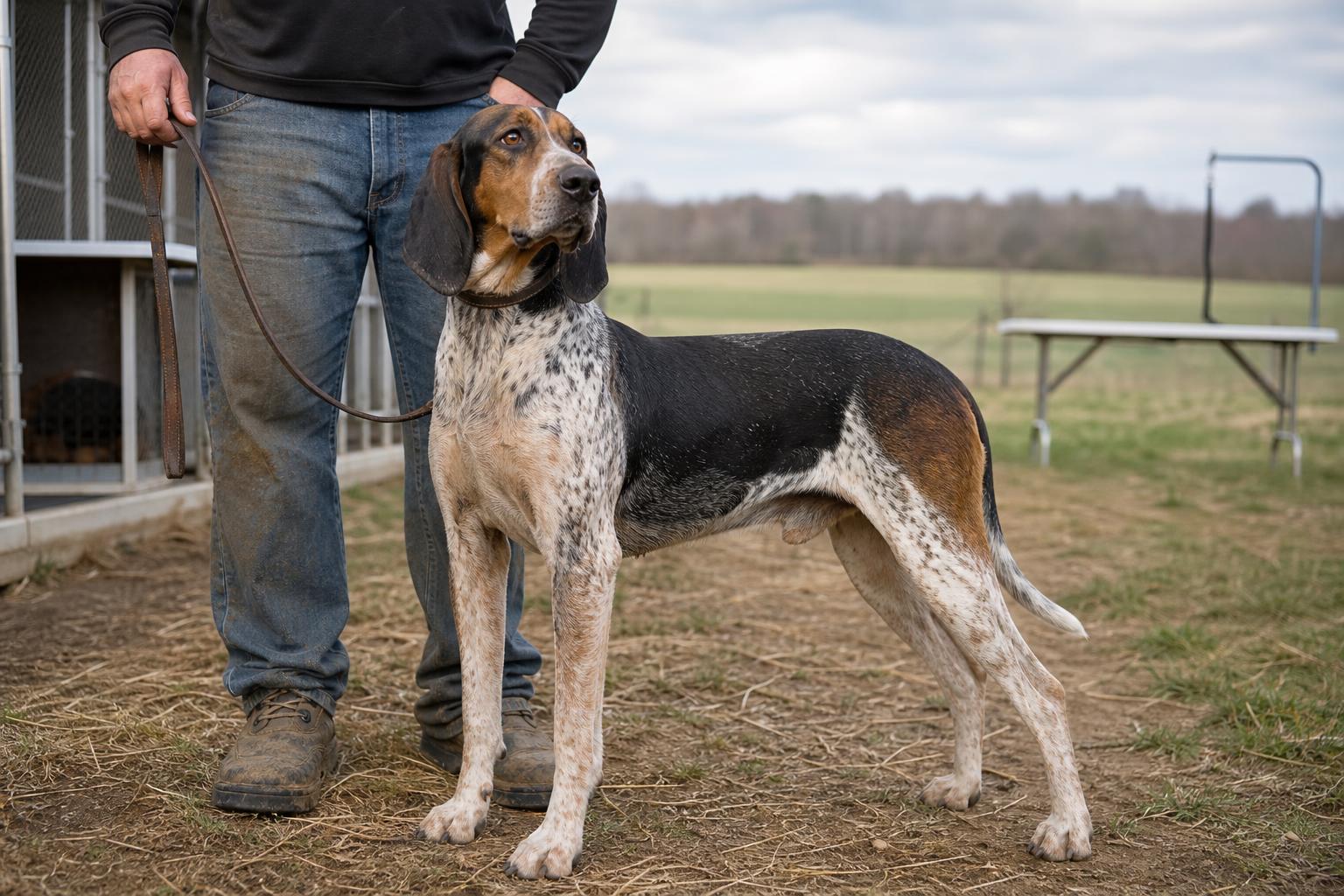
Selecting an English Coonhound stud dog should start with the reason for the litter. This is a medium-to-large, athletic scent hound developed in the United States for tracking and treeing game, especially raccoon. The breed is valued for endurance, nose, voice, determination, and the ability to work difficult country at night. A good stud choice should support those strengths while also matching the dam in temperament, structure, health background, and practical hunting style.
English Coonhounds, also recognized by the AKC as American English Coonhounds and long recorded in UKC coonhound programs, can vary by line. Some families emphasize hard-driving competition or night-hunt traits, while others are known for a steadier home temperament, versatile hunting ability, or a particular mouth and tree style. The right stud is not automatically the most advertised dog. It is the dog whose proof, pedigree, health information, and owner communication fit the breeding goal.
Use this guide as a checklist before booking a breeding. It does not replace veterinary advice, registry rules, or a written contract, but it can help buyers and breeders ask better questions and avoid vague promises.
Health clearances for English Coonhound stud dogs
Health clearances are the foundation of a responsible stud decision. The English Coonhound is generally built for hard use, with a lean, muscular frame, long ears, and a short-to-medium protective hound coat. Even rugged working dogs need documentation, not just assurances that they have hunted for years without obvious trouble. Ask what health issues the stud owner tracks in the line and what records can be shared before a breeding is planned.
Useful documentation may include veterinary exams, orthopedic screening, eye evaluations where relevant, brucellosis testing before breeding, and any breed or line-specific genetic testing that applies. Not every clearance common in retrievers, pointing dogs, or other sporting breeds will be standard in coonhound circles, so the goal is not to demand irrelevant paperwork. The goal is to understand what has been checked, what has not been checked, and why.
- Ask for copies of records rather than verbal summaries.
- Confirm the registered name and number match the dog being offered at stud.
- Discuss health history in parents, siblings, and previous offspring when available.
- Ask whether the stud has produced any recurring concerns in prior litters.
- Use your veterinarian to interpret results before committing.
OFA and orthopedic screening
OFA records can be helpful when evaluating an English Coonhound stud dog, especially for hips, elbows, eyes, or other screenings that may be submitted by the owner. However, buyers should verify what is actually available for the individual dog instead of assuming every stud has a complete public OFA profile. Some working hound breeders use different documentation habits than show or companion breeders, and some may have veterinary records that were never submitted to a public database.
If an OFA listing exists, check the registered name, registration number, date of birth, and microchip or identification details if shown. Look at the actual result and the age at evaluation. A passing result can support confidence, but it should still be considered alongside the dam, the wider pedigree, and the dog’s soundness in real work. A hound that covers ground for hours needs efficient movement, good feet, strong muscle, and a body kept lean enough for endurance.
If OFA results are not available, ask the stud owner to explain their screening approach. A responsible answer might include veterinary examinations, long-term soundness under hunting conditions, information about relatives, and a willingness to discuss limitations. A weak answer is a shrug, a sales pitch, or pressure to ignore the topic because the dog is famous or has won casts.
DNA testing and identity verification
DNA testing can mean several different things in stud-dog conversations. It may refer to parentage verification, genetic disease panels, color information, or permanent identity support for registration. For an English Coonhound breeding, ask which type of DNA testing has been done and why it matters for the planned litter. Do not assume that a DNA number proves health, and do not assume that a health panel proves hunting ability.
Parentage verification can be especially useful when semen is shipped, when a popular stud has produced many litters, or when registry paperwork requires it. Genetic screening may be valuable if a known test is relevant to the breed or family. Because testing options and registry requirements change over time, buyers should verify current AKC, UKC, or other registry requirements directly rather than relying on old advertisements.
- Ask whether the stud is DNA profiled for parentage.
- Ask whether any genetic health panel was performed and request the report.
- Confirm whether the dam also needs testing for the result to be meaningful.
- Do not treat color DNA or parentage DNA as a substitute for health evaluation.
Frozen semen for English Coonhound breeding
Frozen semen can expand access to an English Coonhound stud dog that is older, deceased, distant, or unavailable for natural breeding. It can preserve valuable working lines and make timing easier when travel is unrealistic. At the same time, frozen semen is a technical breeding option that depends on semen quality, storage records, veterinary timing, and the reproductive health of the female.
Before choosing frozen semen, ask for collection details, post-thaw motility information if available, number of breeding units, storage location, release requirements, and who pays shipping or transfer fees. Confirm that the paperwork can support the registry you plan to use. Frozen semen does not guarantee a litter, and buyers should avoid any claim that treats it as a sure thing. Success depends on the semen, the female, the timing method, and the veterinarian handling the breeding.
For coonhound breeders, frozen semen may be useful when a past stud dog had a proven record on raccoon, a distinctive bawl or chop mouth, a strong tree style, or a pedigree that is hard to find today. Still, older fame should be weighed against the dam’s needs. A historic dog may not fix modern weaknesses if the match is not thoughtful.
Live cover vs AI
Live cover and artificial insemination each have practical advantages. Live cover can be straightforward when both dogs are healthy, nearby, properly managed, and compatible. It also allows the stud owner to observe behavior and timing. However, travel, safety, disease prevention, and stress on the female must be considered. Current brucellosis testing and clear handling expectations are important before any natural breeding.
Artificial insemination, often called AI, may be preferred when distance, temperament, timing, semen transport, or veterinary oversight makes natural breeding less practical. Fresh, chilled, and frozen semen each require different planning. Ask the stud owner what options are actually available for that English Coonhound stud dog. Do not assume a dog is available for shipped semen, frozen semen, or every reproductive method just because another stud advertisement offers those services.
- Live cover may reduce shipping logistics but requires safe handling and travel planning.
- Fresh or chilled semen can help when the stud and dam are in different locations.
- Frozen semen can preserve access but requires careful veterinary timing.
- All methods should include disease testing, identity confirmation, and clear paperwork.
Stud contracts
A written stud contract protects both sides. It should explain the stud fee, what counts as a successful breeding, whether a return service is offered if no litter results, and what documentation must be completed. For English Coonhound breeders, the contract should also cover registration details, performance titles or claims used in advertising, semen shipping terms if applicable, and responsibilities for veterinary costs.
Read the contract before the female comes into season if possible. Last-minute breeding decisions are when people accept vague terms. A good contract is specific without being hostile. It should identify the stud and dam, list the agreed breeding method, state the fee and payment schedule, define live puppy terms if used, and describe who receives what paperwork after the litter is born.
Be cautious with contracts that promise exact puppy prices, guaranteed hunting ability, or health outcomes that no breeder can honestly guarantee. A stud owner can provide records, history, and reasonable expectations. They cannot promise that every pup will tree hard, have the same voice, or avoid every medical issue.
Pedigree analysis for English Coonhound stud dogs
Pedigree analysis is more than counting famous names. The English Coonhound has roots in American hunting traditions and has historically overlapped with lines that later became distinct coonhound breeds. Because of that history, buyers should understand what the pedigree represents in the registry being used and how the dogs behind it performed. Look for repeated strengths and weaknesses, not just titles.
Important questions include whether the stud comes from lines known for speed, track accuracy, tree style, independence, handle, voice, stamina, or temperament in the home. For a working litter, compare those traits with the dam. If she is very independent, a stud that consistently throws more biddability may be useful. If she has excellent nose but lacks tree power, look for documented production in that area. If the goal is an active family companion with hunting potential, temperament and an off-switch matter as much as competition results.
- Ask what the stud has produced, not only what he personally accomplished.
- Look at full siblings and previous litters when possible.
- Match strengths to the dam instead of doubling up on weaknesses.
- Verify titles, hunt records, and registry claims with the issuing organization.
- Meet or observe relatives when you can.
Working proof, hunt records, and titles
English Coonhound stud dogs may be advertised with UKC, AKC, or other hunt-related accomplishments, but buyers should verify each claim. Hunt tests, night hunts, bench show wins, trial records, and local reputation all mean different things. A competition record can show ability under a set format, but it is not the same as seeing how the dog hunts in the woods where you live.
Ask for specifics: what game the dog hunts, how he opens on track, whether he trees accurately, how independent he is, how he handles pressure from other dogs, and whether he has a reliable recall or requires careful management. Because this breed is vocal and scent-driven, a stud’s mouth, track style, and temperament are practical traits, not decoration. Buyers planning a family-compatible litter should also ask how the dog behaves after exercise, around children, with other dogs, and in routine handling.
Red flags when evaluating an English Coonhound stud dog
Walk away from pressure, secrecy, or claims that cannot be checked. A stud owner does not need to have every possible test or title, but they should be honest about what they have and what they do not have. Red flags include refusal to provide registration information, no current disease testing before breeding, inconsistent stories about the dog’s age or ownership, exaggerated health guarantees, or promises that every puppy will become a finished coon dog.
Also be cautious when the advertisement focuses only on color, volume, or popularity. Color variety is normal in English Coonhounds, including redtick, bluetick, tri-color with ticking, and combinations of white with red, black, or lemon. Color can be part of breed identity, but it should not outrank health, soundness, temperament, and performance fit.
Questions to ask before booking a breeding
- What is the stud dog’s registered name, number, age, and ownership status?
- Which registry or registries will the litter be eligible for, and what paperwork is required?
- What health clearances, OFA results, DNA tests, or veterinary records are available?
- Has the stud produced litters before, and what are those offspring like as hunters and companions?
- What breeding methods are available: live cover, fresh chilled semen, frozen semen, or AI?
- What are the stud fee, collection fees, shipping costs, return service terms, and deadlines?
- What traits does the stud owner believe this dog consistently contributes?
- What weaknesses would the stud owner avoid pairing him with?
Conclusion: choose the English Coonhound stud that fits the litter
The best English Coonhound stud dog for one female may be the wrong choice for another. Look past the loudest advertisement and evaluate the whole dog: health documentation, OFA or veterinary records where available, DNA and parentage status, semen options, contract terms, pedigree, working proof, and temperament. Verify claims through registries, veterinarians, and real conversations with people who know the dog and his offspring.
A thoughtful breeding should protect the breed’s useful hound traits: stamina, nose, voice, determination, athletic build, and a sociable nature when properly raised. When the paperwork is clear and the match makes sense, buyers and breeders are in a stronger position to produce English Coonhound puppies with the best chance of becoming sound workers and good companions.
Explore English Coonhound on Working Dog Central
View the English Coonhound breed profile or browse English Coonhound listings.


