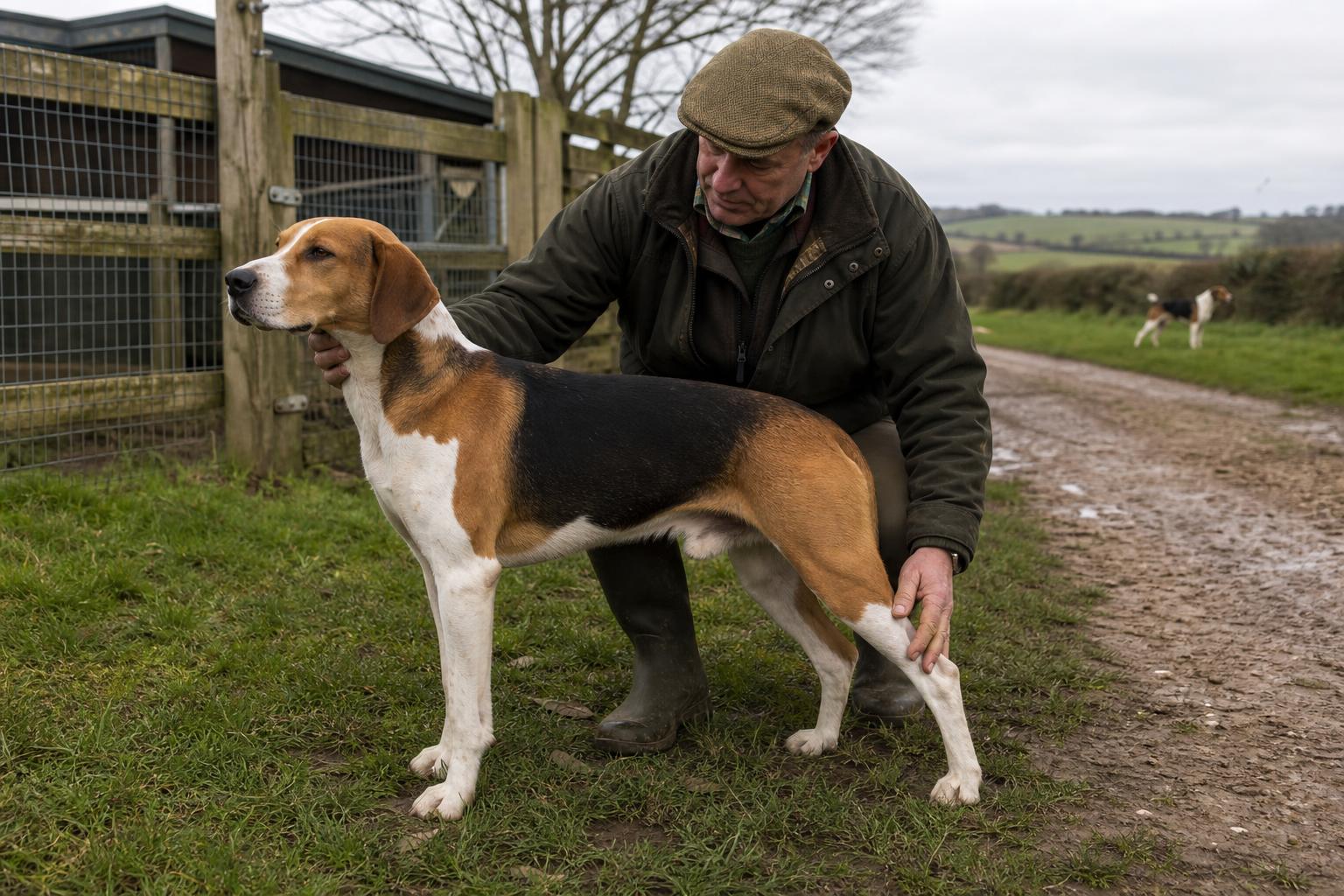
An English Foxhound finished dog should be more than an older hound with time in the field. This breed was developed as a traditional pack scenthound, valued for stamina, nose, soundness, and the ability to stay useful over long days. A finished English Foxhound should show practical manners, proven scenting ability, physical conditioning, and a temperament that fits the buyer's home, kennel, or hunting program.
Because English Foxhounds are not usually purchased the same way as common household companion breeds, buyers need to ask specific questions. Some dogs come from organized pack environments, some from private hunting homes, and some from rescue or rehoming situations after a working life changed. The right dog can be a tremendous partner for an active owner, but the wrong match can be noisy, restless, and hard to manage without space, structure, and daily exercise.
What makes a finished dog
A finished English Foxhound is a dog with enough maturity, training, and real-world experience that a knowledgeable handler can evaluate what the dog actually does, not just what it might become. For this breed, that usually means the dog has been exposed to practical scent work, pack manners, handling routines, travel, and extended exercise. The dog should be physically able to cover ground efficiently, mentally steady around people and other dogs, and understandable in its strengths and limitations.
Finished does not mean perfect. It means the dog has a known pattern. A buyer should be able to see how the hound handles, how it responds when called or gathered, how it behaves in a kennel or vehicle, and whether it remains social and biddable after excitement. In an English Foxhound, pay close attention to endurance, feet, joints, respiratory soundness, and recovery after exercise. The breed's value has always been tied to long-distance work, so conditioning and durability matter as much as polish.
- Ask what work the dog has done and how often it has done it.
- Watch the hound around unfamiliar people and dogs.
- Evaluate leash manners, loading, kennel behavior, and recall expectations honestly.
- Confirm whether the dog has lived primarily in a pack kennel, home, or both.
Hunt tests
Formal hunt test records can be useful for some sporting breeds, but buyers should verify whether a particular test program is relevant to an English Foxhound and to the dog's actual job. This breed is a scenthound with a foxhunting background, not a pointing dog or retriever. If a seller mentions hunt tests, ask for the organization, date, level, rules, and written proof of the result. Do not assume that a title from another venue proves the hound will fit your intended work.
For many English Foxhound buyers, practical demonstration may matter more than a formal hunt test. A seller should be able to explain how the dog hunts, what kind of country it has worked, whether it has been hunted alone or with a pack, and how it handles distractions. If you are buying for a specific use, arrange to see the dog in a realistic setting or ask for recent video that shows the dog before, during, and after work.
Verify working records and breed eligibility
Verify reported working titles and test results with the issuing organisation. Confirm that the programme applies to the breed and ask what the result demonstrates about the individual dog.
Verify reported working titles and test results with the issuing organisation. Confirm that the programme applies to the breed and ask what the result demonstrates about the individual dog.
Trial records
Trial records can add confidence when they are legitimate and relevant. English Foxhounds may be associated with pack hunting, hound shows, field competitions, or other working records depending on the region and organization. Ask for the exact registry or association, the dog's registered name if applicable, and copies of any official documentation. Then verify that the record belongs to the same dog being offered.
Trial results should be read carefully. A record may show that the dog competed, but it does not automatically tell you how the dog behaves in your kennel, with your dogs, or around your family. Ask what qualities the record reflects: nose, voice, endurance, pack sense, drive, correctness, or show conformation. The best sellers are clear about what the dog has accomplished and equally clear about what the dog is not suited for.
- Confirm names, dates, organizations, and ownership history.
- Ask whether the dog has worked recently or only in the past.
- Separate marketing language from verifiable records.
- Consider temperament and daily manageability alongside any awards.
Age expectations
Age is one of the main reasons buyers consider a finished English Foxhound. A mature dog gives you a clearer picture of size, temperament, voice, stamina, and social behavior. Many finished dogs will be adults with established habits. That can be an advantage if the dog has been well managed, but it can be a challenge if the dog has never learned household manners or has spent its life in a very different environment.
Ask what the dog has done at each stage of life. A young adult may offer more years of work but may still need finishing in manners and consistency. A middle-aged hound may be steadier and easier to read. An older hound can be a wonderful companion or light-use dog if expectations are fair. In every case, match the age to the job. Do not buy a dog for heavy work without discussing conditioning, veterinary history, injury history, and current fitness.
Because English Foxhounds are athletic and deep-chested, buyers should ask practical health questions without expecting a seller to make medical promises. Discuss feeding routine, exercise schedule, ear care, dental care, parasite prevention, and any known history of bloat risk, lameness, or chronic ear irritation. A pre-purchase veterinary exam is a sensible step, especially for a finished dog expected to work.
Investment value
The investment value of a finished English Foxhound is not only the purchase price. It includes the time saved by buying a dog with known ability, the cost of maintaining a working hound, and the risk reduced by seeing the dog as an adult. A finished dog may cost more than a puppy because someone has already fed, conditioned, handled, transported, and evaluated it. That value is real when the training and experience match your needs.
A fair evaluation looks at the whole dog: health, temperament, field history, documentation, age, manners, and fit. Avoid vague claims like fully trained or champion quality unless the seller can explain and prove them. Also avoid assuming that a high price guarantees a better dog. The best finished English Foxhound for you is the one whose strengths are useful, whose limits you can live with, and whose background has been presented honestly.
- Budget for secure fencing, quality feed, veterinary care, transport, and continued conditioning.
- Ask whether a trial period, references, or return agreement is available.
- Get expectations in writing, especially for working ability and known health history.
- Choose fit over flash; a steady, honest hound is often the better long-term buy.
Buyer-focused conclusion
Buying an English Foxhound finished dog can be a smart choice when you want a mature hound with visible ability and an established temperament. Take your time, verify records, watch the dog work when possible, and ask questions that fit the breed's real purpose as an endurance scenthound. A good seller will welcome practical scrutiny. A good buyer will be honest about space, exercise, handling skill, and the kind of life the hound will have after the sale.
For the right owner, a finished English Foxhound offers history, stamina, and a friendly pack-minded nature in a dog whose qualities can be evaluated before purchase. Focus on proof, soundness, and fit, and you will be far more likely to bring home a hound that earns its place for years to come.
Explore English Foxhound on Working Dog Central
View the English Foxhound breed profile or browse English Foxhound listings.


