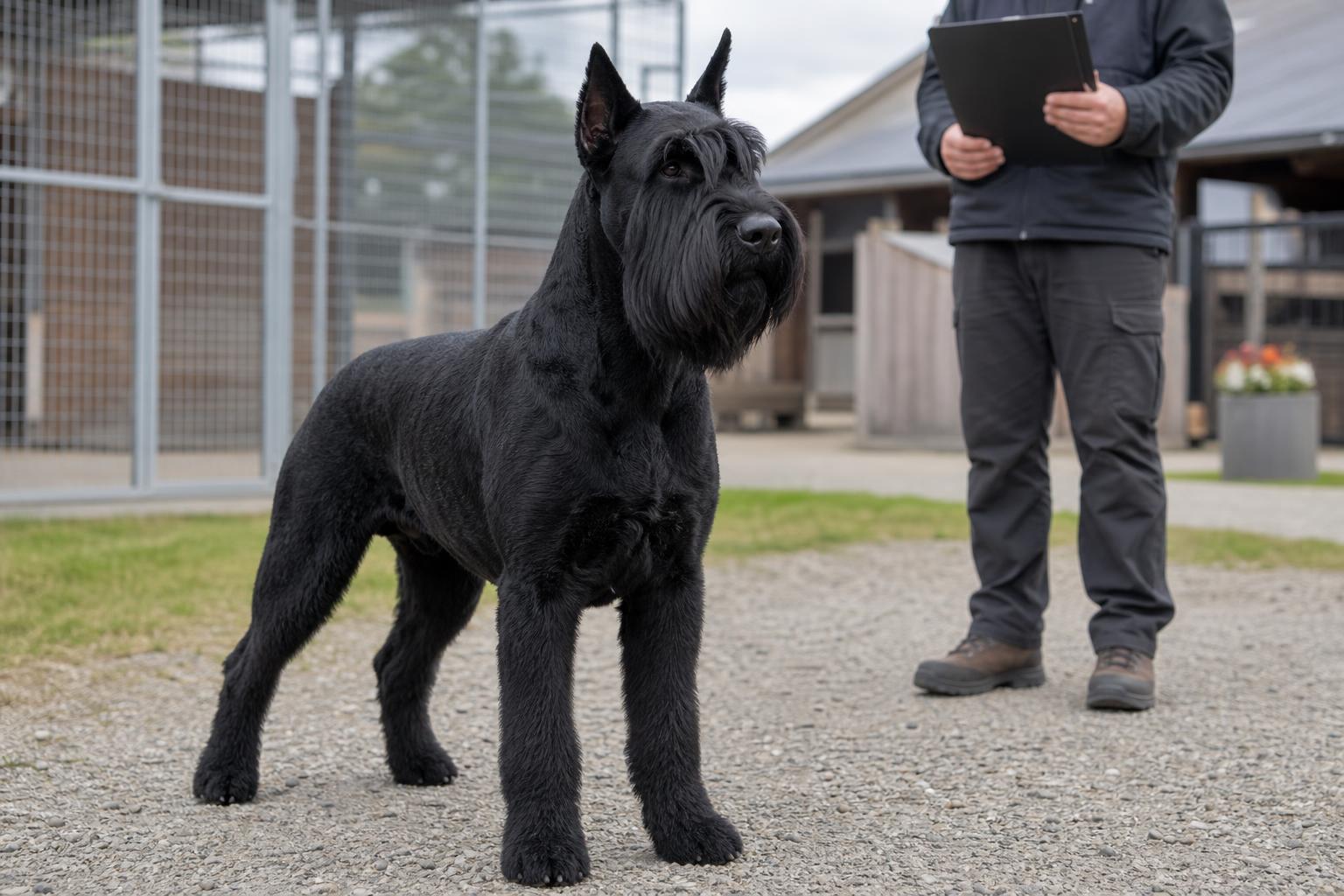
Choosing a Giant Schnauzer stud dog is not just a search for an impressive male with size, coat, and presence. It is a breeding decision that can shape temperament, structure, work ethic, health risk, and the reputation of a litter for years. The Giant Schnauzer is a powerful German working breed known for intelligence, loyalty, protective instinct, and a serious need for structure. A good stud choice should support those strengths without exaggerating sharpness, hardness, size, or drive beyond what the future homes can manage.
This guide is written for breeders and buyers evaluating Giant Schnauzer stud dogs through a practical lens. Use it to ask better questions, compare males fairly, and verify claims before you commit to a breeding. Every program is different, and requirements can vary by registry, country, club, and individual breeding goal, so treat documentation as essential rather than optional.
Health clearances for Giant Schnauzer stud dogs
Health clearances are one of the first things to review before using or recommending a Giant Schnauzer stud dog. They do not guarantee perfect puppies, but they show that the owner is making informed breeding decisions instead of relying only on appearance or popularity. For a large, athletic breed, buyers should ask about orthopedic screening, eye evaluations when relevant, cardiac history when available, thyroid or autoimmune concerns if present in the line, and any breed-club recommendations that apply at the time of breeding.
Do not accept vague phrases such as “vet checked,” “healthy,” or “never had a problem” as substitutes for actual records. A routine veterinary exam is useful, but it is not the same as documented screening. Ask to see certificates, database links, registration numbers, dates, and the dog’s registered name. If a breeder says a specific test does not apply to the Giant Schnauzer or to that registry, ask them to explain why and what they use instead to evaluate risk.
- Confirm the stud dog’s registered identity matches the paperwork.
- Review test dates and whether results are final or preliminary.
- Ask how the male’s close relatives have aged, not just how he looks today.
- Look for openness about weaknesses as well as strengths.
OFA and orthopedic verification
OFA is commonly used in the United States to record health screening results, but the exact recommended tests can vary by breed, parent club guidance, and breeder goals. For Giant Schnauzer stud dogs, the practical point is not to assume that “OFA” means everything has been checked. Ask which results are available, whether they are public, and whether hips, elbows, eyes, cardiac, thyroid, or other evaluations are relevant to the line.
Large working dogs need sound bodies. A Giant Schnauzer that looks powerful in a photo should also move cleanly, recover well after exercise, and have the structure to support a lifetime of training. Orthopedic screening is one part of that picture. It should be considered alongside gait, conditioning, injury history, weight management, and the health of parents, siblings, and previous offspring.
If the stud owner provides an OFA link, review it directly rather than relying on a screenshot. If results are from another registry or a country outside the United States, ask for the equivalent documentation and, when necessary, have a knowledgeable veterinarian or breed mentor help interpret it. Good stud owners are usually willing to explain what they have tested and what they have chosen not to test.
DNA testing and inherited risk
DNA testing can be valuable, but it is not magic. It helps identify known genetic variants, carrier status, parentage, color or coat traits, and sometimes disease risks depending on the test panel. For Giant Schnauzers, buyers should ask which laboratory was used, what conditions were included, and whether the results are specific and meaningful for the breed. Broad panels can be useful, but they can also include conditions that are rare, unvalidated, or not central to the breed’s main concerns.
The most important part is how the information is used. A carrier result is not automatically a reason to reject a stud dog if the female is tested clear for the same condition and the breeding is planned responsibly. On the other hand, ignoring DNA results because a dog is titled, attractive, or in demand is poor practice. Ask the stud owner how they match females to the male and whether they require test results from the bitch before approving a breeding.
- Request the full DNA report, not just a verbal summary.
- Verify the microchip or identifying information attached to the test.
- Ask whether parentage verification is available if it matters to the litter registration.
- Use DNA results together with health history, not instead of it.
Frozen semen for Giant Schnauzer breeding
Frozen semen may be an option with some Giant Schnauzer stud dogs, especially when the male is deceased, geographically distant, or part of a valuable older line. However, buyers should not assume it is available. Ask whether semen has been collected, where it is stored, how many breeding units are available, what the post-thaw quality is, and who is authorized to release it. Documentation should include the dog’s identity, collection records, storage facility information, and any contract terms tied to use.
Frozen semen breedings require planning. Timing is more exact than a casual natural breeding, and reproduction veterinary support is often needed. Costs may include progesterone testing, shipping, storage release fees, insemination procedures, and possible repeat attempts. None of those expenses guarantee a litter. Before buying or reserving frozen semen, discuss success history, semen quality, and whether the stud owner has produced litters from frozen semen before.
If frozen semen is advertised, be careful with claims that sound too certain. A responsible seller can explain the records and process without promising pregnancy, litter size, or specific results. Make sure ownership rights, transfer rights, registration paperwork, and refund or replacement terms are written clearly.
Live cover vs AI
Live cover and artificial insemination each have advantages and drawbacks. Live cover may be simpler when both dogs are nearby, healthy, cooperative, and appropriately managed. It still requires planning, supervision, brucellosis testing when required by the stud owner or veterinarian, and clear agreements about missed breedings or failed pregnancies. Because the Giant Schnauzer is strong and assertive, safe handling matters. Neither dog should be forced through a poorly managed breeding.
Artificial insemination can be useful when distance, timing, safety, or semen type makes live cover impractical. AI may use fresh, chilled, or frozen semen, and the best method depends on reproductive timing and veterinary guidance. Ask what method the stud owner supports, what paperwork is required, and who pays for collection, shipping, veterinary procedures, and repeat attempts if the breeding does not take.
For either method, verify whether registry rules apply. Some registries have specific forms for artificial insemination, frozen semen, transported semen, or ownership signatures. Do not wait until puppies are born to discover that the litter cannot be registered as expected.
Stud contracts
A Giant Schnauzer stud contract should protect both sides and, more importantly, protect the future litter. It should identify the stud dog and bitch by registered name, registration number, microchip if available, owner names, agreed fee, breeding method, timing, required health testing, and what counts as a completed breeding. It should also explain what happens if the female does not conceive, produces a very small litter, or cannot be bred at the planned time.
Read the contract before money changes hands. Some stud owners require approval of the female, proof of health testing, brucellosis testing, progesterone timing, or limits on where puppies can be sold. Those requirements are not automatically red flags; they often show that the stud owner cares about how the male is used. Problems arise when terms are vague, verbal, or changed after the fact.
- Confirm whether the fee is cash, pick puppy, or another arrangement.
- Define whether a return service is offered and under what conditions.
- Clarify who signs litter registration documents and when.
- Put shipping, collection, veterinary, and storage expenses in writing.
- Include expectations for truthful advertising of the stud dog and litter.
Pedigree analysis
Pedigree analysis is more than counting champions. A strong Giant Schnauzer pedigree should be evaluated for health, temperament, structure, working aptitude, longevity, and consistency. Titles can be useful evidence, but they need context. Obedience, working sport, conformation, protection, agility, herding, or other achievements may show trainability and stability, but not every title means the same thing. Ask what the dog actually did to earn the title and whether that achievement supports your breeding goal.
Because the Giant Schnauzer is a serious working breed, temperament deserves special attention. Look for relatives known for confident, clear-headed behavior rather than unnecessary sharpness or reactivity. A protective dog should still be controllable, socially stable, and able to settle. If the female is already intense, breeding to a very hard or highly defensive male may produce puppies that are too much for typical homes. If the female lacks drive or confidence, a stud with proven stability and working desire may help, but the match should still be realistic.
Ask about previous offspring from the stud dog. How large were the litters? How did the puppies mature? Were any kept for work, sport, show, or breeding? What feedback came from owners at two, four, or six years old? The best stud owners track outcomes and can discuss both the successes and the limitations of what the male tends to produce.
Final thoughts for Giant Schnauzer stud dog buyers
A good Giant Schnauzer stud dog should bring more than a strong head, dark coat, and impressive presence. Look for documented health screening, honest discussion of DNA and orthopedic information, clear reproductive options, a fair contract, and a pedigree that supports the kind of puppies you want to produce. Verify every claim that matters, especially registry requirements, OFA or equivalent results, semen availability, and prior offspring history.
The right choice is rarely the most convenient male or the flashiest advertisement. It is the stud dog whose strengths genuinely complement the female, whose owner communicates clearly, and whose records can stand up to careful review. For a powerful, intelligent breed like the Giant Schnauzer, that level of care is not overthinking. It is responsible breeding.
Explore Giant Schnauzer on Working Dog Central
View the Giant Schnauzer breed profile or browse Giant Schnauzer listings.


