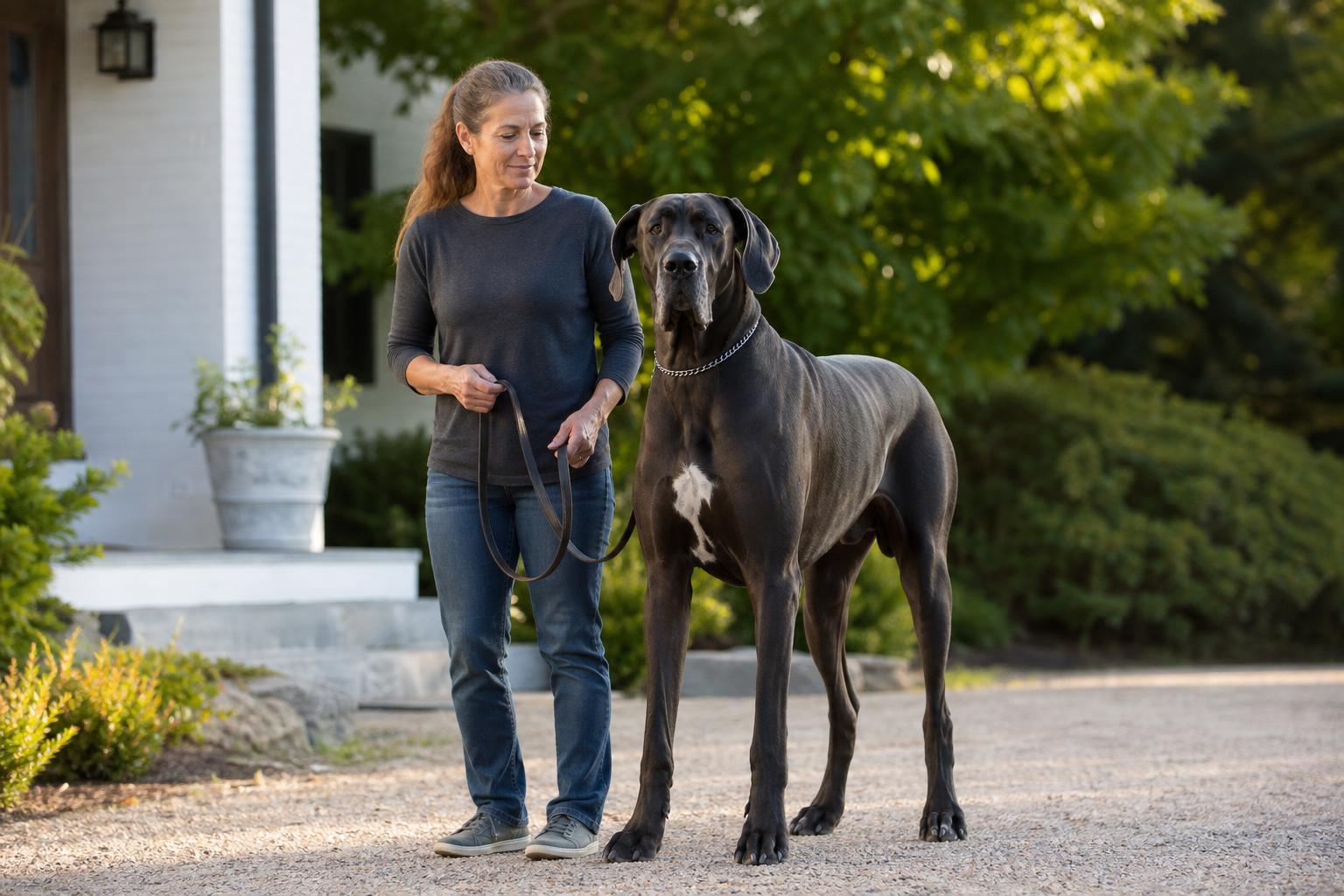
A finished Great Dane is usually purchased by someone who wants a mature, trained dog rather than the uncertainty and workload of raising a giant-breed puppy. That can be a smart path, but only if the word finished is backed by clear proof. In the Great Dane world, finished may describe a dog with reliable household manners, public composure, obedience, show experience, estate-guardian steadiness, or historical working ability. It should not be treated as a magic label that guarantees the dog will fit every home.
The Great Dane was developed from powerful European hunting and guardian dogs, with old roots in large-game work such as wild boar hunting. Modern Great Danes are far more often family companions than field dogs. Their great strengths are size, presence, loyalty, and a typically affectionate, steady temperament when well bred and properly trained. Because they are so large, finished training matters. A small dog that pulls, jumps, or panics is inconvenient; a Great Dane with those habits can be unsafe.
Use this guide to evaluate finished Great Dane dogs with practical eyes. Ask what the dog has actually been trained to do, where the training was tested, how the dog behaves with strangers and other animals, and whether the seller can document health, age, temperament, and ownership history. A finished dog should make life easier, not simply arrive with a higher price tag.
What makes a finished dog
For a Great Dane, finished should mean the dog has moved beyond basic exposure and can perform reliably in ordinary life. At minimum, a finished companion should walk politely on leash, settle indoors, accept normal handling, ride in a vehicle, respond to basic cues, and behave calmly around household routines. Many buyers also expect crate comfort, house manners, polite greetings, and the ability to be managed safely by more than one adult.
If the dog is advertised as finished for a specific purpose, define that purpose in writing. A finished show dog should have ring experience and records the buyer can verify. A finished obedience dog should demonstrate trained responses under distraction, not only in the seller's yard. A finished guardian-type companion should show confidence and discernment, not reactivity or uncontrolled suspicion. For a breed as large as the Great Dane, emotional steadiness is part of the finish.
- Ask for a live demonstration in a real setting, not just a polished video.
- Watch leash manners, greeting behavior, recovery from distractions, and response to handling.
- Confirm who trained the dog and what cues, equipment, and routines the dog understands.
- Ask whether the dog has lived in a home, kennel, show environment, or mixed setting.
- Get all claims, included records, trial periods, and return terms in writing.
Great Dane hunt tests
Hunt tests are an important benchmark for many sporting breeds, but buyers should be careful about applying that standard to Great Danes. The breed has historical hunting roots, especially in large-game work, yet it is not commonly evaluated today through the same hunt-test systems used for retrievers, pointing dogs, or versatile gun dogs. If a seller uses hunting language, ask exactly what venue, organization, or practical work supports the claim.
Verify reported working titles and test results with the issuing organisation. Confirm that the programme applies to the breed and ask what the result demonstrates about the individual dog.
Verify working records and breed eligibility
Verify reported working titles and test results with the issuing organisation. Confirm that the programme applies to the breed and ask what the result demonstrates about the individual dog.
For most finished Great Dane buyers, more useful evidence will be practical obedience, temperament testing, veterinary history, stable household behavior, and any legitimate show, therapy, working, or companion titles the dog has earned. The goal is not to dismiss records; it is to match the records to the breed and the job you expect the dog to perform. A great score in an unrelated venue tells you less than a calm, sound, well-mannered Great Dane demonstrating the skills you need.
Trial records
Trial records can add value when they are real, relevant, and current. With Great Danes, trial records may be more likely to involve conformation, obedience, rally, temperament, or other companion and working-dog venues than field trials. Ask for the dog's registered name, registration number where applicable, title certificates, show or trial results, and the organization that issued them. Then verify those records through the registry, club, or event database when possible.
Be wary of vague phrases such as champion bloodlines, proven worker, professionally finished, or fully trained without documentation. Pedigree can matter, but it does not replace the individual dog's behavior. A finished Great Dane should be evaluated as the dog in front of you: soundness, temperament, training reliability, recovery from stress, and suitability for your home. If the dog has formal titles, they should support that evaluation rather than distract from it.
Age expectations
Age matters more with Great Danes than many buyers realize. This is a giant breed with a relatively short average lifespan compared with smaller dogs, and maturity comes gradually. A two-year-old Great Dane may be physically large but still developing mentally. A three- to five-year-old dog is often easier to evaluate for adult temperament, structure, and long-term manners. Older dogs can be wonderful purchases, but buyers should weigh remaining working years, comfort, veterinary needs, and lifestyle fit.
Ask for a complete age history, including date of birth, prior homes, training timeline, and veterinary records. Because Great Danes are deep-chested and large-framed, discuss concerns such as joint comfort, heart screening where available, body condition, mobility, and bloat awareness with your veterinarian. Do not expect a seller to promise future health. Instead, look for transparency: records, exams, honest disclosure, and willingness to let you perform due diligence before purchase.
Investment value
A finished Great Dane may cost more than a puppy because the seller has invested time, food, veterinary care, socialization, and training. That added value can be real. A mature dog with proven manners may save months of work and reduce the risk of adolescent giant-breed behavior problems. However, price should reflect evidence, not adjectives. Training quality, temperament, health records, age, titles, and seller support all affect fair value.
Typical pricing can vary widely by region, pedigree, training level, records, and the dog's suitability. Avoid anyone who promises exact future performance, guaranteed breeding value, or medical certainty. A fair seller should be able to explain how the price was set and what is included: registration paperwork if applicable, health records, training notes, transfer terms, equipment, a transition plan, and return policy. If breeding rights are part of the discussion, that should be handled separately and carefully, with health clearances and contract terms reviewed before money changes hands.
Evaluating a finished Great Dane before purchase
Plan to meet the dog in more than one context if possible. Watch the Great Dane move on safe footing, greet people, pass other dogs at a reasonable distance, load into a vehicle, settle quietly, and accept gentle handling of feet, ears, collar, and mouth. If children, small dogs, livestock, or frequent visitors are part of your life, ask how the dog has been exposed to them. Do not create risky tests, but do ask for honest history.
Because size amplifies every management issue, pay attention to small signs. Does the dog lean, shove, mouth, jump, or drag the handler? Does it recover from a surprise, or does it escalate? Is the seller using heavy restraint to hide weak training? A well-finished Great Dane should not have to be perfect, but it should be understandable. You should leave the evaluation knowing what the dog does well, what still needs management, and whether your household can provide the right structure.
Questions to ask the seller
- What exactly does finished mean for this Great Dane?
- What cues does the dog know, and what words or hand signals are used?
- Has the dog lived indoors, in a kennel, or both?
- What health records, screenings, or veterinary notes are available?
- Are any hunt tests, NAVHDA scores, trial records, or titles relevant and verifiable?
- How does the dog behave with strangers, dogs, children, travel, grooming, and the veterinarian?
- What transition support, trial period, or return policy is offered?
Buyer-focused conclusion
A finished Great Dane can be an excellent choice for the right buyer: mature, trained, affectionate, and easier to assess than a young puppy. The key is to define finished in practical terms and verify every important claim. Look for a dog whose size is matched by manners, whose records are relevant, and whose seller is transparent about health, training, age, and temperament. When the fit is right, a finished Great Dane can bring the best of the breed into your home with less guesswork and a clearer path forward.
Explore Great Dane on Working Dog Central
View the Great Dane breed profile or browse Great Dane listings.


