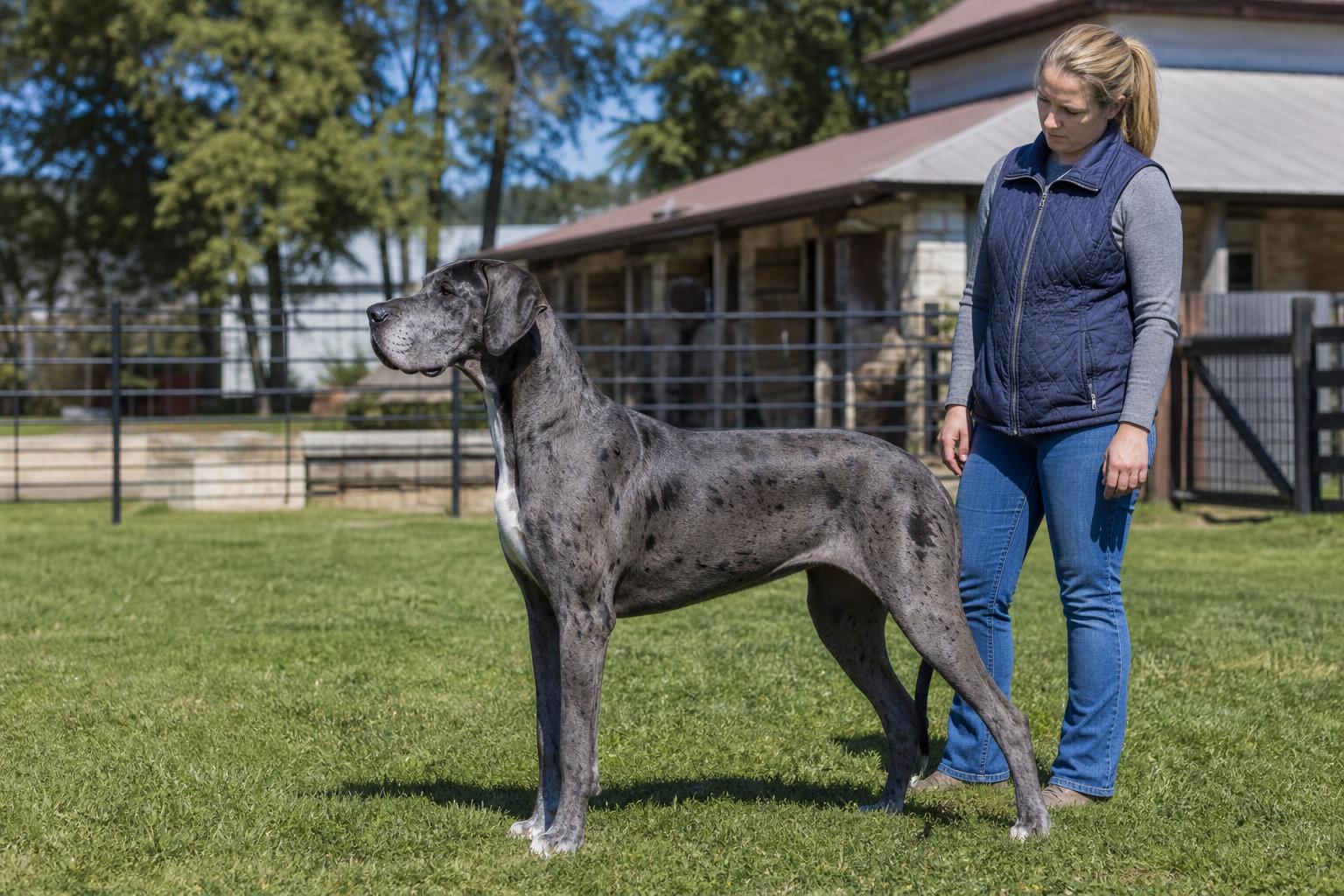
A proven Great Dane female should be evaluated as a complete dog, not simply as a mother of attractive puppies. The breed is a giant, deep-chested companion and former large-game hunting dog known for height, dignity, a smooth short coat, and a generally affectionate gentle-giant temperament. Those qualities make the Great Dane impressive, but they also raise the stakes for every breeding decision. Size, stability, soundness, and honest records matter because each puppy may grow into a powerful dog that needs good structure and a dependable mind.
When a female is advertised as proven, the word should mean that there is real information to review: prior litters, reproductive history, maternal behavior, health screening, temperament, pedigree strength, and the condition of the puppies she has produced. It should not be treated as a shortcut around due diligence. A buyer still needs to ask for documentation, compare claims against records, and decide whether the female fits the goals of a responsible Great Dane program.
Start with the production record
The production record is the first place to separate marketing from useful evidence. Ask how many litters the female has had, when they were born, how large they were, whether deliveries were natural or assisted, and how the puppies developed. Great Danes mature into very large dogs, so early puppy cuteness is not enough. The stronger question is what the offspring looked and acted like as they grew: structure, movement, temperament, health, size balance, and owner satisfaction.
- How many litters has she produced, and at what ages?
- Were there any whelping complications, emergency veterinary visits, or losses?
- Are there adult photos, owner references, or follow-up notes on previous puppies?
- Did the female produce consistent temperament and sound, functional movement?
- Were any health issues reported in puppies, siblings, parents, or related dogs?
A good seller should be comfortable discussing both strengths and limits. No female produces perfect puppies every time. What matters is whether the breeder tracked outcomes honestly and used that information to make better pairings. Be cautious if the only proof offered is a few flattering puppy photos or broad claims such as “throws huge pups” without health, temperament, or maturity information.
Review previous litters carefully
Previous litters can reveal patterns that are hard to see from the female alone. Great Danes should be tall and powerful, but they should also be balanced, elegant, and able to move efficiently. If prior puppies were consistently too coarse, weak in topline, nervous, hard to manage, or affected by recurring health concerns, that history matters even if the dam herself is sweet and attractive.
Ask whether the same sire was used more than once and why. A female may produce well with one male and less successfully with another, so evaluate each litter in context. If possible, speak with owners of older offspring. Their day-to-day experience can tell you a lot about temperament, trainability, manners in the home, joint comfort, growth, and how manageable the dogs became once they reached adult size.
Maternal ability and puppy care
Maternal ability is especially important in a giant breed. A Great Dane mother needs to be steady, attentive, and safely managed around newborn puppies. Ask whether she settled well with her litters, nursed reliably, tolerated handling, and accepted normal breeder support. Also ask what kind of whelping setup was used, because management is part of the story. Large females can accidentally injure puppies if the environment is poorly designed or if supervision is weak.
Maternal behavior should be described in specific terms. “Good mom” is less useful than details about milk production, cleanliness, calmness during weighing and bedding changes, willingness to let the breeder assist, and whether supplemental feeding was needed. A female that required help is not automatically a poor choice, but the reason should be clear and the buyer should understand what may repeat in a future litter.
Health clearances and veterinary history
Great Dane breed information emphasizes practical health concerns such as hip dysplasia, heart problems, bloat or GDV risk, and the importance of regular veterinary care. A proven female should come with a clear veterinary history, not vague assurances. Ask what orthopedic, cardiac, eye, thyroid, or other screening has been completed when relevant, and verify records where possible. If testing was not done, treat that as missing information rather than proof that the dog is healthy.
- Request copies of health clearances and match them to the dog’s registered identity or microchip.
- Ask about heart evaluations, joint history, prior injuries, medications, and reproductive veterinary records.
- Discuss body condition, recovery after litters, and whether she has remained lean and mobile.
- Ask whether GDV or bloat has occurred in the female, her close relatives, or previous offspring.
- Have your own veterinarian review records before purchase or before planning another breeding.
Health records do not guarantee future outcomes, but they reduce guesswork. They also show how seriously the seller approaches the breed. In a giant, deep-chested dog with a relatively shorter typical lifespan than many smaller breeds, transparency about health and longevity is not optional; it is central to responsible ownership and breeding.
Age, breeding history, and fertility considerations
Age and breeding history should be reviewed together. A proven female may be valuable because she has already demonstrated fertility and maternal ability, but repeated litters, difficult recoveries, or breeding too close together can raise welfare concerns. Ask for the dates of each heat, breeding, whelping, and recovery period. The goal is to understand whether she was managed carefully and whether another breeding would be fair to the dog.
Fertility information can include natural breeding success, artificial insemination history, progesterone timing, conception rates, litter size, resorption, false pregnancy, c-sections, or missed breedings. None of these details should be considered embarrassing; they are practical facts. A buyer considering a proven female should know whether future breeding is realistic, whether reproductive veterinary support may be needed, and whether retirement as a companion is the better path.
Pedigree strength and compatibility
A pedigree should be used as a planning tool, not a trophy list. In Great Danes, look for depth of information: health, longevity, temperament, structure, color family, and consistency across generations. Famous names or impressive size claims do not automatically make a female valuable. A strong pedigree is one that helps you understand what the female is likely to pass on and what kind of stud might complement her.
If you are buying the female for a program, compare her pedigree to the dogs you may use in the future. Avoid doubling up on known weaknesses. Consider whether she tends to produce steady, people-friendly puppies with the kind of manners and stability families need. Since Great Danes are usually close indoor companions rather than high-drive kennel dogs, temperament and livability deserve as much attention as outline and size.
Temperament and working proof
The modern Great Dane is commonly valued as a calm, loyal family companion, but the breed’s history includes large-game hunting and estate-guardian work. Practical proof today may look like stable behavior in public, polite handling, calm recovery from stress, good manners around visitors, and sound responses to training. For a proven female, temperament should be judged both directly and through what she has produced.
Meet the female if possible. Watch how she greets people, how she moves on leash, how she responds to the seller, and whether she seems comfortable with normal household activity. A shy, defensive, or chaotic dog should not be excused just because she has had puppies. Because adult Great Danes are so large, minor instability can become a major management problem for future puppy buyers.
Fair evaluation before purchase
A fair evaluation protects the buyer, the seller, the female, and any future puppies. Put agreements in writing. Clarify whether the female is being sold as a breeding prospect, co-owned dog, retired companion, or conditional placement. If breeding rights are included, the contract should address registration expectations, health records, pregnancy status if applicable, return terms, and what happens if a veterinarian finds a serious concern.
Do not rush because a female is labeled proven. The best purchase is the one where the facts still make sense after records are reviewed. Compare her production record, maternal ability, health history, age, fertility, pedigree, and temperament against your actual goals. A well-chosen Great Dane proven female can contribute valuable predictability to a thoughtful program. A poorly evaluated one can pass along expensive problems, welfare concerns, and difficult traits to very large puppies.
Buyer-focused conclusion
The right Great Dane proven female is not simply the one with the biggest frame, the most dramatic photos, or the most puppies behind her. She is the female whose records, condition, temperament, previous litters, maternal behavior, and pedigree can be reviewed clearly and honestly. Ask specific questions, verify health information, talk with your veterinarian, and be willing to walk away if the story is incomplete. Careful evaluation is the practical path to protecting the dam, the puppies, and the families who may live with these gentle giants for years.
Explore Great Dane on Working Dog Central
View the Great Dane breed profile or browse Great Dane listings.


