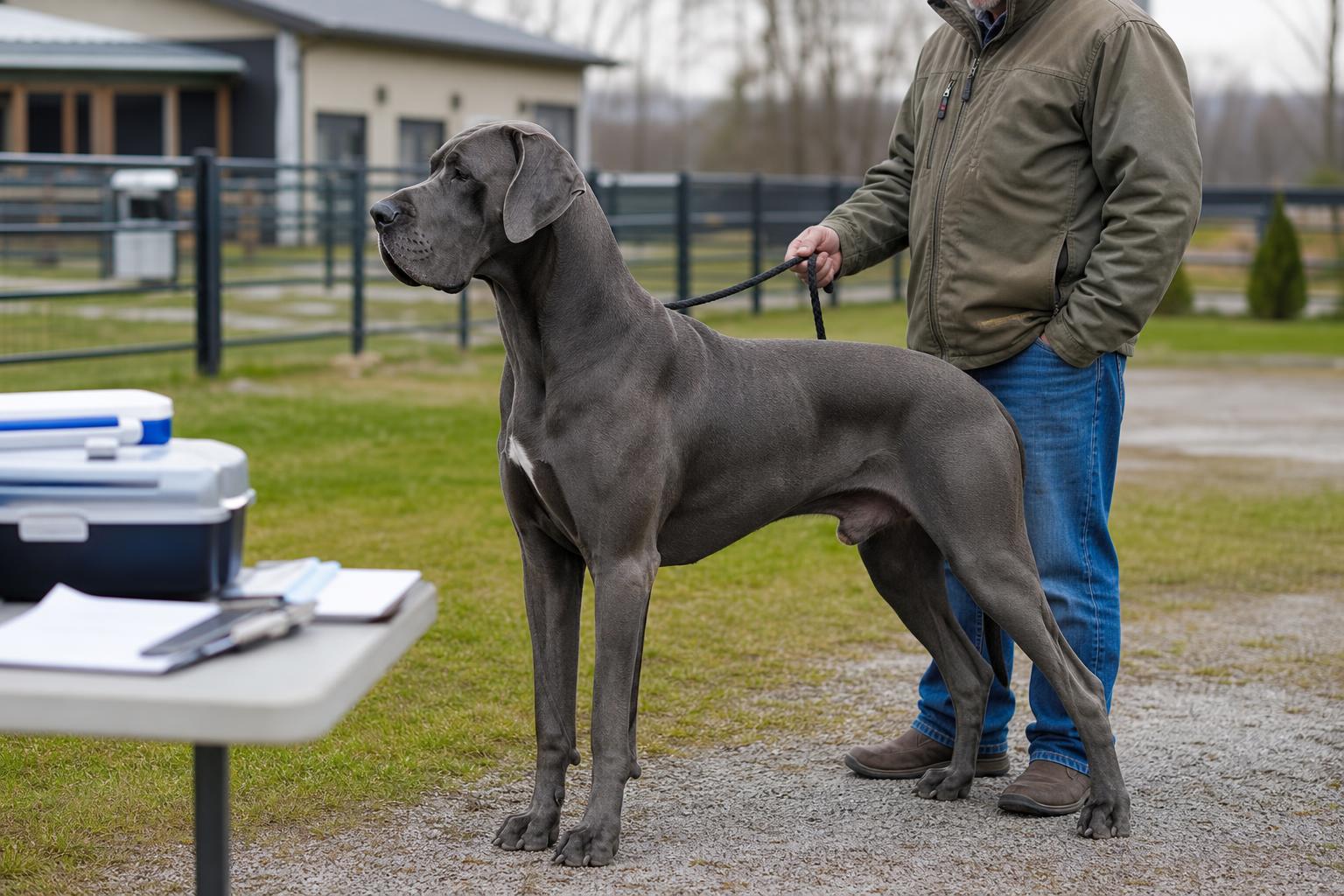
Great Dane stud dogs should be evaluated with the same seriousness you would bring to any giant-breed breeding decision: structure, temperament, health history, longevity, pedigree compatibility, and the practical realities of producing very large puppies. The Great Dane is known for its imposing height, smooth outline, dignified presence, and affectionate "gentle giant" temperament. Historically developed in Germany from large hunting and estate-guardian dogs, the breed has moved from boar-hunting work into companion life, but size and soundness still matter deeply.
For a breeder, selecting a stud is not simply choosing the biggest male or the flashiest photograph. A good match should support the dam's strengths, reduce the chance of doubling up on weaknesses, and fit the goals of the litter. In Great Danes, that usually means paying close attention to temperament stability, moderate and functional movement, joint health, heart history, depth of pedigree information, and whether the dog's owner communicates clearly. Buyers should also remember that advertising language is not proof. Ask for records, verify them when possible, and involve a veterinarian or experienced breed mentor before committing.
Health clearances for Great Dane stud dogs
Health clearances are the backbone of responsible stud dog evaluation. Great Danes are giant, deep-chested dogs, and the breed information available here emphasizes concerns such as hip dysplasia, heart problems, bloat or GDV risk, and the importance of regular veterinary care. A stud owner should be willing to discuss what screening has been completed, what the results mean, and where the documentation can be independently checked.
Useful questions include:
- Has the dog had orthopedic screening appropriate for a giant breed?
- Has cardiac screening been performed by a qualified veterinarian or specialist?
- Are results public, current where relevant, and tied to the dog's registered identity?
- Is there information on parents, siblings, previous offspring, and longevity in the family?
- Does the stud owner explain both strengths and limitations honestly?
No clearance guarantees perfect puppies, and buyers should avoid anyone who presents testing as a total health guarantee. Testing is a risk-management tool. It helps breeders make more informed pairings, especially in a breed where poor structure, unstable temperament, or inherited health concerns can have serious consequences because the dogs become so large.
OFA and other verifiable records
OFA records can be helpful when they apply to a particular Great Dane stud dog, especially for hips, elbows, cardiac evaluations, thyroid, eyes, or other breed-relevant screening. Do not assume every advertised Great Dane stud has complete OFA information. Ask for the dog's registered name or registration number, then verify any available public results directly through the appropriate database. If the stud owner uses a different registry, testing organization, or veterinary specialist, ask for copies of the reports and confirm that the identification on the report matches the dog being offered.
For Great Danes, OFA should be viewed as one part of the full picture rather than a single pass-fail label. A dog can have attractive scores and still be a poor match for a particular female if temperament, type, size balance, pedigree overlap, or family health history are not suitable. Likewise, a breeder should be cautious about using a very young dog before enough health and maturity information is available. Giant breeds change with age, and maturity can reveal structural strengths and weaknesses that were not obvious earlier.
DNA testing and genetic verification
DNA testing can support responsible breeding, but buyers should verify which tests are actually relevant to Great Danes and to the specific lines being considered. A generic "DNA clear" claim is not enough. It may mean parentage testing, a genetic diversity panel, a color-related test, or screening for one or more inherited conditions. Ask the stud owner to identify each test by name, laboratory, date, and result.
DNA testing is most useful when it is paired with phenotype, veterinary screening, and pedigree knowledge. A Great Dane stud dog still needs sound movement, stable temperament, appropriate size and substance, and a family history that does not raise avoidable red flags. Color genetics may also matter in this breed because Great Danes appear in several coat colors and patterns. Breeders should understand the color-family rules and health considerations in their registry or breed community rather than breeding only for rare or eye-catching color.
Frozen semen for Great Dane stud dogs
Frozen semen may be available from some Great Dane stud dogs, but buyers should not assume it exists for every male. When frozen semen is offered, ask for collection dates, storage location, post-thaw quality information, ownership documentation, shipping requirements, and the reproductive veterinarian's contact details. Frozen semen can make it possible to use a deceased, distant, or unavailable stud, but it also adds cost, timing pressure, and the need for careful progesterone testing and veterinary coordination.
Before committing, clarify who owns the semen, how many breeding units are being sold or reserved, whether a live-puppy guarantee applies, and what happens if the insemination fails. With a giant breed such as the Great Dane, also weigh the age and era of the stud. Older frozen semen can be valuable, but the pedigree should still be evaluated for health, temperament, type, and compatibility with the female being bred.
Live cover vs AI
Live cover and artificial insemination each have practical and welfare considerations. Live cover may be simple when both dogs are local, compatible, healthy, and safely managed, but Great Danes are large dogs. Size, footing, experience, and temperament matter. No breeding should be attempted in a chaotic or unsafe setting, and both owners should be prepared to stop if either dog is stressed or at risk.
Artificial insemination may be preferred when distance, timing, safety, or semen type makes live cover impractical. Fresh, chilled, and frozen semen all have different handling requirements. A reproductive veterinarian can advise on timing, collection, insemination method, and realistic expectations. Buyers should verify that AI is legal, ethical, and registry-acceptable for the intended registration path before assuming puppies will be eligible for papers.
Stud contracts
A written stud contract protects both sides and is especially important when breeding a valuable giant-breed litter. The contract should identify the stud and dam, fee or puppy-back arrangement, timing, method of breeding, required health testing, registration expectations, semen terms if applicable, and what counts as a successful breeding. It should also explain whether there is a return service, live-puppy condition, or no-refund policy.
Look for plain language rather than vague promises. The contract should address who pays for collection, shipping, progesterone testing, veterinary services, travel, boarding, and emergency care. It should also state whether the stud owner has the right to approve the female, review health clearances, or decline a breeding. Responsible Great Dane stud owners often care deeply about where their dog's genetics go, and that selectiveness is usually a positive sign.
Pedigree analysis for a Great Dane breeding
Pedigree analysis means looking beyond famous names. In a Great Dane breeding, study several generations for health information, longevity, temperament, size, structure, color family, and consistency. Ask whether the stud has produced previous litters, what those puppies are like as adults, and whether any patterns have emerged. One impressive show photo or one popular ancestor does not make a pedigree safe or suitable.
Compare the stud's strengths to the dam's needs. If the female is large but lacks firmness of topline, you may prioritize a male known for balance and movement rather than one advertised only for size. If the female's family has health concerns, do not double down on similar risks. If both sides have limited information, proceed cautiously. Great Dane puppies grow quickly into powerful adults, so responsible planning matters for the future owners as much as for the breeder.
Buyer-focused conclusion
The best Great Dane stud dog is not simply the tallest, rarest-colored, or most heavily advertised male. He is the dog whose health records, temperament, structure, pedigree, and owner transparency make sense for the female and for the goals of the litter. Verify OFA or other health records when available, ask specific questions about DNA testing and semen options, use a clear contract, and involve qualified veterinary guidance for breeding logistics. A careful choice helps protect the dam, the puppies, and the families who will live with these gentle giants for years.
Explore Great Dane on Working Dog Central
View the Great Dane breed profile or browse Great Dane listings.


