Guard Dogs in Ancient Civilizations
How Early Empires Shaped the Working Dogs We Know Today
Jeff Davis | https://workingdogcentral.com
 0
0 0
0 0
0 0
0 0
0
The best working dogs were never accidents. Hard dogs, stock dogs, and protection-bred animals carry the marks of generations of deliberate selection for the jobs people needed done. Long before breed registries, trial titles, or imported bloodlines, people were shaping dogs for purpose. Among the oldest of those purposes was standing guard. The story of guard dogs in ancient civilizations reaches well beyond palace gates and walled settlements—it helps explain the working dogs we depend on today.
Across the old world, from river valleys and fortified towns to desert trade routes and mountain farms, people needed animals that could sense danger before a man heard it and hold ground when trouble came close. A true guard dog had to do more than bark. He had to read the air, know his people, distrust the stranger, and carry enough nerve to stay put when fear rolled in. Ancient handlers may not have used modern training language, but they understood those traits as well as any seasoned dog man does now.
Why Ancient People Needed Guard Dogs
Life in ancient civilizations was close to the edge. Livestock could be stolen in a night. Storehouses full of grain drew thieves and vermin. Camps on the move faced raiders, predators, and rival tribes. In that kind of world, a reliable guard dog was not a luxury. He was insurance with teeth.
Most people today think of guard dogs only in terms of estate protection or personal security, but in the ancient world the role was broader. Dogs guarded sheep, goats, cattle, homes, military camps, merchants, and sacred sites. In many places they worked as a first warning system, sounding off long before a sentry picked up movement in the dark. In rough country, that extra minute mattered. I have seen enough dogs strike alert before daylight to know how much value lives in a good nose and a settled mind. Ancient people knew it too.
Guard Dogs in Mesopotamia
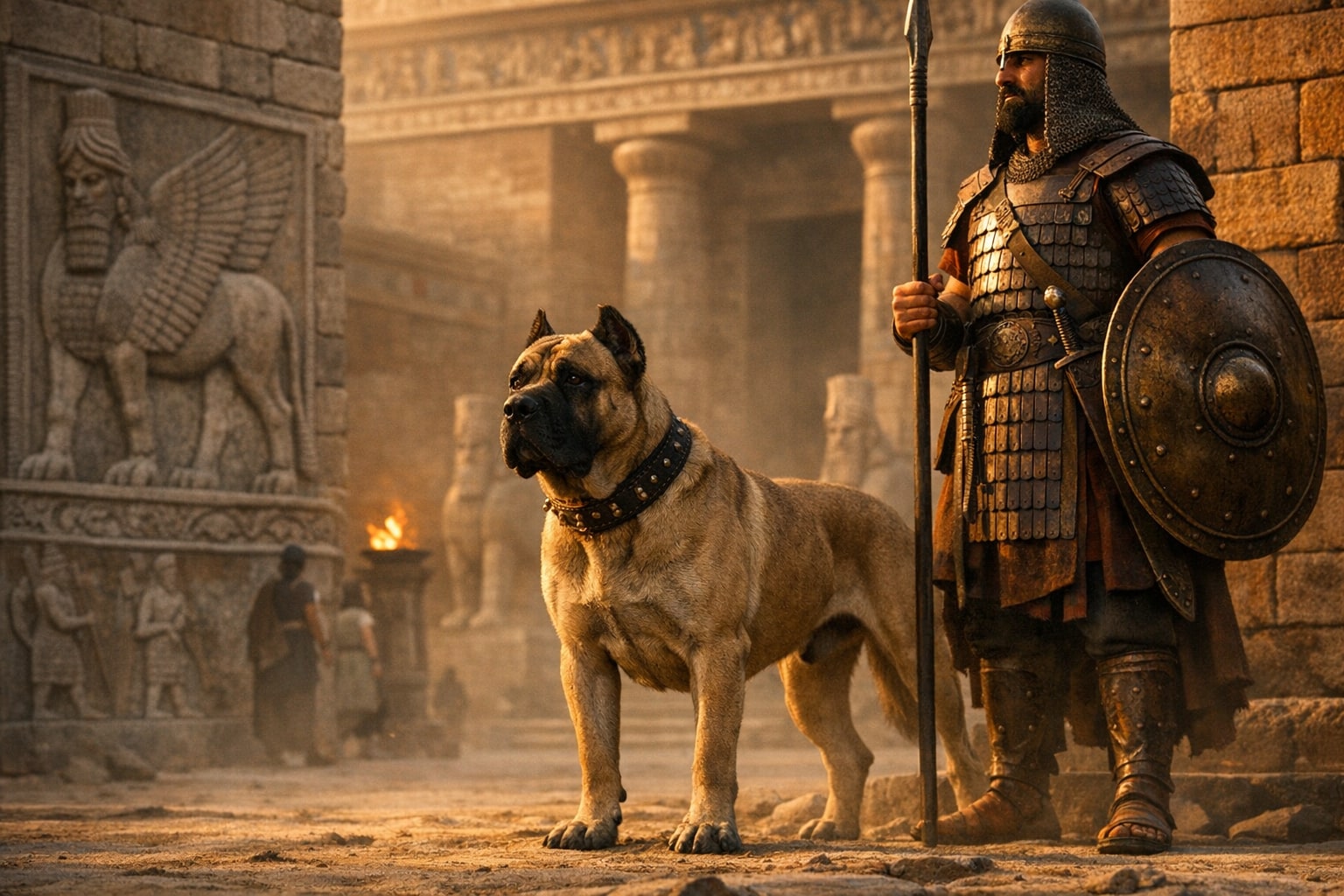
Some of the earliest strong evidence of large protection dogs comes out of Mesopotamia, the land between the Tigris and Euphrates. This cradle of civilization produced crowded cities, managed agriculture, and organized warfare, all of which created a need for dependable guardians. Art and inscriptions from the region show large, powerful dogs associated with both hunting and protection.
The Assyrians in particular are often linked with mastiff-type dogs, heavy-built animals used around property and in military settings. These were not lap dogs dressed up in grand language. They were serious animals, broad in frame, heavy in head, and bred to confront threats. When you study old carvings of Assyrian dogs, you can see the same practical preference that still guides working breeders now: substance, confidence, and a body built to push into pressure rather than retreat from it.
Mesopotamian people also tied dogs to protection in a spiritual sense. Dogs appeared in healing and protective symbolism, which tells us they were seen as more than tools. That happens in every age where men truly depend on dogs. Once an animal proves himself at the gate, beside the herd, or outside the sleeping place of children, he stops being just livestock and becomes part of the order of the household.
Ancient Egypt and the Watchful Dog
Egypt is often remembered for sleek hounds and elegant depictions of dogs in tomb art, but protection and watchfulness were part of the picture there too. Settlements along the Nile had wealth concentrated in grain, animals, and storehouses, and anything valuable invites trouble. Dogs in ancient Egypt served in hunting roles, yes, but they also watched homes and compounds.
Egyptian art shows a range of canine types, and while many were built for speed, others appear more robust and useful in practical guarding work. A dog did not need to resemble a modern protection breed to serve as an effective guardian. Alertness, loyalty, and territorial instinct go a long way, especially when paired with close living conditions where a dog knows every familiar scent and sound.
There is also a strong emotional thread in how Egyptians regarded their dogs. Some were named, honored, and buried with care. That kind of treatment usually belongs to animals that earned trust through real daily service. A dog that warns the household night after night, that holds his place at the doorway, and that goes into the field by day and returns to the courtyard by dark becomes unforgettable. Civilizations may change their clothing and language, but that bond remains familiar.
Greek Guard Dogs and the Value of Vigilance
The ancient Greeks wrote plainly about dogs, and in their world a good dog had practical value. Greek farms, estates, and flocks all benefited from canine protection. Large Molossian dogs from Epirus became especially famous. These dogs are often discussed as the ancestors of many mastiff-type breeds, and whether every modern claim holds up or not, their reputation in the ancient world was formidable.
Greek writers praised dogs that could defend livestock from wolves and discourage intruders from pressing too close. That takes a balanced animal. A wild, noisy dog is a nuisance. A soft dog is no guard at all. The useful one has judgment. He watches, warns, and commits only when the line is crossed. Men who lived off flocks and small holdings had no patience for unstable animals, and that practical pressure shaped dog populations just as surely as any modern breeding program.
There is a lesson there for today’s owners. Ancient handlers favored dogs with function over fashion. They needed animals that could work long hours, survive local conditions, and remain trustworthy around their own people. That same standard still separates a true working dog from a showpiece with good advertising.
Rome and the Organized Use of Guard Dogs
If any ancient civilization understood how to use dogs systematically, it was Rome. The Romans employed dogs in homes, on rural properties, with livestock, and alongside military operations. The famous warning “Cave Canem,” or “Beware of the Dog,” preserved in mosaics, says a good deal in just a few words. A guard dog was expected, respected, and openly advertised.
Roman estates often relied on dogs to patrol boundaries and protect animals. In towns, dogs watched courtyards and entrances. In military environments, they could serve as alarms and deterrents. Rome valued organization, and dogs fit neatly into that structure because they extended human awareness. A sleeping man misses things. A settled guard dog rarely does.
The Roman approach also points to an old truth familiar to anyone who has worked kennels or run dogs on a property: environment shapes performance. A dog that lives among the people, learns the rhythms of the place, and understands what belongs there becomes far more effective than one treated like a decorative extra. Ancient Romans knew dogs were part of security, not separate from it.
Guard Dogs in Ancient Asia and Beyond
Though much of the popular conversation centers on the Mediterranean world, guard dogs had deep roots across ancient Asia as well. In regions tied to early trade, pastoral life, and fortified settlements, large protective dogs were prized for guarding flocks, camps, and caravans. Ancestors of livestock guardian types likely developed through necessity in mountain country and open grazing lands where predators and raiders were constant threats.
That kind of work produces a certain dog: independent but loyal, calm until stirred, and willing to face danger without waiting for close instruction. Anyone who has spent time around serious guardian stock knows those dogs think for themselves. They have to. The old pastoral peoples who relied on them were selecting for nerve, endurance, and judgment long before anyone put those ideas into neat breeding theories.
What Ancient Guard Dogs Were Really Bred For
Strip away the romantic language, and ancient guard dogs were bred for usefulness. They needed strong senses, territorial instinct, courage, physical durability, and enough intelligence to distinguish family from threat. In some places speed mattered. In others, mass and staying power mattered more. The exact type changed with terrain and purpose, but the principle stayed constant: dogs were shaped by the work in front of them.
That is why the old guard dog story still matters to modern working dog enthusiasts. The foundations of temperament, structure, and instinct were laid by people who could not afford poor performance. If a dog failed in the field, the flock suffered, the home was vulnerable, or the owner paid for it directly. That kind of pressure creates honest dogs.
The Legacy of Ancient Guard Dogs in Modern Working Breeds
Today’s protection dogs, estate guardians, livestock guardian dogs, and many mastiff-type breeds all carry echoes of that ancient work. The gear is newer, the training methods more refined, and the living arrangements often cleaner, but the core traits remain recognizable. We still value a dog that is observant without being frantic, bold without being reckless, and loyal without losing good sense.
For modern dog owners interested in working dogs, ancient history offers more than trivia. It reminds us that a dog’s original purpose matters. Understanding what a breed or type was developed to do helps explain behavior in the yard, on the leash, around strangers, and under stress. A dog bred for generations to guard will often carry pieces of that instinct even in a suburban setting. Respecting that history leads to better handling, better training, and fairer expectations.
When I look at a serious guardian dog standing quiet and watchful at dusk, I do not just see a modern animal in a modern world. I see a line that stretches back through farms, camps, walled towns, and old empires where people slept easier because a dog was awake. That partnership has lasted because it works. Ancient civilizations did not keep guard dogs for image. They kept them because the right dog could mean the difference between safety and loss.
And if there is one lesson that has held from those first cities to the present day, it is this: the finest working dogs are built on purpose, tested by real life, and remembered because they stood their ground when it counted.
Across the old world, from river valleys and fortified towns to desert trade routes and mountain farms, people needed animals that could sense danger before a man heard it and hold ground when trouble came close. A true guard dog had to do more than bark. He had to read the air, know his people, distrust the stranger, and carry enough nerve to stay put when fear rolled in. Ancient handlers may not have used modern training language, but they understood those traits as well as any seasoned dog man does now.
Why Ancient People Needed Guard Dogs
Life in ancient civilizations was close to the edge. Livestock could be stolen in a night. Storehouses full of grain drew thieves and vermin. Camps on the move faced raiders, predators, and rival tribes. In that kind of world, a reliable guard dog was not a luxury. He was insurance with teeth.
Most people today think of guard dogs only in terms of estate protection or personal security, but in the ancient world the role was broader. Dogs guarded sheep, goats, cattle, homes, military camps, merchants, and sacred sites. In many places they worked as a first warning system, sounding off long before a sentry picked up movement in the dark. In rough country, that extra minute mattered. I have seen enough dogs strike alert before daylight to know how much value lives in a good nose and a settled mind. Ancient people knew it too.
Guard Dogs in Mesopotamia
Some of the earliest strong evidence of large protection dogs comes out of Mesopotamia, the land between the Tigris and Euphrates. This cradle of civilization produced crowded cities, managed agriculture, and organized warfare, all of which created a need for dependable guardians. Art and inscriptions from the region show large, powerful dogs associated with both hunting and protection.
The Assyrians in particular are often linked with mastiff-type dogs, heavy-built animals used around property and in military settings. These were not lap dogs dressed up in grand language. They were serious animals, broad in frame, heavy in head, and bred to confront threats. When you study old carvings of Assyrian dogs, you can see the same practical preference that still guides working breeders now: substance, confidence, and a body built to push into pressure rather than retreat from it.
Mesopotamian people also tied dogs to protection in a spiritual sense. Dogs appeared in healing and protective symbolism, which tells us they were seen as more than tools. That happens in every age where men truly depend on dogs. Once an animal proves himself at the gate, beside the herd, or outside the sleeping place of children, he stops being just livestock and becomes part of the order of the household.
Ancient Egypt and the Watchful Dog
Egypt is often remembered for sleek hounds and elegant depictions of dogs in tomb art, but protection and watchfulness were part of the picture there too. Settlements along the Nile had wealth concentrated in grain, animals, and storehouses, and anything valuable invites trouble. Dogs in ancient Egypt served in hunting roles, yes, but they also watched homes and compounds.
Egyptian art shows a range of canine types, and while many were built for speed, others appear more robust and useful in practical guarding work. A dog did not need to resemble a modern protection breed to serve as an effective guardian. Alertness, loyalty, and territorial instinct go a long way, especially when paired with close living conditions where a dog knows every familiar scent and sound.
There is also a strong emotional thread in how Egyptians regarded their dogs. Some were named, honored, and buried with care. That kind of treatment usually belongs to animals that earned trust through real daily service. A dog that warns the household night after night, that holds his place at the doorway, and that goes into the field by day and returns to the courtyard by dark becomes unforgettable. Civilizations may change their clothing and language, but that bond remains familiar.
Greek Guard Dogs and the Value of Vigilance
The ancient Greeks wrote plainly about dogs, and in their world a good dog had practical value. Greek farms, estates, and flocks all benefited from canine protection. Large Molossian dogs from Epirus became especially famous. These dogs are often discussed as the ancestors of many mastiff-type breeds, and whether every modern claim holds up or not, their reputation in the ancient world was formidable.
Greek writers praised dogs that could defend livestock from wolves and discourage intruders from pressing too close. That takes a balanced animal. A wild, noisy dog is a nuisance. A soft dog is no guard at all. The useful one has judgment. He watches, warns, and commits only when the line is crossed. Men who lived off flocks and small holdings had no patience for unstable animals, and that practical pressure shaped dog populations just as surely as any modern breeding program.
There is a lesson there for today’s owners. Ancient handlers favored dogs with function over fashion. They needed animals that could work long hours, survive local conditions, and remain trustworthy around their own people. That same standard still separates a true working dog from a showpiece with good advertising.
Rome and the Organized Use of Guard Dogs
If any ancient civilization understood how to use dogs systematically, it was Rome. The Romans employed dogs in homes, on rural properties, with livestock, and alongside military operations. The famous warning “Cave Canem,” or “Beware of the Dog,” preserved in mosaics, says a good deal in just a few words. A guard dog was expected, respected, and openly advertised.
Roman estates often relied on dogs to patrol boundaries and protect animals. In towns, dogs watched courtyards and entrances. In military environments, they could serve as alarms and deterrents. Rome valued organization, and dogs fit neatly into that structure because they extended human awareness. A sleeping man misses things. A settled guard dog rarely does.
The Roman approach also points to an old truth familiar to anyone who has worked kennels or run dogs on a property: environment shapes performance. A dog that lives among the people, learns the rhythms of the place, and understands what belongs there becomes far more effective than one treated like a decorative extra. Ancient Romans knew dogs were part of security, not separate from it.
Guard Dogs in Ancient Asia and Beyond
Though much of the popular conversation centers on the Mediterranean world, guard dogs had deep roots across ancient Asia as well. In regions tied to early trade, pastoral life, and fortified settlements, large protective dogs were prized for guarding flocks, camps, and caravans. Ancestors of livestock guardian types likely developed through necessity in mountain country and open grazing lands where predators and raiders were constant threats.
That kind of work produces a certain dog: independent but loyal, calm until stirred, and willing to face danger without waiting for close instruction. Anyone who has spent time around serious guardian stock knows those dogs think for themselves. They have to. The old pastoral peoples who relied on them were selecting for nerve, endurance, and judgment long before anyone put those ideas into neat breeding theories.
What Ancient Guard Dogs Were Really Bred For
Strip away the romantic language, and ancient guard dogs were bred for usefulness. They needed strong senses, territorial instinct, courage, physical durability, and enough intelligence to distinguish family from threat. In some places speed mattered. In others, mass and staying power mattered more. The exact type changed with terrain and purpose, but the principle stayed constant: dogs were shaped by the work in front of them.
That is why the old guard dog story still matters to modern working dog enthusiasts. The foundations of temperament, structure, and instinct were laid by people who could not afford poor performance. If a dog failed in the field, the flock suffered, the home was vulnerable, or the owner paid for it directly. That kind of pressure creates honest dogs.
The Legacy of Ancient Guard Dogs in Modern Working Breeds
Today’s protection dogs, estate guardians, livestock guardian dogs, and many mastiff-type breeds all carry echoes of that ancient work. The gear is newer, the training methods more refined, and the living arrangements often cleaner, but the core traits remain recognizable. We still value a dog that is observant without being frantic, bold without being reckless, and loyal without losing good sense.
For modern dog owners interested in working dogs, ancient history offers more than trivia. It reminds us that a dog’s original purpose matters. Understanding what a breed or type was developed to do helps explain behavior in the yard, on the leash, around strangers, and under stress. A dog bred for generations to guard will often carry pieces of that instinct even in a suburban setting. Respecting that history leads to better handling, better training, and fairer expectations.
When I look at a serious guardian dog standing quiet and watchful at dusk, I do not just see a modern animal in a modern world. I see a line that stretches back through farms, camps, walled towns, and old empires where people slept easier because a dog was awake. That partnership has lasted because it works. Ancient civilizations did not keep guard dogs for image. They kept them because the right dog could mean the difference between safety and loss.
And if there is one lesson that has held from those first cities to the present day, it is this: the finest working dogs are built on purpose, tested by real life, and remembered because they stood their ground when it counted.