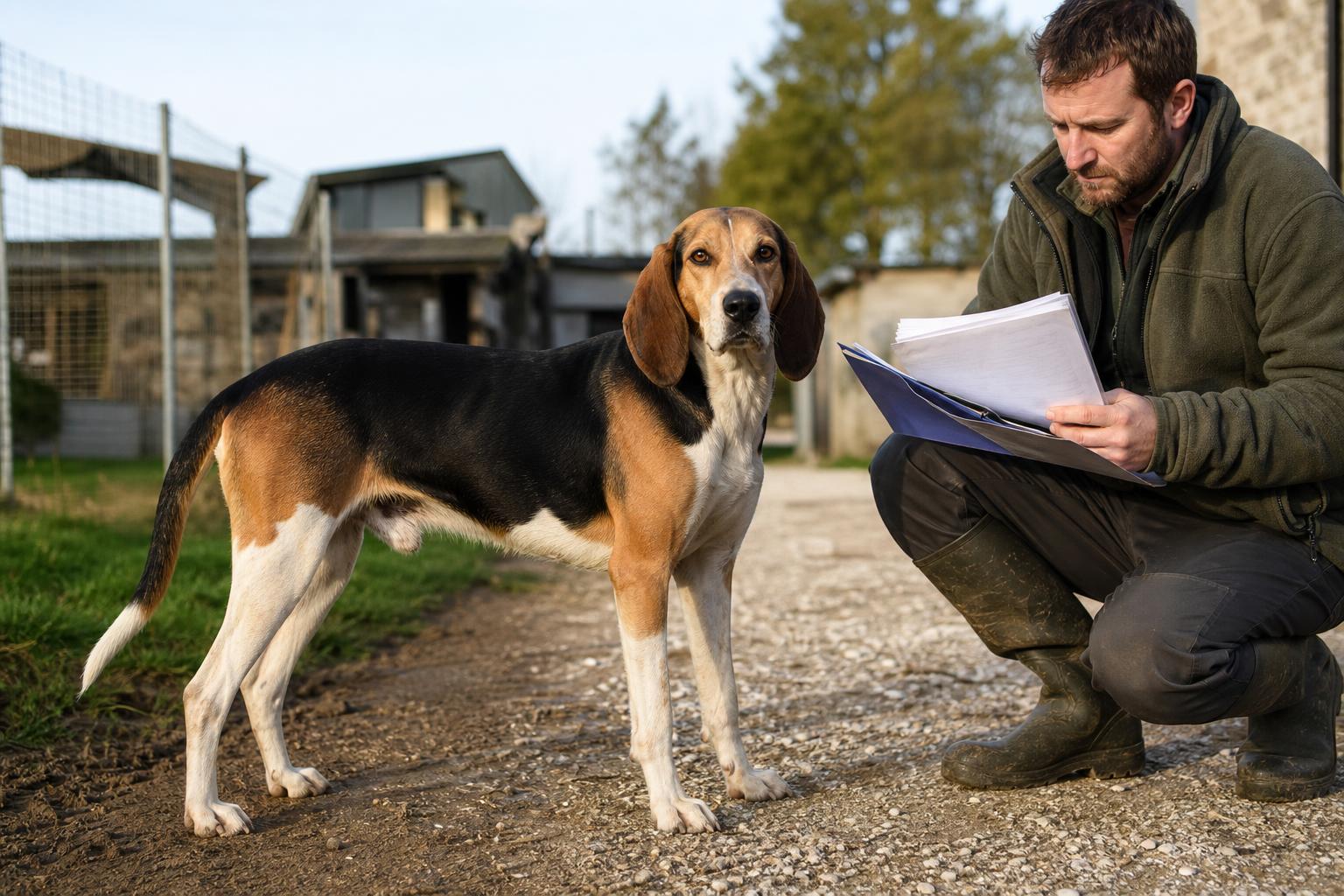
The Harrier is a medium-sized English scent hound developed to hunt hare in packs, valued for endurance, nose, social temperament, and the ability to work steadily over distance. When you are researching Harrier stud dogs, the goal is not simply to find a handsome male. The right sire should complement the female, fit the purpose of the planned litter, and bring documented strengths without doubling up on avoidable weaknesses.
Harriers are rare in many modern breeding circles, especially compared with Beagles, Foxhounds, or more common gun dog breeds. That rarity makes careful evaluation even more important. A limited gene pool can make pedigree knowledge, temperament history, and honest breeder communication just as valuable as a show photo or a short description. Whether the planned litter is aimed at active companion homes, scent work, field work, pack hunting, or breed preservation, the stud decision should be deliberate.
This guide is written for buyers, breeders, hunters, trainers, and families trying to understand what to ask before using or purchasing access to a Harrier stud dog. It uses known Harrier breed facts as the foundation: this is an athletic scent hound with strong tracking drive, a short dense coat, a friendly pack-oriented nature, and a real need for exercise and management. Always verify details directly with the stud owner, breed club resources, registration bodies, veterinarians, and any relevant working-dog organizations before making a breeding commitment.
Health Clearances for Harrier Stud Dogs
Health clearances are one of the first places to slow down and ask for documentation. Harriers are often described as hardy working hounds, but hardiness is not a substitute for screening. A responsible stud owner should be willing to discuss what health checks have been completed, what results are available, and what concerns are known in the family line. The answer may vary by country, registry, and the specific goals of the breeding program.
Ask for copies or database links rather than relying on broad statements like “vet checked” or “healthy.” A routine veterinary exam can be useful, but it is not the same thing as breed-relevant screening. For an active scent hound, buyers should pay close attention to structure, sound movement, lean body condition, and any history of lameness or recurring ear problems. Dogs that spend time outdoors may also need routine parasite prevention and careful ear monitoring, but those are management issues rather than proof of genetic quality.
- Ask what health screenings were performed and when.
- Verify that the dog is physically mature enough for breeding decisions.
- Review known issues in parents, siblings, and prior offspring when available.
- Discuss temperament, prey drive, sociability with dogs, and trainability honestly.
- Confirm that the stud is not being promoted with unsupported medical claims.
OFA
OFA records can be helpful when they apply, but buyers should not assume every Harrier stud dog will have every possible OFA result. The correct approach is to verify which evaluations are relevant, completed, and publicly searchable. For many breeds, OFA-style documentation may include hips, elbows, eyes, cardiac exams, thyroid testing, or other evaluations, but requirements and common practices vary widely.
If a Harrier stud owner lists OFA results, ask for the registered name or number needed to look them up. Confirm that the dog in the listing is the same dog represented in the records. Also consider context: one good result does not make the entire breeding decision, and one missing optional test does not automatically mean the dog is unsuitable. The key is transparency. A serious stud owner should be able to explain what was tested, what was not tested, and why.
Because Harriers are athletic scent hounds built for movement, structure matters. Hip and joint information may be especially useful when available, but it should be considered alongside real-world soundness, conditioning, age, and family history. If you are unsure which screenings are most meaningful for this breed and your country, ask a veterinarian familiar with working hounds or contact a recognized breed club for guidance.
DNA Testing
DNA testing can support better breeding decisions, but it should be used carefully. A DNA panel may confirm parentage, identify carrier status for certain inherited conditions, or help manage genetic diversity. It should not be treated as a magic certificate proving that a dog will produce healthy puppies. For a rare breed like the Harrier, DNA information can be especially useful when paired with pedigree analysis and honest knowledge of family lines.
Before choosing a Harrier stud dog, ask what DNA testing has been completed and whether the results are relevant to the breed. Some large commercial panels include conditions that may not be common or validated for every breed. If a result is listed, confirm what it means: clear, carrier, at-risk, or simply a trait marker. If the female has also been tested, compare both dogs together. A carrier result may be manageable when bred to a clear mate, but that decision should be made with full understanding and proper advice.
- Ask whether DNA results are available as official reports.
- Confirm that the test applies to Harriers or to scent hounds broadly.
- Use DNA results to avoid risky pairings, not to market vague superiority.
- Consider genetic diversity when breeding within a small population.
Frozen Semen
Frozen semen can open access to Harrier stud dogs that are geographically distant, aging, deceased, or unavailable for live breeding. It can also help preserve valuable lines in a rare breed. However, frozen semen is a technical breeding option that requires planning, veterinary coordination, and clear paperwork. Do not assume it is available just because a male is advertised as a stud.
If frozen semen is offered, verify collection dates, storage location, ownership rights, number of breeding units, motility information if available, and the process for shipment. Ask whether the semen has produced litters before, but remember that past success does not guarantee future results. The female’s timing, reproductive health, insemination method, and veterinary expertise all matter.
Buyers should also clarify what happens if the breeding does not take. Some contracts offer a repeat breeding, while others sell semen units without a live-puppy guarantee. Avoid vague arrangements. A written agreement should define exactly what is being purchased, who authorizes release from storage, who pays shipping and veterinary costs, and whether registration documents or stud certificates will be provided after whelping.
Live Cover vs AI
Live cover and artificial insemination each have practical advantages and drawbacks. Live cover may be straightforward when both dogs are compatible, healthy, and located close enough to manage timing. It also allows the breeder to observe natural behavior, but it comes with travel, biosecurity, injury, and scheduling considerations. Harriers are social hounds, yet individual dogs can still be inexperienced, distracted, or unsuitable for a specific pairing.
Artificial insemination, often called AI, may be used when distance, safety, timing, or semen type makes live cover impractical. AI can include fresh, chilled, or frozen semen depending on what is available and legally permitted. Regulations and registry rules vary, so buyers should verify requirements before making plans. For example, some registries may require additional documentation, DNA parentage verification, or specific collection and insemination procedures.
The right choice depends on the dogs, the breeder’s experience, the veterinarian’s recommendations, and the registration goals for the litter. Do not let convenience override welfare. Both sire and dam should be handled calmly, safely, and with attention to health. If the stud owner pressures you into a method without explaining risks, costs, and paperwork, that is a reason to pause.
Stud Contracts
A Harrier stud contract should be clear before the female is bred. Good contracts protect both parties and reduce misunderstandings later. At minimum, the agreement should identify the stud dog and female, the fee or puppy-back arrangement, the breeding method, timing, repeat-breeding terms, registration responsibilities, and what documentation will be supplied after a confirmed litter.
Because Harriers are not a high-volume breed in many areas, informal arrangements may be common, but a handshake is not enough when puppies, registration, semen ownership, travel costs, and expectations are involved. If a stud owner refuses written terms, consider that a warning sign. The contract does not need to be hostile or complicated; it needs to be specific.
- Confirm the stud fee, deposit, and when payment is due.
- Define whether a return service is offered if no pregnancy occurs.
- Clarify who pays veterinary, shipping, boarding, and collection costs.
- State what health testing and registration documents each party provides.
- Include expectations for litter reporting and stud certificates.
- Address whether the stud owner has any say in puppy placement or advertising.
Pedigree Analysis
Pedigree analysis is especially important when evaluating Harrier stud dogs. The breed has a long history as a pack hound for hare hunting, but modern populations can be limited. A pedigree can help identify linebreeding, outcross opportunities, repeated ancestors, working families, temperament patterns, and potential health concerns. It should be read as a map, not as a trophy list.
Look beyond the first generation. A sire with a strong individual record may still be a poor match for a particular female if the pairing concentrates the same weaknesses. Conversely, a less flashy male may be valuable if he brings sound structure, stable temperament, proven scenting ability, and complementary bloodlines. Ask the stud owner what the dog has produced in prior litters, if any. Production record matters more than marketing language.
For Harriers intended for active homes or field use, pedigree research should also consider functional traits. Does the line maintain the stamina, nose, social pack nature, and practical build expected of the breed? Are relatives known for being manageable in homes with adequate exercise, or are they difficult to contain and train? The Harrier’s independent scent-hound character is part of the breed, but breeding choices can still influence how that drive is expressed.
Evaluating Working Ability and Temperament
Not every Harrier stud dog will have formal hunt titles or trial records, and buyers should verify whether those programs are relevant and available for this breed in their region. Harriers were developed for hare hunting and can adapt to other scent-driven work, but formal evaluation systems differ by country, registry, and hunting community. Instead of assuming a specific title should exist, ask for evidence of ability that fits the dog’s actual use.
Useful evidence may include field references, pack experience, tracking or scent-work participation, video of the dog moving and working, comments from trainers, or observations from people who have hunted behind him. Temperament is just as important. Harriers are generally friendly and social with other dogs, a trait connected to their pack-hound background. A stud dog should not be selected solely for drive if he lacks stability, soundness, or livability.
Families and breeders should ask how the dog behaves around people, other dogs, confinement, travel, and daily routines. A Harrier can be affectionate and bright while still being independent and scent-focused. The ideal stud owner will describe both strengths and challenges plainly. Beware of anyone who claims a stud dog has no faults.
Red Flags When Shopping for Harrier Stud Dogs
Stud listings should make it easier to verify quality, not harder. Be cautious of advertisements that rely on rare-breed hype, exaggerated guarantees, or unsupported claims. A Harrier’s rarity should never be used as a reason to skip health screening, temperament evaluation, or basic contract terms. Rarity makes responsible breeding more important, not less.
- No willingness to share health documentation or registered identity.
- Pressure to breed quickly without discussing the female’s suitability.
- Claims of guaranteed health, guaranteed performance, or exact puppy outcomes.
- No written contract for live cover, chilled semen, or frozen semen.
- Unclear ownership of frozen semen or registration paperwork.
- Advertising based only on color, size, or scarcity.
- No honest discussion of the Harrier’s exercise needs, prey drive, or scent-hound independence.
Buyer-Focused Conclusion
Choosing among Harrier stud dogs is a breeding decision with long-term consequences. The best sire for a litter should bring more than availability. Look for documented health work, transparent OFA or other screening information when applicable, meaningful DNA testing, clear breeding logistics, a fair contract, and a pedigree that genuinely complements the female. Just as important, evaluate the dog as a Harrier: athletic, social, scent-driven, enduring, and suited to active homes that understand hounds.
Take your time, verify every claim, and ask practical questions before money changes hands or breeding plans are made. A responsible stud choice protects the sire, the dam, the breeder, future puppy buyers, and the breed itself.


