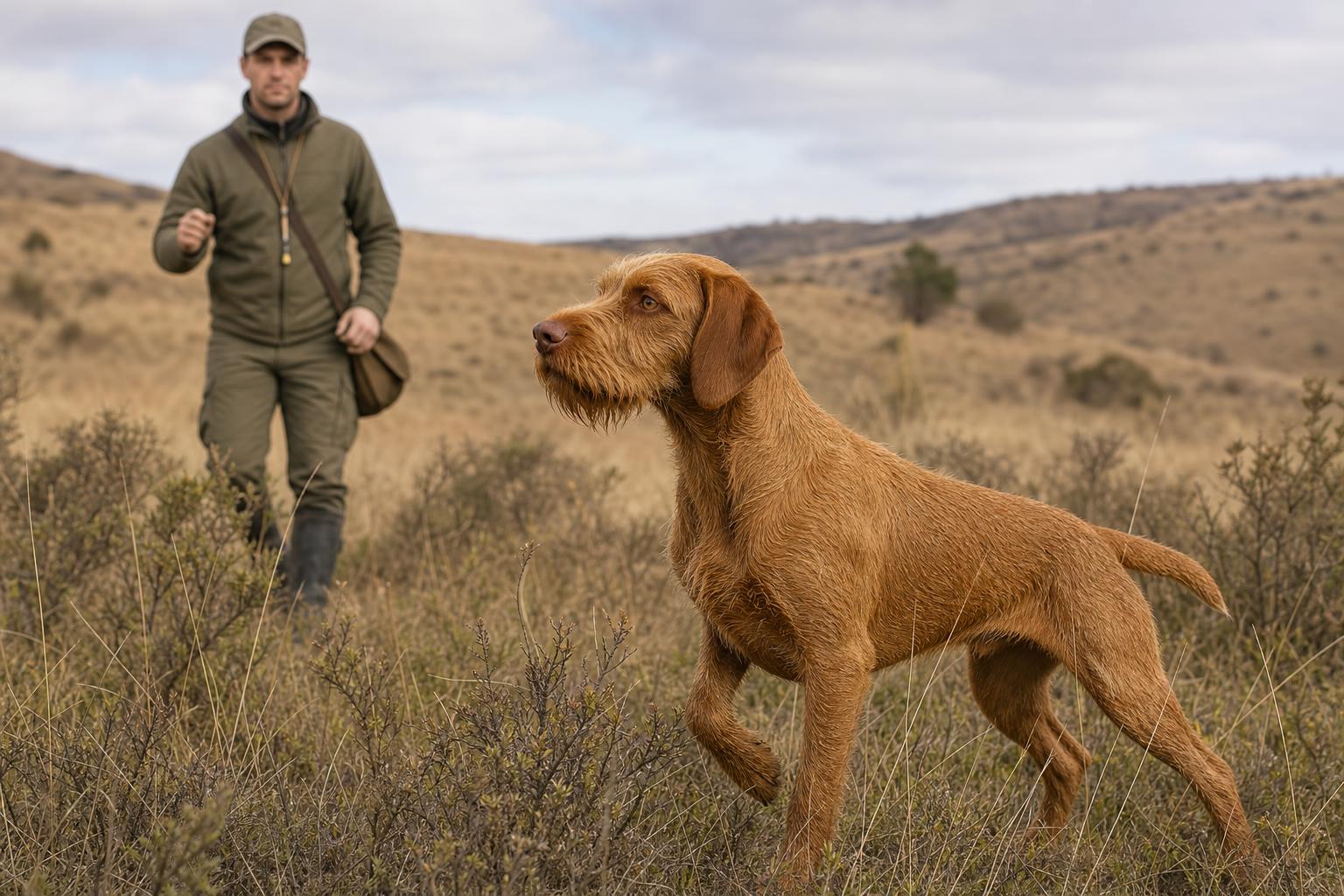
A Hungarian Wirehaired Vizsla started dog can be an appealing option for hunters and active families who want to skip the earliest puppy stages while still shaping a young dog into their own hunting partner. This breed was developed in Hungary as a versatile, all-purpose gun dog with a harsh weather-resistant coat, strong pointing and retrieving instincts, and the ability to work on land and in water. Those traits make the breed attractive, but they also make careful evaluation important. A started dog is not automatically finished, steady, polished, or ready for every hunting situation.
The best started Hungarian Wirehaired Vizsla prospects combine natural ability with honest early training. Buyers should look for a dog that has been exposed thoughtfully, handled fairly, and developed at a pace that protects confidence. Because the breed is intelligent, affectionate, energetic, and often sensitive to harsh correction, the quality of early handling matters as much as the number of drills completed. Use the seller’s facts, demonstrations, and documentation as your guide rather than relying on broad claims.
What Qualifies as “Started” in a Hungarian Wirehaired Vizsla
“Started” is one of the most flexible terms in the gun dog market. For one seller, it may mean a young Hungarian Wirehaired Vizsla has basic obedience, crate manners, bird exposure, and a developing point. For another, it may mean a dog has hunted a season, retrieves naturally, handles gunfire, and works cover with purpose. Before discussing price or pickup dates, ask the seller to define exactly what the dog has done.
A practical started-dog description should include the dog’s age, living situation, daily routine, obedience foundation, bird or game exposure, retrieving experience, water exposure if relevant, gun introduction status, and how the dog behaves around people, dogs, vehicles, kennels, and the house. It should also be clear whether the dog is being sold as a hunting prospect, a dual-purpose hunting and family companion, or a more advanced training project.
- Ask what commands the dog knows and whether they are reliable away from home.
- Ask how the dog hunts: range, pace, use of nose, check-ins, and response to handler direction.
- Ask whether the dog points, retrieves, tracks, swims, or only shows early interest.
- Ask for a live demonstration or current video, not only older puppy clips.
- Ask what the dog still needs before it should be considered a finished hunting dog.
For this breed, “started” should usually suggest useful exposure and a promising foundation, not completion. A buyer who expects a fully steady, force-fetched, finished versatile dog may be disappointed unless the seller specifically demonstrates those skills.
Birds Introduced or Breed-Appropriate Game Exposure
The Hungarian Wirehaired Vizsla is known as a versatile pointing and retrieving breed, so bird exposure is often central to evaluating a started dog. The selector facts for this breed describe ability on birds, rabbits, and even larger game such as deer, along with aptitude for waterfowl work. That does not mean every individual has been exposed to all of those jobs. Buyers should verify the exact game, conditions, and training goals used with the dog being offered.
For upland work, ask whether the dog has been introduced to planted birds, wild birds, or both. Planted bird work can be useful for controlled lessons, but wild bird contacts often reveal more about nose, search pattern, cooperation, and mental toughness. A started Hungarian Wirehaired Vizsla should show curiosity and purpose in cover, use its nose, and begin to understand that birds are found by hunting rather than by sight alone.
If the seller claims the dog points, ask what that looks like. Does the dog establish point on scent and hold until the handler arrives, or does it pause briefly and rush in? Has the dog been allowed to catch birds? Has steadiness been introduced, or is the dog still in an early chase-and-learn stage? Early enthusiasm is valuable, but repeated uncontrolled catching can create habits a later trainer must repair.
For waterfowl or retrieving-oriented buyers, ask about water entry, swimming confidence, retrieving desire, and response to decoys, blinds, boats, or cold water. The breed’s wiry coat can help in rough cover and cooler conditions, but no buyer should assume every young dog is automatically water-ready. If rabbits, tracking, or other game are part of your plans, ask whether that exposure was deliberate and controlled, or merely incidental.
Gun Introduction When Relevant
Gun introduction is one of the most important questions in any Hungarian Wirehaired Vizsla started dog purchase. A dog that has been rushed, startled, or pressured around gunfire may need careful rebuilding. A dog that has been introduced gradually, with birds or retrieving excitement paired to distant sound, is usually a safer prospect. Do not accept “not gun shy” as enough detail.
Ask how the introduction was done. Good answers usually mention distance, progression, the dog’s body language, and the reward or bird contact that made the sound meaningful. Ask what firearms or launchers were used, how close the dog was, and whether the dog has heard shots while actively hunting rather than only while eating or playing. If the dog has not been introduced to gunfire yet, that is not necessarily a deal-breaker, but it should affect your training plan and evaluation.
When possible, watch the dog work in a controlled field setup. Look for a dog that remains engaged after a shot, continues to hunt, or associates the sound with opportunity. Be cautious if the dog tucks its tail, leaves the area, avoids birds after the shot, startles repeatedly, or needs heavy encouragement to continue. If gunfire is not relevant to your intended use, such as a companion or non-shooting field sport home, clarify that with the seller and evaluate the dog for your actual lifestyle instead.
Obedience Level
Started does not have to mean perfect obedience, but a Hungarian Wirehaired Vizsla offered at this stage should have a foundation. This breed is people-oriented and often eager to work with a handler, yet it is also energetic and independent enough to make consistency important. Buyers should evaluate obedience in several places, not only in the seller’s yard.
Useful started-dog obedience commonly includes a name response, recall foundation, leash walking, crate comfort, loading into a vehicle, basic sit or whoa-style control depending on the trainer’s system, and enough manners to be handled safely. In a pointing breed, obedience should support field work without crushing drive. A dog that recalls beautifully in the kennel but disappears in cover may need more development. A dog that is over-controlled and hesitant may have lost confidence.
- Test recall in a safe, fenced or controlled area with moderate distractions.
- Watch leash behavior before and after excitement, not just when the dog is tired.
- Ask whether the dog lives in a house, kennel, or both, and what manners are established.
- Confirm crate and vehicle habits if you travel to hunt or train.
- Ask how corrections and rewards have been used so you can maintain continuity.
Because Hungarian Wirehaired Vizslas often bond closely with their families, a transition period is normal. Even a well-started dog may test boundaries or seem unsettled in a new home. Plan to review basics patiently before expecting the dog to perform at its best.
Evaluating Training Before You Buy
The safest way to evaluate a Hungarian Wirehaired Vizsla started dog is to see the dog do the work that matters to you. Video is helpful, but a live demonstration is better when distance allows. Ask the seller to show the dog in realistic conditions: kennel or house behavior, loading, basic obedience, field search, bird contact, retrieving if claimed, water if claimed, and gunfire if already introduced. A polished sales video can hide gaps; a calm, transparent demonstration usually tells the truth.
Pay attention to the dog’s attitude. A good started prospect should look interested, resilient, and connected to the handler. It does not need to be flawless. Young versatile dogs make mistakes. What matters is whether the dog recovers, keeps working, and responds to fair direction. Avoid dogs that seem shut down, fearful, excessively frantic, or dependent on constant pressure to function.
Verify reported working titles and test results with the issuing organisation. Confirm that the programme applies to the breed and ask what the result demonstrates about the individual dog.
Price should reflect age, training, exposure, health documentation, pedigree, and demonstrated ability. Exact prices vary by region, seller, and level of training, so be wary of anyone who cannot explain what supports the asking price. A started dog with thoughtful bird introduction, stable temperament, useful obedience, and transparent records is different from an older puppy with limited exposure and a sales label.
Matching the Started Dog to Your Home and Hunting Goals
Before buying, be honest about your own experience. A Hungarian Wirehaired Vizsla is typically active, intelligent, affectionate, and happiest with close involvement in family life. A started dog may still need daily exercise, ongoing obedience, field sessions, and careful exposure to new places. If you want a calm house companion during the week and a focused hunting partner on the weekend, ask specifically how the dog settles indoors after work and how much exercise it needs to stay balanced.
For upland hunters, range, point development, cooperation, and steadiness goals may be most important. For waterfowl hunters, water confidence, retrieving desire, and tolerance of cold or wet conditions may matter more. For versatile-dog enthusiasts, tracking, pointing, retrieving, water work, and trainability may all be part of the evaluation. No started dog will be perfect in every category, so decide which traits are essential and which can be developed after purchase.
Buyer-Focused Conclusion
A Hungarian Wirehaired Vizsla started dog can be a smart choice when the dog’s early training matches your goals and the seller is clear about what has actually been done. Focus on evidence: current demonstrations, honest descriptions, records you can verify, and a dog that shows confidence, cooperation, and natural working desire. Treat “started” as the beginning of a partnership, not a shortcut around training. With careful evaluation and continued development, the right Hungarian Wirehaired Vizsla can become a capable field companion and a loyal dog at home.
Explore Hungarian Wirehaired Vizsla on Working Dog Central
View the Hungarian Wirehaired Vizsla breed profile or browse Hungarian Wirehaired Vizsla listings.


