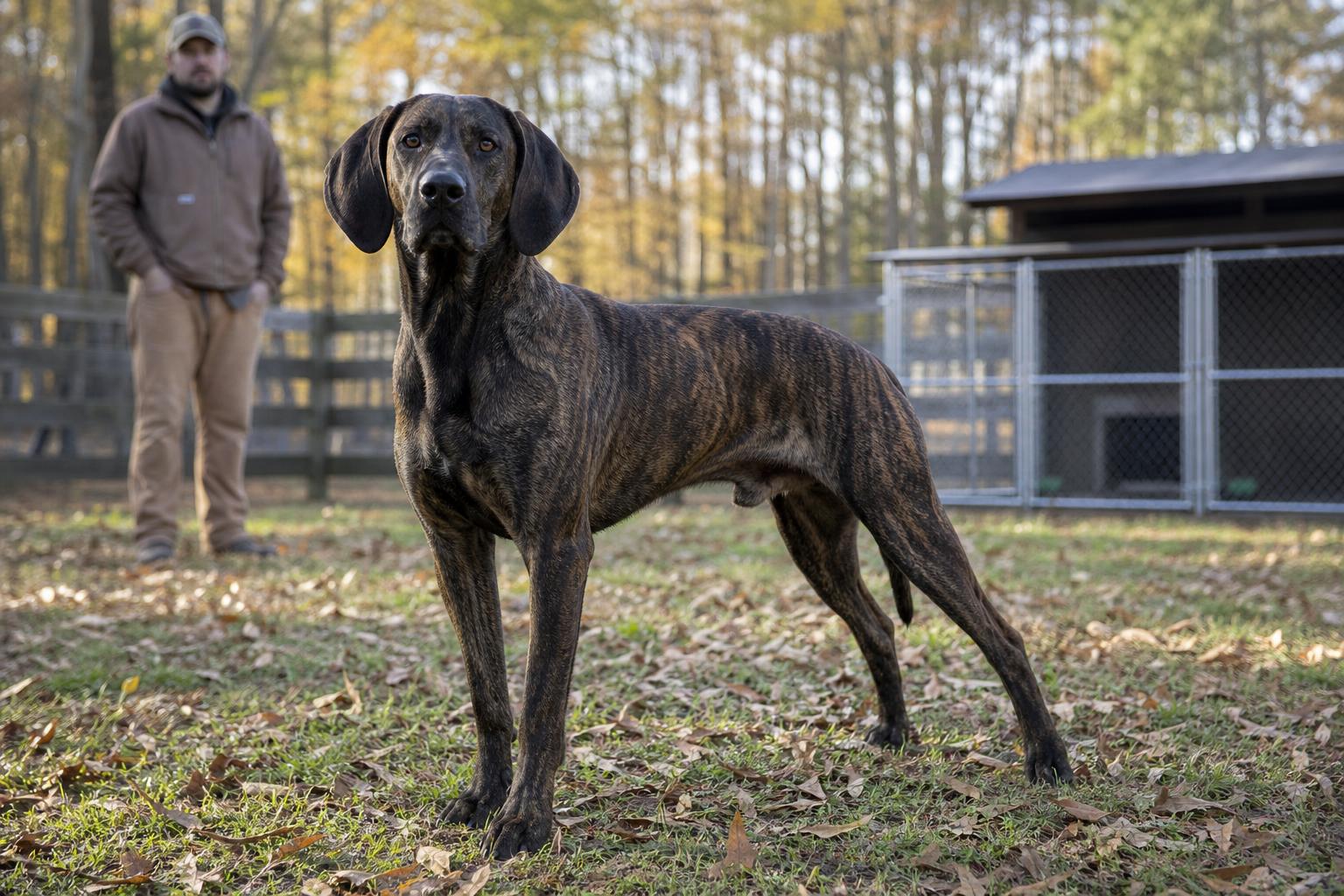
Choosing a Plott Hound stud dog is not just a pedigree decision. It is a working-dog decision, a temperament decision, and a long-term breeding decision. The Plott Hound was shaped in rugged country as a determined scenthound with the stamina and courage to trail and tree large game. A good stud should reflect that heritage while also fitting the goals of the female, the breeder, and the future homes that may raise the pups.
This guide is written for buyers, breeders, hunters, and families evaluating Plott Hound stud dogs through Working Dog Central. It does not assume every stud is advertised with the same records, registrations, clearances, or breeding options. Instead, it gives you a practical framework for verifying what matters before you commit to a breeding.
What to Look for in a Plott Hound Stud Dog
A Plott Hound stud should be more than a handsome brindle dog with a strong voice. Start with the basics: sound structure, athletic condition, stable temperament, and a proven reason for being used at stud. In a working scenthound, that reason may include hunting performance, consistency on track, grit, treeing ability, handling, stamina, or producing useful offspring. In a companion-focused program, temperament, trainability, health documentation, and breed type may carry more weight.
Ask the owner to describe the dog plainly. What game has he worked? How does he behave around people, other dogs, kennels, vehicles, and new environments? Is he independent, handler-oriented, intense, quiet at home, vocal, or slow to settle? Plott Hounds can be loyal and affectionate, but they are also driven hounds. A stud’s everyday behavior matters because puppies may inherit both his strengths and his management challenges.
Health clearances
Health clearances are one of the first things to verify when evaluating Plott Hound stud dogs. Do not rely on phrases such as “healthy,” “vet checked,” or “never had a problem” as substitutes for documentation. Ask what screenings have been completed, when they were done, and whether results can be shared before a breeding agreement is signed.
For an athletic medium-to-large hound, orthopedic soundness is commonly discussed, but the exact tests a breeder uses can vary by line, registry, and breeding goal. A responsible stud owner should be able to explain why each screening was chosen and how the result fits the dog’s overall value. If a particular test is not available, not commonly used in that circle, or not relevant to the stated breeding goal, ask for that explanation in writing rather than guessing.
- Request copies of health testing records, not just verbal summaries.
- Ask whether any close relatives have known orthopedic, reproductive, temperament, or chronic health issues.
- Confirm the dog is in fit breeding condition, not merely old enough to breed.
- Ask what health information is shared with puppy buyers from the resulting litter.
OFA
OFA, the Orthopedic Foundation for Animals, is commonly used in many breeds to record health screening results, especially orthopedic evaluations. That does not mean every Plott Hound stud dog will have every OFA test, or that a dog without a public listing is automatically poor quality. It does mean buyers should know how to verify claims.
If the stud owner mentions OFA hips, elbows, eyes, cardiac, thyroid, or other results, ask for the registered name or identifying information needed to look up records. Confirm that the dog in the listing is the same dog represented in the testing records. If results are preliminary, private, pending, or performed through another veterinary channel, ask for documentation and your veterinarian’s opinion.
OFA records are one useful tool, not the entire evaluation. A Plott Hound also needs functional movement, endurance, a sensible temperament, and a breeding plan that pairs him with a compatible female. Use OFA information to reduce avoidable risk, not to replace judgment.
DNA testing
DNA testing can help breeders confirm parentage, identify certain inherited risks, and support transparency. However, DNA panels vary, and not every condition on a broad panel is meaningful for every breed. When evaluating a Plott Hound stud, ask what DNA testing was done, which laboratory performed it, and what the results actually mean for the planned mating.
Be cautious with vague claims like “DNA clear” unless the owner can name the specific test. A dog may be clear for one condition, a carrier for another, and untested for a third. Carrier status is not automatically disqualifying if the female is tested and the pairing is planned responsibly, but buyers should understand the risk management behind the decision.
- Ask for copies of DNA reports or parentage verification when relevant.
- Confirm whether the female has compatible testing before breeding.
- Discuss uncertain results with a veterinarian or qualified genetics resource.
- Do not assume a generic DNA panel proves overall health, hunting ability, or temperament.
Frozen semen
Frozen semen can make an influential Plott Hound stud available after travel, distance, retirement, or death would otherwise prevent a breeding. It can also help preserve a working line. Still, frozen semen is a reproductive tool, not a guarantee of puppies. Success depends on semen quality, storage, timing, veterinary skill, the female’s fertility, and the breeding method used.
If frozen semen is offered, ask where it is stored, how many breeding units are available, whether post-thaw motility has been evaluated, and what paperwork transfers with the semen. Clarify who pays shipping, storage, reproductive veterinary fees, and repeat-breeding costs if the attempt does not result in a litter. Because rules and practices differ, verify any registry or litter-registration requirements before money changes hands.
Live cover vs AI
Live cover and artificial insemination each have practical advantages. Live cover may be simple when both dogs are nearby, experienced, healthy, and behaviorally appropriate. It still requires supervision, safe handling, and agreement about timing, boarding, liability, and what happens if the dogs will not breed naturally.
AI, or artificial insemination, may be useful when distance, safety, timing, or semen logistics make natural breeding difficult. Depending on the situation, AI may involve fresh, chilled, or frozen semen, and may require veterinary reproductive support. Do not assume AI is available for a specific Plott Hound stud unless the owner states it clearly and can explain the process.
Before choosing either method, ask your veterinarian what is realistic for the female and the breeding timeline. Also verify any registry rules that may apply to litter registration, semen handling, signatures, and documentation.
Stud contracts
A written stud contract protects both sides. It should identify the Plott Hound stud, the female, the owner of each dog, the fee, the breeding method, the expected timing, and what counts as a successful breeding. It should also explain whether the stud fee is paid up front, after confirmed pregnancy, after live birth, or through a puppy-back agreement.
Good contracts avoid vague promises. They address repeat breeding, missed pregnancies, small litters, veterinary costs, boarding, semen shipment, registration paperwork, and who is responsible for transportation. They should also state what health documentation each side must provide and whether the stud owner has the right to refuse the breeding if the female is not suitable.
- Read the contract before scheduling travel or reproductive appointments.
- Confirm the stud owner will sign any required litter-registration forms.
- Clarify whether the stud owner makes any claims about resulting puppies.
- Keep copies of receipts, veterinary records, semen paperwork, and correspondence.
Pedigree analysis
Pedigree analysis is where many Plott Hound breeding decisions become more serious. A pedigree can show working families, repeated ancestors, registry names, and patterns of selection. It can also hide problems if no one is willing to discuss what the dogs were actually like. A famous name several generations back is not enough. Ask what the stud himself has done and what his relatives have produced.
For hunting buyers, pedigree questions should connect to function. Are the dogs known for bear, boar, coon, tracking, treeing, cold nose, speed, grit, or handling? Are they early starters or slower to mature? Are they kennel-sensible and manageable, or extremely intense? For family-focused buyers, ask about stability, social behavior, vocal tendencies, and prey drive around small animals.
Linebreeding, outcrossing, and tight family breeding can all be used responsibly or irresponsibly. The point is not to chase the most fashionable pedigree. The point is to understand the strengths and risks of pairing a particular Plott Hound stud with a particular female.
Performance, Records, and Real-World Proof
Performance claims should be specific. If a Plott Hound stud is advertised as proven in the woods, ask for examples: game pursued, terrain hunted, frequency of work, age when started, strengths, weaknesses, and whether independent references can speak to the dog. Photos and stories are helpful, but they are not the same as a complete evaluation.
Verify reported working titles and test results with the issuing organisation. Confirm that the programme applies to the breed and ask what the result demonstrates about the individual dog.
Questions to Ask Before Booking a Plott Hound Stud
- What are the stud’s strongest traits, and what would you improve?
- What health clearances, OFA results, DNA tests, or veterinary records are available?
- Has he produced litters before, and what are those pups like as adults?
- What kind of female is he best suited for?
- Is live cover, fresh chilled semen, frozen semen, or AI available?
- What does the stud contract include if the female does not conceive?
- Can I speak with hunters, breeders, or owners who know this dog or his offspring?
Red Flags When Evaluating Stud Dogs
Be careful with any stud owner who cannot answer basic questions, refuses documentation, pressures for a fast deposit, or makes sweeping guarantees about puppy health, hunting ability, color, size, or income potential. No responsible breeder can promise every outcome. They can explain their reasoning, show records, and stand behind their process.
Other warning signs include breeding solely for color, breeding an unsound or unstable dog because he is convenient, using a very young dog before his traits are known, or avoiding questions about relatives and previous litters. A Plott Hound is a serious working breed. The goal should be better dogs, not just more dogs.
Buyer-Focused Conclusion
The best Plott Hound stud dog for your breeding is the one whose health, temperament, working style, pedigree, and breeding terms honestly match your female and your goals. Verify health clearances, understand OFA and DNA claims, ask detailed questions about frozen semen or live cover versus AI, read the stud contract closely, and study the pedigree in terms of real dogs rather than famous names. A careful decision now gives the resulting litter a stronger start and helps preserve the grit, loyalty, and usefulness that make the Plott Hound worth breeding well.
Explore Plott Hound on Working Dog Central
View the Plott Hound breed profile or browse Plott Hound listings.


