Scent Theory in Search Dogs
How Working Dogs Follow Odor in the Real World
Jeff Davis | https://workingdogcentral.com
 0
0 0
0 0
0 0
0 0
0
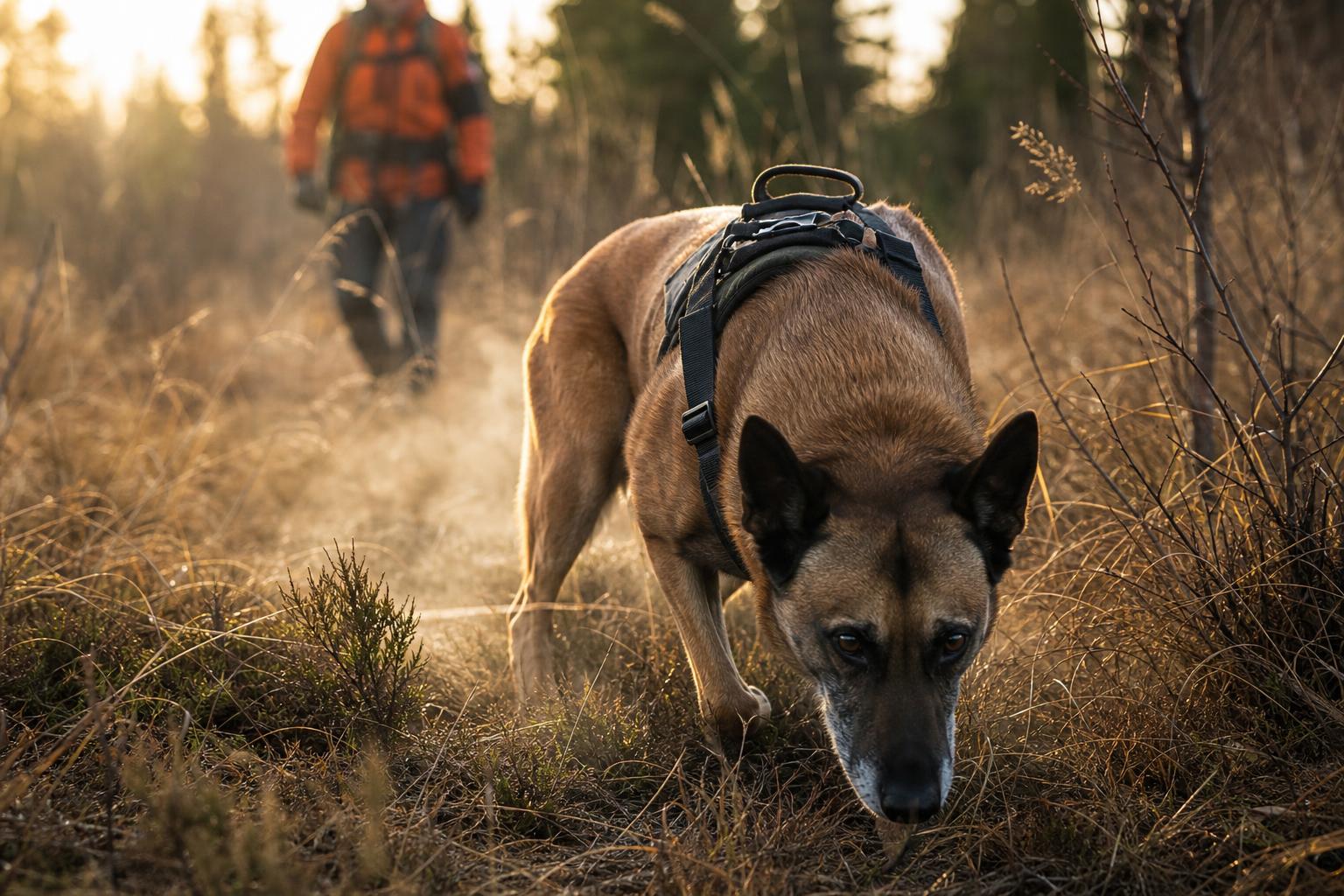
A good search dog can make a difficult scent trail look straightforward, but the nose is working through something constantly changing. Scent does more than lie along the ground or drift on the wind. It scatters, pools, rises, settles into cover, and sometimes fades where a handler would expect it to be strongest. A dog may follow a line with confidence across damp grass in the morning, then struggle with a similar track that afternoon after the sun has dried the ground and the wind has shifted. The task may look the same to the handler, but the scent conditions have changed.
Scent theory in search dogs is really the study of how odor behaves and how a trained dog interprets it. The dog is not solving the problem the way we do. He is not building a map in words. He is sorting scent picture from scent picture, taking in concentrations, aging, direction, contamination, and change with a nose far beyond human understanding. A handler who knows even the basic rules of scent movement gives that dog a better chance to succeed.
What a Search Dog Is Really Following
People new to working dogs often imagine a dog following a neat line of human scent, as if somebody dragged a paintbrush across the landscape. Field experience will cure that idea fast. Human odor is made of skin rafts, bacteria, perspiration, breath, crushed vegetation, and disturbance in the environment itself. Every footstep leaves more than one clue. That is why a capable search dog may work with nose down in one stretch, then cast with nose up in another, then swing wide to pick up a cone of odor that drifted off the original path.
There are two broad ways handlers often talk about scent in practical terms: ground scent and airborne scent. Ground scent includes the odor left by footsteps, crushed plant matter, and disturbed soil. Airborne scent is odor carried on moving air, sometimes well off the actual route of travel. In truth, a dog often uses both at once. He is not nearly as interested in our categories as we are. He is interested in where odor is strongest, freshest, and most useful.
The Role of Human Scent and Disturbance
One of the most overlooked parts of scent theory is disturbance. A person walking through cover does more than shed odor. He changes the environment. He bends stems, bruises leaves, exposes damp soil, and leaves behind tiny thermal and physical changes. Dogs can key on that. I have watched a good dog sort out a track in thin cover where there seemed to be little odor in the air, yet he moved with purpose because the ground itself held the story.
This is one reason fresh tracks often behave differently than older ones. A fresh track can contain strong human odor, but it may also still be influenced by recent disturbance and body heat. As time passes, some of that changes. Certain scent components weaken while others spread and settle. The dog adjusts if he is experienced, but the handler has to understand that the picture is changing by the minute.
How Weather Changes the Search
If I had to name one thing that humbles handlers more than anything else, it would be weather. Cool, damp mornings tend to be kind to scent. Moisture holds odor closer and often makes it easier for dogs to work consistently. Dry heat can scatter and weaken things fast, especially on open ground. Wind is both friend and thief. A steady breeze can carry odor nicely and help a dog air scent from distance. A gusty, switching wind can throw scent around like a deck of cards.
Temperature matters, but temperature alone does not tell the whole tale. Humidity, sunlight, cloud cover, and the nature of the surface all play a role. Scent on shaded leaf litter behaves differently than scent on blacktop baking in full sun. A low area may collect cool, damp air and hold odor long after a ridge top has dried out. In thick timber, scent may hang under the canopy. On open pasture, it may move broad and loose.
Wind, Moisture, and Thermal Lift
Morning and evening often produce some of the most readable scent conditions because air movement is steadier and ground temperatures are less extreme. As the day warms, thermal lift can pull odor upward. That can make a dog raise his head and search more in the air than on the track itself. In hilly country, warming slopes and cooling draws can create odd scent drift. A subject may walk one route, while most of the odor ends up collecting somewhere else entirely.
That is where inexperienced handlers get into trouble. They see the dog drift off line and assume he is wrong. Sometimes he is not off the scent problem at all. He may be working the odor where nature moved it. Good handling takes trust, but not blind trust. You learn to read the dog’s change of behavior, tail carriage, breathing, and intensity. The nose tells him one story. The landscape tells you whether that story makes sense.
Terrain and Cover Shape the Scent Picture
Anyone who has hunted with dogs knows that the land itself has a say in every track. Thick grass can trap odor low. Bare ground may lose it quickly in heat. Brush lines, fence rows, creek bottoms, and timber edges often collect scent because they interrupt airflow. Water adds another layer of complexity. Dogs can track to water, lose the concentrated foot scent at the bank, and then have to solve for drift, splash contamination, or the subject exiting at another point downstream.
Urban environments create a different puzzle. Pavement, vehicle exhaust, old human traffic, food odor, and hard surfaces scatter and dilute the target picture. Yet good search dogs can still work there because scent does not simply vanish on concrete. It moves, eddies, and gathers near walls, alleys, parked cars, and doorways. In many cases, handlers do better when they stop expecting a perfect line and start thinking in terms of odor availability.
Why Low Areas and Edges Matter
Low ground, ditches, creek beds, and edges where one type of cover changes to another often hold useful scent. I have seen dogs overshoot in open ground, then hook into a shaded depression where odor had settled like cool smoke. Edge habitat is especially interesting because air currents change there. Timber to field, brush to trail, sun to shade, wet to dry ground, all of those transitions can concentrate odor enough for a dog to make sense of a weak problem.
How Search Dogs Solve Odor Problems
A trained search dog is never just smelling one thing. He is sorting a layered puzzle under pressure. He checks intensity, compares direction, evaluates freshness, and works through contamination from other people, animals, and old scent. That is why problem-solving matters more than simple enthusiasm. A hard-charging dog with no discipline may overrun every turn. A cautious dog with no confidence may stall. The best ones hunt scent honestly. They push when the picture is clear and slow down when it frays.
Handlers sometimes make the mistake of helping too much. They crowd the dog, steer him physically, or talk when they should be watching. In my experience, dogs reveal a lot if you let them work. A head snap into the wind, a sudden check at a corner, a widening cast in sparse odor, these are not random movements. They are part of the dog’s conversation with the scent picture. Training should sharpen that conversation, not drown it out.
Training for Real-World Scent Conditions
Strong search dogs are not built on easy tracks alone. They need age, cross-tracks, bad weather, changing surfaces, and difficult turns. They need woods, fields, roadsides, buildings, and water edges. The point is not to confuse them for the sake of confusion. The point is to teach them that odor changes form and location without losing meaning. A dog that has only trained under tidy conditions may look brilliant at home and struggle when the world gets messy.
For owners interested in working dogs, one of the best habits is keeping notes. Record wind, temperature, humidity, surface type, time since track laid, and how the dog worked. After a while patterns emerge. You begin to see that the dog struggles on sun-baked gravel after noon, or tends to overrun in swirling wind near buildings, or excels in damp hardwood bottoms. That kind of knowledge is worth more than a dozen guesses.
The Handler’s Eye Matters as Much as the Dog’s Nose
Scent theory is not an academic idea reserved for trainers and instructors. It is practical field knowledge. The handler who understands odor movement places better starts, avoids contaminating the working area, and knows when to give the dog room. He also knows when the dog is truly in scent and when he is simply searching with hope. That difference can save time and sharpen training fast.
I have always believed the best dog men and women stay humble around a nose. You can study all you want, and you should, but the dog will still show you something new when weather, terrain, and odor come together in an unfamiliar way. That is part of what makes search work so honest. You cannot fake understanding for long. The dog either solves the problem or he does not.
For anyone raising or handling a working dog, scent theory is the backbone of smart training. Learn how odor behaves. Watch how your dog responds under different conditions. Trust experience more than assumptions. The more you understand about scent, the more clearly you will see your dog at work, and the better partner you will become when the search turns difficult and the ground starts telling its story.
Scent theory in search dogs is really the study of how odor behaves and how a trained dog interprets it. The dog is not solving the problem the way we do. He is not building a map in words. He is sorting scent picture from scent picture, taking in concentrations, aging, direction, contamination, and change with a nose far beyond human understanding. A handler who knows even the basic rules of scent movement gives that dog a better chance to succeed.
What a Search Dog Is Really Following
People new to working dogs often imagine a dog following a neat line of human scent, as if somebody dragged a paintbrush across the landscape. Field experience will cure that idea fast. Human odor is made of skin rafts, bacteria, perspiration, breath, crushed vegetation, and disturbance in the environment itself. Every footstep leaves more than one clue. That is why a capable search dog may work with nose down in one stretch, then cast with nose up in another, then swing wide to pick up a cone of odor that drifted off the original path.
There are two broad ways handlers often talk about scent in practical terms: ground scent and airborne scent. Ground scent includes the odor left by footsteps, crushed plant matter, and disturbed soil. Airborne scent is odor carried on moving air, sometimes well off the actual route of travel. In truth, a dog often uses both at once. He is not nearly as interested in our categories as we are. He is interested in where odor is strongest, freshest, and most useful.
The Role of Human Scent and Disturbance
One of the most overlooked parts of scent theory is disturbance. A person walking through cover does more than shed odor. He changes the environment. He bends stems, bruises leaves, exposes damp soil, and leaves behind tiny thermal and physical changes. Dogs can key on that. I have watched a good dog sort out a track in thin cover where there seemed to be little odor in the air, yet he moved with purpose because the ground itself held the story.
This is one reason fresh tracks often behave differently than older ones. A fresh track can contain strong human odor, but it may also still be influenced by recent disturbance and body heat. As time passes, some of that changes. Certain scent components weaken while others spread and settle. The dog adjusts if he is experienced, but the handler has to understand that the picture is changing by the minute.
How Weather Changes the Search
If I had to name one thing that humbles handlers more than anything else, it would be weather. Cool, damp mornings tend to be kind to scent. Moisture holds odor closer and often makes it easier for dogs to work consistently. Dry heat can scatter and weaken things fast, especially on open ground. Wind is both friend and thief. A steady breeze can carry odor nicely and help a dog air scent from distance. A gusty, switching wind can throw scent around like a deck of cards.
Temperature matters, but temperature alone does not tell the whole tale. Humidity, sunlight, cloud cover, and the nature of the surface all play a role. Scent on shaded leaf litter behaves differently than scent on blacktop baking in full sun. A low area may collect cool, damp air and hold odor long after a ridge top has dried out. In thick timber, scent may hang under the canopy. On open pasture, it may move broad and loose.
Wind, Moisture, and Thermal Lift
Morning and evening often produce some of the most readable scent conditions because air movement is steadier and ground temperatures are less extreme. As the day warms, thermal lift can pull odor upward. That can make a dog raise his head and search more in the air than on the track itself. In hilly country, warming slopes and cooling draws can create odd scent drift. A subject may walk one route, while most of the odor ends up collecting somewhere else entirely.
That is where inexperienced handlers get into trouble. They see the dog drift off line and assume he is wrong. Sometimes he is not off the scent problem at all. He may be working the odor where nature moved it. Good handling takes trust, but not blind trust. You learn to read the dog’s change of behavior, tail carriage, breathing, and intensity. The nose tells him one story. The landscape tells you whether that story makes sense.
Terrain and Cover Shape the Scent Picture
Anyone who has hunted with dogs knows that the land itself has a say in every track. Thick grass can trap odor low. Bare ground may lose it quickly in heat. Brush lines, fence rows, creek bottoms, and timber edges often collect scent because they interrupt airflow. Water adds another layer of complexity. Dogs can track to water, lose the concentrated foot scent at the bank, and then have to solve for drift, splash contamination, or the subject exiting at another point downstream.
Urban environments create a different puzzle. Pavement, vehicle exhaust, old human traffic, food odor, and hard surfaces scatter and dilute the target picture. Yet good search dogs can still work there because scent does not simply vanish on concrete. It moves, eddies, and gathers near walls, alleys, parked cars, and doorways. In many cases, handlers do better when they stop expecting a perfect line and start thinking in terms of odor availability.
Why Low Areas and Edges Matter
Low ground, ditches, creek beds, and edges where one type of cover changes to another often hold useful scent. I have seen dogs overshoot in open ground, then hook into a shaded depression where odor had settled like cool smoke. Edge habitat is especially interesting because air currents change there. Timber to field, brush to trail, sun to shade, wet to dry ground, all of those transitions can concentrate odor enough for a dog to make sense of a weak problem.
How Search Dogs Solve Odor Problems
A trained search dog is never just smelling one thing. He is sorting a layered puzzle under pressure. He checks intensity, compares direction, evaluates freshness, and works through contamination from other people, animals, and old scent. That is why problem-solving matters more than simple enthusiasm. A hard-charging dog with no discipline may overrun every turn. A cautious dog with no confidence may stall. The best ones hunt scent honestly. They push when the picture is clear and slow down when it frays.
Handlers sometimes make the mistake of helping too much. They crowd the dog, steer him physically, or talk when they should be watching. In my experience, dogs reveal a lot if you let them work. A head snap into the wind, a sudden check at a corner, a widening cast in sparse odor, these are not random movements. They are part of the dog’s conversation with the scent picture. Training should sharpen that conversation, not drown it out.
Training for Real-World Scent Conditions
Strong search dogs are not built on easy tracks alone. They need age, cross-tracks, bad weather, changing surfaces, and difficult turns. They need woods, fields, roadsides, buildings, and water edges. The point is not to confuse them for the sake of confusion. The point is to teach them that odor changes form and location without losing meaning. A dog that has only trained under tidy conditions may look brilliant at home and struggle when the world gets messy.
For owners interested in working dogs, one of the best habits is keeping notes. Record wind, temperature, humidity, surface type, time since track laid, and how the dog worked. After a while patterns emerge. You begin to see that the dog struggles on sun-baked gravel after noon, or tends to overrun in swirling wind near buildings, or excels in damp hardwood bottoms. That kind of knowledge is worth more than a dozen guesses.
The Handler’s Eye Matters as Much as the Dog’s Nose
Scent theory is not an academic idea reserved for trainers and instructors. It is practical field knowledge. The handler who understands odor movement places better starts, avoids contaminating the working area, and knows when to give the dog room. He also knows when the dog is truly in scent and when he is simply searching with hope. That difference can save time and sharpen training fast.
I have always believed the best dog men and women stay humble around a nose. You can study all you want, and you should, but the dog will still show you something new when weather, terrain, and odor come together in an unfamiliar way. That is part of what makes search work so honest. You cannot fake understanding for long. The dog either solves the problem or he does not.
For anyone raising or handling a working dog, scent theory is the backbone of smart training. Learn how odor behaves. Watch how your dog responds under different conditions. Trust experience more than assumptions. The more you understand about scent, the more clearly you will see your dog at work, and the better partner you will become when the search turns difficult and the ground starts telling its story.