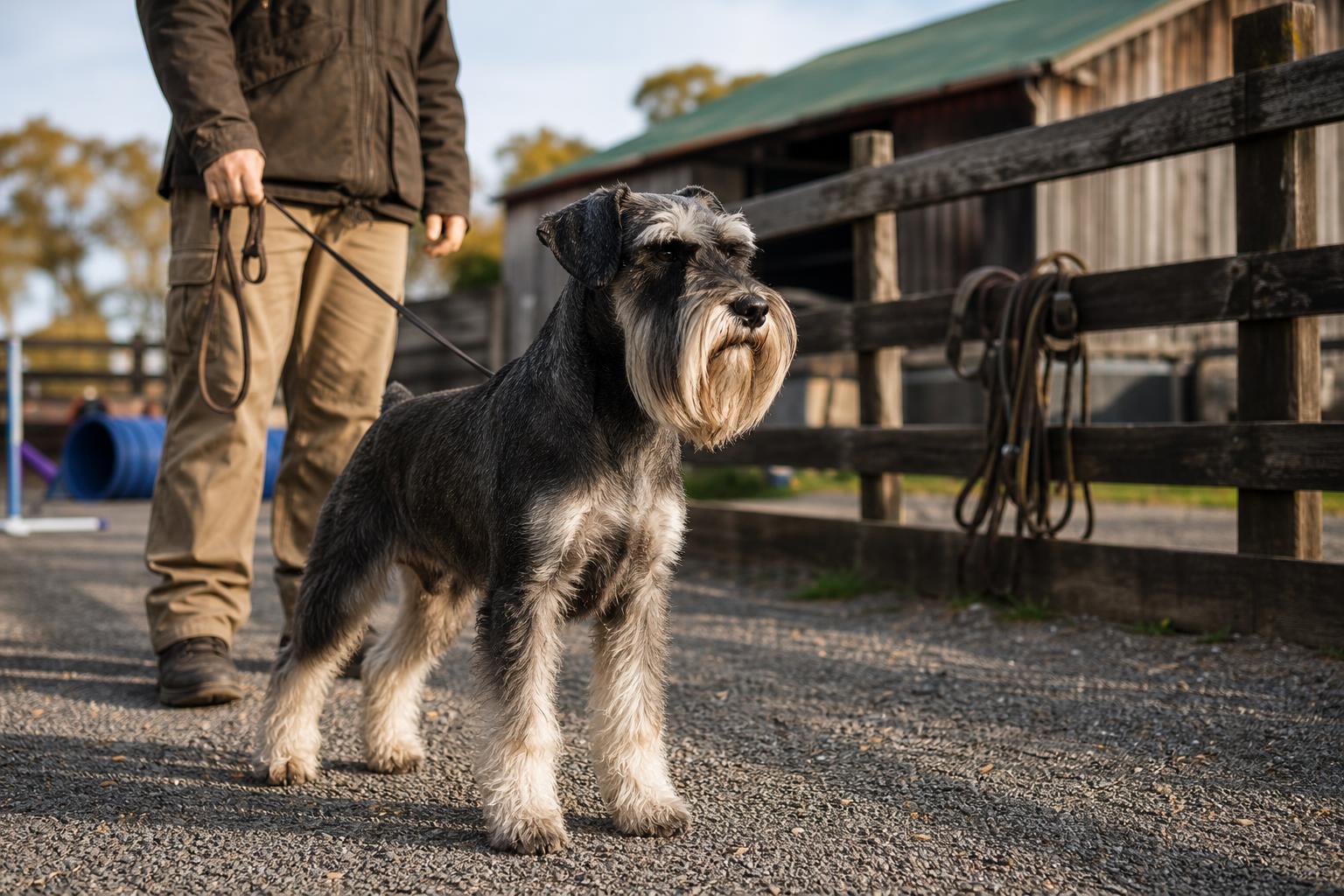
A finished Standard Schnauzer can be a smart choice for a buyer who wants the advantages of an adult dog with known temperament, clearer manners, and some meaningful training already in place. The Standard Schnauzer is an energetic, intelligent, medium-sized working breed developed in Germany as a versatile farm dog, watchdog, herding helper, and determined rat catcher. That background matters when evaluating a finished dog, because this breed is usually alert, confident, socially engaged with its family, and quick to notice anything unusual.
Finished does not mean automatic, effortless, or perfect. With Standard Schnauzers, the label should describe what the dog can reliably do in real life. A finished dog may have obedience training, household manners, sport experience, farm exposure, scent work, agility, rally, protection-style foundations, or other practical work depending on the seller's program. The buyer's job is to match the dog in front of them to the life they actually plan to provide.
What makes a finished dog
A finished Standard Schnauzer should have a clear training history and enough maturity that a buyer can judge its personality, drive, handling, and day-to-day habits. Because the breed is intelligent and often independent, reliable response to basic cues is important. Look for a dog that can settle, walk politely, accept grooming routines, recover from excitement, and work with a handler without constant conflict.
Ask the seller to define finished in plain terms. Does the dog know obedience commands only in a training yard, or does it respond in public, around other dogs, and in a busy home? Has it lived as a house dog, kennel dog, farm dog, or sport prospect? How does it react to strangers, children, small animals, delivery drivers, livestock, and unfamiliar noises? A Standard Schnauzer's alert nature can be a strength, but it needs structure and social judgment.
- Request a demonstration of the actual skills being advertised.
- Watch the dog before and after work, not only during polished exercises.
- Ask how the dog handles grooming, nail trims, the beard, coat care, and travel.
- Clarify whether the dog is finished for family life, dog sports, farm work, or another purpose.
Hunt tests
Hunt tests may not be a central measure for most Standard Schnauzer finished-dog purchases. The breed has working roots and can enjoy scent games and training-based activities, but it is not usually evaluated by the same hunt test expectations as many pointing, flushing, or retrieving breeds. If a seller mentions hunt tests, ask which organization issued the result, what skills were tested, and why that test is relevant to this individual dog.
The absence of hunt test credentials should not automatically count against a Standard Schnauzer. For many buyers, practical obedience, stable temperament, confident public behavior, controlled alertness, and good household manners will be more important. When hunt-related claims are made, verify the details rather than relying on broad phrases like fully trained or field proven.
Verify working records and breed eligibility
Verify reported working titles and test results with the issuing organisation. Confirm that the programme applies to the breed and ask what the result demonstrates about the individual dog.
For this breed, buyers should usually give more weight to demonstrations and references that show trainability, impulse control, confidence, recovery, and handler relationship. The Standard Schnauzer's strengths include intelligence, energy, loyalty, watchdog instinct, and willingness to work. Those traits can be excellent in the right home, but they should be evaluated in settings that resemble the buyer's daily life.
Trial records
Trial records or sport results can add value when they are authentic and connected to the dog being sold. Standard Schnauzers may be involved in obedience, rally, agility, scent work, barn-hunt style activities, or other structured performance events. These records can show that the dog has trained around distractions and performed under outside evaluation, but titles alone do not tell the whole story.
Ask for the dog's registered name, event organization, dates, levels, and score sheets where available. Then ask what the records mean in practical terms. A dog with strong sport drive may be a wonderful partner for an active owner, while the same dog may be too intense for someone seeking a quiet, low-maintenance companion. A buyer should also learn whether the dog is confident with strangers handling it, patient with grooming, and manageable around small moving animals.
- Verify titles, placements, or certificates with the issuing organization when possible.
- Ask whether the handler was the seller, trainer, breeder, or another owner.
- Compare formal records with everyday behavior in the home, vehicle, kennel, and public places.
- Make sure the dog's drive level fits your available exercise and training time.
Age expectations
A finished Standard Schnauzer is typically old enough for the seller to describe its adult temperament more accurately than with a puppy. Many buyers prefer a trained young adult or mature adult because the dog's size, coat, energy level, confidence, and social habits are easier to see. Still, age should be considered alongside condition, training consistency, and the buyer's goals.
A younger finished dog may have strong foundations but still need firm routines and continued social development. A middle-aged adult may offer more settled behavior and a clearer record of how it handles family life, travel, and training. An older dog may be a good match for a buyer who values predictability, but the purchase should reflect current health, mobility, grooming comfort, and expected activity level. For any age, ask about veterinary history, exercise tolerance, dental care, coat maintenance, and how the dog behaves after a busy day.
Investment value
The value of a finished Standard Schnauzer is based on suitability, proof, temperament, training quality, and honest disclosure. Exact pricing varies too much by region, pedigree, age, training depth, and seller reputation to state a universal amount. Instead of focusing only on the purchase price, consider what risk has been reduced. A well-evaluated adult can give you clearer information about energy, size, coat care, vocal habits, watchdog tendencies, and social confidence.
At the same time, a trained adult is only a good investment if the dog fits your household. Standard Schnauzers need mental engagement, exercise, grooming, and consistent expectations. A bargain dog that is too reactive, too vocal for shared-wall living, difficult to groom, or poorly matched with small pets can become expensive in time, training, and stress. A fair purchase should include transparent records, a health history, a clear explanation of training, and enough observation for the buyer to make an informed decision.
Practical questions before buying
- What specific behaviors and skills make this Standard Schnauzer finished?
- Can the seller demonstrate those skills in a realistic setting?
- How does the dog respond to strangers, dogs, children, small animals, and routine household activity?
- What grooming method has been used, and how cooperative is the dog for coat care?
- What records, references, training notes, and veterinary history are available?
- What ongoing exercise, enrichment, and handling structure does the dog need?
Buyer-focused conclusion
Verify reported working titles and test results with the issuing organisation. Confirm that the programme applies to the breed and ask what the result demonstrates about the individual dog.
Explore Standard Schnauzer on Working Dog Central
View the Standard Schnauzer breed profile or browse Standard Schnauzer listings.


