Working as a Detection Dog Trainer
What the Job Really Demands
Jeff Davis | https://workingdogcentral.com
 0
0 0
0 0
0 0
0 0
0
There is a romantic picture some folks carry of detection dog work. They imagine a sharp dog quartering through a room, nose busy, tail alive, then freezing into a final response while everyone around nods in admiration. That moment is real, and when you have built a dog to that point with your own hands, it is satisfying in a way few jobs can match. Still, working as a detection dog trainer is not a string of dramatic finds and polished demonstrations. It is patient, repetitive, detail-heavy work that demands timing, honesty, and a deep respect for what a dog can and cannot tell you.
I have spent enough time around working dogs to know that good training is usually quieter than outsiders expect. It happens in empty buildings, in hot vehicles, in training fields before sunrise, and in the plain little repetitions that teach a dog how to hunt, how to stay in odor, and how to trust the game. If you are a dog owner interested in working dogs, and you have wondered what this line of work is actually like, it helps to understand that a detection dog trainer is shaping behavior, building desire, and creating reliability under pressure. That is the heart of it.
What a Detection Dog Trainer Really Does
At the most basic level, a detection dog trainer teaches a dog to locate a target odor and communicate that find in a clear, reliable way. Depending on the program, those target odors may involve narcotics, explosives, firearms, bed bugs, agricultural pests, wildlife scat, or conservation scents. The odor changes, the operational environment changes, and the client’s expectations change, but the core principles stay remarkably similar.
The trainer starts by building value for the search itself. A dog that loves to hunt is easier to train than a dog that is merely compliant. Most strong detection prospects carry natural hunt drive, possession, environmental stability, and enough nerve to work through pressure without falling apart. The trainer’s job is to take those raw materials and polish them into a dependable pattern. That means teaching the dog how to search methodically without draining initiative, how to source odor instead of guessing, and how to offer a trained final response that is easy for the handler to read.
But the work does not stop with the dog. A detection dog trainer is also training handlers, supervisors, clients, and sometimes entire organizations. Plenty of weak teams are not weak because the dog lacks talent. They are weak because the person on the other end of the leash does not understand scent movement, reward timing, search patterns, contamination, or the way their own body language can influence outcomes. A seasoned trainer spends nearly as much time educating people as shaping dogs.
The Difference Between Training and Testing
This is one lesson that separates serious trainers from showmen. Training is where you build understanding, solve problems, and let the dog learn. Testing is where you measure what is truly there. If you blur the two, you start lying to yourself. A good detection dog trainer protects the integrity of both. In training, you can guide, reward, reset, and break pieces apart. In testing, the dog and handler must stand on their own. If they cannot, then the answer is not to explain it away. The answer is to go back to work.
The Dogs Best Suited for Detection Work
Not every good dog is a detection dog, and that is worth saying plainly. A fine house dog, a steady bird dog, or a willing obedience dog may still lack the traits that make detection work practical at a high level. Detection dogs need hunt, independence without chaos, clear reward motivation, confidence in strange places, and the resilience to stay engaged after mistakes or frustration.
Some of the best dogs I have seen carried an almost irritating persistence. They did not quit on a problem just because it became difficult. They kept digging with their nose and mind. That kind of dog can be molded into something special. On the other hand, dogs that shut down in slick buildings, distrust novel surfaces, or lose intensity when reward is delayed often require far more management and may never become truly reliable operational partners.
Breed matters some, but individual dog matters more. Labrador Retrievers, German Shorthaired Pointers, Belgian Malinois, German Shepherds, Springer Spaniels, and mixes with the right traits all appear in detection work for good reason. They tend to offer athleticism, drive, and workable temperaments. Still, no breed alone guarantees success. A detection dog trainer learns quickly to evaluate the dog in front of them rather than chase reputation.
How Detection Dogs Are Built
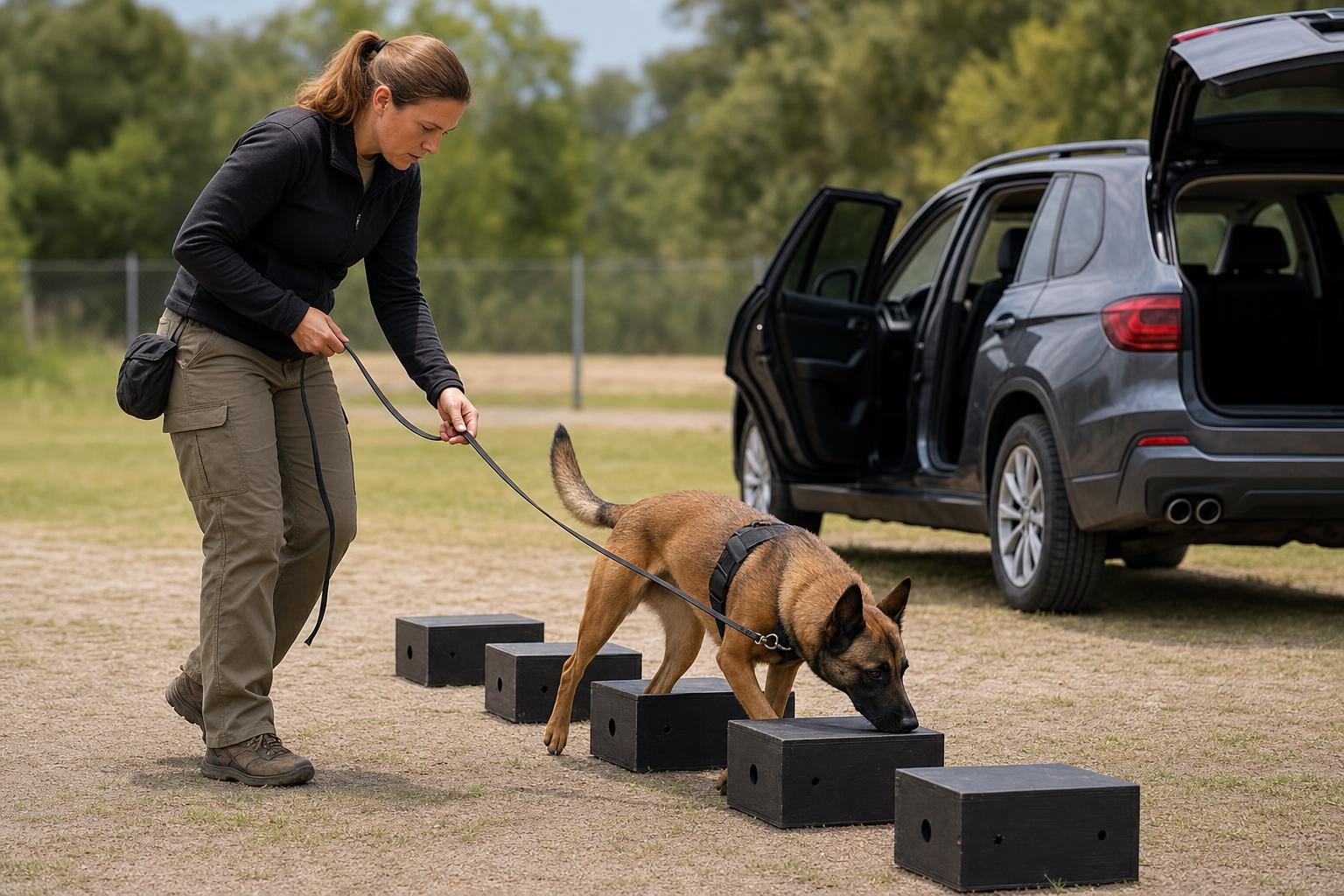
Most solid detection programs begin with a simple idea: make odor the path to reward. However that reward is delivered, whether it is a toy, food, or a tightly controlled work game, the dog must believe the search pays. In the early stages, training often looks almost too simple to outsiders. A hide is set, the dog encounters odor, and the trainer creates a clean, meaningful association. Over time, those straightforward setups give way to more complicated problems involving inaccessible hides, elevated odor, converging scent, residual odor, distractors, and environmental noise.
The trainer must read every piece of the picture. Did the dog truly commit to odor, or did it key off pattern? Was that change of behavior genuine, or was the dog checking in from uncertainty? Did the reward come at exactly the right moment, or did sloppy timing reinforce something secondary? This is where experience matters. A detection dog trainer lives in the small details, because the small details are what later become strengths or liabilities in the field.
Reading the Dog in Real Time
One of the hardest skills to teach is dog reading, because it cannot be reduced to a script. When a dog enters odor, the signs may be bold or subtle. Head carriage changes, breathing shifts, tail rhythm changes, speed alters, and the dog may begin casting to solve the cone. A novice may miss half of it. A seasoned trainer watches that sequence unfold like a familiar trail in fresh dust.
I have seen young trainers focus so hard on the final alert that they ignore the hunt before it. That is backwards. The alert matters, but the hunt tells the truth. If you do not understand how the dog arrived there, you cannot diagnose problems, strengthen commitment, or explain performance to a handler. Good trainers learn to see searching as a conversation the dog is having with scent and environment.
The Daily Reality of the Job
There is field craft in this work, but there is also routine. You clean kennels. You maintain records. You source training aids responsibly. You set blinds. You drive long hours to access fresh locations. You repeat foundation exercises on days when nothing feels glamorous. If you train handler teams, you also manage nerves, ego, and inconsistent homework. Some dogs progress cleanly. Others hit rough patches that require patience and creative problem solving.
Operational readiness is built on consistency, not inspiration. A detection dog trainer cannot afford lazy setups or sentimental evaluation. If a dog is weak on vehicles, you train vehicles. If the final response is sticky in luggage but sloppy indoors, you isolate that issue and work it honestly. If a handler crowds the dog and creates false indications, you address it directly. The work rewards discipline more than flair.
That said, there are moments that stay with you. Watching a green dog suddenly understand source and drive into it with confidence is one of them. Seeing a handler who once fumbled the leash now trust their dog and move with purpose is another. Those are hard-earned moments, and they carry a kind of pride that anyone who values working dogs will understand.
Skills You Need Beyond Dog Training
A successful detection dog trainer needs more than mechanical dog skills. Communication is critical. You may know exactly why a dog is failing, but if you cannot explain it in plain language to the handler, improvement comes slowly. Observation is another major piece. Strong trainers notice patterns across sessions, environments, and teams. They keep records not for paperwork alone, but because data tells the truth when memory grows flattering.
Integrity may be the most important trait of all. In detection work, a trainer can do real damage by overrating a dog, inflating a team’s readiness, or letting weak performance slide because confrontation is uncomfortable. Honest training protects the dog, the handler, the client, and the public. There is no room for fantasy in work that depends on reliability.
Understanding Scent Is Essential
If you want to work as a detection dog trainer, spend serious time learning scent theory. Odor is influenced by airflow, temperature, moisture, surfaces, elevation, contamination, and countless little quirks of structure and terrain. Dogs do not smell in straight lines, and odor rarely sits where beginners expect it to. Trainers who fail to understand scent movement often blame the dog for problems the environment created. That is unfair and unproductive.
The best trainers I have known treat every search area like a living system. They watch wind, heat, and air exchange. They think about how odor pools, lifts, drifts, and leaks. That knowledge makes training cleaner and problem solving faster.
Is Detection Dog Training a Good Career?
For the right person, it can be deeply rewarding. You work close to dogs, develop practical skill, and contribute to something that matters. You may train for law enforcement, private security, conservation programs, pest detection companies, or specialty search services. Still, it is not easy money and it is not a casual hobby once lives, cases, contracts, or public trust are attached to the work.
The best path into the profession usually involves apprenticing under credible trainers, handling dogs yourself, learning decoy-proof record keeping and evaluation methods, and spending time around proven working teams. Certifications have their place, but paper alone does not make a dog trainer. Repetition, exposure, mentorship, and honest outcomes do.
If you are coming at this as a dog owner with a strong interest in working dogs, the first step is not pretending to be an expert. It is learning to watch good work, asking better questions, and building your own handling and observation skills. Detection dog training is one of those trades where humility will carry you farther than swagger.
Final Thoughts on Working as a Detection Dog Trainer
At its best, this work is a partnership between instinct and structure. The dog brings nose, drive, and desire. The trainer brings timing, clarity, standards, and experience. When the two come together, the result is a working animal that can search with purpose in places where human senses fall short.
That is what keeps people in the profession. Not the title, and not the image of it, but the craft itself. A detection dog trainer gets to shape natural ability into useful performance, one session at a time. It is demanding work, honest work, and for people who admire what a good working dog can do, it is hard to imagine a finer trade.
I have spent enough time around working dogs to know that good training is usually quieter than outsiders expect. It happens in empty buildings, in hot vehicles, in training fields before sunrise, and in the plain little repetitions that teach a dog how to hunt, how to stay in odor, and how to trust the game. If you are a dog owner interested in working dogs, and you have wondered what this line of work is actually like, it helps to understand that a detection dog trainer is shaping behavior, building desire, and creating reliability under pressure. That is the heart of it.
What a Detection Dog Trainer Really Does
At the most basic level, a detection dog trainer teaches a dog to locate a target odor and communicate that find in a clear, reliable way. Depending on the program, those target odors may involve narcotics, explosives, firearms, bed bugs, agricultural pests, wildlife scat, or conservation scents. The odor changes, the operational environment changes, and the client’s expectations change, but the core principles stay remarkably similar.
The trainer starts by building value for the search itself. A dog that loves to hunt is easier to train than a dog that is merely compliant. Most strong detection prospects carry natural hunt drive, possession, environmental stability, and enough nerve to work through pressure without falling apart. The trainer’s job is to take those raw materials and polish them into a dependable pattern. That means teaching the dog how to search methodically without draining initiative, how to source odor instead of guessing, and how to offer a trained final response that is easy for the handler to read.
But the work does not stop with the dog. A detection dog trainer is also training handlers, supervisors, clients, and sometimes entire organizations. Plenty of weak teams are not weak because the dog lacks talent. They are weak because the person on the other end of the leash does not understand scent movement, reward timing, search patterns, contamination, or the way their own body language can influence outcomes. A seasoned trainer spends nearly as much time educating people as shaping dogs.
The Difference Between Training and Testing
This is one lesson that separates serious trainers from showmen. Training is where you build understanding, solve problems, and let the dog learn. Testing is where you measure what is truly there. If you blur the two, you start lying to yourself. A good detection dog trainer protects the integrity of both. In training, you can guide, reward, reset, and break pieces apart. In testing, the dog and handler must stand on their own. If they cannot, then the answer is not to explain it away. The answer is to go back to work.
The Dogs Best Suited for Detection Work
Not every good dog is a detection dog, and that is worth saying plainly. A fine house dog, a steady bird dog, or a willing obedience dog may still lack the traits that make detection work practical at a high level. Detection dogs need hunt, independence without chaos, clear reward motivation, confidence in strange places, and the resilience to stay engaged after mistakes or frustration.
Some of the best dogs I have seen carried an almost irritating persistence. They did not quit on a problem just because it became difficult. They kept digging with their nose and mind. That kind of dog can be molded into something special. On the other hand, dogs that shut down in slick buildings, distrust novel surfaces, or lose intensity when reward is delayed often require far more management and may never become truly reliable operational partners.
Breed matters some, but individual dog matters more. Labrador Retrievers, German Shorthaired Pointers, Belgian Malinois, German Shepherds, Springer Spaniels, and mixes with the right traits all appear in detection work for good reason. They tend to offer athleticism, drive, and workable temperaments. Still, no breed alone guarantees success. A detection dog trainer learns quickly to evaluate the dog in front of them rather than chase reputation.
How Detection Dogs Are Built
Most solid detection programs begin with a simple idea: make odor the path to reward. However that reward is delivered, whether it is a toy, food, or a tightly controlled work game, the dog must believe the search pays. In the early stages, training often looks almost too simple to outsiders. A hide is set, the dog encounters odor, and the trainer creates a clean, meaningful association. Over time, those straightforward setups give way to more complicated problems involving inaccessible hides, elevated odor, converging scent, residual odor, distractors, and environmental noise.
The trainer must read every piece of the picture. Did the dog truly commit to odor, or did it key off pattern? Was that change of behavior genuine, or was the dog checking in from uncertainty? Did the reward come at exactly the right moment, or did sloppy timing reinforce something secondary? This is where experience matters. A detection dog trainer lives in the small details, because the small details are what later become strengths or liabilities in the field.
Reading the Dog in Real Time
One of the hardest skills to teach is dog reading, because it cannot be reduced to a script. When a dog enters odor, the signs may be bold or subtle. Head carriage changes, breathing shifts, tail rhythm changes, speed alters, and the dog may begin casting to solve the cone. A novice may miss half of it. A seasoned trainer watches that sequence unfold like a familiar trail in fresh dust.
I have seen young trainers focus so hard on the final alert that they ignore the hunt before it. That is backwards. The alert matters, but the hunt tells the truth. If you do not understand how the dog arrived there, you cannot diagnose problems, strengthen commitment, or explain performance to a handler. Good trainers learn to see searching as a conversation the dog is having with scent and environment.
The Daily Reality of the Job
There is field craft in this work, but there is also routine. You clean kennels. You maintain records. You source training aids responsibly. You set blinds. You drive long hours to access fresh locations. You repeat foundation exercises on days when nothing feels glamorous. If you train handler teams, you also manage nerves, ego, and inconsistent homework. Some dogs progress cleanly. Others hit rough patches that require patience and creative problem solving.
Operational readiness is built on consistency, not inspiration. A detection dog trainer cannot afford lazy setups or sentimental evaluation. If a dog is weak on vehicles, you train vehicles. If the final response is sticky in luggage but sloppy indoors, you isolate that issue and work it honestly. If a handler crowds the dog and creates false indications, you address it directly. The work rewards discipline more than flair.
That said, there are moments that stay with you. Watching a green dog suddenly understand source and drive into it with confidence is one of them. Seeing a handler who once fumbled the leash now trust their dog and move with purpose is another. Those are hard-earned moments, and they carry a kind of pride that anyone who values working dogs will understand.
Skills You Need Beyond Dog Training
A successful detection dog trainer needs more than mechanical dog skills. Communication is critical. You may know exactly why a dog is failing, but if you cannot explain it in plain language to the handler, improvement comes slowly. Observation is another major piece. Strong trainers notice patterns across sessions, environments, and teams. They keep records not for paperwork alone, but because data tells the truth when memory grows flattering.
Integrity may be the most important trait of all. In detection work, a trainer can do real damage by overrating a dog, inflating a team’s readiness, or letting weak performance slide because confrontation is uncomfortable. Honest training protects the dog, the handler, the client, and the public. There is no room for fantasy in work that depends on reliability.
Understanding Scent Is Essential
If you want to work as a detection dog trainer, spend serious time learning scent theory. Odor is influenced by airflow, temperature, moisture, surfaces, elevation, contamination, and countless little quirks of structure and terrain. Dogs do not smell in straight lines, and odor rarely sits where beginners expect it to. Trainers who fail to understand scent movement often blame the dog for problems the environment created. That is unfair and unproductive.
The best trainers I have known treat every search area like a living system. They watch wind, heat, and air exchange. They think about how odor pools, lifts, drifts, and leaks. That knowledge makes training cleaner and problem solving faster.
Is Detection Dog Training a Good Career?
For the right person, it can be deeply rewarding. You work close to dogs, develop practical skill, and contribute to something that matters. You may train for law enforcement, private security, conservation programs, pest detection companies, or specialty search services. Still, it is not easy money and it is not a casual hobby once lives, cases, contracts, or public trust are attached to the work.
The best path into the profession usually involves apprenticing under credible trainers, handling dogs yourself, learning decoy-proof record keeping and evaluation methods, and spending time around proven working teams. Certifications have their place, but paper alone does not make a dog trainer. Repetition, exposure, mentorship, and honest outcomes do.
If you are coming at this as a dog owner with a strong interest in working dogs, the first step is not pretending to be an expert. It is learning to watch good work, asking better questions, and building your own handling and observation skills. Detection dog training is one of those trades where humility will carry you farther than swagger.
Final Thoughts on Working as a Detection Dog Trainer
At its best, this work is a partnership between instinct and structure. The dog brings nose, drive, and desire. The trainer brings timing, clarity, standards, and experience. When the two come together, the result is a working animal that can search with purpose in places where human senses fall short.
That is what keeps people in the profession. Not the title, and not the image of it, but the craft itself. A detection dog trainer gets to shape natural ability into useful performance, one session at a time. It is demanding work, honest work, and for people who admire what a good working dog can do, it is hard to imagine a finer trade.