How Puppies Are Selected for Detection Programs
Jeff Davis | https://workingdogcentral.com
How Puppies Are Selected for Detection Programs
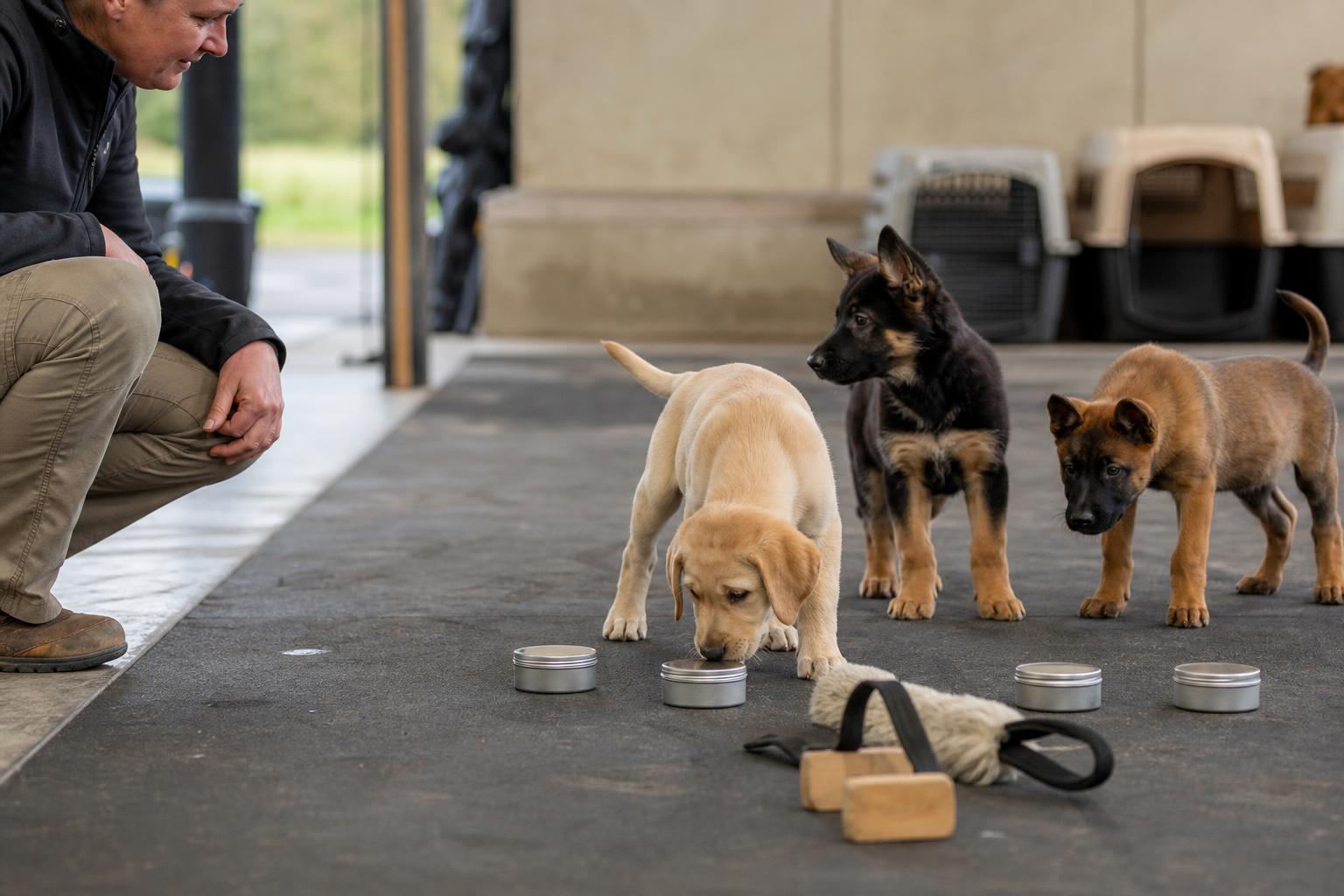
Folks who have never stood in a kennel aisle full of bright-eyed pups often think detection dogs are chosen by luck. They picture one puppy sniffing a toy harder than the others and assume that is the whole story. In truth, selecting puppies for detection programs is a careful process shaped by genetics, observation, field sense, and a fair bit of humility. Even with all the right signs early on, no honest trainer will tell you there are guarantees. What we are really doing is stacking the odds in our favor and looking for young dogs with the mind, body, and desire to handle demanding work.
I have seen pups from the same litter split wide apart as they matured. One grows into a tireless worker that hunts odor like it was born for nothing else, while another, just as healthy and well-bred, decides life is better spent in a family home with a soft bed and a tennis ball. That is why good detection programs do not rely on a single moment or a single test. They look at the whole dog, and just as importantly, they look at the dog over time.
Why Selection Matters So Much in Detection Work
Detection work asks a lot from a dog. Whether the program is focused on narcotics, explosives, conservation detection, human remains, or bed bugs, the foundation is the same. The dog must want to hunt, stay engaged, recover from pressure, and work through strange environments without quitting. A pup that startles and never settles, or one that loses interest when the game gets hard, is going to struggle in a real deployment setting.
The cost of raising and training a detection dog is too high to guess recklessly. Programs invest months, sometimes years, into development. That means the selection phase is where discipline starts. A promising puppy is not just cute or energetic. It needs the raw materials for a job that demands nerve, focus, endurance, and a deep love of seeking out reward.
Good Detection Puppies Usually Start with Good Breeding
Most experienced programs begin with genetics. That does not mean every great detection dog comes from a famous pedigree, but breeding matters. Generations of dogs selected for hunt drive, environmental toughness, stable nerves, and health tend to produce pups with a better chance of succeeding. Labrador Retrievers, German Shorthaired Pointers, Belgian Malinois, German Shepherd Dogs, and Springer Spaniels are common in different detection roles for a reason. These breeds, when well-bred, often carry the working traits trainers need.
A good breeder or program manager studies more than titles on paper. They look at what the parents are actually like day to day. Do they search with intensity? Do they recover quickly from startling noises? Are they social without being soft? Can they shift from high arousal to clear thinking? A puppy inherits more than color and build. It inherits tendencies, thresholds, and instincts that may shape every part of its future training.
Health Is Never an Afterthought
No matter how driven a puppy looks, soundness comes first. Detection dogs spend long hours moving across concrete, brush, slick floors, vehicles, warehouses, and uneven ground. Programs pay close attention to orthopedic health, eye issues, cardiac concerns, and any inherited weakness that could shorten a working life. Early veterinary screening, honest breeder records, and close physical observation all play a role.
Even in very young puppies, experienced evaluators watch how they move, how they carry themselves, and whether anything about their structure raises concern. A dog may have all the heart in the world, but if the body cannot hold up, the program will pay for it later.
Temperament Testing Is Helpful, but It Is Not Magic
There is a lot of talk about puppy tests, and some of it gets overblown. Temperament testing can be useful, but only when the person reading the puppy understands context. A bold pup on one day may be tired the next. A quieter pup may wake up once confidence develops. That is why the best evaluators do not treat a single test like a crystal ball.
What they do look for is pattern. They watch how a puppy responds to novelty, restraint, sound, footing changes, movement, and social pressure. They notice which pups engage quickly, which persist when frustrated, and which recover after a surprise. Recovery is a trait old dog men respect because it shows up again and again in real work. A pup that startles at a dropped pan but returns to investigate often has better prospects than one that shuts down or avoids the area entirely.
Drive Is More Than Hyperactivity
One of the most misunderstood parts of puppy selection is drive. People sometimes confuse a busy, bouncing puppy with a true working prospect. Real detection drive is not just motion. It is purposeful desire. The puppy wants the toy, the rolled towel, the box with odor, or the hidden reward, and it keeps working to get it.
That kind of pup will chase with commitment, grab with conviction, and re-engage after a miss. If you take the reward away, it comes back asking questions. It hunts with its nose and brain, not just its feet. That matters because detection training leans heavily on a dog’s willingness to solve a problem for pay. Trainers want pups that see searching as the best game in the world.
Environmental Confidence Separates Many Prospects
I have seen more than one flashy young dog look excellent in a familiar yard and come unraveled on metal stairs, dark hallways, or slippery tile. Detection dogs do not work only where they are comfortable. They may search schools, cargo areas, airports, barns, offices, alleys, and vehicles, often with noise, strange scents, and people crowding the scene.
That is why programs test environmental confidence early. They expose puppies to odd surfaces, unstable objects, loud sounds, narrow spaces, and unfamiliar settings. The goal is not to find a pup that never reacts. The goal is to find one that reacts, thinks, and then works through it. That is a dog with usable nerve.
A strong puppy will often step into uncertainty with curiosity. You can almost see the wheels turning. It may pause at a wobble board or glance at a clattering object, but then it leans in, investigates, and gets back to the game. That willingness to push forward is worth its weight in gold.
The Best Programs Watch Puppies Over Time
Anybody can fall in love with a single afternoon performance. Good programs know better. Puppies change fast, and development is not always linear. One week they seem fearless, the next week they go through a cautious spell. Teething, growth, stress, social development, and environment can all influence behavior.
That is why the strongest selection systems involve repeated observation. Trainers watch how a puppy plays, eats, sleeps, explores, handles travel, responds to strangers, and pursues reward over several weeks or months. They note how quickly the pup bounces back after pressure and whether drive holds steady in new places. Consistency tells a truer story than one flashy session ever will.
Handler Fit Still Matters
Even a talented puppy is not a perfect fit for every program or every handler. Some dogs are intense and sharp, well suited for experienced trainers who like a lot of motor. Others are more social and biddable, making them easier to develop in programs that need a dog with broad public access manners. Selection is not just about identifying quality. It is about matching that quality to the work ahead.
A seasoned trainer will often ask not only, “Is this puppy good?” but also, “Good for what, and good for whom?” That question saves a lot of disappointment down the road.
Early Search Behavior and Toy Possession Tell a Bigger Story
Many detection programs put a heavy emphasis on play because reward drives the work. A puppy that loves possession, tug, chase, and searching for a hidden toy often transitions more naturally into odor work. The toy becomes payment, and the search becomes the path to earning it.
In practical evaluations, trainers may toss a toy into light cover, drag a reward through an area, or partly hide it behind simple obstacles. They are not expecting polished behavior. They are looking for intent. Does the puppy use its nose? Does it keep hunting when the reward is not immediately obvious? Does it celebrate success and want to go again?
There is something special about watching a young dog lock onto a problem and refuse to quit. It reminds me of seeing a good bird pup hit a hedgerow for the first time and hunt like it has old instincts whispering in its ear. Different jobs, same truth: heart shows itself early if you know how to look.
No Puppy Is Chosen on Potential Alone
The hard truth is that not every promising puppy makes it through a detection pipeline. Some wash out for health, some for environmental weakness, some because their reward system never deepens enough, and some simply because the work is not right for them. Honest programs accept that and keep standards high.
That is not failure. It is responsible dog selection. A puppy that does not belong in detection may still become an excellent sporting dog, service prospect, or family companion. Good evaluators respect the dog in front of them instead of trying to force a square peg into a round hole.
What Dog Owners Should Understand About Detection Puppy Selection
For dog owners interested in working dogs, the biggest lesson is this: the best detection puppies are chosen through a blend of breeding, health screening, repeated evaluation, and practical experience. Trainers are looking for hunt drive, confidence, recovery, sound structure, and a reward system strong enough to carry the dog through serious training.
It takes a sharp eye to spot those traits and an even sharper one to stay realistic about them. The best selectors I have known were not the loudest men in the room. They watched carefully, said little, and trusted what the puppy showed them over time. In the end, detection dog selection is about reading possibility without fooling yourself. When a pup has the right mind, the right body, and that honest hunger to go find something hidden, you know you are not just looking at a puppy. You are looking at the beginning of a working partner.
Folks who have never stood in a kennel aisle full of bright-eyed pups often think detection dogs are chosen by luck. They picture one puppy sniffing a toy harder than the others and assume that is the whole story. In truth, selecting puppies for detection programs is a careful process shaped by genetics, observation, field sense, and a fair bit of humility. Even with all the right signs early on, no honest trainer will tell you there are guarantees. What we are really doing is stacking the odds in our favor and looking for young dogs with the mind, body, and desire to handle demanding work.
I have seen pups from the same litter split wide apart as they matured. One grows into a tireless worker that hunts odor like it was born for nothing else, while another, just as healthy and well-bred, decides life is better spent in a family home with a soft bed and a tennis ball. That is why good detection programs do not rely on a single moment or a single test. They look at the whole dog, and just as importantly, they look at the dog over time.
Why Selection Matters So Much in Detection Work
Detection work asks a lot from a dog. Whether the program is focused on narcotics, explosives, conservation detection, human remains, or bed bugs, the foundation is the same. The dog must want to hunt, stay engaged, recover from pressure, and work through strange environments without quitting. A pup that startles and never settles, or one that loses interest when the game gets hard, is going to struggle in a real deployment setting.
The cost of raising and training a detection dog is too high to guess recklessly. Programs invest months, sometimes years, into development. That means the selection phase is where discipline starts. A promising puppy is not just cute or energetic. It needs the raw materials for a job that demands nerve, focus, endurance, and a deep love of seeking out reward.
Good Detection Puppies Usually Start with Good Breeding
Most experienced programs begin with genetics. That does not mean every great detection dog comes from a famous pedigree, but breeding matters. Generations of dogs selected for hunt drive, environmental toughness, stable nerves, and health tend to produce pups with a better chance of succeeding. Labrador Retrievers, German Shorthaired Pointers, Belgian Malinois, German Shepherd Dogs, and Springer Spaniels are common in different detection roles for a reason. These breeds, when well-bred, often carry the working traits trainers need.
A good breeder or program manager studies more than titles on paper. They look at what the parents are actually like day to day. Do they search with intensity? Do they recover quickly from startling noises? Are they social without being soft? Can they shift from high arousal to clear thinking? A puppy inherits more than color and build. It inherits tendencies, thresholds, and instincts that may shape every part of its future training.
Health Is Never an Afterthought
No matter how driven a puppy looks, soundness comes first. Detection dogs spend long hours moving across concrete, brush, slick floors, vehicles, warehouses, and uneven ground. Programs pay close attention to orthopedic health, eye issues, cardiac concerns, and any inherited weakness that could shorten a working life. Early veterinary screening, honest breeder records, and close physical observation all play a role.
Even in very young puppies, experienced evaluators watch how they move, how they carry themselves, and whether anything about their structure raises concern. A dog may have all the heart in the world, but if the body cannot hold up, the program will pay for it later.
Temperament Testing Is Helpful, but It Is Not Magic
There is a lot of talk about puppy tests, and some of it gets overblown. Temperament testing can be useful, but only when the person reading the puppy understands context. A bold pup on one day may be tired the next. A quieter pup may wake up once confidence develops. That is why the best evaluators do not treat a single test like a crystal ball.
What they do look for is pattern. They watch how a puppy responds to novelty, restraint, sound, footing changes, movement, and social pressure. They notice which pups engage quickly, which persist when frustrated, and which recover after a surprise. Recovery is a trait old dog men respect because it shows up again and again in real work. A pup that startles at a dropped pan but returns to investigate often has better prospects than one that shuts down or avoids the area entirely.
Drive Is More Than Hyperactivity
One of the most misunderstood parts of puppy selection is drive. People sometimes confuse a busy, bouncing puppy with a true working prospect. Real detection drive is not just motion. It is purposeful desire. The puppy wants the toy, the rolled towel, the box with odor, or the hidden reward, and it keeps working to get it.
That kind of pup will chase with commitment, grab with conviction, and re-engage after a miss. If you take the reward away, it comes back asking questions. It hunts with its nose and brain, not just its feet. That matters because detection training leans heavily on a dog’s willingness to solve a problem for pay. Trainers want pups that see searching as the best game in the world.
Environmental Confidence Separates Many Prospects
I have seen more than one flashy young dog look excellent in a familiar yard and come unraveled on metal stairs, dark hallways, or slippery tile. Detection dogs do not work only where they are comfortable. They may search schools, cargo areas, airports, barns, offices, alleys, and vehicles, often with noise, strange scents, and people crowding the scene.
That is why programs test environmental confidence early. They expose puppies to odd surfaces, unstable objects, loud sounds, narrow spaces, and unfamiliar settings. The goal is not to find a pup that never reacts. The goal is to find one that reacts, thinks, and then works through it. That is a dog with usable nerve.
A strong puppy will often step into uncertainty with curiosity. You can almost see the wheels turning. It may pause at a wobble board or glance at a clattering object, but then it leans in, investigates, and gets back to the game. That willingness to push forward is worth its weight in gold.
The Best Programs Watch Puppies Over Time
Anybody can fall in love with a single afternoon performance. Good programs know better. Puppies change fast, and development is not always linear. One week they seem fearless, the next week they go through a cautious spell. Teething, growth, stress, social development, and environment can all influence behavior.
That is why the strongest selection systems involve repeated observation. Trainers watch how a puppy plays, eats, sleeps, explores, handles travel, responds to strangers, and pursues reward over several weeks or months. They note how quickly the pup bounces back after pressure and whether drive holds steady in new places. Consistency tells a truer story than one flashy session ever will.
Handler Fit Still Matters
Even a talented puppy is not a perfect fit for every program or every handler. Some dogs are intense and sharp, well suited for experienced trainers who like a lot of motor. Others are more social and biddable, making them easier to develop in programs that need a dog with broad public access manners. Selection is not just about identifying quality. It is about matching that quality to the work ahead.
A seasoned trainer will often ask not only, “Is this puppy good?” but also, “Good for what, and good for whom?” That question saves a lot of disappointment down the road.
Early Search Behavior and Toy Possession Tell a Bigger Story
Many detection programs put a heavy emphasis on play because reward drives the work. A puppy that loves possession, tug, chase, and searching for a hidden toy often transitions more naturally into odor work. The toy becomes payment, and the search becomes the path to earning it.
In practical evaluations, trainers may toss a toy into light cover, drag a reward through an area, or partly hide it behind simple obstacles. They are not expecting polished behavior. They are looking for intent. Does the puppy use its nose? Does it keep hunting when the reward is not immediately obvious? Does it celebrate success and want to go again?
There is something special about watching a young dog lock onto a problem and refuse to quit. It reminds me of seeing a good bird pup hit a hedgerow for the first time and hunt like it has old instincts whispering in its ear. Different jobs, same truth: heart shows itself early if you know how to look.
No Puppy Is Chosen on Potential Alone
The hard truth is that not every promising puppy makes it through a detection pipeline. Some wash out for health, some for environmental weakness, some because their reward system never deepens enough, and some simply because the work is not right for them. Honest programs accept that and keep standards high.
That is not failure. It is responsible dog selection. A puppy that does not belong in detection may still become an excellent sporting dog, service prospect, or family companion. Good evaluators respect the dog in front of them instead of trying to force a square peg into a round hole.
What Dog Owners Should Understand About Detection Puppy Selection
For dog owners interested in working dogs, the biggest lesson is this: the best detection puppies are chosen through a blend of breeding, health screening, repeated evaluation, and practical experience. Trainers are looking for hunt drive, confidence, recovery, sound structure, and a reward system strong enough to carry the dog through serious training.
It takes a sharp eye to spot those traits and an even sharper one to stay realistic about them. The best selectors I have known were not the loudest men in the room. They watched carefully, said little, and trusted what the puppy showed them over time. In the end, detection dog selection is about reading possibility without fooling yourself. When a pup has the right mind, the right body, and that honest hunger to go find something hidden, you know you are not just looking at a puppy. You are looking at the beginning of a working partner.