Dobermans as Protection Dogs
What Owners Need to Know
Jeff Davis | https://workingdogcentral.com
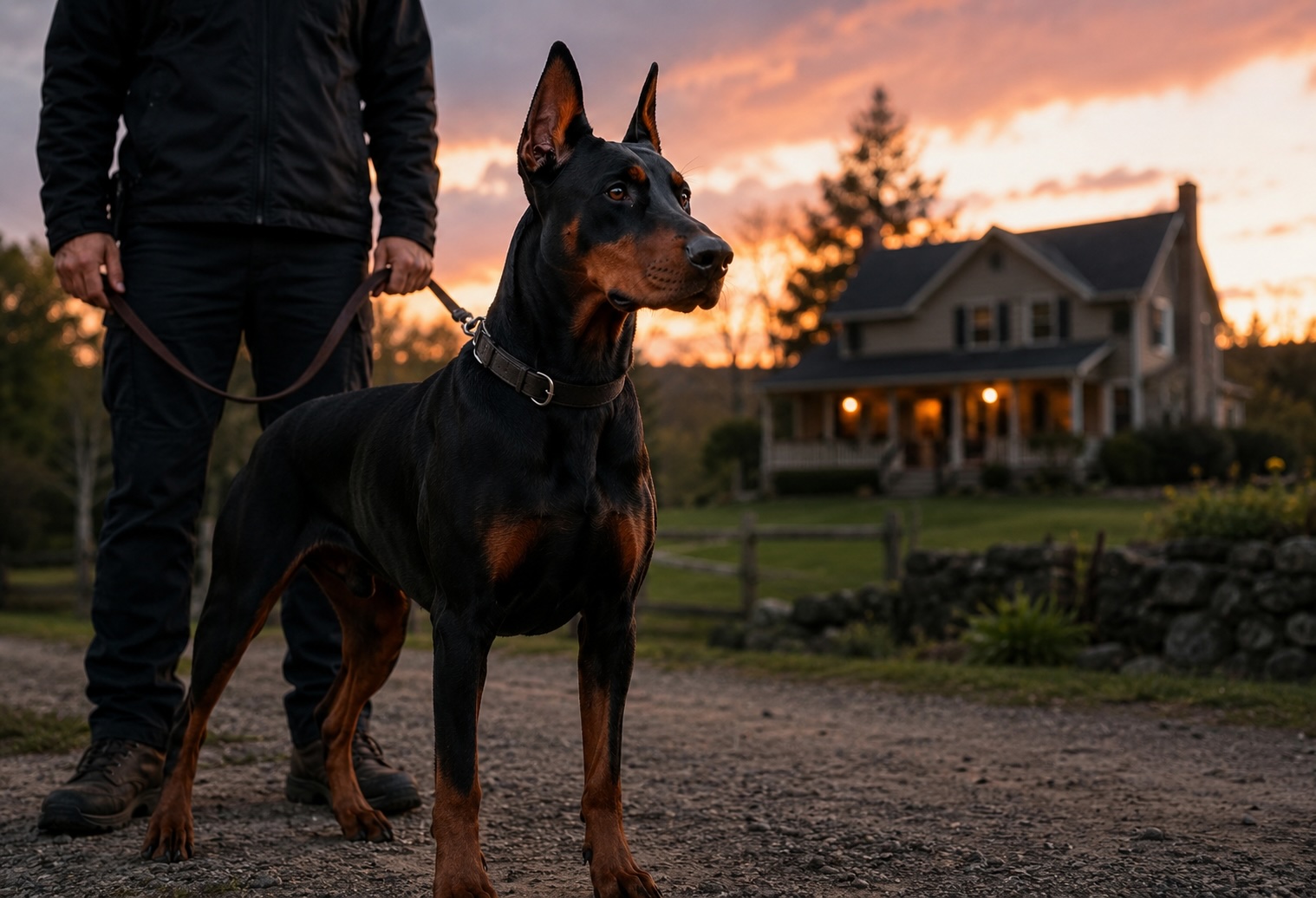
I've spent enough years around hard-working dogs to know that reputation and reality are not always the same thing. Some breeds get talked up by folks who have never handled one under pressure, and others get unfairly judged by stories that have outlived the truth. The Doberman sits squarely in that second camp. Mention the breed and you'll still hear old talk about aggression, unpredictability, and danger. Spend real time with well-bred Dobermans, though, and you see something different. You see a dog built for purpose, quick in both body and mind, deeply handler-focused, and naturally suited to protection work when raised and trained the right way.
The Doberman was developed to be a personal protection dog, and that history still shows in the breed. There is alertness in the eyes, efficiency in movement, and a kind of quiet awareness that tells you the dog is taking stock of everything around it. A good one does not need to posture all day to prove anything. The best protection Dobermans are steady, observant, and fully under control until a genuine threat presents itself.
Why Dobermans Make Strong Protection Dogs
There are several reasons the Doberman remains one of the most respected protection breeds in the world. First is athleticism. These dogs are fast, agile, and powerful without being clumsy. They can cover ground in a hurry, pivot quickly, and respond with a level of precision that matters in real-life protection scenarios. A protection dog is not just a dog that can bite. It is a dog that can think, move cleanly, and act with timing.
The second advantage is intelligence. Dobermans learn quickly, and they tend to retain lessons well when training is fair and consistent. That intelligence cuts both ways. In capable hands, it creates a polished, reliable dog. In careless hands, it creates trouble. A Doberman that is undertrained, overstimulated, or handled with mixed signals can become anxious, reactive, or difficult to manage. This is not a breed that thrives on guesswork.
Then there is loyalty. A sound Doberman usually bonds hard with its people. That bond is one of the breed's greatest strengths in protection work. These dogs are naturally tuned in to their household and tend to notice changes in tone, posture, and environment before many owners do. It is one reason they are often described as velcro dogs. They want to be near their people, and that closeness feeds their usefulness as guardians.
Natural Suspicion Without Needless Nerve
One trait that separates a real protection prospect from a dog that is simply reactive is nerve. A good Doberman should be naturally watchful with strangers, but not panicked, frantic, or unstable. In the field, around kennels, and in training yards, I've always preferred dogs that can stay clear-headed in confusion. Noise, unfamiliar movement, pressure from a decoy, strangers entering space unexpectedly, all of that tells you whether the dog has the internal strength for protection work.
A dependable Doberman should not look for a fight with every new face. It should assess, hold itself together, and take direction from the handler. That balance is what responsible owners need to understand. True protection work is built on control, not chaos.
Temperament Comes Before Training
If you are considering Dobermans as protection dogs, start with breeding and temperament before you ever think about advanced bite work. Too many people chase the image of a fierce dog and forget that the foundation has to be a stable mind. Protection training cannot fix bad nerves, weak confidence, or poor genetics. At best, it exposes them. At worst, it magnifies them.
A properly bred Doberman should be confident, biddable, environmentally sound, and socially stable. It can be reserved with strangers without being fear-driven. It can be alert without becoming hectic. Those are not small distinctions. They are the difference between a dog that can be safely trained for family protection and one that becomes a legal and practical liability.
I've seen folks buy the toughest-looking pup in the litter, thinking they found a natural protector, when what they really chose was a dog with busy nerves and no off switch. The best protection dogs often do not advertise themselves in foolish ways as puppies. They are engaged, bold, curious, and composed. They recover quickly from stress. That recovery matters more than noisy bravado ever will.
The Difference Between Guarding Instinct and Trained Protection
Most Dobermans have some natural protective instinct. They alert to unusual activity, stay close to home territory, and pay attention to strangers. That does not automatically make them trained protection dogs. There is a big difference between a dog that barks at the gate and a dog that can respond to a threat under command, disengage when told, and remain safe around family, visitors, and daily life.
Formal protection training teaches the dog how to channel instinct through obedience, confidence-building, targeting, and control. The obedience portion is every bit as important as any defensive work. In truth, more important. If a dog cannot hold a down under distraction, recall cleanly, or settle when pressure lifts, it is not ready for serious protection training.
Responsible trainers build from the ground up. They develop engagement, clarity, environmental confidence, and nerve before asking for real defensive responses. The end goal is not a dog that lives in a state of suspicion. The goal is a dog that can switch on when needed and just as importantly switch off when the situation is over.
Protection Dog or Deterrent Dog?
This is a useful question for owners to ask themselves. Many households do not need a fully trained personal protection dog. They need a strong deterrent. A large, alert Doberman with solid obedience, clear boundaries, and a stable temperament is enough to make most trouble move on down the road. Presence alone carries weight. A dog that stands tall at the front walk, watches carefully, and listens instantly to its owner has a way of changing people's plans.
For many families, that level of security is more practical and more responsible than pursuing advanced protection work. It also tends to fit better with suburban living, visitors, service workers, and the rhythm of everyday home life.
Training the Doberman the Right Way
Dobermans respond best to structured, fair training with clear expectations. They are sensitive enough to sour under heavy-handed handling, but they are also too capable to be left without standards. Good trainers strike that balance. The dog should understand what is being asked, why compliance matters, and how to succeed under pressure.
Early socialization is essential, but that word gets thrown around loosely. Socialization does not mean letting every stranger crowd your pup or allowing chaotic dog-park behavior. It means exposing the dog to the world in a measured way so it learns confidence, neutrality, and adaptability. Slick floors, traffic noise, busy sidewalks, livestock smells, dark hallways, strange voices, rattling trailers, those are the kinds of things that build a useful working mind.
Obedience should begin young and continue through adulthood. Heel, place, recall, stay, and a reliable out command are not fancy extras for a protection prospect. They are the bones of the whole operation. Without them, all you have is potential wrapped around risk.
And this is worth saying plainly: real protection training should be done with a qualified professional. Internet clips and backyard bite games create bad habits fast. A Doberman trained poorly can become confused, defensive, and dangerous in all the wrong ways. A Doberman trained correctly becomes clearer, steadier, and more reliable.
Are Dobermans Good Family Protection Dogs?
In the right home, yes, they can be exceptional. Dobermans tend to be deeply devoted to their families, and many are naturally gentle and affectionate with children they are raised with. They often want to be involved in everything, from a morning walk to the last quiet hour in the evening. That closeness is part of what makes them effective family guardians. They are not usually detached dogs posted out in the yard. They are house dogs, companion dogs, and working dogs all at once.
But that same closeness means they require time, guidance, and engagement. A neglected Doberman can become restless, destructive, or neurotic. This is not a breed for someone who wants a security system with fur and no emotional upkeep. If you want the benefits of a Doberman's protective nature, you have to give the dog leadership, exercise, and a meaningful role in the household.
I've always believed that the best family protection dogs are the ones that know how to live peacefully ninety-nine percent of the time. They lie quietly while the family eats supper, track every unusual sound after dark, and rise with purpose only when something truly deserves their attention. That is where the Doberman shines when everything is done right.
Common Mistakes Owners Make
The biggest mistake is choosing intimidation over stability. Some buyers chase the most extreme dog they can find, then discover too late they brought home an animal they cannot read or manage. Another mistake is skipping foundation work because the owner is eager for the dog to look protective. Protection is the result of maturity and training, not theatrics.
Owners also underestimate exercise and mental workload. Dobermans are not dogs you wind up and leave sitting in a crate or backyard day after day. They need movement, tasks, interaction, and consistency. A dog with nowhere to put its energy will invent its own job, and owners rarely like the result.
Health is another practical concern. Anyone serious about the breed should pay attention to issues like dilated cardiomyopathy, hip concerns, thyroid problems, and overall longevity in the bloodline. A protection dog is an investment of time, money, and trust. It makes no sense to ignore the health side of the equation.
Is a Doberman the Right Protection Dog for You?
That depends on what you want and what you can offer. If you want a sharp, loyal, highly trainable dog that lives close to its people and carries a natural protective presence, the Doberman deserves a hard look. If you are willing to invest in breeding, training, structure, and daily involvement, this breed can be one of the finest family protection dogs a person could own.
If, on the other hand, you want a dog to leave alone, show off, or push into protection work without a foundation, you would be better off choosing differently or stepping back entirely. Dobermans are too intelligent and too serious for careless ownership.
At their best, they are not reckless dogs. They are purposeful dogs. There is a difference, and it matters. A good Doberman reads the room, trusts its handler, and stands ready when needed. That kind of dog is not built by accident. It is bred with care, trained with discipline, and lived with in close partnership. For the right owner, that partnership is hard to beat.
The Doberman was developed to be a personal protection dog, and that history still shows in the breed. There is alertness in the eyes, efficiency in movement, and a kind of quiet awareness that tells you the dog is taking stock of everything around it. A good one does not need to posture all day to prove anything. The best protection Dobermans are steady, observant, and fully under control until a genuine threat presents itself.
Why Dobermans Make Strong Protection Dogs
There are several reasons the Doberman remains one of the most respected protection breeds in the world. First is athleticism. These dogs are fast, agile, and powerful without being clumsy. They can cover ground in a hurry, pivot quickly, and respond with a level of precision that matters in real-life protection scenarios. A protection dog is not just a dog that can bite. It is a dog that can think, move cleanly, and act with timing.
The second advantage is intelligence. Dobermans learn quickly, and they tend to retain lessons well when training is fair and consistent. That intelligence cuts both ways. In capable hands, it creates a polished, reliable dog. In careless hands, it creates trouble. A Doberman that is undertrained, overstimulated, or handled with mixed signals can become anxious, reactive, or difficult to manage. This is not a breed that thrives on guesswork.
Then there is loyalty. A sound Doberman usually bonds hard with its people. That bond is one of the breed's greatest strengths in protection work. These dogs are naturally tuned in to their household and tend to notice changes in tone, posture, and environment before many owners do. It is one reason they are often described as velcro dogs. They want to be near their people, and that closeness feeds their usefulness as guardians.
Natural Suspicion Without Needless Nerve
One trait that separates a real protection prospect from a dog that is simply reactive is nerve. A good Doberman should be naturally watchful with strangers, but not panicked, frantic, or unstable. In the field, around kennels, and in training yards, I've always preferred dogs that can stay clear-headed in confusion. Noise, unfamiliar movement, pressure from a decoy, strangers entering space unexpectedly, all of that tells you whether the dog has the internal strength for protection work.
A dependable Doberman should not look for a fight with every new face. It should assess, hold itself together, and take direction from the handler. That balance is what responsible owners need to understand. True protection work is built on control, not chaos.
Temperament Comes Before Training
If you are considering Dobermans as protection dogs, start with breeding and temperament before you ever think about advanced bite work. Too many people chase the image of a fierce dog and forget that the foundation has to be a stable mind. Protection training cannot fix bad nerves, weak confidence, or poor genetics. At best, it exposes them. At worst, it magnifies them.
A properly bred Doberman should be confident, biddable, environmentally sound, and socially stable. It can be reserved with strangers without being fear-driven. It can be alert without becoming hectic. Those are not small distinctions. They are the difference between a dog that can be safely trained for family protection and one that becomes a legal and practical liability.
I've seen folks buy the toughest-looking pup in the litter, thinking they found a natural protector, when what they really chose was a dog with busy nerves and no off switch. The best protection dogs often do not advertise themselves in foolish ways as puppies. They are engaged, bold, curious, and composed. They recover quickly from stress. That recovery matters more than noisy bravado ever will.
The Difference Between Guarding Instinct and Trained Protection
Most Dobermans have some natural protective instinct. They alert to unusual activity, stay close to home territory, and pay attention to strangers. That does not automatically make them trained protection dogs. There is a big difference between a dog that barks at the gate and a dog that can respond to a threat under command, disengage when told, and remain safe around family, visitors, and daily life.
Formal protection training teaches the dog how to channel instinct through obedience, confidence-building, targeting, and control. The obedience portion is every bit as important as any defensive work. In truth, more important. If a dog cannot hold a down under distraction, recall cleanly, or settle when pressure lifts, it is not ready for serious protection training.
Responsible trainers build from the ground up. They develop engagement, clarity, environmental confidence, and nerve before asking for real defensive responses. The end goal is not a dog that lives in a state of suspicion. The goal is a dog that can switch on when needed and just as importantly switch off when the situation is over.
Protection Dog or Deterrent Dog?
This is a useful question for owners to ask themselves. Many households do not need a fully trained personal protection dog. They need a strong deterrent. A large, alert Doberman with solid obedience, clear boundaries, and a stable temperament is enough to make most trouble move on down the road. Presence alone carries weight. A dog that stands tall at the front walk, watches carefully, and listens instantly to its owner has a way of changing people's plans.
For many families, that level of security is more practical and more responsible than pursuing advanced protection work. It also tends to fit better with suburban living, visitors, service workers, and the rhythm of everyday home life.
Training the Doberman the Right Way
Dobermans respond best to structured, fair training with clear expectations. They are sensitive enough to sour under heavy-handed handling, but they are also too capable to be left without standards. Good trainers strike that balance. The dog should understand what is being asked, why compliance matters, and how to succeed under pressure.
Early socialization is essential, but that word gets thrown around loosely. Socialization does not mean letting every stranger crowd your pup or allowing chaotic dog-park behavior. It means exposing the dog to the world in a measured way so it learns confidence, neutrality, and adaptability. Slick floors, traffic noise, busy sidewalks, livestock smells, dark hallways, strange voices, rattling trailers, those are the kinds of things that build a useful working mind.
Obedience should begin young and continue through adulthood. Heel, place, recall, stay, and a reliable out command are not fancy extras for a protection prospect. They are the bones of the whole operation. Without them, all you have is potential wrapped around risk.
And this is worth saying plainly: real protection training should be done with a qualified professional. Internet clips and backyard bite games create bad habits fast. A Doberman trained poorly can become confused, defensive, and dangerous in all the wrong ways. A Doberman trained correctly becomes clearer, steadier, and more reliable.
Are Dobermans Good Family Protection Dogs?
In the right home, yes, they can be exceptional. Dobermans tend to be deeply devoted to their families, and many are naturally gentle and affectionate with children they are raised with. They often want to be involved in everything, from a morning walk to the last quiet hour in the evening. That closeness is part of what makes them effective family guardians. They are not usually detached dogs posted out in the yard. They are house dogs, companion dogs, and working dogs all at once.
But that same closeness means they require time, guidance, and engagement. A neglected Doberman can become restless, destructive, or neurotic. This is not a breed for someone who wants a security system with fur and no emotional upkeep. If you want the benefits of a Doberman's protective nature, you have to give the dog leadership, exercise, and a meaningful role in the household.
I've always believed that the best family protection dogs are the ones that know how to live peacefully ninety-nine percent of the time. They lie quietly while the family eats supper, track every unusual sound after dark, and rise with purpose only when something truly deserves their attention. That is where the Doberman shines when everything is done right.
Common Mistakes Owners Make
The biggest mistake is choosing intimidation over stability. Some buyers chase the most extreme dog they can find, then discover too late they brought home an animal they cannot read or manage. Another mistake is skipping foundation work because the owner is eager for the dog to look protective. Protection is the result of maturity and training, not theatrics.
Owners also underestimate exercise and mental workload. Dobermans are not dogs you wind up and leave sitting in a crate or backyard day after day. They need movement, tasks, interaction, and consistency. A dog with nowhere to put its energy will invent its own job, and owners rarely like the result.
Health is another practical concern. Anyone serious about the breed should pay attention to issues like dilated cardiomyopathy, hip concerns, thyroid problems, and overall longevity in the bloodline. A protection dog is an investment of time, money, and trust. It makes no sense to ignore the health side of the equation.
Is a Doberman the Right Protection Dog for You?
That depends on what you want and what you can offer. If you want a sharp, loyal, highly trainable dog that lives close to its people and carries a natural protective presence, the Doberman deserves a hard look. If you are willing to invest in breeding, training, structure, and daily involvement, this breed can be one of the finest family protection dogs a person could own.
If, on the other hand, you want a dog to leave alone, show off, or push into protection work without a foundation, you would be better off choosing differently or stepping back entirely. Dobermans are too intelligent and too serious for careless ownership.
At their best, they are not reckless dogs. They are purposeful dogs. There is a difference, and it matters. A good Doberman reads the room, trusts its handler, and stands ready when needed. That kind of dog is not built by accident. It is bred with care, trained with discipline, and lived with in close partnership. For the right owner, that partnership is hard to beat.