Livestock Protection Dogs vs Personal Protection Dogs
What Every Working Dog Owner Should Know
Jeff Davis | https://workingdogcentral.com
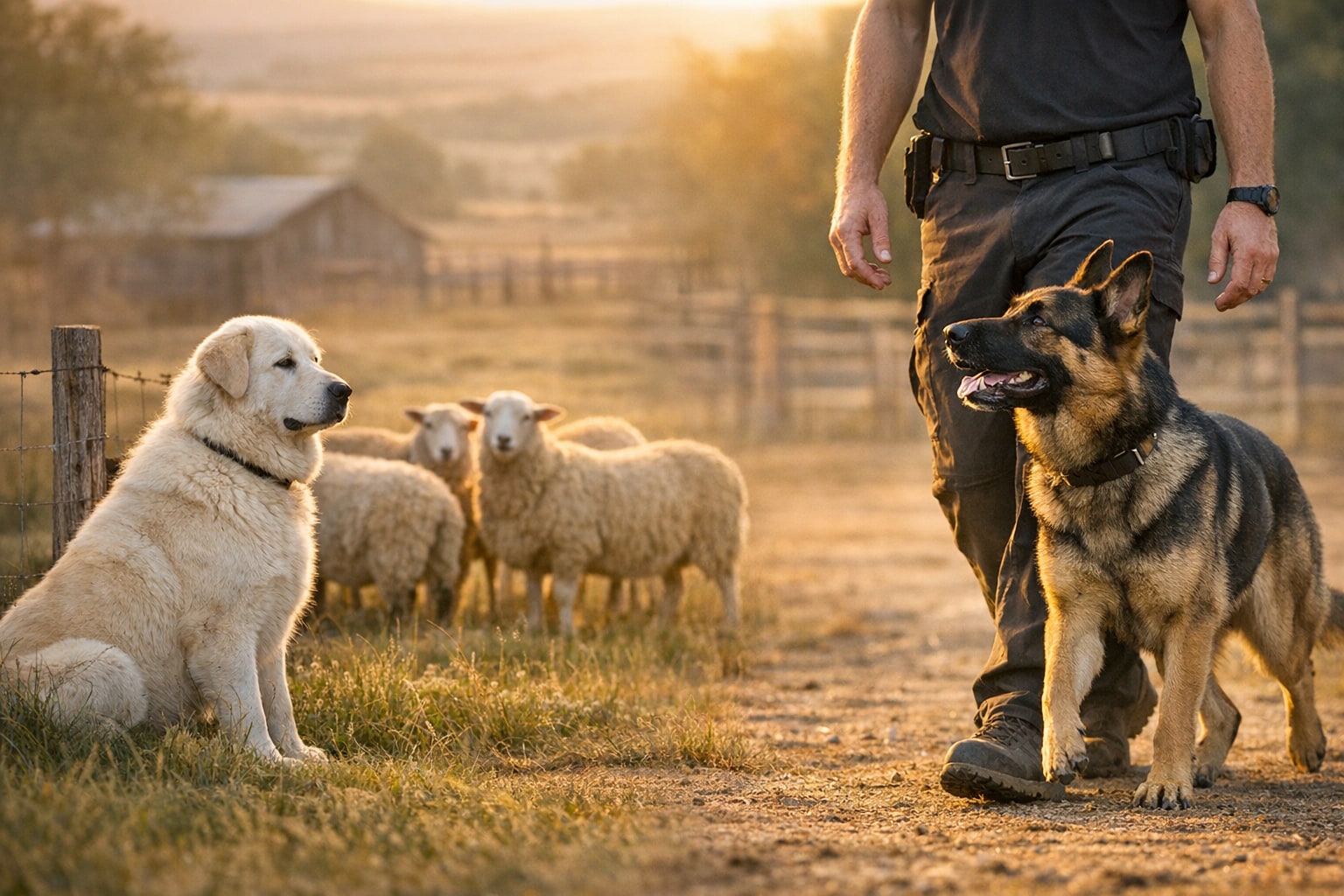
Spend enough time around working dogs and you learn a simple truth fast: a hard-looking dog is not always the right dog for the job. I have seen folks assume that any big, confident dog can guard anything, whether that means a flock of sheep in a back pasture or a family home at the end of a gravel drive. That kind of thinking usually ends with disappointment, and sometimes with a mess that takes years to straighten out.
Livestock protection dogs and personal protection dogs are often spoken about in the same breath because both are called "guard dogs." But in the field, they are not the same animal in mindset, training, or purpose. One is bred to live with stock, make independent decisions, and deter predators with steady presence. The other is bred to bond tightly with people, read human direction, and engage a threat when necessary. If you are a dog owner interested in working dogs, understanding that difference matters more than size, bark, or reputation.
What Livestock Protection Dogs Were Bred to Do
Livestock protection dogs, often called LGDs, were developed to stay with animals and protect them from predators. That job is older than most modern dog sports, older than fenced pastures in many places, and rooted in hard country where wolves, bears, coyotes, and thieves all posed a real threat. Breeds like the Great Pyrenees, Anatolian Shepherd, Akbash, Maremma Sheepdog, and Kangal were selected for patience, toughness, and independence.
An LGD is not supposed to wait for constant commands. Out on a cold hillside or in a lambing pasture at two in the morning, there is no handler standing nearby giving cues. The dog has to think, patrol, watch, and decide. Good livestock protection dogs bond to the flock or herd almost as strongly as they bond to the property. They read the normal rhythms of the animals they protect, and they notice fast when something is off.
I have watched good LGDs work in a way that looks almost lazy until you understand what you are seeing. They may spend hours resting where they can scent the wind and watch movement, then be on their feet in an instant when coyotes skirt the fence line. The best ones do not waste energy. They conserve it, then use just enough force to push trouble back where it came from.
Temperament and Daily Behavior of an LGD
That breeding creates a dog with a very specific nature. Most livestock protection dogs are calm, observant, territorial, and suspicious of novelty. They are not usually eager-to-please in the way a retriever or shepherd may be. Many are affectionate with family but somewhat aloof with strangers. Their job is not to socialize with every visitor. Their job is to assess.
That can catch first-time owners off guard. A livestock guardian often matures slowly, tests boundaries, and prefers to make up its own mind. On a farm or ranch, those traits can be assets. In a suburban neighborhood with constant foot traffic, delivery drivers, and close property lines, they can become a management problem in a hurry.
What Personal Protection Dogs Were Bred to Do
Personal protection dogs serve a different purpose entirely. These dogs are bred and trained to protect people, not livestock. They live close to the handler, respond to human direction, and are expected to show controlled suspicion, clear-headed nerve, and immediate obedience under stress. Breeds commonly used in personal protection work include the German Shepherd, Belgian Malinois, Doberman Pinscher, Cane Corso, Giant Schnauzer, and in some cases Dutch Shepherds and Rottweilers.
The key difference is focus. A personal protection dog centers its world around the handler and household. It is trained to distinguish everyday life from a real threat and to act with control. That control is everything. A genuine protection dog is not merely aggressive, and it is certainly not chaotic. The dog should be stable enough to lie quietly at your feet, travel in public, and ignore harmless strangers, yet be capable of responding when a situation turns dangerous.
That kind of dog is built through genetics and serious training. Good protection work is not about creating a mean dog. It is about developing a confident, balanced dog with reliable obedience and a clear head. In the wrong hands, people confuse fear, reactivity, and noise for protection. In truth, a frantic dog is often a liability, not security.
Temperament and Training in Personal Protection Dogs
Unlike livestock guardians, personal protection dogs are expected to take direction moment by moment. Their training often includes obedience under distraction, environmental confidence, controlled bite work with professional decoys, and clean response to command. They must switch on and off. That is a big ask, and not every dog can do it, even within capable breeds.
I have spent enough time around solid working shepherds and Malinois to respect the difference between natural protectiveness and polished protection training. A dog that simply barks at strangers is common. A dog that can identify threat, remain composed, engage with purpose, and disengage on command is something else entirely.
Livestock Protection Dogs vs Personal Protection Dogs: The Biggest Differences
If you strip away appearance and focus on the work, the differences become plain. Livestock protection dogs are independent problem-solvers tied to territory and stock. Personal protection dogs are handler-oriented workers tied to human safety and direct control. An LGD is often expected to make decisions on its own in open country. A personal protection dog is expected to make good decisions too, but within a framework shaped tightly by training and command.
The social expectations are different as well. A livestock guardian may be reserved, even stern, with visitors because its duty is to protect its ground and animals. A personal protection dog, if properly trained, should be safer and more manageable in varied human environments because public stability is part of the work. One guards a living perimeter. The other guards people.
Even the way they confront danger differs. LGDs often use posture, barking, patrol, and presence to deter predators before a fight starts. Their strength lies in persistence and territorial pressure. Personal protection dogs are trained for direct intervention when a human threat escalates. Their strength lies in control, responsiveness, and engagement under command.
Which Dog Fits Your Property and Lifestyle?
This is where a lot of owners make an expensive mistake. If you have goats, sheep, chickens, or cattle and your main concern is coyotes, feral dogs, or night predators, a livestock protection dog may be the right tool. But only if you truly have livestock, enough room, and the patience to raise and manage the dog properly. An LGD kept as a yard ornament without stock to bond with can become bored, overprotective, and difficult.
On the other hand, if your concern is family security, home defense, and a dog that travels with you or lives as a close household companion, a personal protection dog is the better fit. But that path comes with its own demands. A true protection prospect needs quality breeding, serious obedience, regular maintenance training, and an owner who values structure. These dogs are not casual pets with a tougher label slapped on them.
I have seen rural properties where people brought in a Great Pyrenees hoping for a family bodyguard, only to end up with a dog that wanted to patrol fence lines and bark all night. I have also seen high-drive shepherds placed on hobby farms where owners thought the dog would naturally guard chickens, only to discover the dog was more interested in movement than patient stock protection. Breed purpose has a long memory.
Can One Dog Do Both Jobs?
In theory, some dogs may show traits that overlap. In practice, asking one dog to be both a dedicated livestock guardian and a polished personal protection dog is usually unrealistic. The jobs pull behavior in different directions. Livestock guardians need independence and tolerance for stock behavior. Personal protection dogs need handler focus, precision, and urban adaptability. There may be rare exceptions, but most owners are far better served by choosing the right dog for the primary task rather than chasing a fantasy of one dog doing everything.
Training, Management, and Owner Expectations
No matter which path you choose, success begins with honest expectations. Livestock protection dogs need early exposure to stock, proper fencing, patient correction, and time to mature. Many do not become fully reliable until they are well past puppyhood. Personal protection dogs need foundational obedience, environmental stability, professional training, and consistent rules at home. Shortcut either process and you invite trouble.
There is also an ethical side to this conversation. A dog bred to protect deserves a life that matches its wiring. These dogs are not props, not status symbols, and not shortcuts around good property management or personal security habits. The best working dogs thrive because someone gave them the right job, enough room to do it, and clear guidance.
That is the lesson the field teaches over and over. The right dog in the right role is a beautiful thing to watch. Whether it is an Anatolian standing silent over a flock as dusk settles in, or a well-trained shepherd heeling calmly at a handler’s side with complete attention, purpose shows in the way they carry themselves. They know their work. Our part is choosing wisely enough not to ask them to be something they were never meant to be.
Final Thoughts
When comparing livestock protection dogs vs personal protection dogs, the question is not which one is tougher. The real question is what you need protected, how you live, and what kind of partnership you can honestly maintain. If your world revolves around stock and predators, look toward the livestock guardian breeds. If your priority is personal and family security with direct control, a trained protection dog makes more sense.
Working dogs are at their best when instinct, environment, and training all point in the same direction. Get that right, and you do not just own a dog. You gain a partner with a job written deep in its bones.
Livestock protection dogs and personal protection dogs are often spoken about in the same breath because both are called "guard dogs." But in the field, they are not the same animal in mindset, training, or purpose. One is bred to live with stock, make independent decisions, and deter predators with steady presence. The other is bred to bond tightly with people, read human direction, and engage a threat when necessary. If you are a dog owner interested in working dogs, understanding that difference matters more than size, bark, or reputation.
What Livestock Protection Dogs Were Bred to Do
Livestock protection dogs, often called LGDs, were developed to stay with animals and protect them from predators. That job is older than most modern dog sports, older than fenced pastures in many places, and rooted in hard country where wolves, bears, coyotes, and thieves all posed a real threat. Breeds like the Great Pyrenees, Anatolian Shepherd, Akbash, Maremma Sheepdog, and Kangal were selected for patience, toughness, and independence.
An LGD is not supposed to wait for constant commands. Out on a cold hillside or in a lambing pasture at two in the morning, there is no handler standing nearby giving cues. The dog has to think, patrol, watch, and decide. Good livestock protection dogs bond to the flock or herd almost as strongly as they bond to the property. They read the normal rhythms of the animals they protect, and they notice fast when something is off.
I have watched good LGDs work in a way that looks almost lazy until you understand what you are seeing. They may spend hours resting where they can scent the wind and watch movement, then be on their feet in an instant when coyotes skirt the fence line. The best ones do not waste energy. They conserve it, then use just enough force to push trouble back where it came from.
Temperament and Daily Behavior of an LGD
That breeding creates a dog with a very specific nature. Most livestock protection dogs are calm, observant, territorial, and suspicious of novelty. They are not usually eager-to-please in the way a retriever or shepherd may be. Many are affectionate with family but somewhat aloof with strangers. Their job is not to socialize with every visitor. Their job is to assess.
That can catch first-time owners off guard. A livestock guardian often matures slowly, tests boundaries, and prefers to make up its own mind. On a farm or ranch, those traits can be assets. In a suburban neighborhood with constant foot traffic, delivery drivers, and close property lines, they can become a management problem in a hurry.
What Personal Protection Dogs Were Bred to Do
Personal protection dogs serve a different purpose entirely. These dogs are bred and trained to protect people, not livestock. They live close to the handler, respond to human direction, and are expected to show controlled suspicion, clear-headed nerve, and immediate obedience under stress. Breeds commonly used in personal protection work include the German Shepherd, Belgian Malinois, Doberman Pinscher, Cane Corso, Giant Schnauzer, and in some cases Dutch Shepherds and Rottweilers.
The key difference is focus. A personal protection dog centers its world around the handler and household. It is trained to distinguish everyday life from a real threat and to act with control. That control is everything. A genuine protection dog is not merely aggressive, and it is certainly not chaotic. The dog should be stable enough to lie quietly at your feet, travel in public, and ignore harmless strangers, yet be capable of responding when a situation turns dangerous.
That kind of dog is built through genetics and serious training. Good protection work is not about creating a mean dog. It is about developing a confident, balanced dog with reliable obedience and a clear head. In the wrong hands, people confuse fear, reactivity, and noise for protection. In truth, a frantic dog is often a liability, not security.
Temperament and Training in Personal Protection Dogs
Unlike livestock guardians, personal protection dogs are expected to take direction moment by moment. Their training often includes obedience under distraction, environmental confidence, controlled bite work with professional decoys, and clean response to command. They must switch on and off. That is a big ask, and not every dog can do it, even within capable breeds.
I have spent enough time around solid working shepherds and Malinois to respect the difference between natural protectiveness and polished protection training. A dog that simply barks at strangers is common. A dog that can identify threat, remain composed, engage with purpose, and disengage on command is something else entirely.
Livestock Protection Dogs vs Personal Protection Dogs: The Biggest Differences
If you strip away appearance and focus on the work, the differences become plain. Livestock protection dogs are independent problem-solvers tied to territory and stock. Personal protection dogs are handler-oriented workers tied to human safety and direct control. An LGD is often expected to make decisions on its own in open country. A personal protection dog is expected to make good decisions too, but within a framework shaped tightly by training and command.
The social expectations are different as well. A livestock guardian may be reserved, even stern, with visitors because its duty is to protect its ground and animals. A personal protection dog, if properly trained, should be safer and more manageable in varied human environments because public stability is part of the work. One guards a living perimeter. The other guards people.
Even the way they confront danger differs. LGDs often use posture, barking, patrol, and presence to deter predators before a fight starts. Their strength lies in persistence and territorial pressure. Personal protection dogs are trained for direct intervention when a human threat escalates. Their strength lies in control, responsiveness, and engagement under command.
Which Dog Fits Your Property and Lifestyle?
This is where a lot of owners make an expensive mistake. If you have goats, sheep, chickens, or cattle and your main concern is coyotes, feral dogs, or night predators, a livestock protection dog may be the right tool. But only if you truly have livestock, enough room, and the patience to raise and manage the dog properly. An LGD kept as a yard ornament without stock to bond with can become bored, overprotective, and difficult.
On the other hand, if your concern is family security, home defense, and a dog that travels with you or lives as a close household companion, a personal protection dog is the better fit. But that path comes with its own demands. A true protection prospect needs quality breeding, serious obedience, regular maintenance training, and an owner who values structure. These dogs are not casual pets with a tougher label slapped on them.
I have seen rural properties where people brought in a Great Pyrenees hoping for a family bodyguard, only to end up with a dog that wanted to patrol fence lines and bark all night. I have also seen high-drive shepherds placed on hobby farms where owners thought the dog would naturally guard chickens, only to discover the dog was more interested in movement than patient stock protection. Breed purpose has a long memory.
Can One Dog Do Both Jobs?
In theory, some dogs may show traits that overlap. In practice, asking one dog to be both a dedicated livestock guardian and a polished personal protection dog is usually unrealistic. The jobs pull behavior in different directions. Livestock guardians need independence and tolerance for stock behavior. Personal protection dogs need handler focus, precision, and urban adaptability. There may be rare exceptions, but most owners are far better served by choosing the right dog for the primary task rather than chasing a fantasy of one dog doing everything.
Training, Management, and Owner Expectations
No matter which path you choose, success begins with honest expectations. Livestock protection dogs need early exposure to stock, proper fencing, patient correction, and time to mature. Many do not become fully reliable until they are well past puppyhood. Personal protection dogs need foundational obedience, environmental stability, professional training, and consistent rules at home. Shortcut either process and you invite trouble.
There is also an ethical side to this conversation. A dog bred to protect deserves a life that matches its wiring. These dogs are not props, not status symbols, and not shortcuts around good property management or personal security habits. The best working dogs thrive because someone gave them the right job, enough room to do it, and clear guidance.
That is the lesson the field teaches over and over. The right dog in the right role is a beautiful thing to watch. Whether it is an Anatolian standing silent over a flock as dusk settles in, or a well-trained shepherd heeling calmly at a handler’s side with complete attention, purpose shows in the way they carry themselves. They know their work. Our part is choosing wisely enough not to ask them to be something they were never meant to be.
Final Thoughts
When comparing livestock protection dogs vs personal protection dogs, the question is not which one is tougher. The real question is what you need protected, how you live, and what kind of partnership you can honestly maintain. If your world revolves around stock and predators, look toward the livestock guardian breeds. If your priority is personal and family security with direct control, a trained protection dog makes more sense.
Working dogs are at their best when instinct, environment, and training all point in the same direction. Get that right, and you do not just own a dog. You gain a partner with a job written deep in its bones.