The Science Behind a Dog’s Nose
Jeff Davis | https://workingdogcentral.com
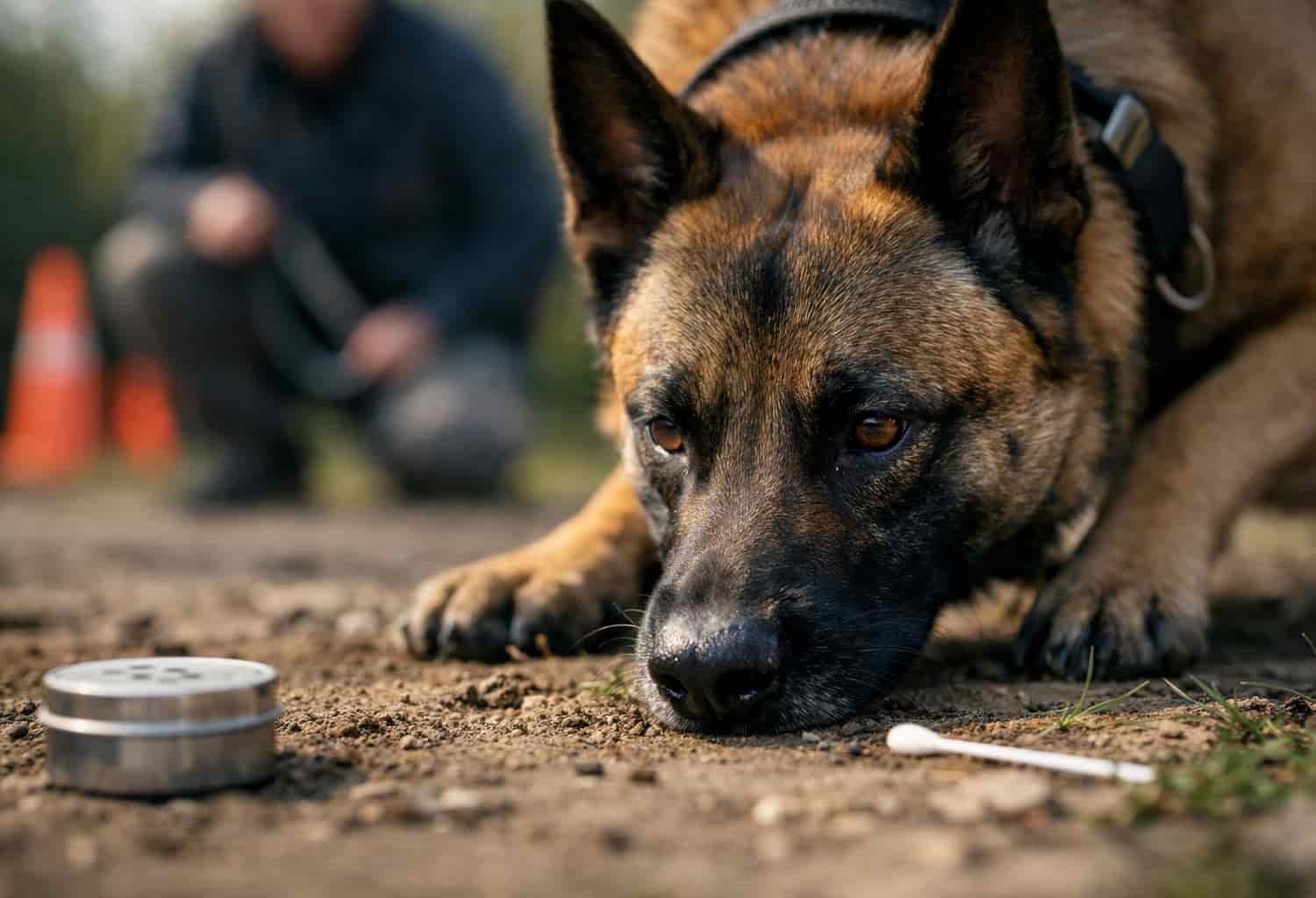
If you have spent any real time behind a good dog in the field, you already know one truth better than any textbook can tell it: a dog lives in a world of scent the rest of us only brush against. I have watched a dog hit the edge of a cattail slough, lift its head into a crosswind, and turn with complete certainty toward a bird no hunter in the line knew was there. To the dog, that hidden pheasant was not hidden at all. It was broadcasting its presence in tiny drifting particles, and the dog’s nose was built to read that message with astonishing precision.
That is where the science gets interesting. A dog’s nose is not simply stronger than a human nose. It is a different kind of instrument altogether, shaped by anatomy, airflow, moisture, brain function, and behavior. For dog owners interested in working dogs, understanding how that nose works can change the way you train, hunt, and handle your dog. It gives you a clearer picture of why dogs quarter into the wind, why some tracks fall apart in bad conditions, and why one sniff can tell a trained dog more than our eyes and ears combined.
Why a Dog’s Nose Is So Powerful
The first piece of the puzzle is receptor count. Humans have roughly 5 to 6 million scent receptors. Many dogs have well over 100 million, and some breeds bred for scent work carry numbers far beyond that. Bloodhounds are famous for it, but even versatile hunting breeds and retrievers operate on a sensory level that leaves us behind. The inside of a dog’s nasal cavity is packed with specialized tissue designed to capture odor molecules and send that information to the brain.
That alone would be impressive, but receptor count is only part of the story. The canine olfactory bulb, the part of the brain that processes scent, is proportionally much larger than ours. In plain terms, dogs do not just collect more odor information. They are built to interpret it better. They can sort through layers of scent, separate old odor from fresh odor, and often distinguish one individual animal from another within the same patch of cover.
In hunting country, that explains a lot. A seasoned bird dog can work old foot scent, body scent, and airborne odor at the same time. A trailing hound can stay on a line where a person sees nothing but leaves and dirt. The dog is not guessing. It is processing an amount of chemical information we can barely imagine.
The Role of Nasal Structure
A dog’s nose is engineered for efficiency. When a dog inhales, air separates into different pathways. Some air goes toward respiration, while some is directed into the olfactory recess, where scent detection happens. That means dogs can continue smelling in a highly focused way while breathing normally. It is one reason they can work continuously for long stretches without losing sensory input.
Then there is the shape of the nostrils. Dogs can move each nostril somewhat independently, helping them determine the direction of a scent source. In the field, that matters. A dog casting across a breeze is not just smelling odor. It is triangulating it. That subtle side-to-side shift you see in a dog’s head and gait often reflects active scent mapping, not random movement.
The wet surface of the nose also plays a role. Moisture helps capture odor particles, making scents easier to detect. Dogs will often lick their noses to keep them damp, improving their ability to gather chemical traces from the environment. It is a small detail, but one tied directly to performance.
How Dogs Smell While Exhaling
One of the great design features of the canine nose is that dogs can keep taking in scent even as they exhale. Air pushed out through slits in the side of the nostrils creates a swirl that stirs odor molecules from the ground and the air around them. Instead of blowing scent away and interrupting the process, the dog’s breathing mechanics help pull new odor into range.
That is why a hard-working tracking dog can put its nose down and sniff in rapid bursts without losing momentum. It is also why you will see some dogs appear to “vacuum” a track, drawing in repeated samples as they move. They are refreshing the scent picture with each step, building confidence or making corrections in real time.
The Difference Between Ground Scent and Air Scent
Any hunter who has followed dogs long enough learns there is more than one kind of scent work happening in front of him. Ground scent is odor left on the surface, disturbed vegetation, crushed plant oils, skin cells, and minute traces that settle where an animal has traveled. Air scent is carried on wind currents and often comes from the animal itself, drifting through cover before the dog ever reaches the source.
Some working dogs specialize naturally in one method over the other, but many use both. A bird dog might run with its head high when body odor is riding the wind, then drop its nose lower when scent conditions get tricky and it needs to sort out where a bird moved. A tracking dog may begin with a ground trail and then lift its head when wind shifts push the target odor into open air.
Weather, terrain, humidity, and time all influence which scent picture is strongest. Damp mornings often hold odor close and make tracking easier. Hot, dry afternoons can burn scent off quickly. Wind can help a dog find game from a distance, but swirling wind in timber or broken terrain can also scatter scent and create confusion. This is where experience matters, both for the dog and the handler. A good handler learns to read conditions and understand what kind of scent problem the dog is trying to solve.
Why Conditions Change Everything
I have seen young dogs look brilliant on cool, humid mornings and then seem average by noon when the sun baked the field. The dog did not lose ability. The scent changed. Odor disperses differently depending on moisture, temperature, and air movement. Heavy cover can trap scent. Bare ground can let it dissipate. Frost can lock odor down for a while, then release it as things thaw.
That is worth remembering in training. If a dog struggles on a difficult day, the issue may not be obedience or drive. Sometimes the science of scent explains what the eye wants to blame on attitude.
The Jacobson’s Organ and Chemical Communication
Dogs also have another scent tool humans do not rely on much at all: the vomeronasal organ, often called Jacobson’s organ. This specialized structure helps detect certain chemical signals, including pheromones. It plays a role in social and reproductive communication, but it also reminds us that scent is layered. Dogs are not only detecting “what” is there. They are often reading biological information tied to identity, state, and presence.
For working dogs, that broader chemical awareness contributes to their ability to distinguish one person, animal, or target odor from another. It is one more reason trained detection dogs can single out an odor hidden among a flood of competing smells.
Why Breed and Genetics Matter
Not all noses are equal, and anyone who has hunted behind different breeds can tell you that without opening a lab report. Genetics influence nasal anatomy, receptor density, stamina, and the style in which a dog uses scent. Hounds, pointing dogs, retrievers, and shepherd-type working breeds may all be impressive, but they often solve scent problems in different ways.
Selective breeding has sharpened those strengths over generations. A beagle working a rabbit line, a Labrador handling a blind retrieve, and a German shorthaired pointer pinning a running covey are all using the same basic science through different behavioral packages. Drive, focus, range, cooperation, and persistence all shape how the nose gets applied in real-world work.
That is why dog owners should think beyond the simple idea of a “good nose.” The best working nose is a combination of physical ability, mental processing, and the inherited instinct to use scent with purpose.
Training the Nose You Already Have
Here is something old hunters learn and new handlers need to hear: you do not create a nose through training. You develop the dog’s ability to trust it, organize it, and use it under pressure. Good training teaches a dog how to stay engaged with odor, work through distraction, and communicate what it has found. It also teaches the handler not to interfere at the wrong moment.
Too many people talk when they should watch. A dog working scent is often solving a problem that is invisible to us. If you crowd it, call it off, or force movement before it has sorted the odor cone, you can break down confidence. On the other hand, smart exposure to varied conditions, planted scenarios, live game, and controlled problem-solving can make a talented dog far better at applying the nose it was born with.
The strongest teams in the field are usually the ones where the handler understands what scent work looks like in motion. A slight tail change, a head snap into the wind, a sudden check back to a patch of cover—those are not quirks. They are information.
The Nose Is the Foundation of Working Ability
At the end of the day, the science behind a dog’s nose only confirms what practical dog men and women have known for generations. The working dog’s nose is a marvel of biology, but it is also the foundation of usefulness. Whether the job is finding birds, trailing wounded game, locating shed antlers, detecting narcotics, or searching for a missing person, everything begins with scent.
That is what makes a good dog so humbling to watch. We bring the boots, the gun, the GPS, the maps, and all the confidence of human planning. Then the dog steps out, catches a thread of odor on moving air, and reveals how much of the world has been there all along, waiting for a better nose to read it.
For dog owners interested in working dogs, learning the science behind that ability is more than an academic exercise. It helps you become a better trainer, a more patient handler, and a more observant partner. The more you understand the nose, the more respect you gain for the animal using it. And once you have seen a truly gifted dog work scent with intensity and certainty, it is hard not to believe you are watching one of nature’s finest instruments in action.
That is where the science gets interesting. A dog’s nose is not simply stronger than a human nose. It is a different kind of instrument altogether, shaped by anatomy, airflow, moisture, brain function, and behavior. For dog owners interested in working dogs, understanding how that nose works can change the way you train, hunt, and handle your dog. It gives you a clearer picture of why dogs quarter into the wind, why some tracks fall apart in bad conditions, and why one sniff can tell a trained dog more than our eyes and ears combined.
Why a Dog’s Nose Is So Powerful
The first piece of the puzzle is receptor count. Humans have roughly 5 to 6 million scent receptors. Many dogs have well over 100 million, and some breeds bred for scent work carry numbers far beyond that. Bloodhounds are famous for it, but even versatile hunting breeds and retrievers operate on a sensory level that leaves us behind. The inside of a dog’s nasal cavity is packed with specialized tissue designed to capture odor molecules and send that information to the brain.
That alone would be impressive, but receptor count is only part of the story. The canine olfactory bulb, the part of the brain that processes scent, is proportionally much larger than ours. In plain terms, dogs do not just collect more odor information. They are built to interpret it better. They can sort through layers of scent, separate old odor from fresh odor, and often distinguish one individual animal from another within the same patch of cover.
In hunting country, that explains a lot. A seasoned bird dog can work old foot scent, body scent, and airborne odor at the same time. A trailing hound can stay on a line where a person sees nothing but leaves and dirt. The dog is not guessing. It is processing an amount of chemical information we can barely imagine.
The Role of Nasal Structure
A dog’s nose is engineered for efficiency. When a dog inhales, air separates into different pathways. Some air goes toward respiration, while some is directed into the olfactory recess, where scent detection happens. That means dogs can continue smelling in a highly focused way while breathing normally. It is one reason they can work continuously for long stretches without losing sensory input.
Then there is the shape of the nostrils. Dogs can move each nostril somewhat independently, helping them determine the direction of a scent source. In the field, that matters. A dog casting across a breeze is not just smelling odor. It is triangulating it. That subtle side-to-side shift you see in a dog’s head and gait often reflects active scent mapping, not random movement.
The wet surface of the nose also plays a role. Moisture helps capture odor particles, making scents easier to detect. Dogs will often lick their noses to keep them damp, improving their ability to gather chemical traces from the environment. It is a small detail, but one tied directly to performance.
How Dogs Smell While Exhaling
One of the great design features of the canine nose is that dogs can keep taking in scent even as they exhale. Air pushed out through slits in the side of the nostrils creates a swirl that stirs odor molecules from the ground and the air around them. Instead of blowing scent away and interrupting the process, the dog’s breathing mechanics help pull new odor into range.
That is why a hard-working tracking dog can put its nose down and sniff in rapid bursts without losing momentum. It is also why you will see some dogs appear to “vacuum” a track, drawing in repeated samples as they move. They are refreshing the scent picture with each step, building confidence or making corrections in real time.
The Difference Between Ground Scent and Air Scent
Any hunter who has followed dogs long enough learns there is more than one kind of scent work happening in front of him. Ground scent is odor left on the surface, disturbed vegetation, crushed plant oils, skin cells, and minute traces that settle where an animal has traveled. Air scent is carried on wind currents and often comes from the animal itself, drifting through cover before the dog ever reaches the source.
Some working dogs specialize naturally in one method over the other, but many use both. A bird dog might run with its head high when body odor is riding the wind, then drop its nose lower when scent conditions get tricky and it needs to sort out where a bird moved. A tracking dog may begin with a ground trail and then lift its head when wind shifts push the target odor into open air.
Weather, terrain, humidity, and time all influence which scent picture is strongest. Damp mornings often hold odor close and make tracking easier. Hot, dry afternoons can burn scent off quickly. Wind can help a dog find game from a distance, but swirling wind in timber or broken terrain can also scatter scent and create confusion. This is where experience matters, both for the dog and the handler. A good handler learns to read conditions and understand what kind of scent problem the dog is trying to solve.
Why Conditions Change Everything
I have seen young dogs look brilliant on cool, humid mornings and then seem average by noon when the sun baked the field. The dog did not lose ability. The scent changed. Odor disperses differently depending on moisture, temperature, and air movement. Heavy cover can trap scent. Bare ground can let it dissipate. Frost can lock odor down for a while, then release it as things thaw.
That is worth remembering in training. If a dog struggles on a difficult day, the issue may not be obedience or drive. Sometimes the science of scent explains what the eye wants to blame on attitude.
The Jacobson’s Organ and Chemical Communication
Dogs also have another scent tool humans do not rely on much at all: the vomeronasal organ, often called Jacobson’s organ. This specialized structure helps detect certain chemical signals, including pheromones. It plays a role in social and reproductive communication, but it also reminds us that scent is layered. Dogs are not only detecting “what” is there. They are often reading biological information tied to identity, state, and presence.
For working dogs, that broader chemical awareness contributes to their ability to distinguish one person, animal, or target odor from another. It is one more reason trained detection dogs can single out an odor hidden among a flood of competing smells.
Why Breed and Genetics Matter
Not all noses are equal, and anyone who has hunted behind different breeds can tell you that without opening a lab report. Genetics influence nasal anatomy, receptor density, stamina, and the style in which a dog uses scent. Hounds, pointing dogs, retrievers, and shepherd-type working breeds may all be impressive, but they often solve scent problems in different ways.
Selective breeding has sharpened those strengths over generations. A beagle working a rabbit line, a Labrador handling a blind retrieve, and a German shorthaired pointer pinning a running covey are all using the same basic science through different behavioral packages. Drive, focus, range, cooperation, and persistence all shape how the nose gets applied in real-world work.
That is why dog owners should think beyond the simple idea of a “good nose.” The best working nose is a combination of physical ability, mental processing, and the inherited instinct to use scent with purpose.
Training the Nose You Already Have
Here is something old hunters learn and new handlers need to hear: you do not create a nose through training. You develop the dog’s ability to trust it, organize it, and use it under pressure. Good training teaches a dog how to stay engaged with odor, work through distraction, and communicate what it has found. It also teaches the handler not to interfere at the wrong moment.
Too many people talk when they should watch. A dog working scent is often solving a problem that is invisible to us. If you crowd it, call it off, or force movement before it has sorted the odor cone, you can break down confidence. On the other hand, smart exposure to varied conditions, planted scenarios, live game, and controlled problem-solving can make a talented dog far better at applying the nose it was born with.
The strongest teams in the field are usually the ones where the handler understands what scent work looks like in motion. A slight tail change, a head snap into the wind, a sudden check back to a patch of cover—those are not quirks. They are information.
The Nose Is the Foundation of Working Ability
At the end of the day, the science behind a dog’s nose only confirms what practical dog men and women have known for generations. The working dog’s nose is a marvel of biology, but it is also the foundation of usefulness. Whether the job is finding birds, trailing wounded game, locating shed antlers, detecting narcotics, or searching for a missing person, everything begins with scent.
That is what makes a good dog so humbling to watch. We bring the boots, the gun, the GPS, the maps, and all the confidence of human planning. Then the dog steps out, catches a thread of odor on moving air, and reveals how much of the world has been there all along, waiting for a better nose to read it.
For dog owners interested in working dogs, learning the science behind that ability is more than an academic exercise. It helps you become a better trainer, a more patient handler, and a more observant partner. The more you understand the nose, the more respect you gain for the animal using it. And once you have seen a truly gifted dog work scent with intensity and certainty, it is hard not to believe you are watching one of nature’s finest instruments in action.