The 7 Core Roles of Working Dogs Explained
Jeff Davis | https://workingdogcentral.com
 0
0 0
0 0
0 0
0 0
0
Anyone who has spent much time around serious working dogs knows one thing right away—these animals were never meant to spend their lives as ornaments on a couch. A true working dog carries a different kind of energy. You see it in their eyes, in the way they move, and in the way they lock onto a task with complete focus.
For thousands of years, people have bred dogs for specific jobs. Hunters shaped dogs that could follow scent trails through the dark timber. Shepherds developed dogs that could control livestock with nothing more than posture and instinct. Soldiers, police officers, and rescue teams eventually discovered that a dog’s nose and drive could accomplish things no piece of equipment ever could.
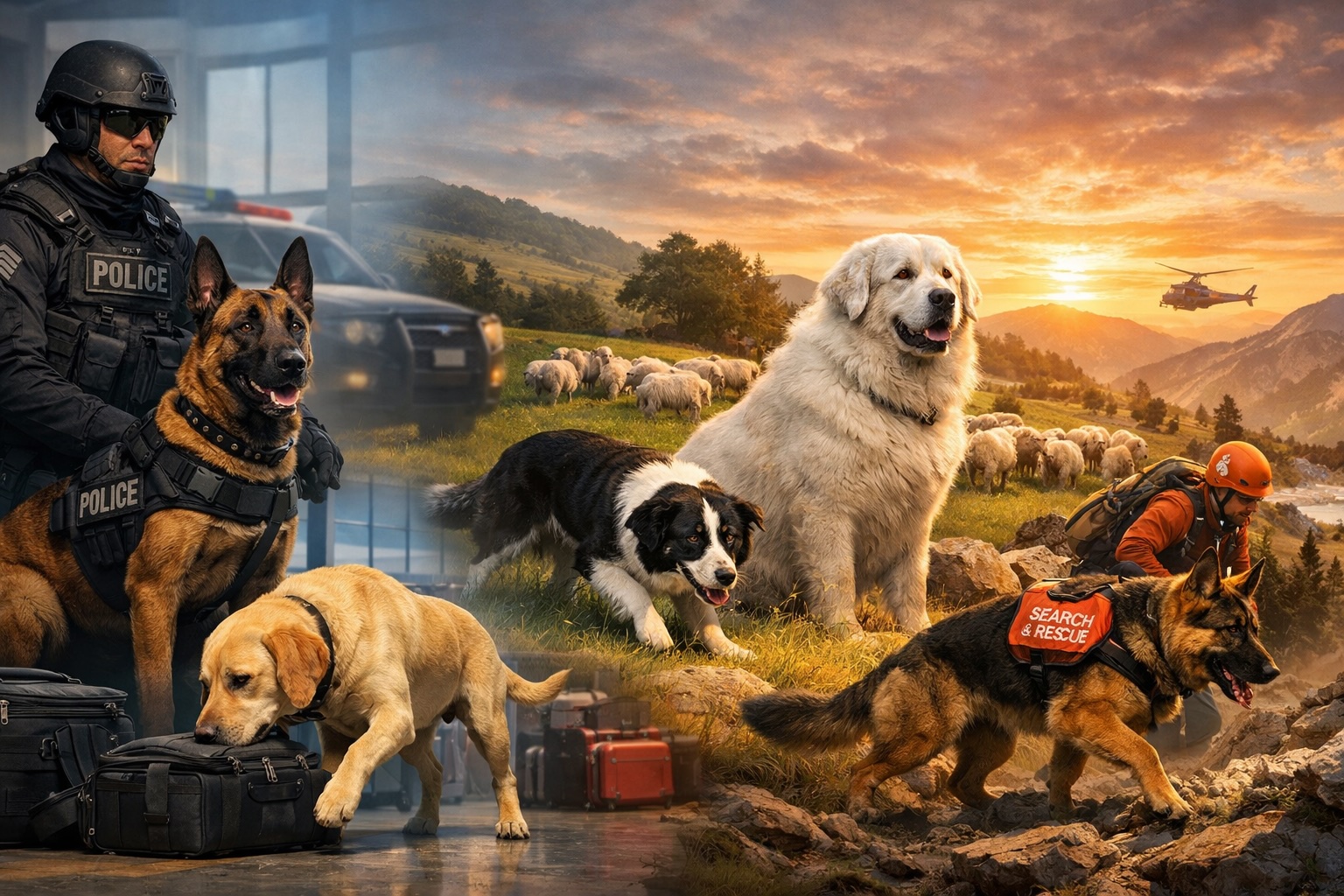
Today, working dogs perform an astonishing range of duties across the world. While the specific jobs vary, most of them fall into seven core roles that define how dogs work alongside people.
Understanding these roles reveals just how remarkable the partnership between humans and dogs has become.
Protection and Guard Dogs
One of the oldest jobs a dog has ever held is guarding people and property. Long before alarm systems and surveillance cameras existed, a loyal dog sleeping beside the fire served as the first line of defense.
Protection dogs are bred for confidence, intelligence, and the ability to assess threats. A well-trained protection dog doesn’t simply attack on command. Instead, it learns to read situations and respond appropriately while remaining under the handler’s control.
Breeds like German Shepherds, Belgian Malinois, Dobermans, and Rottweilers have become famous for this work. These dogs combine athletic ability with a strong protective instinct that allows them to stand their ground when danger appears.
Good protection dogs possess something that experienced handlers often call “clear-headed courage.” They’re not reckless. They’re steady, deliberate, and absolutely loyal to the people they’re tasked with protecting.
Detection Dogs
Few tools on earth can match the power of a dog’s nose. A trained detection dog can identify odors measured in parts per trillion—amounts so small they are almost impossible to comprehend.
Because of this extraordinary ability, detection dogs have become invaluable in fields ranging from law enforcement to conservation. These dogs locate narcotics, explosives, firearms, electronics, and even invasive species.
Airports rely on detection dogs to keep travelers safe. Wildlife biologists use them to locate endangered animals or track illegal poaching activity. Some dogs are even trained to detect certain medical conditions, including low blood sugar or cancer markers.
Watching a good detection dog work is something to behold. The dog moves through an area with quiet intensity, nose low and tail steady, following invisible scent currents that no human could ever perceive.
When the odor appears, the dog instantly changes behavior, locking onto the source with unmistakable certainty.
Search and Rescue Dogs
When disaster strikes or someone disappears in the wilderness, search and rescue dogs often become the best chance of bringing that person home.
These dogs are trained to locate missing people using scent. Some follow ground tracks the way a hound follows game, while others work airborne human scent carried by the wind.
Search and rescue dogs operate in environments that would challenge even the toughest people. They work through dense forests, collapsed buildings, avalanche fields, and rugged mountain terrain.
What makes these dogs extraordinary isn’t just their nose—it’s their drive. A good search dog possesses an intense desire to find people. That motivation keeps them working hour after hour, often in conditions that would wear out most animals.
Handlers will tell you that when a search dog finally locates a missing person, the dog often celebrates like it just won the greatest game in the world.
Service Dogs
Service dogs perform some of the most personal and life-changing work in the working dog world. These animals are trained to assist individuals with physical or medical challenges, helping them navigate everyday life with greater independence.
Guide dogs help people with vision loss move safely through crowded streets and unfamiliar spaces. Mobility assistance dogs can retrieve objects, open doors, or provide balance support.
Some service dogs monitor medical conditions. They may alert their handler to an oncoming seizure, detect dangerous drops in blood sugar, or provide grounding assistance during episodes of post-traumatic stress.
The training required for service dogs is extensive, and not every dog has the temperament for it. The best service dogs are calm, highly intelligent, and capable of remaining focused even in chaotic environments.
To the person they assist, however, these dogs are far more than trained animals. They are trusted partners who provide safety, independence, and confidence every single day.
Livestock Guardian Dogs
Out on remote ranches and high mountain pastures, another kind of working dog carries out a job that hasn’t changed much in centuries.
Livestock guardian dogs live with the animals they protect. Their duty is simple: keep predators away.
Unlike herding dogs that control livestock movement, guardian dogs become part of the herd itself. From the moment they are young puppies, they bond with sheep, goats, or cattle and treat those animals as their family.
Breeds such as the Great Pyrenees, Anatolian Shepherd, and Kuvasz have guarded flocks against wolves, bears, and mountain lions for generations.
A good livestock guardian dog rarely needs to fight. Most predators simply choose easier prey once they realize a large, confident dog is standing watch.
Out in those quiet pastures under the night sky, these dogs carry on one of the oldest partnerships between humans and animals.
Herding Dogs
While guardian dogs protect livestock, herding dogs manage them.
Herding dogs are among the most intelligent animals ever bred. With a glance, a posture change, or a quick burst of speed, they can move hundreds of animals exactly where they need to go.
Watching a skilled Border Collie or Australian Shepherd work a flock is something you never forget. The dog flows across the field like a shadow, anticipating the animals’ movement and guiding them with precision.
Many herding dogs possess what handlers call “eye,” an intense gaze that applies psychological pressure to livestock without physical contact.
These dogs don’t just chase animals. They control them.
And they do it with a kind of quiet intelligence that leaves most observers amazed.
Police and Military Working Dogs
Few roles demand as much discipline and versatility as police and military working dogs.
These dogs often combine several abilities into one package. A single dog may perform detection work, track suspects, patrol with officers, and apprehend criminals when necessary.
Police K9 units depend heavily on breeds like Belgian Malinois, German Shepherds, and Dutch Shepherds because of their athleticism and intense working drive.
Military working dogs operate in some of the most dangerous environments on earth. They locate explosives, scout buildings, and accompany soldiers on patrol.
Handlers who work with these dogs develop incredibly strong bonds with them. In many cases, the dog becomes both partner and protector.
It’s no exaggeration to say that these dogs have saved countless lives.
The Unbreakable Partnership
Across all seven roles, one truth remains the same. Working dogs are not simply tools.
They are partners.
Each job—whether guarding livestock on a windswept hillside, detecting explosives in a crowded airport, or guiding someone safely across a busy street—depends on a deep connection between dog and handler.
That connection has been built over thousands of years of shared work. Humans shaped dogs to perform tasks we could never accomplish alone, and in return dogs found purpose in the partnership.
Spend enough time around real working dogs and you start to understand something important.
These animals don’t just enjoy their jobs.
They live for them.
For thousands of years, people have bred dogs for specific jobs. Hunters shaped dogs that could follow scent trails through the dark timber. Shepherds developed dogs that could control livestock with nothing more than posture and instinct. Soldiers, police officers, and rescue teams eventually discovered that a dog’s nose and drive could accomplish things no piece of equipment ever could.
Today, working dogs perform an astonishing range of duties across the world. While the specific jobs vary, most of them fall into seven core roles that define how dogs work alongside people.
Understanding these roles reveals just how remarkable the partnership between humans and dogs has become.
Protection and Guard Dogs
One of the oldest jobs a dog has ever held is guarding people and property. Long before alarm systems and surveillance cameras existed, a loyal dog sleeping beside the fire served as the first line of defense.
Protection dogs are bred for confidence, intelligence, and the ability to assess threats. A well-trained protection dog doesn’t simply attack on command. Instead, it learns to read situations and respond appropriately while remaining under the handler’s control.
Breeds like German Shepherds, Belgian Malinois, Dobermans, and Rottweilers have become famous for this work. These dogs combine athletic ability with a strong protective instinct that allows them to stand their ground when danger appears.
Good protection dogs possess something that experienced handlers often call “clear-headed courage.” They’re not reckless. They’re steady, deliberate, and absolutely loyal to the people they’re tasked with protecting.
Detection Dogs
Few tools on earth can match the power of a dog’s nose. A trained detection dog can identify odors measured in parts per trillion—amounts so small they are almost impossible to comprehend.
Because of this extraordinary ability, detection dogs have become invaluable in fields ranging from law enforcement to conservation. These dogs locate narcotics, explosives, firearms, electronics, and even invasive species.
Airports rely on detection dogs to keep travelers safe. Wildlife biologists use them to locate endangered animals or track illegal poaching activity. Some dogs are even trained to detect certain medical conditions, including low blood sugar or cancer markers.
Watching a good detection dog work is something to behold. The dog moves through an area with quiet intensity, nose low and tail steady, following invisible scent currents that no human could ever perceive.
When the odor appears, the dog instantly changes behavior, locking onto the source with unmistakable certainty.
Search and Rescue Dogs
When disaster strikes or someone disappears in the wilderness, search and rescue dogs often become the best chance of bringing that person home.
These dogs are trained to locate missing people using scent. Some follow ground tracks the way a hound follows game, while others work airborne human scent carried by the wind.
Search and rescue dogs operate in environments that would challenge even the toughest people. They work through dense forests, collapsed buildings, avalanche fields, and rugged mountain terrain.
What makes these dogs extraordinary isn’t just their nose—it’s their drive. A good search dog possesses an intense desire to find people. That motivation keeps them working hour after hour, often in conditions that would wear out most animals.
Handlers will tell you that when a search dog finally locates a missing person, the dog often celebrates like it just won the greatest game in the world.
Service Dogs
Service dogs perform some of the most personal and life-changing work in the working dog world. These animals are trained to assist individuals with physical or medical challenges, helping them navigate everyday life with greater independence.
Guide dogs help people with vision loss move safely through crowded streets and unfamiliar spaces. Mobility assistance dogs can retrieve objects, open doors, or provide balance support.
Some service dogs monitor medical conditions. They may alert their handler to an oncoming seizure, detect dangerous drops in blood sugar, or provide grounding assistance during episodes of post-traumatic stress.
The training required for service dogs is extensive, and not every dog has the temperament for it. The best service dogs are calm, highly intelligent, and capable of remaining focused even in chaotic environments.
To the person they assist, however, these dogs are far more than trained animals. They are trusted partners who provide safety, independence, and confidence every single day.
Livestock Guardian Dogs
Out on remote ranches and high mountain pastures, another kind of working dog carries out a job that hasn’t changed much in centuries.
Livestock guardian dogs live with the animals they protect. Their duty is simple: keep predators away.
Unlike herding dogs that control livestock movement, guardian dogs become part of the herd itself. From the moment they are young puppies, they bond with sheep, goats, or cattle and treat those animals as their family.
Breeds such as the Great Pyrenees, Anatolian Shepherd, and Kuvasz have guarded flocks against wolves, bears, and mountain lions for generations.
A good livestock guardian dog rarely needs to fight. Most predators simply choose easier prey once they realize a large, confident dog is standing watch.
Out in those quiet pastures under the night sky, these dogs carry on one of the oldest partnerships between humans and animals.
Herding Dogs
While guardian dogs protect livestock, herding dogs manage them.
Herding dogs are among the most intelligent animals ever bred. With a glance, a posture change, or a quick burst of speed, they can move hundreds of animals exactly where they need to go.
Watching a skilled Border Collie or Australian Shepherd work a flock is something you never forget. The dog flows across the field like a shadow, anticipating the animals’ movement and guiding them with precision.
Many herding dogs possess what handlers call “eye,” an intense gaze that applies psychological pressure to livestock without physical contact.
These dogs don’t just chase animals. They control them.
And they do it with a kind of quiet intelligence that leaves most observers amazed.
Police and Military Working Dogs
Few roles demand as much discipline and versatility as police and military working dogs.
These dogs often combine several abilities into one package. A single dog may perform detection work, track suspects, patrol with officers, and apprehend criminals when necessary.
Police K9 units depend heavily on breeds like Belgian Malinois, German Shepherds, and Dutch Shepherds because of their athleticism and intense working drive.
Military working dogs operate in some of the most dangerous environments on earth. They locate explosives, scout buildings, and accompany soldiers on patrol.
Handlers who work with these dogs develop incredibly strong bonds with them. In many cases, the dog becomes both partner and protector.
It’s no exaggeration to say that these dogs have saved countless lives.
The Unbreakable Partnership
Across all seven roles, one truth remains the same. Working dogs are not simply tools.
They are partners.
Each job—whether guarding livestock on a windswept hillside, detecting explosives in a crowded airport, or guiding someone safely across a busy street—depends on a deep connection between dog and handler.
That connection has been built over thousands of years of shared work. Humans shaped dogs to perform tasks we could never accomplish alone, and in return dogs found purpose in the partnership.
Spend enough time around real working dogs and you start to understand something important.
These animals don’t just enjoy their jobs.
They live for them.


View all 0 comments