
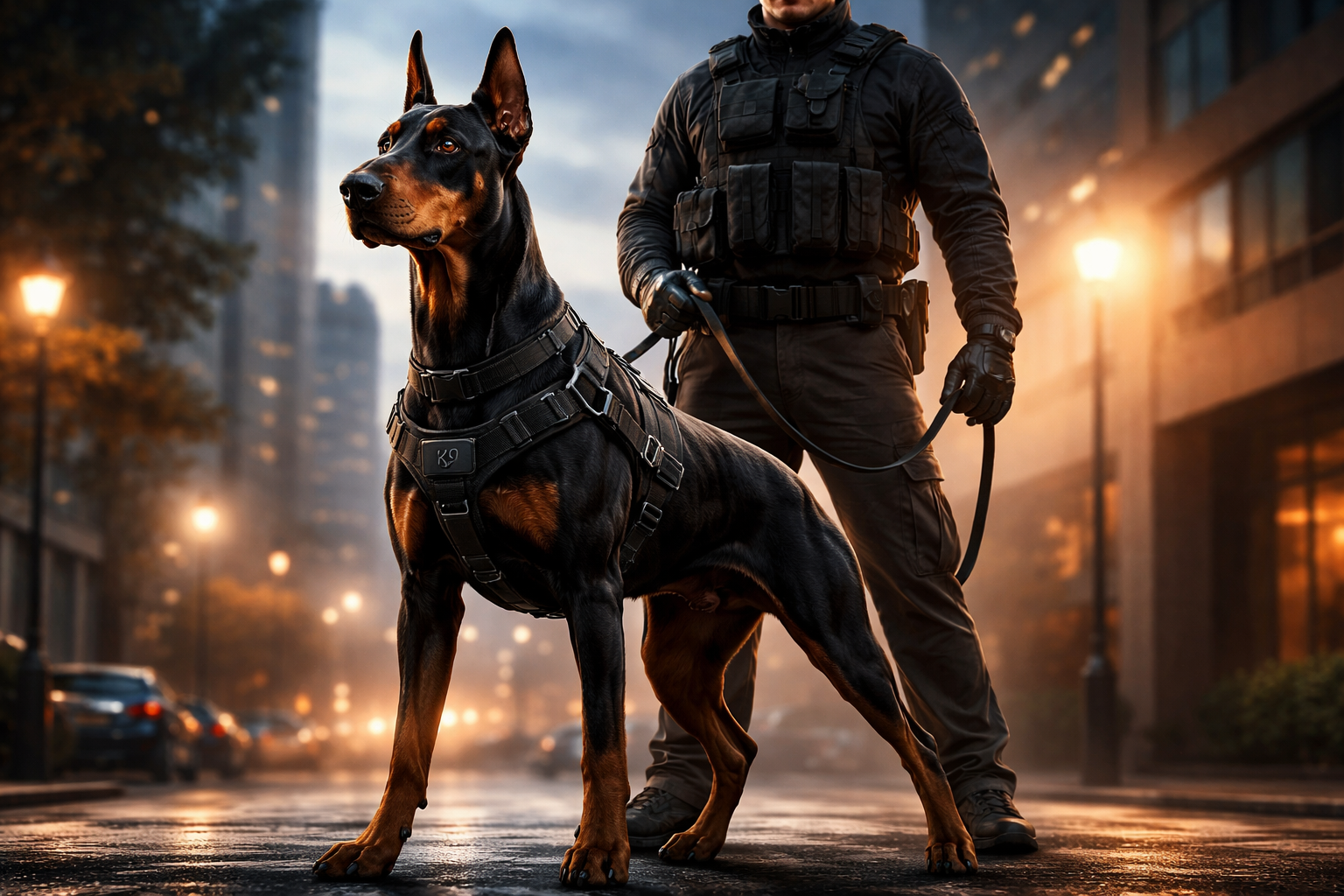
The Doberman Pinscher
One of the World’s Finest Protection Dogs
Jeff Davis | https://workingdogcentral.com
 0
0 0
0 0
0 0
0 0
0
The Doberman Pinscher: One of the World’s Finest Protection Dogs
Some dog breeds were shaped by hunting. Others by herding or guarding livestock. But every once in a while a breed comes along that was designed for a very specific purpose.
The Doberman Pinscher is one of those dogs.
Spend enough time around working dogs and you learn to read them the same way you read the woods—watching posture, movement, and the quiet signals most people miss. Dobermans carry themselves with a certain confidence that’s hard to mistake. They move like athletes, think like problem solvers, and form bonds with their handlers that run deep.
It’s no accident this breed has become one of the most respected protection dogs in the world.
A Breed Built for Protection
The story of the Doberman begins in late 19th century Germany with a tax collector named Karl Friedrich Louis Dobermann. Dobermann’s job required him to travel through rough towns carrying money, often alone and often after dark. Naturally, that kind of work came with risk.
Dobermann set out to develop the ultimate personal protection dog—one that was fearless, intelligent, and loyal enough to stand beside its handler no matter the situation.
Using several breeds believed to include the Rottweiler, German Pinscher, Weimaraner, and various shepherd-type dogs, he produced a powerful new working dog that combined speed, courage, and sharp intelligence.
What he created wasn’t just a guard dog.
He created a thinking dog.
That distinction is what still separates the Doberman from many protection breeds today.
Intelligence That Demands Respect
Anyone who has worked with a Doberman will tell you the same thing: these dogs are extremely intelligent.
Not just trainable.
Intelligent.
There’s a difference.
Some breeds learn commands well but rely heavily on repetition and structure. Dobermans tend to read situations on their own. They observe. They analyze. They anticipate what their handler wants.
In protection work, that ability becomes incredibly valuable.
A well-trained Doberman doesn’t simply react to commands—it understands when something is wrong.
Handlers often describe the breed as “thinking three steps ahead.” In a protection scenario, that awareness allows the dog to evaluate threats quickly while remaining calm and controlled.
And control is the key to a good protection dog.
Built Like an Athlete
Physically, the Doberman Pinscher looks exactly like what it was bred to be—a fast, powerful guardian capable of explosive movement.
The breed carries a lean, muscular frame built for endurance and speed rather than brute strength. A mature Doberman can cover ground with surprising quickness, making it incredibly effective at intercepting threats.
Watch one run across an open field and you’ll see a dog that moves almost like a greyhound, yet carries the muscle and determination of a working guardian.
That combination of agility and power gives the Doberman a unique edge in protection work.
Where some larger guardian breeds rely on intimidation alone, the Doberman brings speed, reaction time, and precision.
Loyalty That Runs Deep
Protection dogs must possess more than courage.
They must possess loyalty.
Dobermans are famous for forming extremely tight bonds with their families. Once attached to their handler, they tend to remain deeply devoted for life.
This loyalty is what makes them so effective as personal protection dogs.
A Doberman doesn’t guard territory simply because it was trained to do so. It protects the people it cares about.
Spend time with the breed and you’ll see it quickly. Dobermans often stay close to their owners, watching quietly from nearby as if keeping a mental record of everything happening around them.
They notice strangers.
They notice unusual behavior.
And they never truly switch off.
Natural Protective Instincts
One of the reasons Dobermans excel in protection roles is their natural guarding instinct.
Unlike some breeds that require heavy conditioning to perform guard work, Dobermans already possess strong protective tendencies. Good training simply channels those instincts into controlled, reliable behavior.
Without structure, however, that same instinct can lead to problems.
Protection work demands balance.
The dog must remain confident and alert without becoming reactive or unstable. That’s why responsible training and early socialization are critical for the breed.
When raised properly, Dobermans tend to be calm, observant, and steady in temperament.
They are not dogs that bark endlessly at every passing sound.
Instead, they tend to evaluate first.
And when they decide something isn’t right, they respond quickly.
Dobermans in Military and Police Work
While many people think of Dobermans primarily as personal protection dogs, the breed has also served with distinction in military and law enforcement roles.
During World War II, Dobermans were widely used by the United States Marine Corps as sentry dogs, messengers, and scouts in the Pacific theater. Their intelligence, speed, and trainability made them invaluable in jungle warfare environments.
These dogs became known as the “Devil Dogs” of the Marines.
Many gave their lives protecting soldiers during the conflict, and their service remains one of the most respected chapters in working dog history.
Today, while breeds like the Belgian Malinois and German Shepherd dominate modern military K9 units, Dobermans still appear in specialized protection and security roles around the world.
Their ability to combine intelligence with controlled aggression remains highly valued.
The Doberman as a Family Protection Dog
For many households, the Doberman’s greatest strength is its ability to serve as both companion and guardian.
Unlike some livestock guardian breeds that tend to remain independent, Dobermans thrive when they are part of the family. They prefer to live close to their people rather than patrol distant territory.
This makes them particularly well suited for home protection.
A properly trained Doberman can relax quietly in the house one moment and respond instantly to a potential threat the next.
Their awareness is constant.
But their response is measured.
In experienced hands, this creates one of the most reliable family protection dogs available.
Training Matters More Than Breed
One thing experienced dog men understand is that no breed becomes a protection dog automatically.
Instinct may provide the foundation.
Training provides the control.
Dobermans respond extremely well to structured training programs that emphasize obedience, confidence, and clear communication between dog and handler.
Without that leadership, their intelligence can become a challenge.
With it, they become remarkable partners.
Protection training should always be conducted by experienced trainers who understand working dogs and behavioral development. The goal is not aggression—it is controlled response.
A true protection dog remains calm until needed.
A Legacy That Endures
The Doberman Pinscher has earned its place among the world’s elite protection breeds through decades of proven performance.
It combines intelligence, loyalty, athletic ability, and natural guarding instinct in a way few dogs can match.
For the right owner—someone willing to invest time, training, and leadership—the Doberman becomes more than just a guard dog.
It becomes a partner.
A watchful presence.
And when necessary, a fearless protector.
Like many great working dogs, the Doberman’s true strength isn’t found in intimidation or aggression.
It’s found in the quiet confidence of a dog that knows its job—and stands ready to do it.
Some dog breeds were shaped by hunting. Others by herding or guarding livestock. But every once in a while a breed comes along that was designed for a very specific purpose.
The Doberman Pinscher is one of those dogs.
Spend enough time around working dogs and you learn to read them the same way you read the woods—watching posture, movement, and the quiet signals most people miss. Dobermans carry themselves with a certain confidence that’s hard to mistake. They move like athletes, think like problem solvers, and form bonds with their handlers that run deep.
It’s no accident this breed has become one of the most respected protection dogs in the world.
A Breed Built for Protection
The story of the Doberman begins in late 19th century Germany with a tax collector named Karl Friedrich Louis Dobermann. Dobermann’s job required him to travel through rough towns carrying money, often alone and often after dark. Naturally, that kind of work came with risk.
Dobermann set out to develop the ultimate personal protection dog—one that was fearless, intelligent, and loyal enough to stand beside its handler no matter the situation.
Using several breeds believed to include the Rottweiler, German Pinscher, Weimaraner, and various shepherd-type dogs, he produced a powerful new working dog that combined speed, courage, and sharp intelligence.
What he created wasn’t just a guard dog.
He created a thinking dog.
That distinction is what still separates the Doberman from many protection breeds today.
Intelligence That Demands Respect
Anyone who has worked with a Doberman will tell you the same thing: these dogs are extremely intelligent.
Not just trainable.
Intelligent.
There’s a difference.
Some breeds learn commands well but rely heavily on repetition and structure. Dobermans tend to read situations on their own. They observe. They analyze. They anticipate what their handler wants.
In protection work, that ability becomes incredibly valuable.
A well-trained Doberman doesn’t simply react to commands—it understands when something is wrong.
Handlers often describe the breed as “thinking three steps ahead.” In a protection scenario, that awareness allows the dog to evaluate threats quickly while remaining calm and controlled.
And control is the key to a good protection dog.
Built Like an Athlete
Physically, the Doberman Pinscher looks exactly like what it was bred to be—a fast, powerful guardian capable of explosive movement.
The breed carries a lean, muscular frame built for endurance and speed rather than brute strength. A mature Doberman can cover ground with surprising quickness, making it incredibly effective at intercepting threats.
Watch one run across an open field and you’ll see a dog that moves almost like a greyhound, yet carries the muscle and determination of a working guardian.
That combination of agility and power gives the Doberman a unique edge in protection work.
Where some larger guardian breeds rely on intimidation alone, the Doberman brings speed, reaction time, and precision.
Loyalty That Runs Deep
Protection dogs must possess more than courage.
They must possess loyalty.
Dobermans are famous for forming extremely tight bonds with their families. Once attached to their handler, they tend to remain deeply devoted for life.
This loyalty is what makes them so effective as personal protection dogs.
A Doberman doesn’t guard territory simply because it was trained to do so. It protects the people it cares about.
Spend time with the breed and you’ll see it quickly. Dobermans often stay close to their owners, watching quietly from nearby as if keeping a mental record of everything happening around them.
They notice strangers.
They notice unusual behavior.
And they never truly switch off.
Natural Protective Instincts
One of the reasons Dobermans excel in protection roles is their natural guarding instinct.
Unlike some breeds that require heavy conditioning to perform guard work, Dobermans already possess strong protective tendencies. Good training simply channels those instincts into controlled, reliable behavior.
Without structure, however, that same instinct can lead to problems.
Protection work demands balance.
The dog must remain confident and alert without becoming reactive or unstable. That’s why responsible training and early socialization are critical for the breed.
When raised properly, Dobermans tend to be calm, observant, and steady in temperament.
They are not dogs that bark endlessly at every passing sound.
Instead, they tend to evaluate first.
And when they decide something isn’t right, they respond quickly.
Dobermans in Military and Police Work
While many people think of Dobermans primarily as personal protection dogs, the breed has also served with distinction in military and law enforcement roles.
During World War II, Dobermans were widely used by the United States Marine Corps as sentry dogs, messengers, and scouts in the Pacific theater. Their intelligence, speed, and trainability made them invaluable in jungle warfare environments.
These dogs became known as the “Devil Dogs” of the Marines.
Many gave their lives protecting soldiers during the conflict, and their service remains one of the most respected chapters in working dog history.
Today, while breeds like the Belgian Malinois and German Shepherd dominate modern military K9 units, Dobermans still appear in specialized protection and security roles around the world.
Their ability to combine intelligence with controlled aggression remains highly valued.
The Doberman as a Family Protection Dog
For many households, the Doberman’s greatest strength is its ability to serve as both companion and guardian.
Unlike some livestock guardian breeds that tend to remain independent, Dobermans thrive when they are part of the family. They prefer to live close to their people rather than patrol distant territory.
This makes them particularly well suited for home protection.
A properly trained Doberman can relax quietly in the house one moment and respond instantly to a potential threat the next.
Their awareness is constant.
But their response is measured.
In experienced hands, this creates one of the most reliable family protection dogs available.
Training Matters More Than Breed
One thing experienced dog men understand is that no breed becomes a protection dog automatically.
Instinct may provide the foundation.
Training provides the control.
Dobermans respond extremely well to structured training programs that emphasize obedience, confidence, and clear communication between dog and handler.
Without that leadership, their intelligence can become a challenge.
With it, they become remarkable partners.
Protection training should always be conducted by experienced trainers who understand working dogs and behavioral development. The goal is not aggression—it is controlled response.
A true protection dog remains calm until needed.
A Legacy That Endures
The Doberman Pinscher has earned its place among the world’s elite protection breeds through decades of proven performance.
It combines intelligence, loyalty, athletic ability, and natural guarding instinct in a way few dogs can match.
For the right owner—someone willing to invest time, training, and leadership—the Doberman becomes more than just a guard dog.
It becomes a partner.
A watchful presence.
And when necessary, a fearless protector.
Like many great working dogs, the Doberman’s true strength isn’t found in intimidation or aggression.
It’s found in the quiet confidence of a dog that knows its job—and stands ready to do it.


View all 0 comments