How Detection Dogs Use Scent to Find Hidden Contraband
Jeff Davis | https://workingdogcentral.com
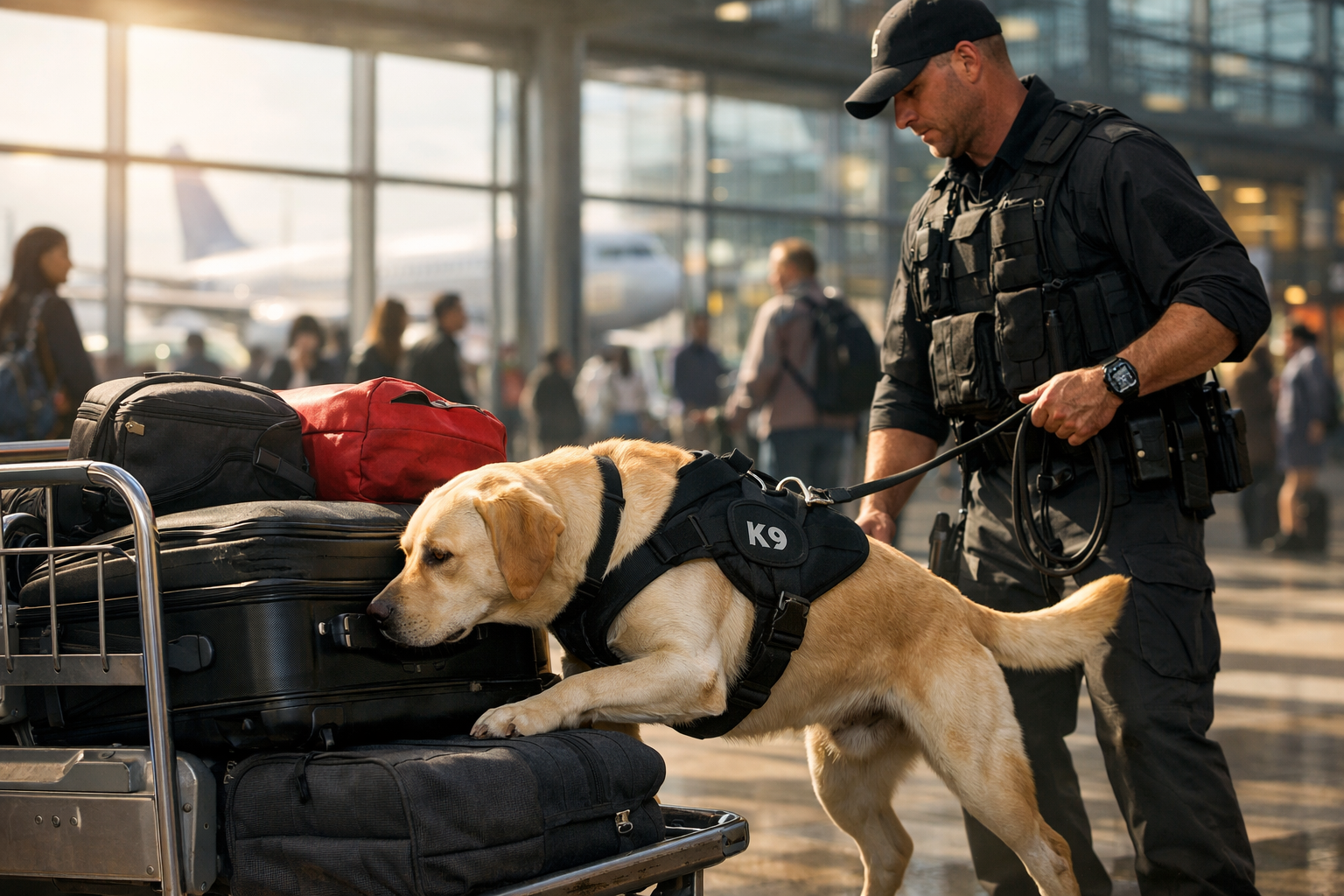
If you’ve ever watched a detection dog work, it’s hard not to be impressed. A dog trots down a line of luggage, nose moving like a radar antenna, handler walking calmly behind. To the casual observer it might look routine. But inside that dog’s nose is a sensory system so advanced it borders on unbelievable.
As someone who has spent decades around working dogs—bird dogs, hounds, tracking dogs—you learn quickly that scent is the dog’s true language. While hunters admire a pointing dog locking up on quail or a hound unraveling a cold raccoon track, detection dogs are doing something equally remarkable. They are locating microscopic scent particles drifting through the air or clinging to surfaces, then telling their handler exactly where the source lies hidden.
It isn’t magic. It’s biology, training, and thousands of years of canine evolution working together.
And when it comes to finding contraband, nothing on earth does the job better than a dog’s nose.
The Nose That Sees the Invisible
The foundation of detection work begins with the extraordinary anatomy of the canine nose.
Humans possess roughly five million scent receptors. A dog may have between 200 and 300 million depending on the breed. That difference alone is staggering, but it’s only part of the story. The portion of a dog’s brain devoted to processing smell is vastly larger than ours.
To put it another way, dogs don’t just smell the world—they interpret it.
When air enters a dog’s nose, it separates into two pathways. One is for breathing. The other is dedicated entirely to scent analysis. Inside that chamber, microscopic odor particles are trapped and examined by specialized receptors capable of identifying incredibly faint chemical signatures.
The result is an olfactory system so sensitive that a well-trained detection dog can locate a few drops of narcotics diluted in gallons of liquid or detect trace explosive residue invisible to laboratory instruments.
To a detection dog, scent behaves almost like a visible cloud drifting through the environment.
And that’s exactly how they hunt it.
Understanding the Scent Picture
One of the biggest misconceptions about detection dogs is that they smell an object directly. In reality, they’re usually detecting the odor plume drifting away from it.
Every substance releases microscopic particles into the air. Drugs, explosives, currency, firearms—everything has a unique scent profile. As these particles disperse, they move with air currents, forming invisible trails or scent cones.
Detection dogs are trained to read that moving scent the same way a bird dog reads wind while hunting quail.
If the odor is strong, the dog closes in quickly. If it’s faint, the dog begins casting back and forth, searching for the strongest concentration. Each step brings the dog closer to the source until the scent becomes undeniable.
When that moment comes, the dog performs what handlers call the “alert.”
That alert might be a sit, a stare, a paw scratch, or simply freezing in place beside the target.
To the trained handler, it’s as clear as a pointing dog locked on a covey.
Something is there.
Training the Nose to Recognize Contraband
A detection dog isn’t born knowing how to find narcotics or explosives. What they are born with is an intense drive to search and hunt.
Training simply redirects that natural instinct.
Most detection programs begin by pairing a target odor with a reward—often a toy or tug. When the dog finds the scent, the reward appears instantly. Before long the dog begins associating that specific odor with success.
To the dog, locating the scent becomes a game.
This motivation is critical. The best detection dogs are obsessed with the hunt. They search eagerly, sometimes with the same intensity you see in a retriever waiting for a duck to fall or a hound working a hot track through the woods.
Over time, the dog learns to ignore distractions and focus entirely on the odor it was trained to find.
Suitcases, vehicles, cargo containers, warehouses—none of it matters.
Only the scent does.
The Role of the Handler
While the dog’s nose does the heavy lifting, the handler plays an equally important role.
A good detection handler learns to read subtle changes in the dog’s behavior. The wag of a tail, the shift in breathing, a slight hesitation—these are clues that the dog is encountering scent.
Experienced handlers sometimes say the dog speaks in whispers.
If you’re paying attention, you’ll hear it.
Handlers also manage search patterns, ensuring the dog covers ground efficiently without contamination or missed areas. In environments like airports or border crossings, this coordination allows detection teams to screen enormous amounts of cargo and luggage in surprisingly little time.
The partnership becomes a quiet conversation between dog and human.
One provides the nose.
The other provides the direction.
Why Certain Breeds Excel at Detection
While many dogs can be trained for scent work, a handful of breeds consistently dominate detection programs.
Labrador Retrievers, for example, are widely used because of their enthusiasm, intelligence, and ability to work calmly in crowded environments. They are social, highly trainable, and possess strong scenting ability.
Belgian Malinois and German Shepherds also excel, particularly in military and law enforcement roles where detection may overlap with patrol or protection duties.
What these breeds share is a combination of drive, stamina, and focus.
But perhaps the most important trait is curiosity.
The best detection dogs are relentless investigators. They treat every search like a puzzle that must be solved.
And once they start hunting scent, they rarely quit.
Detection Dogs in the Real World
Today, detection dogs operate in an astonishing range of environments.
Airports rely on them to screen luggage and cargo for narcotics and explosives. Border patrol teams use them to locate hidden compartments in vehicles. Police departments deploy them during criminal investigations to uncover concealed drugs or weapons.
Even conservation agencies have begun using detection dogs to locate illegal wildlife products, invasive species, and environmental contaminants.
In each case the principle remains the same.
The dog searches.
The scent tells the story.
And the handler listens.
The Hunter’s Perspective
Anyone who has spent time hunting with dogs understands the power of scent work.
Watch a coonhound unravel a winding track through the night woods or an English pointer lock solid on a covey of birds, and you begin to appreciate the sensory world dogs live in. They experience landscapes in layers of smell we can’t even imagine.
Detection dogs simply apply that ancient hunting instinct to modern problems.
Instead of birds or raccoons, they hunt odor molecules drifting through airports and shipping containers.
But the fundamentals are identical.
The wind matters. The terrain matters. The dog follows scent until the truth reveals itself.
That connection between hunting instinct and detection work is why so many working dog handlers come from hunting backgrounds. The principles are familiar.
Trust the dog.
Trust the nose.
And when the dog says something is there, pay attention.
A Nose That Still Outperforms Technology
Despite decades of technological advancement, machines still struggle to match the canine nose.
Electronic sensors can detect certain chemicals under controlled conditions, but they lack the versatility and adaptability of a trained dog. A detection dog can move through complex environments, adjust to changing scent conditions, and analyze multiple odors simultaneously.
All while working with enthusiasm that no machine can replicate.
That’s why detection dogs remain indispensable to law enforcement, security agencies, and military units around the world.
Their noses are simply too good to replace.
The Quiet Guardians
Most people pass detection dogs without giving them much thought. A Labrador sniffing suitcases at an airport may look like just another dog doing a routine job.
But behind that calm exterior is one of the most powerful biological detection systems on the planet.
A few drifting scent particles.
A moment of concentration.
A subtle alert beside a piece of luggage.
And suddenly a hidden truth comes to light.
It’s a quiet kind of heroism, carried out by animals whose greatest tool is something nature gave them long before humans ever thought to put it to work.
And as long as contraband can hide, detection dogs will keep finding it.
As someone who has spent decades around working dogs—bird dogs, hounds, tracking dogs—you learn quickly that scent is the dog’s true language. While hunters admire a pointing dog locking up on quail or a hound unraveling a cold raccoon track, detection dogs are doing something equally remarkable. They are locating microscopic scent particles drifting through the air or clinging to surfaces, then telling their handler exactly where the source lies hidden.
It isn’t magic. It’s biology, training, and thousands of years of canine evolution working together.
And when it comes to finding contraband, nothing on earth does the job better than a dog’s nose.
The Nose That Sees the Invisible
The foundation of detection work begins with the extraordinary anatomy of the canine nose.
Humans possess roughly five million scent receptors. A dog may have between 200 and 300 million depending on the breed. That difference alone is staggering, but it’s only part of the story. The portion of a dog’s brain devoted to processing smell is vastly larger than ours.
To put it another way, dogs don’t just smell the world—they interpret it.
When air enters a dog’s nose, it separates into two pathways. One is for breathing. The other is dedicated entirely to scent analysis. Inside that chamber, microscopic odor particles are trapped and examined by specialized receptors capable of identifying incredibly faint chemical signatures.
The result is an olfactory system so sensitive that a well-trained detection dog can locate a few drops of narcotics diluted in gallons of liquid or detect trace explosive residue invisible to laboratory instruments.
To a detection dog, scent behaves almost like a visible cloud drifting through the environment.
And that’s exactly how they hunt it.
Understanding the Scent Picture
One of the biggest misconceptions about detection dogs is that they smell an object directly. In reality, they’re usually detecting the odor plume drifting away from it.
Every substance releases microscopic particles into the air. Drugs, explosives, currency, firearms—everything has a unique scent profile. As these particles disperse, they move with air currents, forming invisible trails or scent cones.
Detection dogs are trained to read that moving scent the same way a bird dog reads wind while hunting quail.
If the odor is strong, the dog closes in quickly. If it’s faint, the dog begins casting back and forth, searching for the strongest concentration. Each step brings the dog closer to the source until the scent becomes undeniable.
When that moment comes, the dog performs what handlers call the “alert.”
That alert might be a sit, a stare, a paw scratch, or simply freezing in place beside the target.
To the trained handler, it’s as clear as a pointing dog locked on a covey.
Something is there.
Training the Nose to Recognize Contraband
A detection dog isn’t born knowing how to find narcotics or explosives. What they are born with is an intense drive to search and hunt.
Training simply redirects that natural instinct.
Most detection programs begin by pairing a target odor with a reward—often a toy or tug. When the dog finds the scent, the reward appears instantly. Before long the dog begins associating that specific odor with success.
To the dog, locating the scent becomes a game.
This motivation is critical. The best detection dogs are obsessed with the hunt. They search eagerly, sometimes with the same intensity you see in a retriever waiting for a duck to fall or a hound working a hot track through the woods.
Over time, the dog learns to ignore distractions and focus entirely on the odor it was trained to find.
Suitcases, vehicles, cargo containers, warehouses—none of it matters.
Only the scent does.
The Role of the Handler
While the dog’s nose does the heavy lifting, the handler plays an equally important role.
A good detection handler learns to read subtle changes in the dog’s behavior. The wag of a tail, the shift in breathing, a slight hesitation—these are clues that the dog is encountering scent.
Experienced handlers sometimes say the dog speaks in whispers.
If you’re paying attention, you’ll hear it.
Handlers also manage search patterns, ensuring the dog covers ground efficiently without contamination or missed areas. In environments like airports or border crossings, this coordination allows detection teams to screen enormous amounts of cargo and luggage in surprisingly little time.
The partnership becomes a quiet conversation between dog and human.
One provides the nose.
The other provides the direction.
Why Certain Breeds Excel at Detection
While many dogs can be trained for scent work, a handful of breeds consistently dominate detection programs.
Labrador Retrievers, for example, are widely used because of their enthusiasm, intelligence, and ability to work calmly in crowded environments. They are social, highly trainable, and possess strong scenting ability.
Belgian Malinois and German Shepherds also excel, particularly in military and law enforcement roles where detection may overlap with patrol or protection duties.
What these breeds share is a combination of drive, stamina, and focus.
But perhaps the most important trait is curiosity.
The best detection dogs are relentless investigators. They treat every search like a puzzle that must be solved.
And once they start hunting scent, they rarely quit.
Detection Dogs in the Real World
Today, detection dogs operate in an astonishing range of environments.
Airports rely on them to screen luggage and cargo for narcotics and explosives. Border patrol teams use them to locate hidden compartments in vehicles. Police departments deploy them during criminal investigations to uncover concealed drugs or weapons.
Even conservation agencies have begun using detection dogs to locate illegal wildlife products, invasive species, and environmental contaminants.
In each case the principle remains the same.
The dog searches.
The scent tells the story.
And the handler listens.
The Hunter’s Perspective
Anyone who has spent time hunting with dogs understands the power of scent work.
Watch a coonhound unravel a winding track through the night woods or an English pointer lock solid on a covey of birds, and you begin to appreciate the sensory world dogs live in. They experience landscapes in layers of smell we can’t even imagine.
Detection dogs simply apply that ancient hunting instinct to modern problems.
Instead of birds or raccoons, they hunt odor molecules drifting through airports and shipping containers.
But the fundamentals are identical.
The wind matters. The terrain matters. The dog follows scent until the truth reveals itself.
That connection between hunting instinct and detection work is why so many working dog handlers come from hunting backgrounds. The principles are familiar.
Trust the dog.
Trust the nose.
And when the dog says something is there, pay attention.
A Nose That Still Outperforms Technology
Despite decades of technological advancement, machines still struggle to match the canine nose.
Electronic sensors can detect certain chemicals under controlled conditions, but they lack the versatility and adaptability of a trained dog. A detection dog can move through complex environments, adjust to changing scent conditions, and analyze multiple odors simultaneously.
All while working with enthusiasm that no machine can replicate.
That’s why detection dogs remain indispensable to law enforcement, security agencies, and military units around the world.
Their noses are simply too good to replace.
The Quiet Guardians
Most people pass detection dogs without giving them much thought. A Labrador sniffing suitcases at an airport may look like just another dog doing a routine job.
But behind that calm exterior is one of the most powerful biological detection systems on the planet.
A few drifting scent particles.
A moment of concentration.
A subtle alert beside a piece of luggage.
And suddenly a hidden truth comes to light.
It’s a quiet kind of heroism, carried out by animals whose greatest tool is something nature gave them long before humans ever thought to put it to work.
And as long as contraband can hide, detection dogs will keep finding it.