Search and Rescue Dogs
The Working Dogs That Bring People Home
Jeff Davis | https://workingdogcentral.com
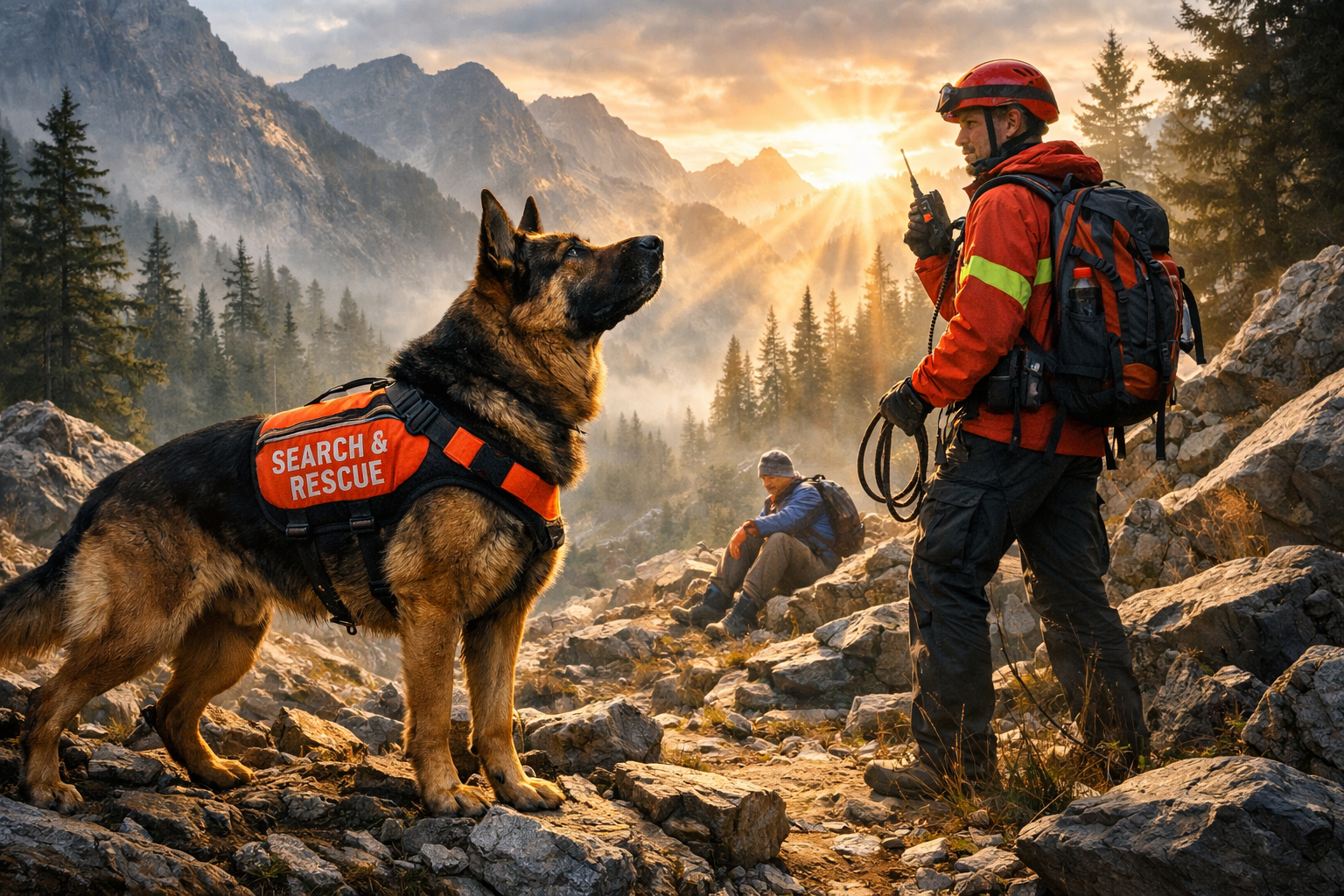
Any hunter who has spent time behind a good dog understands one simple truth: a dog’s nose sees a world we cannot.
Out in the woods, a tracking dog can follow the faint trace of a wounded deer hours after the shot. A hound can unravel a raccoon track laid down the night before. That same natural gift—combined with careful training and an unbreakable partnership with a handler—is what makes search and rescue dogs some of the most important working dogs on earth.
When someone goes missing, these dogs become the difference between hope and tragedy.
A Nose Designed for the Impossible
A human being has roughly six million scent receptors. A well-bred working dog can have more than three hundred million.
That difference changes everything.
To a dog, scent isn’t just a faint smell drifting through the air. It is a complex trail of microscopic skin cells, body odor, environmental changes, and crushed vegetation. Every step a person takes leaves a story behind on the ground, in the air, and on surrounding objects.
Search and rescue dogs are trained to read that story.
Handlers often describe watching a dog work as witnessing a kind of silent conversation between the animal and the landscape. The dog’s head drops, its tail stiffens slightly, and suddenly the animal moves with purpose. The trail has been found.
From that moment on, the dog is in charge.
Wilderness Search and Rescue
Many search and rescue missions begin in the same environments that hunters know well—mountains, forests, river bottoms, and remote country where a person can disappear faster than most folks imagine.
A hiker takes the wrong trail.
A child wanders away from camp.
An elderly person with dementia walks off into the woods.
When daylight fades and temperatures begin to drop, every minute counts.
This is where wilderness search and rescue dogs excel. These dogs are trained to locate human scent across long distances and rough terrain. Some work by tracking a specific individual from a scent article, while others search wide areas for any human presence.
Watching one of these dogs move through timber reminds many old hunters of a good trailing hound. The nose stays low. The body language shifts with each change in scent strength. When the trail grows faint, the dog circles and rechecks until it picks up the direction again.
Unlike hunting dogs, however, the goal isn’t game. It’s a missing person who may be frightened, injured, or exhausted.
When the dog finds them, the reward is not a raccoon in a tree or a covey rising in the pines.
It’s a life saved.
Disaster and Urban Search Dogs
While wilderness searches are common, some of the most dramatic work happens in disaster zones.
Earthquakes.
Collapsed buildings.
Tornado destruction.
Explosions.
In these environments, human search teams can only move so fast and see so much. Rubble piles hide air pockets and voids where survivors may still be alive.
Search and rescue dogs can detect the scent of a buried person through layers of debris, concrete, dust, and twisted steel.
These dogs are trained to scramble over unstable surfaces, climb through wreckage, and navigate environments that would intimidate most animals. Their reward for finding someone is often a toy or praise from their handler, but the stakes are much higher.
After major disasters around the world, search dogs have been responsible for locating survivors that human teams would never have found alone.
The Breeds Built for the Job
While many breeds can perform search and rescue work, certain types of dogs tend to dominate the field.
Breeds known for intelligence, endurance, and strong working drive are natural candidates. German Shepherds, Labrador Retrievers, and Belgian Malinois are common choices. Border Collies, Golden Retrievers, and mixed-breed dogs with the right temperament also perform exceptionally well.
What matters most isn’t pedigree—it’s motivation.
A search dog must possess an almost obsessive desire to work, play, and solve problems. Training turns that energy into a focused mission: find the human scent and stay on it until the handler arrives.
Handlers often say the dog believes the search is simply a game.
But the outcome is far more serious.
Training a Life-Saving Dog
Search and rescue dogs are not created overnight.
Training can take years, and it requires a close partnership between dog and handler. Many handlers volunteer their time, spending countless hours working with their dogs long before they ever respond to a real call.
Training usually begins with simple games. A helper hides nearby while the dog watches, then calls the dog to find them. When the dog succeeds, it receives enthusiastic praise or a favorite toy.
Gradually the difficulty increases.
The helper hides farther away.
The terrain becomes more complex.
Multiple scent trails are introduced.
Eventually the dog learns to search large areas independently while still working within range of its handler.
The finished dog moves through the landscape like a seasoned hunter’s companion—reading wind, ground scent, and environmental clues with remarkable efficiency.
The Bond Between Dog and Handler
If you’ve ever hunted with a truly good dog, you understand the silent communication that develops between human and animal.
A glance.
A hand signal.
A subtle shift in posture.
Search and rescue teams rely on that same bond.
Handlers must learn to read their dog’s body language carefully. A sudden change in pace, a raised head catching wind scent, or a tightening of the tail can signal that the dog is approaching the target.
Unlike machines, dogs do not give digital readouts.
They speak through movement and instinct.
The best handlers become fluent in that language.
Real Lives Saved
Across the world, search and rescue dogs have located lost children, injured hikers, missing hunters, avalanche victims, and disaster survivors.
Many of these rescues happen quietly, without national headlines.
A dog follows a faint trail through miles of forest and finds a hypothermic hiker just before nightfall.
A disaster dog alerts on a small pocket beneath collapsed concrete, leading rescuers to a survivor trapped for hours.
In each case, the dog did what it was bred and trained to do—use its nose, its drive, and its partnership with a handler to solve a problem that humans alone could not.
For the families waiting and hoping, those dogs are more than working animals.
They are miracles with four legs.
A Different Kind of Working Dog
Hunters often measure a dog’s value by the game it produces or the birds it points.
Search and rescue dogs are judged by something far more profound.
They bring people home.
Their work demands courage, stamina, and unwavering focus. They search through storms, darkness, heat, cold, and danger. They climb rubble, cross rivers, and follow scent trails that may stretch for miles.
And when they finally locate the missing person, the reward is something few working dogs ever experience.
The relief of a life saved.
For those of us who understand the power of a good dog’s nose, it isn’t surprising that dogs can accomplish these things.
But it is still remarkable to watch.
Because in the end, search and rescue dogs prove something hunters have known for centuries.
When the stakes are highest and the trail grows difficult, there is still nothing in the world quite like a working dog.
Out in the woods, a tracking dog can follow the faint trace of a wounded deer hours after the shot. A hound can unravel a raccoon track laid down the night before. That same natural gift—combined with careful training and an unbreakable partnership with a handler—is what makes search and rescue dogs some of the most important working dogs on earth.
When someone goes missing, these dogs become the difference between hope and tragedy.
A Nose Designed for the Impossible
A human being has roughly six million scent receptors. A well-bred working dog can have more than three hundred million.
That difference changes everything.
To a dog, scent isn’t just a faint smell drifting through the air. It is a complex trail of microscopic skin cells, body odor, environmental changes, and crushed vegetation. Every step a person takes leaves a story behind on the ground, in the air, and on surrounding objects.
Search and rescue dogs are trained to read that story.
Handlers often describe watching a dog work as witnessing a kind of silent conversation between the animal and the landscape. The dog’s head drops, its tail stiffens slightly, and suddenly the animal moves with purpose. The trail has been found.
From that moment on, the dog is in charge.
Wilderness Search and Rescue
Many search and rescue missions begin in the same environments that hunters know well—mountains, forests, river bottoms, and remote country where a person can disappear faster than most folks imagine.
A hiker takes the wrong trail.
A child wanders away from camp.
An elderly person with dementia walks off into the woods.
When daylight fades and temperatures begin to drop, every minute counts.
This is where wilderness search and rescue dogs excel. These dogs are trained to locate human scent across long distances and rough terrain. Some work by tracking a specific individual from a scent article, while others search wide areas for any human presence.
Watching one of these dogs move through timber reminds many old hunters of a good trailing hound. The nose stays low. The body language shifts with each change in scent strength. When the trail grows faint, the dog circles and rechecks until it picks up the direction again.
Unlike hunting dogs, however, the goal isn’t game. It’s a missing person who may be frightened, injured, or exhausted.
When the dog finds them, the reward is not a raccoon in a tree or a covey rising in the pines.
It’s a life saved.
Disaster and Urban Search Dogs
While wilderness searches are common, some of the most dramatic work happens in disaster zones.
Earthquakes.
Collapsed buildings.
Tornado destruction.
Explosions.
In these environments, human search teams can only move so fast and see so much. Rubble piles hide air pockets and voids where survivors may still be alive.
Search and rescue dogs can detect the scent of a buried person through layers of debris, concrete, dust, and twisted steel.
These dogs are trained to scramble over unstable surfaces, climb through wreckage, and navigate environments that would intimidate most animals. Their reward for finding someone is often a toy or praise from their handler, but the stakes are much higher.
After major disasters around the world, search dogs have been responsible for locating survivors that human teams would never have found alone.
The Breeds Built for the Job
While many breeds can perform search and rescue work, certain types of dogs tend to dominate the field.
Breeds known for intelligence, endurance, and strong working drive are natural candidates. German Shepherds, Labrador Retrievers, and Belgian Malinois are common choices. Border Collies, Golden Retrievers, and mixed-breed dogs with the right temperament also perform exceptionally well.
What matters most isn’t pedigree—it’s motivation.
A search dog must possess an almost obsessive desire to work, play, and solve problems. Training turns that energy into a focused mission: find the human scent and stay on it until the handler arrives.
Handlers often say the dog believes the search is simply a game.
But the outcome is far more serious.
Training a Life-Saving Dog
Search and rescue dogs are not created overnight.
Training can take years, and it requires a close partnership between dog and handler. Many handlers volunteer their time, spending countless hours working with their dogs long before they ever respond to a real call.
Training usually begins with simple games. A helper hides nearby while the dog watches, then calls the dog to find them. When the dog succeeds, it receives enthusiastic praise or a favorite toy.
Gradually the difficulty increases.
The helper hides farther away.
The terrain becomes more complex.
Multiple scent trails are introduced.
Eventually the dog learns to search large areas independently while still working within range of its handler.
The finished dog moves through the landscape like a seasoned hunter’s companion—reading wind, ground scent, and environmental clues with remarkable efficiency.
The Bond Between Dog and Handler
If you’ve ever hunted with a truly good dog, you understand the silent communication that develops between human and animal.
A glance.
A hand signal.
A subtle shift in posture.
Search and rescue teams rely on that same bond.
Handlers must learn to read their dog’s body language carefully. A sudden change in pace, a raised head catching wind scent, or a tightening of the tail can signal that the dog is approaching the target.
Unlike machines, dogs do not give digital readouts.
They speak through movement and instinct.
The best handlers become fluent in that language.
Real Lives Saved
Across the world, search and rescue dogs have located lost children, injured hikers, missing hunters, avalanche victims, and disaster survivors.
Many of these rescues happen quietly, without national headlines.
A dog follows a faint trail through miles of forest and finds a hypothermic hiker just before nightfall.
A disaster dog alerts on a small pocket beneath collapsed concrete, leading rescuers to a survivor trapped for hours.
In each case, the dog did what it was bred and trained to do—use its nose, its drive, and its partnership with a handler to solve a problem that humans alone could not.
For the families waiting and hoping, those dogs are more than working animals.
They are miracles with four legs.
A Different Kind of Working Dog
Hunters often measure a dog’s value by the game it produces or the birds it points.
Search and rescue dogs are judged by something far more profound.
They bring people home.
Their work demands courage, stamina, and unwavering focus. They search through storms, darkness, heat, cold, and danger. They climb rubble, cross rivers, and follow scent trails that may stretch for miles.
And when they finally locate the missing person, the reward is something few working dogs ever experience.
The relief of a life saved.
For those of us who understand the power of a good dog’s nose, it isn’t surprising that dogs can accomplish these things.
But it is still remarkable to watch.
Because in the end, search and rescue dogs prove something hunters have known for centuries.
When the stakes are highest and the trail grows difficult, there is still nothing in the world quite like a working dog.