Detection Dog Training Methods Used by Police
Jeff Davis | https://workingdogcentral.com
 0
0 0
0 0
0 0
0 0
0
There is nothing quite like watching a good detection dog work. The dog hits the ground with purpose, nose alive, body tight with focus, and in a matter of moments begins sorting through a flood of human scent, distractions, and environmental noise to find one target odor. I have spent enough years around working dogs to tell you this kind of performance does not happen by luck. Police detection dogs are made through repetition, sharp timing, clear standards, and training methods that build confidence without dulling the dog’s natural desire to hunt.
For dog owners interested in working dogs, police detection work offers one of the clearest examples of how genetics, structure, temperament, and training all come together. Whether the dog is trained to locate narcotics, explosives, firearms, electronics, or human remains, the foundation is still the same. The trainer is shaping the dog’s hunting instinct into a precise, controlled, and dependable job.
What Makes a Good Detection Dog
Before training methods even begin, police agencies and professional trainers are looking for the right type of dog. In the field, you can teach technique, but it is much harder to manufacture drive where little exists. Most strong candidates have intense hunt drive, confidence on slick floors and strange surfaces, nerve around noise and crowds, and the ability to keep working when the reward is delayed. You want a dog that treats the search like the best game in the world.
That is why many police detection dogs come from working lines of Labrador Retrievers, German Shepherds, Belgian Malinois, and similar breeds. These dogs tend to bring the focus, stamina, and resilience needed for demanding searches. A soft dog that quits under pressure or a dog that startles easily will struggle when asked to work busy streets, warehouses, schools, cars, and luggage lines.
Building Drive Before Odor Work
One of the first training methods used by police trainers is drive development. Before a dog is asked to identify a target odor, it is taught to obsess over a reward. That reward may be a rolled towel, a ball, a kong, or another toy the dog craves. In many programs, trainers spend days or weeks convincing the dog that possession of that reward is everything. The dog learns to chase it, hunt for it, and fight to get it.
This step matters more than many beginners realize. Detection work is not usually taught by making the dog understand the practical meaning of drugs or explosives. The dog is not told, in any human sense, what contraband is. Instead, the dog learns a simple equation: target odor leads to reward. If the reward system is powerful enough, the dog will tear through a search area with the kind of determination you cannot fake.
I have seen average-looking young dogs come alive the moment that game clicked in their head. Their posture changes. Their eyes sharpen. They begin searching because they want to, not because they were physically guided into it. That desire is the engine behind everything that follows.
Using Play as a Training Tool
Police dog trainers commonly use play to create intensity. The toy appears, disappears, moves, and becomes hard to get. The dog learns that hunting solves the problem. This is not rough, mindless excitement. Good trainers are careful. They build arousal while keeping the dog clear-headed enough to think. A frantic dog that loses its nose and starts guessing is no more useful than a dog that lacks enthusiasm.
Odor Imprinting and Association
Once the dog is fully engaged with the reward, police trainers begin odor imprinting. This is the process of pairing a specific target odor with the dog’s prized reward until the odor itself becomes meaningful. There are different ways to do this, but the idea is straightforward. The dog finds the odor source, and the reward appears. Over time, the dog learns that one predicts the other.
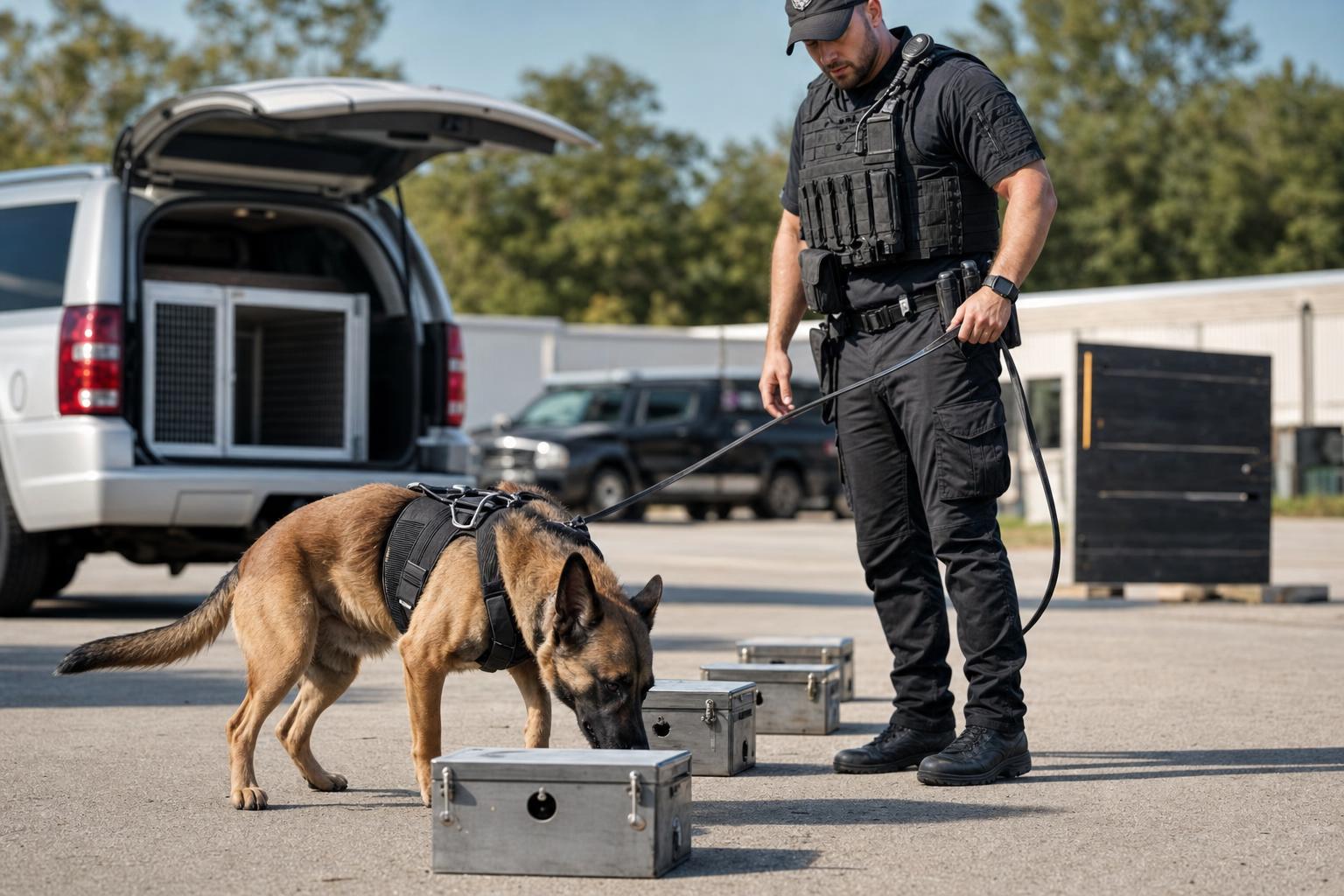
Some programs use boxes, cans, scent walls, or small rooms. Others hide the odor in vehicles, lockers, baggage, or outdoor areas depending on the dog’s future assignment. Early setups are simple. The dog is allowed to win quickly so the lesson stays clean. As the dog progresses, the hides become more difficult, deeper, and more varied.
Timing is everything here. The reward must arrive when the dog is committed to the odor, not wandering near it by accident. That clean timing teaches precision. If a trainer gets sloppy and rewards uncertainty, the dog may learn to indicate where odor once was, where handler pressure is strongest, or where the dog thinks the toy might appear. In police work, that kind of confusion can create serious problems.
Teaching the Final Response
A detection dog must do more than find odor. It must tell the handler clearly and consistently. Police trainers call this the final response or indication. In many law enforcement programs, dogs are taught a passive indication such as a sit or down at source. This is especially common for narcotics and explosives work because agencies often want a controlled response that does not disturb evidence or create danger.
Other dogs may use an active indication, such as barking, scratching, or digging, depending on the discipline and policy. The key is clarity. A good final response is easy for the handler to read and hard to confuse with normal searching behavior.
Trainers usually shape this behavior in small steps. The dog first learns that staying at source brings the reward. Then that pause becomes longer and more deliberate. Eventually the dog offers a formal sit, down, freeze, or focused stare. Done right, the final response becomes a habit the dog performs with conviction. The strongest dogs do not just drift past odor and glance back. They lock in and tell you, plain as day, that they are there.
Passive vs. Active Indications
There is constant discussion in working dog circles about which style is better. In truth, both can work when trained well. A passive response often gives clean, court-defensible alerts and reduces risk around sensitive hides. An active response can be highly obvious and useful in certain tasks. What matters most is consistency under pressure, in clutter, and around distractions.
Search Pattern Training and Environmental Proofing
After odor recognition and indication are established, police dog training shifts toward systematic searching. A talented dog still needs direction. Handlers teach dogs how to work vehicles from seam to seam, rooms from edge to edge, and open areas without wasting time. Search pattern training helps the team cover ground efficiently while reducing missed areas.
This stage often separates flashy young dogs from dependable finished dogs. It is one thing to find a simple training hide in a quiet room. It is another thing entirely to search a parking lot in summer heat, with food wrappers blowing around, engines cooling, strangers watching, and old odor drifting everywhere. Police trainers expose dogs to concrete, grass, schools, warehouses, buses, luggage, traffic stops, and cramped interiors so the dog learns that the job remains the same no matter the setting.
Proofing is a major part of this process. Trainers deliberately place distractions near target odor, use blank searches with no hide at all, and introduce residual odor situations to teach the dog not to cheat. A reliable police detection dog must hunt honestly. That means no false alerts caused by handler cues, environmental pressure, or wishful thinking from either end of the leash.
Handler Training Matters as Much as Dog Training
Folks new to the subject often focus entirely on the dog, but the handler is half the team. Police handlers are trained to read body language, understand changes in breathing and pace, and avoid influencing the dog. A poor handler can create false responses by crowding the dog, staring too hard at likely hide locations, or unconsciously tightening the leash.
The best handlers learn patience. They let the dog work odor out instead of rushing the search. They know when the dog is in scent, when it is working through contamination, and when it is simply out of the hunt. This is something you only really appreciate after watching dozens of teams work. The good ones move with rhythm and trust. The weak ones look like they are trying to drag an answer out of the dog.
Scenario-Based Training and Real-World Readiness
Strong police programs do not stop at controlled training fields. They stage real-world scenarios that mimic deployments. The dog may search a school hallway after hours, a parcel room with stacked boxes, or a vehicle line under time pressure. Trainers vary weather, lighting, surface conditions, hide heights, and contamination levels so the dog learns to solve problems instead of memorizing patterns.
I have always believed this is where a dog becomes truly useful. In the real world, odor moves. Heat lifts it. Wind carries it. Rain knocks it down. Human traffic spreads contamination. A finished detection dog has to work through all of that and still stay honest. That kind of reliability comes from broad, thoughtful exposure, not from repeating the same easy hide in the same four corners.
Maintenance Training Never Ends
One of the biggest misconceptions among dog owners is that a police detection dog is fully trained once it earns certification. In truth, certification is a checkpoint, not the end of the road. These dogs require constant maintenance. Trainers and handlers continue running hides, polishing final responses, proofing against false alerts, and exposing the dog to new search environments.
Without maintenance, performance drifts. Dogs begin anticipating, handlers get sloppy, and little problems take root. The strongest teams train often, review every search critically, and protect the dog’s motivation. A dog that still believes the hunt is a game worth winning will give you better work over the long haul than one that has been dulled by repetition and poor handling.
Why These Methods Work
At the heart of police detection dog training is a simple principle: use the dog’s natural hunting instinct, tie it to a powerful reward, and shape it into a precise behavior that holds up under stress. It is practical, tested, and grounded in what dogs do best. The training methods may look technical from the outside, but down deep they rely on timing, consistency, and understanding canine drive.
For dog owners interested in working dogs, there is a lot to admire here. Police detection training is not magic. It is disciplined craftsmanship. It takes the raw material of a willing, driven dog and turns it into a dependable partner that can search buildings, vehicles, packages, and open areas with accuracy that still impresses even old hands.
When you watch a seasoned detection dog settle into odor and lock at source, you are seeing far more than instinct. You are seeing hundreds of small lessons, properly taught, layered one over another until the work becomes second nature. That is the beauty of a real working dog. It hunts with heart, but it performs with purpose.
For dog owners interested in working dogs, police detection work offers one of the clearest examples of how genetics, structure, temperament, and training all come together. Whether the dog is trained to locate narcotics, explosives, firearms, electronics, or human remains, the foundation is still the same. The trainer is shaping the dog’s hunting instinct into a precise, controlled, and dependable job.
What Makes a Good Detection Dog
Before training methods even begin, police agencies and professional trainers are looking for the right type of dog. In the field, you can teach technique, but it is much harder to manufacture drive where little exists. Most strong candidates have intense hunt drive, confidence on slick floors and strange surfaces, nerve around noise and crowds, and the ability to keep working when the reward is delayed. You want a dog that treats the search like the best game in the world.
That is why many police detection dogs come from working lines of Labrador Retrievers, German Shepherds, Belgian Malinois, and similar breeds. These dogs tend to bring the focus, stamina, and resilience needed for demanding searches. A soft dog that quits under pressure or a dog that startles easily will struggle when asked to work busy streets, warehouses, schools, cars, and luggage lines.
Building Drive Before Odor Work
One of the first training methods used by police trainers is drive development. Before a dog is asked to identify a target odor, it is taught to obsess over a reward. That reward may be a rolled towel, a ball, a kong, or another toy the dog craves. In many programs, trainers spend days or weeks convincing the dog that possession of that reward is everything. The dog learns to chase it, hunt for it, and fight to get it.
This step matters more than many beginners realize. Detection work is not usually taught by making the dog understand the practical meaning of drugs or explosives. The dog is not told, in any human sense, what contraband is. Instead, the dog learns a simple equation: target odor leads to reward. If the reward system is powerful enough, the dog will tear through a search area with the kind of determination you cannot fake.
I have seen average-looking young dogs come alive the moment that game clicked in their head. Their posture changes. Their eyes sharpen. They begin searching because they want to, not because they were physically guided into it. That desire is the engine behind everything that follows.
Using Play as a Training Tool
Police dog trainers commonly use play to create intensity. The toy appears, disappears, moves, and becomes hard to get. The dog learns that hunting solves the problem. This is not rough, mindless excitement. Good trainers are careful. They build arousal while keeping the dog clear-headed enough to think. A frantic dog that loses its nose and starts guessing is no more useful than a dog that lacks enthusiasm.
Odor Imprinting and Association
Once the dog is fully engaged with the reward, police trainers begin odor imprinting. This is the process of pairing a specific target odor with the dog’s prized reward until the odor itself becomes meaningful. There are different ways to do this, but the idea is straightforward. The dog finds the odor source, and the reward appears. Over time, the dog learns that one predicts the other.
Some programs use boxes, cans, scent walls, or small rooms. Others hide the odor in vehicles, lockers, baggage, or outdoor areas depending on the dog’s future assignment. Early setups are simple. The dog is allowed to win quickly so the lesson stays clean. As the dog progresses, the hides become more difficult, deeper, and more varied.
Timing is everything here. The reward must arrive when the dog is committed to the odor, not wandering near it by accident. That clean timing teaches precision. If a trainer gets sloppy and rewards uncertainty, the dog may learn to indicate where odor once was, where handler pressure is strongest, or where the dog thinks the toy might appear. In police work, that kind of confusion can create serious problems.
Teaching the Final Response
A detection dog must do more than find odor. It must tell the handler clearly and consistently. Police trainers call this the final response or indication. In many law enforcement programs, dogs are taught a passive indication such as a sit or down at source. This is especially common for narcotics and explosives work because agencies often want a controlled response that does not disturb evidence or create danger.
Other dogs may use an active indication, such as barking, scratching, or digging, depending on the discipline and policy. The key is clarity. A good final response is easy for the handler to read and hard to confuse with normal searching behavior.
Trainers usually shape this behavior in small steps. The dog first learns that staying at source brings the reward. Then that pause becomes longer and more deliberate. Eventually the dog offers a formal sit, down, freeze, or focused stare. Done right, the final response becomes a habit the dog performs with conviction. The strongest dogs do not just drift past odor and glance back. They lock in and tell you, plain as day, that they are there.
Passive vs. Active Indications
There is constant discussion in working dog circles about which style is better. In truth, both can work when trained well. A passive response often gives clean, court-defensible alerts and reduces risk around sensitive hides. An active response can be highly obvious and useful in certain tasks. What matters most is consistency under pressure, in clutter, and around distractions.
Search Pattern Training and Environmental Proofing
After odor recognition and indication are established, police dog training shifts toward systematic searching. A talented dog still needs direction. Handlers teach dogs how to work vehicles from seam to seam, rooms from edge to edge, and open areas without wasting time. Search pattern training helps the team cover ground efficiently while reducing missed areas.
This stage often separates flashy young dogs from dependable finished dogs. It is one thing to find a simple training hide in a quiet room. It is another thing entirely to search a parking lot in summer heat, with food wrappers blowing around, engines cooling, strangers watching, and old odor drifting everywhere. Police trainers expose dogs to concrete, grass, schools, warehouses, buses, luggage, traffic stops, and cramped interiors so the dog learns that the job remains the same no matter the setting.
Proofing is a major part of this process. Trainers deliberately place distractions near target odor, use blank searches with no hide at all, and introduce residual odor situations to teach the dog not to cheat. A reliable police detection dog must hunt honestly. That means no false alerts caused by handler cues, environmental pressure, or wishful thinking from either end of the leash.
Handler Training Matters as Much as Dog Training
Folks new to the subject often focus entirely on the dog, but the handler is half the team. Police handlers are trained to read body language, understand changes in breathing and pace, and avoid influencing the dog. A poor handler can create false responses by crowding the dog, staring too hard at likely hide locations, or unconsciously tightening the leash.
The best handlers learn patience. They let the dog work odor out instead of rushing the search. They know when the dog is in scent, when it is working through contamination, and when it is simply out of the hunt. This is something you only really appreciate after watching dozens of teams work. The good ones move with rhythm and trust. The weak ones look like they are trying to drag an answer out of the dog.
Scenario-Based Training and Real-World Readiness
Strong police programs do not stop at controlled training fields. They stage real-world scenarios that mimic deployments. The dog may search a school hallway after hours, a parcel room with stacked boxes, or a vehicle line under time pressure. Trainers vary weather, lighting, surface conditions, hide heights, and contamination levels so the dog learns to solve problems instead of memorizing patterns.
I have always believed this is where a dog becomes truly useful. In the real world, odor moves. Heat lifts it. Wind carries it. Rain knocks it down. Human traffic spreads contamination. A finished detection dog has to work through all of that and still stay honest. That kind of reliability comes from broad, thoughtful exposure, not from repeating the same easy hide in the same four corners.
Maintenance Training Never Ends
One of the biggest misconceptions among dog owners is that a police detection dog is fully trained once it earns certification. In truth, certification is a checkpoint, not the end of the road. These dogs require constant maintenance. Trainers and handlers continue running hides, polishing final responses, proofing against false alerts, and exposing the dog to new search environments.
Without maintenance, performance drifts. Dogs begin anticipating, handlers get sloppy, and little problems take root. The strongest teams train often, review every search critically, and protect the dog’s motivation. A dog that still believes the hunt is a game worth winning will give you better work over the long haul than one that has been dulled by repetition and poor handling.
Why These Methods Work
At the heart of police detection dog training is a simple principle: use the dog’s natural hunting instinct, tie it to a powerful reward, and shape it into a precise behavior that holds up under stress. It is practical, tested, and grounded in what dogs do best. The training methods may look technical from the outside, but down deep they rely on timing, consistency, and understanding canine drive.
For dog owners interested in working dogs, there is a lot to admire here. Police detection training is not magic. It is disciplined craftsmanship. It takes the raw material of a willing, driven dog and turns it into a dependable partner that can search buildings, vehicles, packages, and open areas with accuracy that still impresses even old hands.
When you watch a seasoned detection dog settle into odor and lock at source, you are seeing far more than instinct. You are seeing hundreds of small lessons, properly taught, layered one over another until the work becomes second nature. That is the beauty of a real working dog. It hunts with heart, but it performs with purpose.