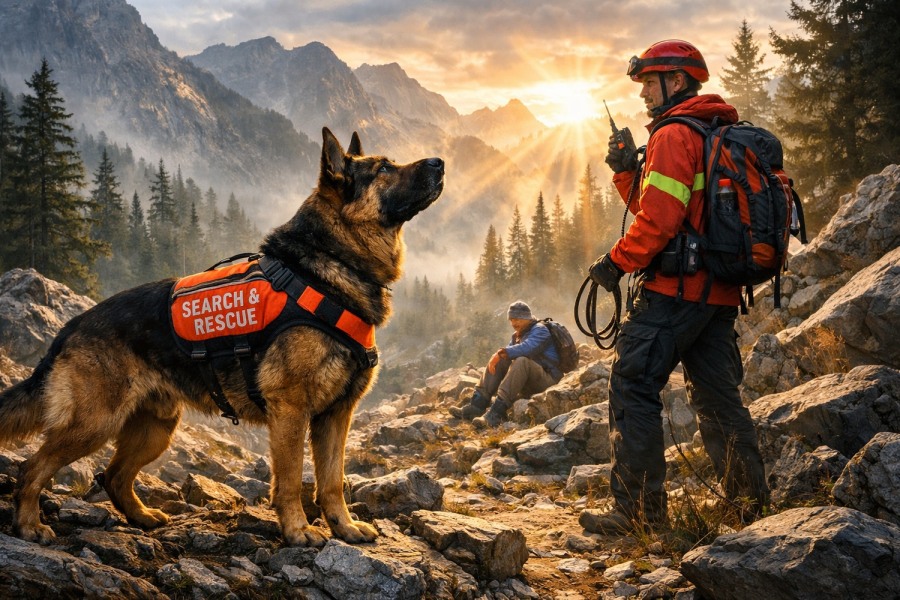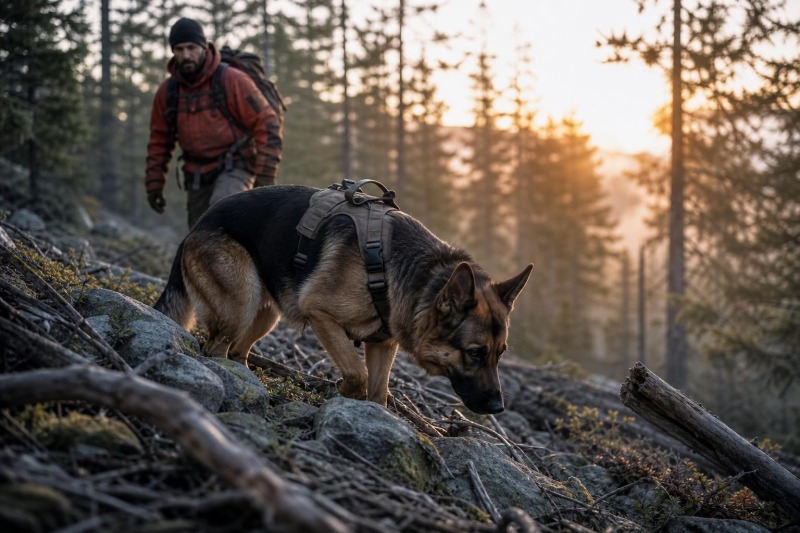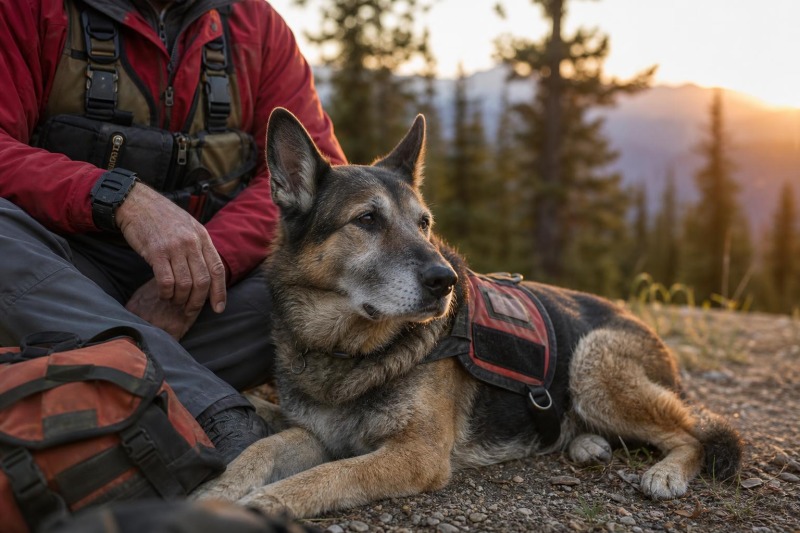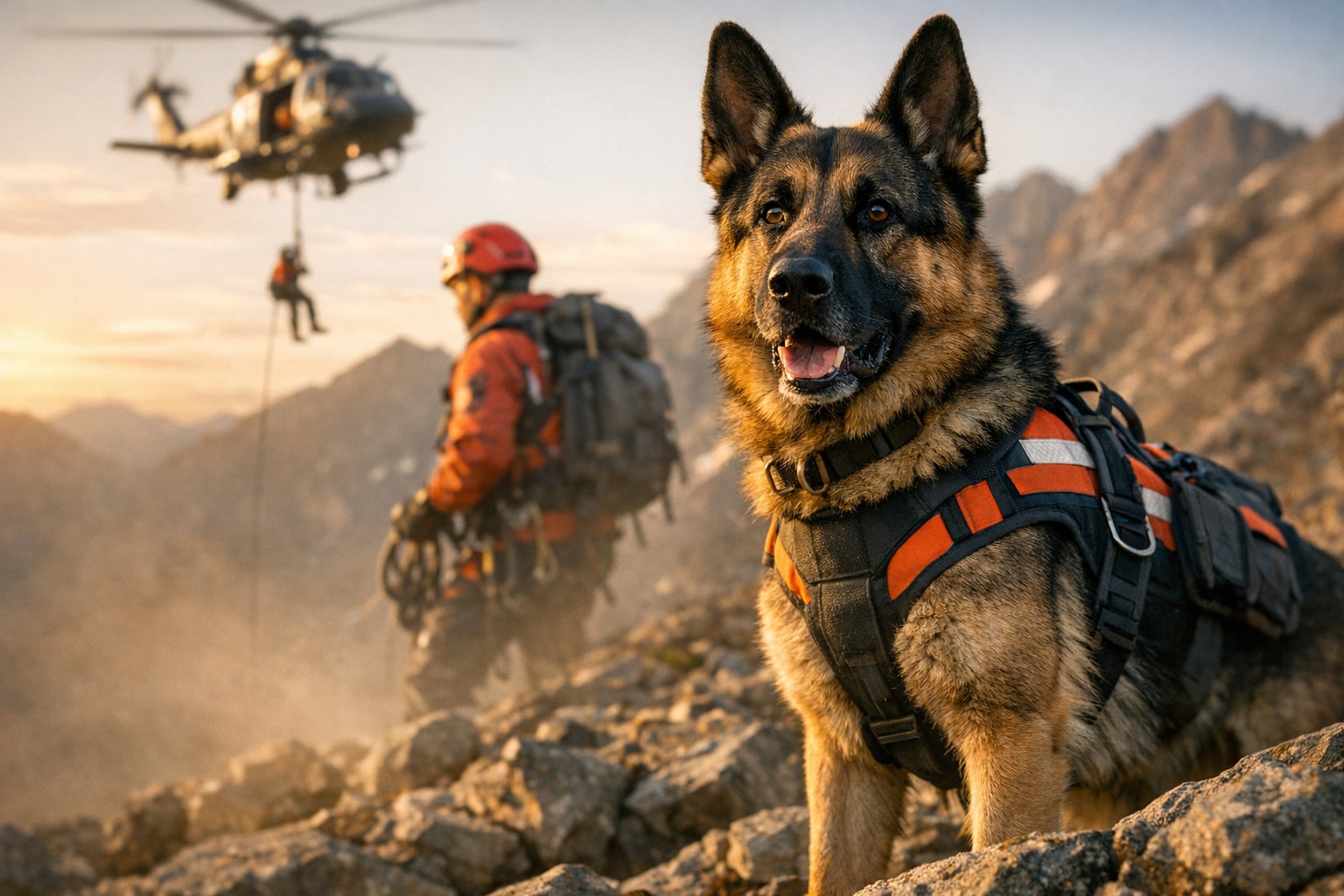
Well-documented search-and-rescue dogs are remembered for teamwork as much as individual ability. Their stories can show how training, handling, and coordinated operations came together. Separating recorded facts from later legend helps preserve that history accurately.
For dog owners interested in working dogs, these stories matter because they remind us what selective breeding, serious training, and trust between handler and dog can accomplish. Search and rescue dogs are not just heroic by accident. They are built through genetics, exposure, repetition, and the kind of bond that only forms when a dog learns that its job matters every single time it leaves the truck.
What Makes Search and Rescue Dogs So Special
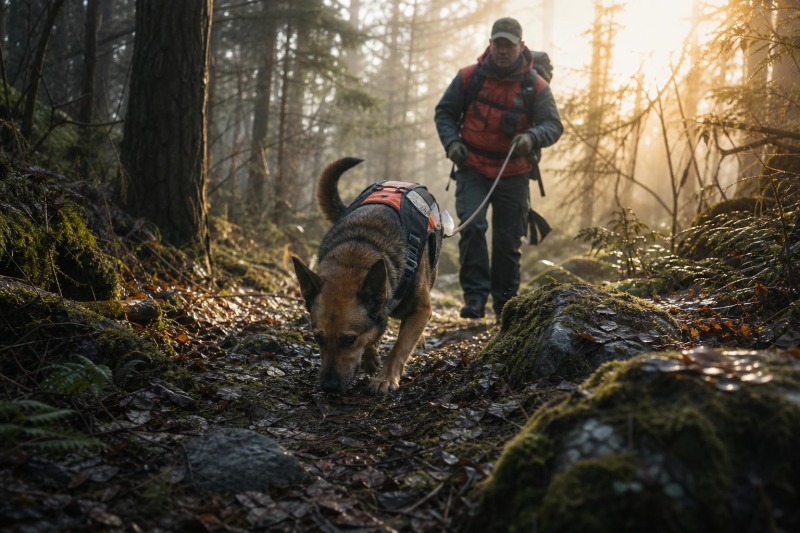
A search and rescue dog is not defined by one breed or one style of work. Some dogs are trained in trailing, following the specific scent of a person over distance and changing terrain. Others work area search, moving through woods, mountains, or open country to locate any human scent in the assigned zone. There are dogs trained for avalanche work, cadaver detection, water recovery, and urban disaster response. The jobs differ, but the foundation stays the same. These dogs must have stamina, nerve, independence, and enough biddability to stay connected to the handler even when excitement is high.
A bird dog might burn hot in the field, and a catch dog may bring raw grit to the task, but a rescue dog needs a cooler kind of courage. It has to push into strange footing, unstable debris, loud machinery, bad scents, and frightened crowds without losing focus. That takes more than prey drive. It takes confidence with a purpose.
Barry the Saint Bernard
No conversation about famous search and rescue dogs starts anywhere but the high Alps with Barry. Working at the Great St. Bernard Hospice in the early 1800s, Barry became a legend for locating travelers lost in snow and brutal mountain conditions. Accounts vary depending on who tells the story, and over time the man likely grew in the retelling, but one fact remains clear: Barry became the symbol of alpine rescue for good reason. He was credited with saving numerous lives, and his name still carries weight whenever Saint Bernards are discussed.
What makes Barry important is not just the number tied to his rescues. He represents an early proof of concept that dogs could do what men often could not. In deep snow, poor visibility, and cold that slows human judgment, a capable dog can range ahead, catch scent, and locate a body far faster than a search party stumbling blind through the mountain.
Balto and Togo
Most people know Balto from popular culture, but folks who study working dogs know the full serum run to Nome was a relay effort involving many dogs and handlers, with Togo often recognized as the toughest and most accomplished lead dog in the operation. While not search and rescue dogs in the modern formal sense, these Siberian Huskies are inseparable from the wider history of lifesaving canine work. They hauled antitoxin through severe Alaskan weather, proving that dogs could deliver hope through conditions that would stop most men cold.
Balto became the public face of the mission, and Togo earned deep respect among dog men for his endurance and leadership. Their place in this conversation matters because rescue work is broader than one title. The same heart, toughness, and reliability that define a good sled dog in life-or-death conditions often overlap with what makes a dependable SAR dog.
Apollo and Bretagne at Ground Zero
When the World Trade Center was attacked on September 11, 2001, search and rescue teams moved into a scene no training field could truly imitate. Smoke, twisted steel, unstable footing, dust-filled air, noise, fire, and the emotional weight of the moment tested every handler and dog on site. Apollo, a German Shepherd, was among the first search dogs deployed to Ground Zero. Bretagne, a Golden Retriever, also served there and later became one of the most widely recognized 9/11 search dogs in the country.
These dogs did not work in storybook conditions. They worked in the wreckage of human tragedy, searching tirelessly for survivors and later helping recovery crews. Their stories hit hard because they show the emotional steadiness of the search dog. A dog like Apollo or Bretagne had to move through danger with confidence, trust its handler, and continue searching despite confusion all around. That kind of work leaves an impression on anyone who understands what real field pressure feels like.
Frida the Rescue Dog
Frida, the Labrador Retriever from the Mexican Navy, became internationally known after earthquake responses in Mexico. Wearing her goggles, harness, and protective boots, she became a symbol of resilience and disciplined canine service. The photographs made her famous, but it was her field performance that earned respect. Frida worked collapsed structures where locating scent in broken concrete, dust, and shifting debris can make every find feel like a miracle.
Labradors have long been valued in many forms of service work because they combine trainability, sociability, and strong hunt drive. In Frida, the public saw the softer face of a hard job, but handlers saw what really mattered: composure, consistency, and the will to keep hunting until called off.
Trakr and the Gift of Drive
Another notable 9/11 search dog, Trakr, was a German Shepherd handled by Canadian officer James Symington. Trakr reportedly helped locate the last survivor pulled from the World Trade Center rubble. That alone would place him among famous search and rescue dogs, but his story carried on after his death when cloning efforts brought unusual attention to his bloodline. Whether a man agrees with cloning or not, the discussion itself shows how deeply people value the inherited potential behind elite working dogs.
Anyone who has bred or trained serious dogs understands the temptation. When a dog shows uncommon nerve, problem-solving ability, and relentless work ethic, you notice. You may never get another exactly like it. Trakr became part of that conversation because he was the kind of dog handlers remember for the rest of their lives.
The Breeds Behind Many Search and Rescue Success Stories
There is no single best breed for all rescue work, though some types show up again and again. German Shepherds remain respected for intelligence, athleticism, courage, and their ability to work in difficult environments. Labrador Retrievers are outstanding for scent work, trainability, and social stability. Golden Retrievers bring similar strengths with a temperament that often suits public-facing operations. Belgian Malinois can excel where speed, agility, and intensity are needed, though they demand skilled handling. Border Collies, mixed breeds, and other purpose-driven dogs also make excellent SAR partners when the individual dog has the right mind.
That last point is worth hanging onto. In the field, the dog in front of you matters more than the breed on paper. Famous search and rescue dogs come from recognizable lines, yes, but greatness usually comes down to the individual. Good lungs, a sound body, a strong nose, and a brain that likes work are what carry a dog through long searches and ugly conditions.
Training Turns Potential Into Performance
Folks sometimes read these stories and imagine heroism as something spontaneous, as if the dog simply rises to the moment. There is some truth in that, but not enough. Search and rescue dogs become reliable through repetitive training in varied settings. They learn to indicate human scent clearly. They learn how to search despite distractions. They practice on rubble piles, in forests, on slopes, near water, and around vehicles, sirens, and strangers. Handlers study wind, scent movement, behavior changes, and reward timing. It is not glamorous work most days. It is steady, humble labor.
That is one reason SAR culture earns respect from seasoned dog people. It is built on proof. The dog either finds the subject or it does not. Fancy talk means little in the search world. Results matter. The best teams look polished because they have spent hundreds of hours getting honest.
Why Famous Search and Rescue Dogs Still Matter Today
The stories of Barry, Balto, Togo, Apollo, Bretagne, Frida, and Trakr endure because they give the public something solid to admire. In a world that leans heavily on technology, these dogs remind us that instinct, partnership, and grit still save lives. A drone can cover ground, and thermal tools are useful, but neither one can replace a determined dog sorting human scent in a mess of weather, terrain, and chaos.
For working dog owners, these famous search and rescue dogs also set a standard. They show what is possible when purpose meets preparation. You do not have to run disaster deployment to appreciate the lesson. Any dog with a job becomes sharper, steadier, and more fulfilled. That is true in a duck blind, on a blood trail, in stock work, and certainly in rescue.
The most memorable dogs are the ones that go to work with full heart and ask for nothing more than the chance to do it again. Search and rescue dogs have been proving that for generations. Their stories are worth telling not because they are sentimental, but because they are earned. And in the world of working dogs, earned respect is the only kind that lasts.