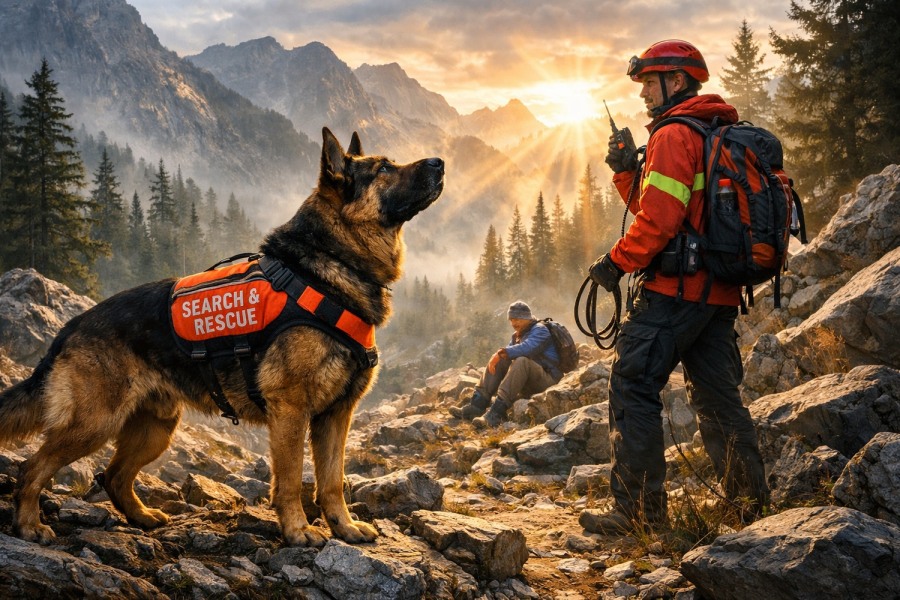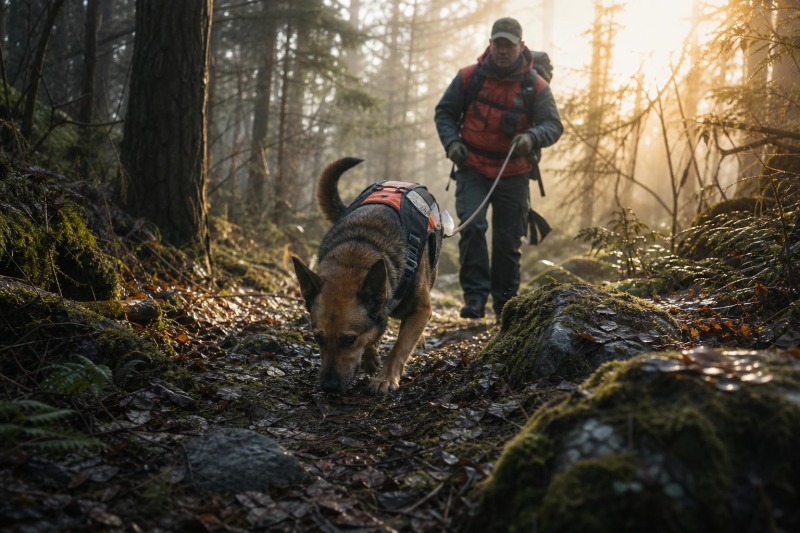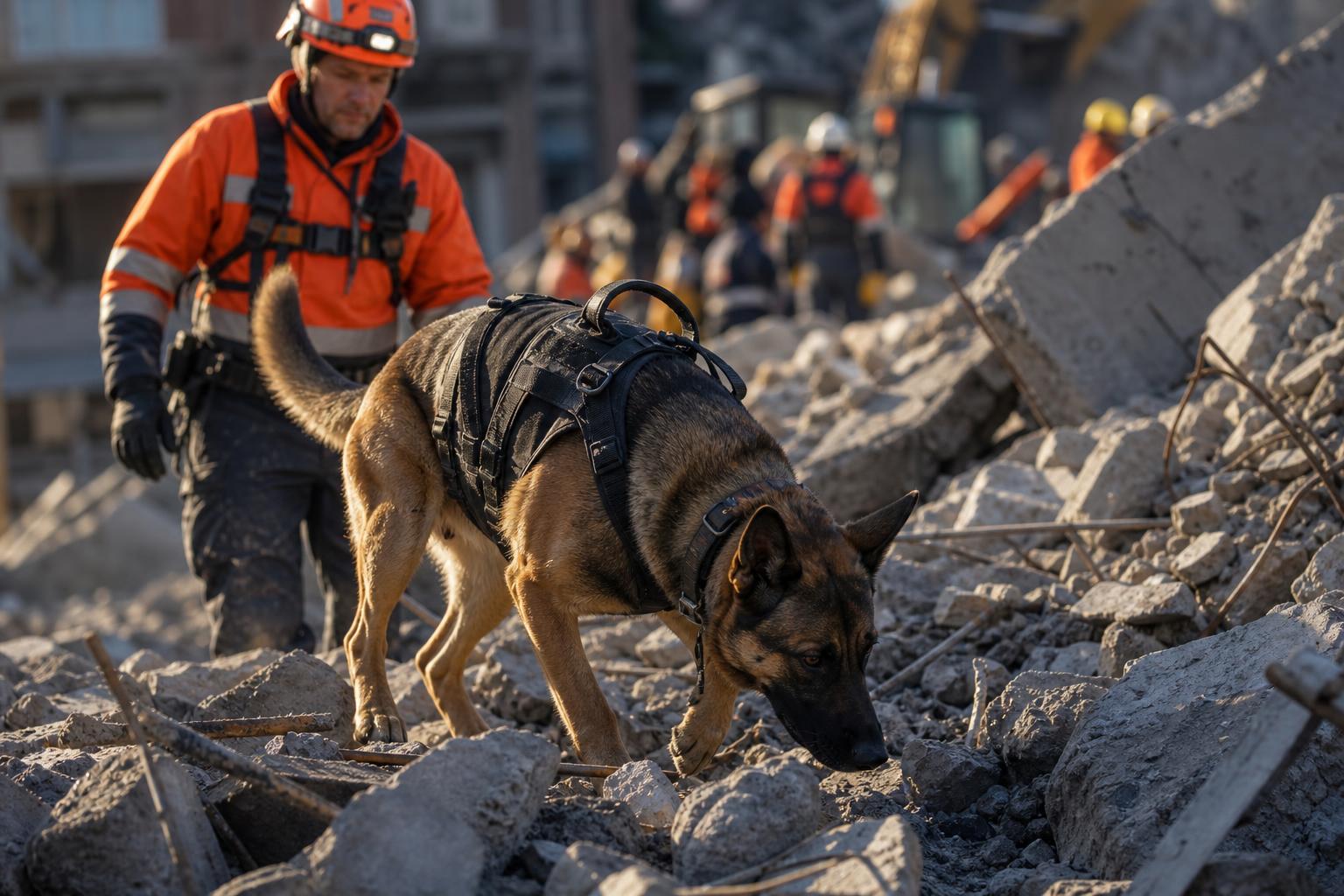
An urban search presents overlapping human odors, hard surfaces, barriers, and constant distraction. Dogs must work through that complexity while handlers interpret access, airflow, and changes in behavior. The search plan needs to fit the specific task and surroundings.
For dog owners interested in working dogs, urban SAR work is worth understanding because it shows just how adaptable a trained dog can be. A city is not a clean field edge or a timber line where scent settles in familiar ways. It is a maze of hard surfaces, tight spaces, stairwells, collapsed structures, alleys, parked vehicles, and shifting air currents. In that kind of country, the dog becomes the search team’s most sensitive instrument, and the handler’s job is to trust what the dog is saying even when the scene itself looks chaotic.
What Urban Search and Rescue Really Means
When most folks picture SAR dogs, they imagine disaster response after a building collapse, and that is certainly part of the job. But urban search and rescue can also involve missing persons in neighborhoods, industrial sites, parking structures, warehouses, and other developed areas where human scent does not behave in a simple, straight line. These dogs may search for live victims trapped under debris, people hidden in inaccessible places, or individuals who wandered into dangerous city spaces.
Unlike wilderness searches, urban operations often happen in tight quarters with a lot of interference. Scent can bounce off walls, rise through broken flooring, collect in voids, or drift down a hallway before ever reaching the dog. A person may be buried under concrete and rebar, and the strongest scent cone might be leaking out through a crack twenty feet away from where that person lies. That is why experienced handlers do not expect the dog to pinpoint a victim like a laser. They expect the dog to work odor, bracket the source, and show enough change in behavior to guide the team toward the most likely location.
Air Scent, Human Odor, and Scent Movement in the City
Most urban SAR dogs are trained to detect and follow airborne human scent rather than track a single footstep trail. Human odor is made up of microscopic particles, skin rafts, body emissions, clothing odor, and all the little scent signatures a living person gives off. In a city environment, that odor gets pushed, trapped, lifted, and twisted by architecture. Wind moving between buildings can act like a funnel. Heat coming off pavement and concrete can carry scent upward. Dust from a collapse can hold odor in one pocket and then release it later as the structure shifts.
A seasoned SAR dog learns to work all that changing information. You may see the dog cast back and forth, climb for elevation, stick its nose into a crack, then wheel around and re-approach from another angle. To somebody unfamiliar, it can look loose or random. It is not. The dog is sampling the scent picture, gathering pieces, and trying to solve the puzzle.
How SAR Dogs Search Collapsed Structures
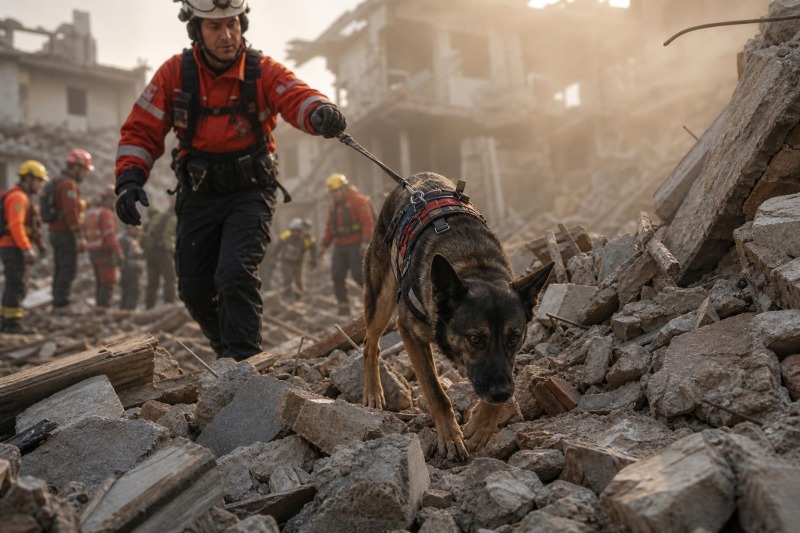
Rubble work is where the public often sees the courage of these dogs most clearly. A collapsed building is not just a pile of broken material. It is unstable, sharp, hot, noisy, and full of void spaces. A dog has to move with confidence over shifting debris, climb strange footing, ignore machinery, and stay mentally engaged long enough to locate hidden human scent. That kind of work takes more than natural talent. It takes hard conditioning, careful training, and a dog with enough drive to push into discomfort without losing its head.
Handlers typically direct the dog into designated search zones, but the dog does the decision-making on scent. Once the dog catches odor, everything changes. Body posture sharpens. The dog may speed up, slow down, climb higher, circle tighter, or return repeatedly to one spot. Trained SAR dogs give a final trained alert when they believe they have located the strongest source. Depending on the program, that may be a bark alert, a focused stare, a sit, or a recall-and-refind style indication. The key is clarity. In a rescue setting, a vague alert wastes precious time and puts people at risk.
Why the Alert Matters So Much
In hunting dogs and in SAR dogs alike, a man learns to read the change before the finish. The head comes up a little different. The tail changes tempo. The feet stop wandering and start hunting with purpose. But in urban rescue, the final alert is what allows the rest of the team to act. Engineers, firefighters, medics, and technical rescuers rely on that dog-and-handler team to tell them where to commit resources. A polished alert can mean the difference between opening the right void space and spending an hour breaking concrete in the wrong place.
The Handler’s Role in Urban SAR Work
A good SAR dog is never working alone, even when it ranges out of arm’s reach. The handler is watching wind, terrain, structure, contamination, access points, and the dog’s behavior every second. In urban environments, that partnership matters even more because scent puzzles are more complicated and safety concerns are constant. The handler has to know when the dog is truly in odor, when it is checking an old scent pool, and when environmental conditions are making the search unreliable.
One thing experienced handlers understand is that the dog is usually first to know something is there, but the handler must shape the search so the dog can confirm it. That may mean changing approach angles, searching from a higher level, clearing distractions, or simply giving the dog enough room to think. Heavy-handed handling can ruin a search. A dog that is micromanaged on rubble or forced through scent without time to work it may miss the very thing it was sent to find.
Training SAR Dogs for City Conditions
Urban SAR training is built step by step, and the best programs start by making the work a game the dog desperately wants to win. The dog learns that finding hidden people leads to praise, reward, and another chance to search. From there, trainers add difficulty. Hides become deeper, access becomes harder, scent becomes older or more complicated, and the search environment gets louder, stranger, and less predictable.
Dogs must learn to work on metal grating, slick floors, unstable surfaces, stair towers, dark rooms, narrow tunnels, and elevated obstacles. They must tolerate sirens, generators, smoke odor, strangers, helmets, flashing lights, and crowds. A soft dog can come undone in that kind of pressure. A reckless dog can get itself hurt. What you want is a balanced animal with nerve, hunt drive, environmental confidence, and enough obedience to stay safe without losing initiative.
Breed, Temperament, and What Makes a Good Urban SAR Dog
Folks always ask if one breed is best. Truth is, several breeds can excel if the individual dog has the right mind for it. German Shepherds, Labrador Retrievers, Belgian Malinois, Border Collies, and mixes with strong working traits are all seen in SAR. The dog does not need to be the biggest or the fastest. It needs stamina, focus, resilience, athleticism, and a powerful desire to search for a human being. Around all kinds of dogs, heart matters as much as pedigree. You can train a lot, but you cannot manufacture the kind of drive that sends a dog back onto a hot rubble pile because it believes there is still somebody to find.
Challenges Unique to Urban Environments
City searches bring headaches you do not see in open country. There is scent contamination everywhere. Hundreds or even thousands of people may have moved through an area. Vehicles carry odor from one place to another. HVAC systems push scent through buildings in unnatural ways. Rain can wash surfaces clean in one corner and trap odor in another. Heat islands around concrete and glass can lift scent high above where a dog expects to find it. Then there is the human factor. Crowds gather, noise rises, and the pressure to produce quick answers can weigh on every handler.
Urban SAR dogs must also deal with physical hazards. Broken glass, exposed wiring, twisted metal, chemicals, and unstable flooring can injure a dog in seconds. Protective gear such as boots may help in some cases, though not every dog works naturally in them. Fitness and foot toughness still matter. So does knowing when to pull the dog out and let the team reset. A tired dog in a dangerous environment is a liability no matter how talented it is.
Why These Dogs Matter to Everyday Dog Owners
Even if you never plan to handle a SAR dog, there is something valuable in seeing how these teams operate. Urban SAR work is proof of what clear training, purpose-driven breeding, and trust between dog and handler can accomplish. It reminds us that dogs are not ornaments. The right dog, given a job and trained fairly, can do work that no machine can fully replace. Thermal cameras, drones, and listening devices all have their place, but a good dog’s nose still solves problems that technology misses.
For working dog enthusiasts, SAR dogs offer a model of usefulness at its highest level. These dogs search not for ribbons or applause but for people who may be frightened, buried, lost, or running out of time. There is a plain honesty in that kind of work. The dog hunts, the handler listens, and together they bring order into a bad situation.
The Bond Behind Every Successful Search
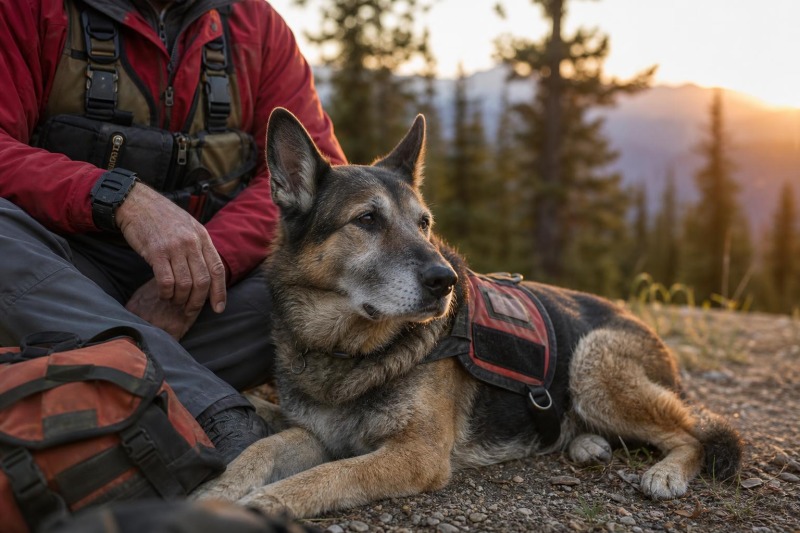
At the heart of urban search and rescue is not just scent science or training theory. It is trust. The dog trusts the handler to send it into the problem and call it back safely. The handler trusts the dog to sort through noise, dust, fear, and confusion and still tell the truth. That kind of partnership is not built in a weekend. It comes from repetition, field time, setbacks, wins, and the slow shaping of a team that learns to think as one.
If you ever watch a skilled SAR dog work an urban scene, pay attention to the quiet moments. The dog lifts its head into the wind, checks a gap in the rubble, turns with purpose, and suddenly the whole search tightens. That is not magic, though it can look like it. It is training meeting instinct, and it is one of the finest displays of working dog ability you will ever witness.