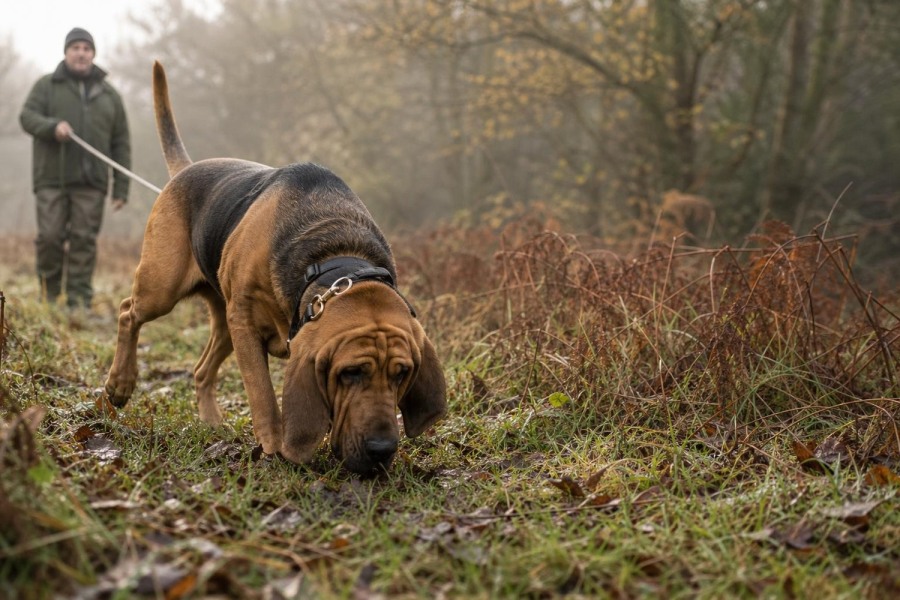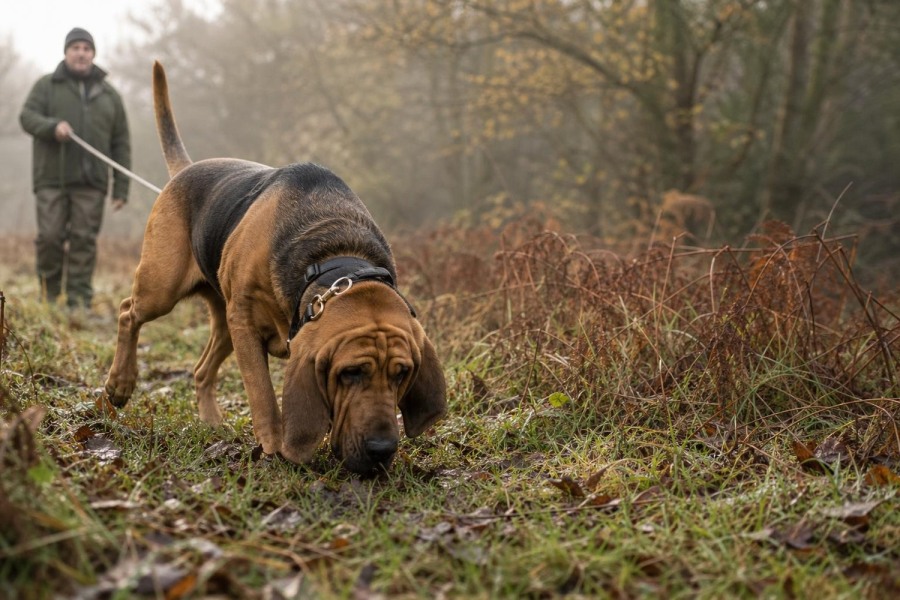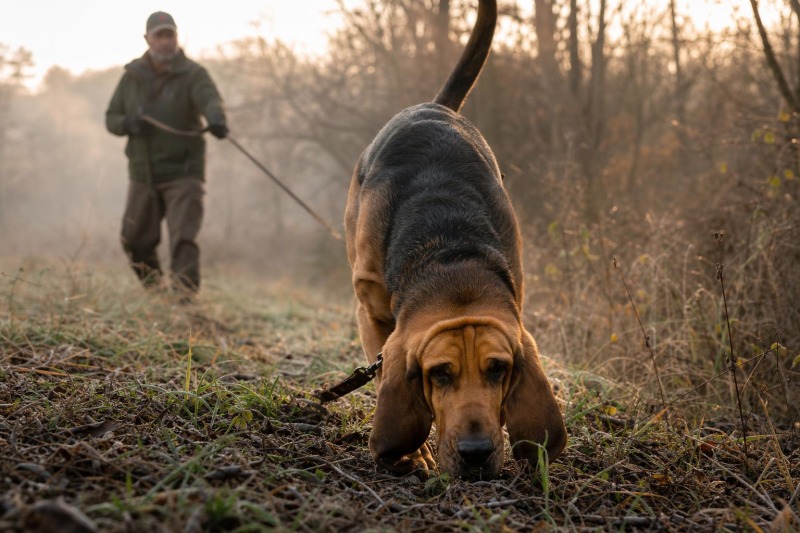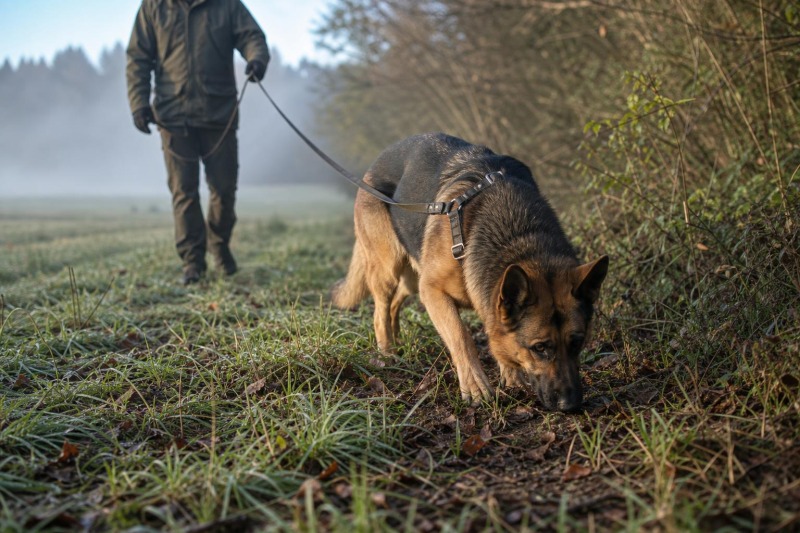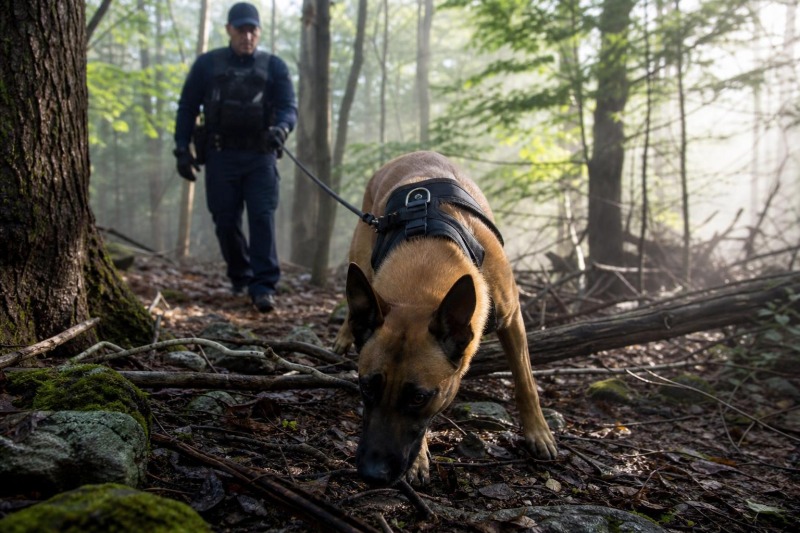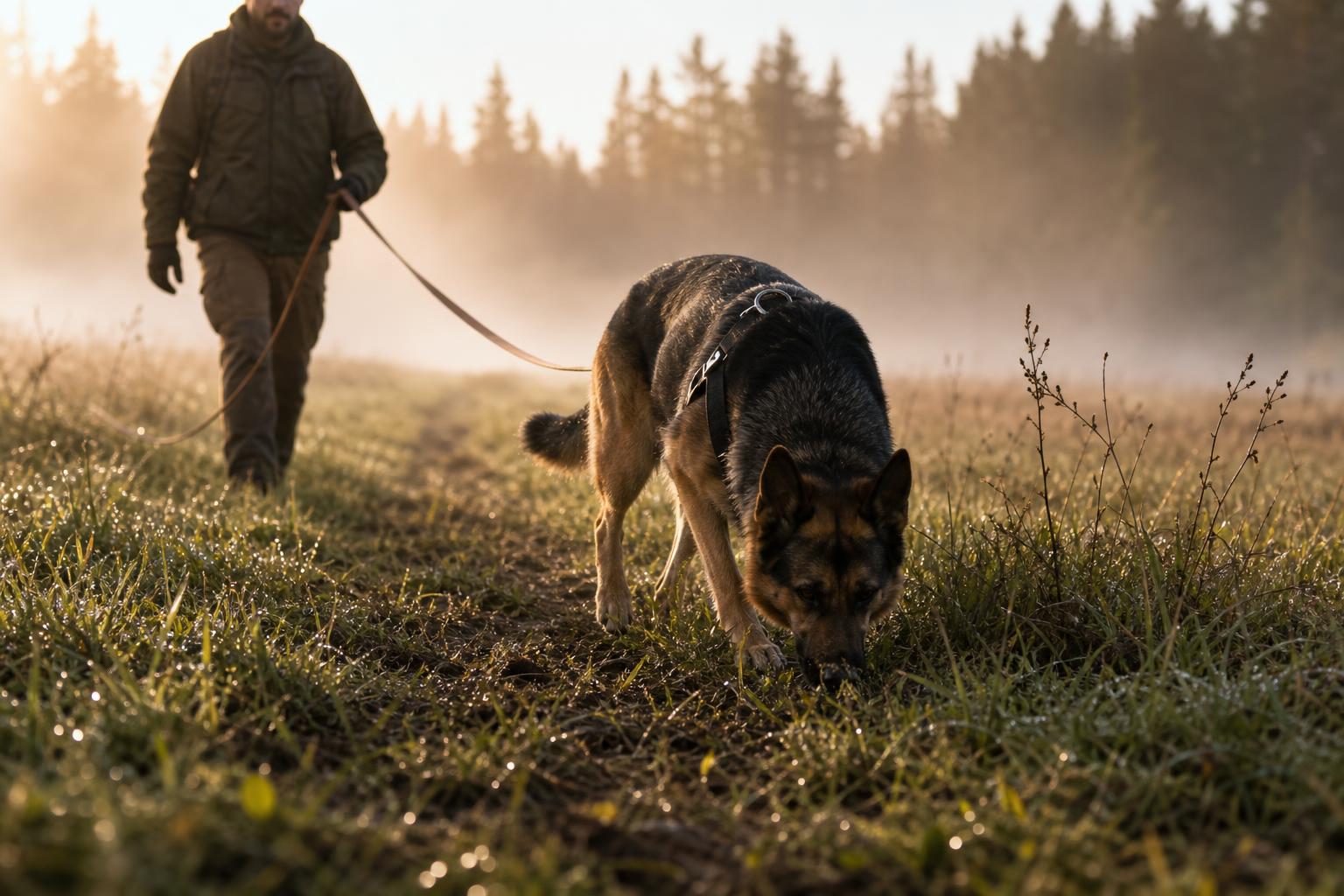
A human trail leaves information that changes with time, surface, weather, and disturbance. Tracking dogs learn to work the available scent while handlers learn to recognize progress and uncertainty. Following the team’s work closely is more useful than expecting every trail to look alike.
Tracking dogs follow human scent by sorting through a cloud of odor that people constantly leave behind. That odor does not come from one single source. It comes from skin cells, body oils, sweat, bacteria, disturbed soil, crushed plants, and every step a person takes through an environment. A trained dog learns to recognize that scent picture, stay committed to it, and work through all the confusion the world throws in its way.
What Human Scent Really Is
When folks first start learning about working dogs, they often think scent means sweat alone. That is only a small part of the story. A person sheds tiny skin particles all day long, sometimes called skin rafts, and those particles carry odor. Human scent is also shaped by bacteria living on the body, the clothes a person wears, what they have handled, and even the food they have eaten. Every person carries a scent signature that is familiar enough for a dog to identify and unique enough for a trained dog to separate from others.
On the ground, every footstep changes the environment. Grass gets bent. Leaves get crushed. Moist soil gets disturbed. In dry country, dust shifts under the sole. That disturbance releases additional odor into the air and onto the track. In timber, in fields, and along two-track roads, a dog is often working a combination of the person’s individual scent and the environmental changes caused by movement.
That is one reason experienced handlers say a dog is not just following footprints. The dog is reading a scent trail, and that trail has depth. It can settle low to the ground, drift with air currents, collect in depressions, or scatter when wind and heat pick up. A seasoned tracking dog learns to solve that moving puzzle one sniff at a time.
How a Tracking Dog Uses Its Nose
A dog’s nose is built for discrimination in a way ours never will be. With every breath, scent is pulled into a highly specialized nasal structure that can separate and process odor particles with astonishing efficiency. While we may catch a general smell, a dog can sort layers within that smell. Out in the field, that means the dog can work through old scent, fresh scent, animal traffic, vehicle contamination, and human cross-tracks while still hunting for the trail it was asked to follow.
What stands out to me after years around working dogs is how differently individual dogs solve a track. One may keep its nose buried deep and move carefully, checking every footfall. Another may raise its head now and then, catching drifting scent in the air before dropping back to the line. Both can be right. Good tracking is not about style points. It is about staying in contact with scent and moving the problem forward.
Ground Scent and Air Scent Working Together
People often separate tracking and trailing into neat categories, but in the real world there is a lot of overlap. Ground scent refers to odor associated with the actual path a person walked, including disturbed vegetation and deposited scent. Air scent is odor that has lifted and moved on wind currents. A skilled dog may use both during the same track.
To someone unfamiliar with dog work, that may look like the dog is guessing. It is not. The dog is adjusting to how scent behaves in that terrain at that moment.
How Weather and Terrain Change a Track
If you want to understand how tracking dogs follow human scent, you have to respect weather. Moisture usually helps. A cool, damp morning often holds scent close and gives a dog more to work with. Light dew on grass can make a fresh track feel almost readable. Heat, direct sun, and dry wind can break scent apart fast, especially on hard surfaces or open ground.
Rain can help or hurt depending on timing and intensity. A light rain after a track is laid may freshen ground odor and slow scent loss. A hard downpour can wash away some evidence, spread odor, and make the picture harder to read. Snow adds another layer. Fresh snow can show disturbance clearly, but extreme cold may reduce how strongly scent rises, and wind over open snow can move odor far from the actual line of travel.
Terrain matters just as much. Woods often hold scent better than open fields because shade and cover limit drying wind and sun. Low areas can trap scent. Rocky ground can be difficult because there is less vegetation and soil disturbance, though a trained dog can still work the residual human odor. Pavement is a challenge many handlers underestimate. There may be little surface disturbance, and traffic, heat, and contamination can scatter the scent picture quickly. Even then, a good dog can move from one concentration point to the next and carry the trail forward.
Why Tracking Dogs Do Not Follow Every Person the Same Way
No two tracks are exactly alike because no two people move exactly alike through the same environment. A running person creates a different scent pattern than someone walking slowly. A frightened person often leaves a stronger and more erratic trail. Heavy boots crush the ground differently than light shoes. A person brushing against waist-high cover leaves scent off the track itself as well.
Age of trail changes everything. Fresh tracks usually present a stronger, tighter scent picture. Older trails spread, weaken, and become more influenced by air movement and environmental change. This is where a dog’s training and nerve show up. Young dogs may fly through easy, fresh work but struggle when the line is old and thin. Mature tracking dogs often settle into a slower, more methodical style because they have learned patience solves problems.
Article Suggestions for WorkingDogCentral
For readers who want to go deeper, consider linking this article to related resources on your site such as /best-working-dog-breeds-for-scent-work, /how-to-start-scent-training-for-dogs, /tracking-vs-trailing-dogs-whats-the-difference, /how-weather-affects-dog-scent-work, and /essential-gear-for-working-dog-handlers.
Training Turns Natural Ability Into Reliable Work
Most dogs can smell far more than people realize, but not every dog can become a dependable tracking dog. Desire, focus, confidence, and trainability all matter. The training process teaches the dog that following a specific human scent is rewarding and worth staying with, even when distractions pile up.
Early work usually starts simple. A short, fresh track in easy ground lets the dog learn that scent on the path leads to a reward. As the dog progresses, the handler adds turns, longer distances, older tracks, cross-tracks, difficult surfaces, and problem-solving situations. Done right, the dog begins to understand that scent may weaken, drift, or break, but the answer is still out there if it keeps working.
Handlers matter more than many newcomers think. A nervous or impatient handler can pull a dog off the line, crowd it at the wrong moment, or misread honest scent checks as failure. The best handlers learn to trust what the dog is telling them. Sometimes that means slowing down. Sometimes it means giving the dog room. The partnership is part science and part hard-earned feel, and that feel only comes from time behind the lead.
What a Tracking Dog Looks Like on a Real Trail
Out in the field, a dog truly on scent tends to show changes in body language. The pull on the line may steady. The tail may settle into a purposeful rhythm. Breathing changes. The dog may drive forward, then hesitate at a corner or contamination point, work a tight circle, and commit again. Those little moments are where experienced handlers make their money. A dog that overshoots and returns is often not making a mistake at all. It is confirming the trail before moving on.
A young dog may charge until the track falls apart under pressure. A finished dog eases into the problem, takes what the conditions offer, and pieces the trail back together. That calm, thoughtful work is what separates a dog with a nose from a dog with a job.
Why Tracking Dogs Matter to Dog Owners
Even if you never run a man-trailing dog in professional work, understanding how tracking dogs follow human scent gives you a deeper respect for what working dogs are capable of. It also helps dog owners train smarter. Scent work is one of the best ways to challenge a dog mentally, build confidence, and tap into natural instincts in a structured way.
For owners of working breeds especially, tracking is not just impressive to watch. It is deeply satisfying for the dog. A dog allowed to use its nose with purpose often becomes steadier, more engaged, and easier to live with. That is true whether the dog is preparing for serious field work or simply learning beginner scent games at home.
A tracking dog follows human scent by reading a living trail made of skin, disturbance, moisture, vegetation, and moving air. The dog is not performing a trick. It is solving a problem with one of the finest biological tools in the natural world. When you have walked behind a good one through the woods at first light, watching it sort out what no human eye can see, you come away with the same thought every time. There is nothing else in the dog world quite like it.