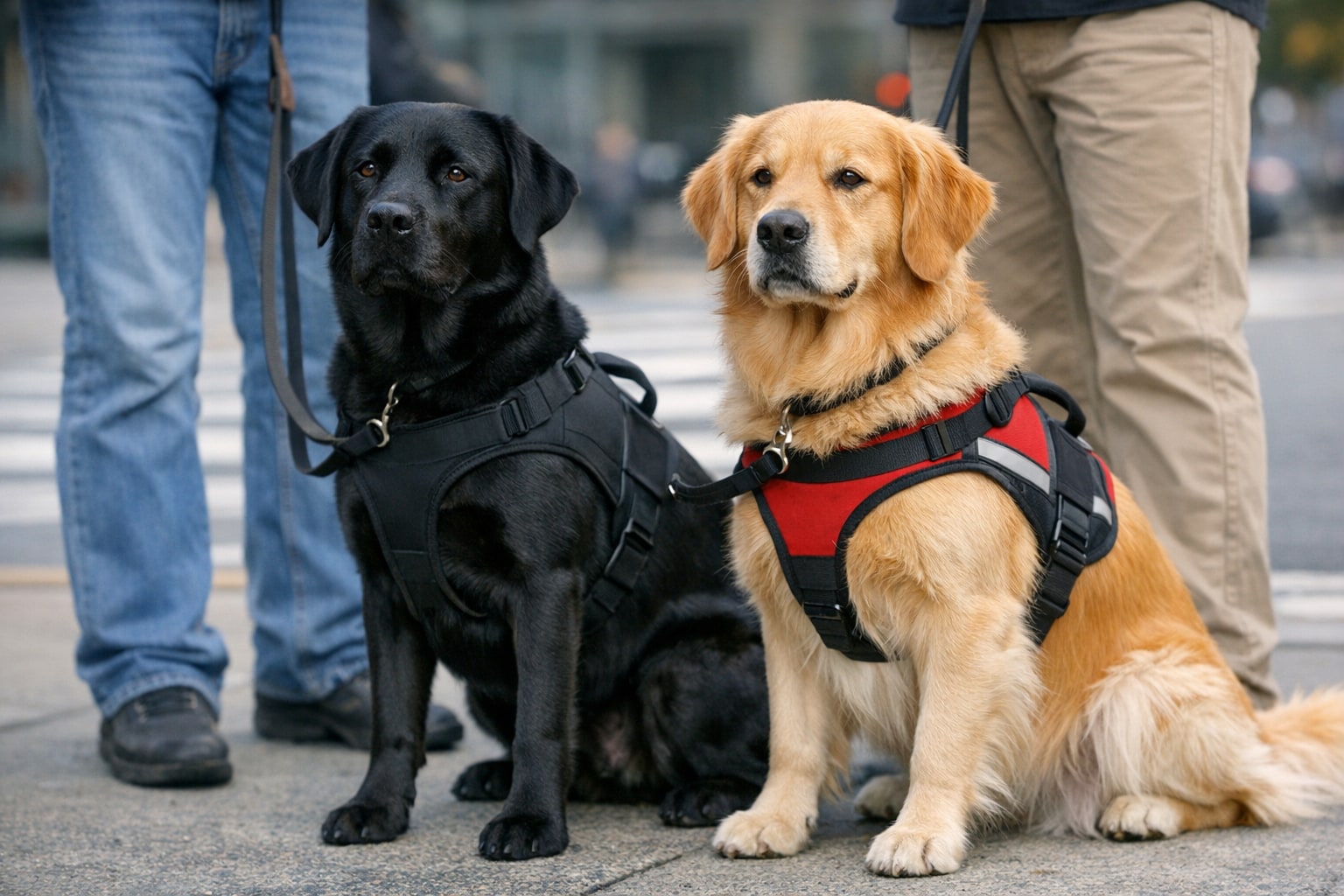
Labradors and Golden Retrievers can bring useful traits to service work, but choosing between them calls for more than comparing breed reputations. The handler’s tasks, the dog’s health and temperament, and the demands of daily life should guide the decision.
And when you compare a Labrador vs Golden Retriever in service work, the truth is this: both breeds can be excellent, but they do not always work in the same style or fit the same handler equally well.
On paper, the two breeds seem close cousins for the job. Both are people-oriented, biddable, smart, and generally stable in public. But once you get past the broad reputation, differences begin to matter. Coat care matters. Energy expression matters. Sensitivity matters. Recovery from stress matters. In service work, the little traits become big traits in a hurry.
Why Labs and Goldens Lead the Service Dog World
There is a reason these two breeds are mentioned first whenever service dogs come up. They were built, over generations, to work closely with people. A good retriever notices a handler, reads tone, responds to direction, and keeps moving forward without needing constant conflict or correction. That willingness to partner is worth a great deal in service work, where trust and consistency matter more than raw intensity.
Labrador Retrievers tend to bring a practical, no-nonsense working style. Many Labs move through tasks with a kind of efficient confidence. They usually adapt well to repetition, recover quickly from distraction, and keep their feet under them in busy environments. A solid Labrador often gives you the impression that the dog likes having a job and sees no reason to make it complicated.
Golden Retrievers often bring a softer touch. Many Goldens are deeply handler-focused and emotionally available in a way that stands out, especially in psychiatric support, autism support, and tasks where close social connection matters. A good Golden can feel almost intuitive with people. That is part of what has made the breed so valuable in many forms of assistance work.
Temperament Differences That Matter in Service Work
That is not a hard rule, and individual dogs can break every stereotype in the book, but it is a useful starting point.
Many Labradors are resilient dogs. They take environmental pressure well, bounce back fast if something startles them, and generally move on without carrying much baggage from one moment to the next. In public access work, that can be a major strength. A dropped tray, a crowd bottleneck, a child moving too fast, or a bus door clattering shut may register for a Lab, but many of them recover and settle quickly.
Golden Retrievers are also capable in public, but they may be more emotionally sensitive depending on the line. That sensitivity can be a gift when a handler needs a dog tuned in to subtle changes in mood, body language, or distress. It can also mean some Goldens need more careful development to avoid becoming overwhelmed, over-attached, or too affected by tension around them.
Confidence Versus Sensitivity
A Labrador with the right temperament often comes across as naturally confident without being pushy. That can make the breed especially attractive for mobility support, guide work, and high-distraction public access tasks. Goldens, on the other hand, may excel where softness, patience, and a calm social demeanor are front and center. The best Golden service dogs are not fragile dogs at all, but they often work best with training that respects their sensitivity rather than grinding against it.
Trainability and Work Style
Both breeds are highly trainable, but they do not always learn or respond in exactly the same way. Labradors are famous for being food-motivated, enthusiastic, and willing to repeat tasks without losing heart. That matters in service work, where precision is built one repetition at a time. Many Labs enjoy the structure of training and handle clear expectations well.
Goldens are also intelligent and eager to please, but many trainers will tell you they can be a touch more emotionally aware of pressure. A Golden that feels confused or corrected too harshly may show it sooner than a Labrador would. In the right hands, that sensitivity becomes an advantage. These dogs often develop beautiful task fluency and strong engagement when training is fair, consistent, and well timed.
There is also a style difference in how they carry themselves. Labs often move with a sturdy, businesslike attitude. Goldens can show a little more softness in expression and body language, which some handlers find comforting and others may read as less durable, even when that is not the case. In reality, durability comes down to the individual dog, its structure, nerves, and preparation.
Physical Build, Coat, and Daily Practicality
This is where real life starts to separate theory from ownership. A Labrador usually has the easier coat to live with in demanding service situations. The short, dense coat sheds, no question, but it is simpler to maintain, dries faster, and tends to bring less grooming burden for handlers who already have enough on their plate. In muddy weather, crowded public settings, and active daily use, that practicality matters more than many first-time owners expect.
Golden Retrievers require more coat care. Their feathering can pick up burrs, water, mud, and debris. Their grooming needs are not impossible, but they are more involved. For some handlers, especially those with limited mobility or energy, that added maintenance may be a real drawback.
Body style matters too. Labs often present as a bit more compact and rugged, especially field-bred or well-balanced working-bred individuals. Goldens can be athletic as well, but their coat and overall presentation may make them seem less utilitarian to some people. That is mostly appearance, though appearance still shapes public response, which is part of service dog life whether we like it or not.
Which Breed Is Better for Different Types of Service Work?
There is no honest one-size-fits-all answer, because service work is not one job. It is many jobs under one name. A dog helping a visually impaired handler navigate urban spaces faces a different demand than a dog interrupting panic behaviors, retrieving dropped items, bracing lightly for balance, or responding to medical episodes.
Labradors often stand out in guide work, mobility-related assistance, and public-heavy tasks because of their environmental stability and straightforward working style. They tend to be durable, practical, and easy to motivate. In programs where consistency across many dogs matters, those traits are gold.
Golden Retrievers often shine in roles where deep handler connection and calm social presence are especially valuable. Many do well in psychiatric service work and support roles requiring close emotional attunement. A really good Golden can bring a grounding presence that feels almost like a steady hand on the shoulder.
The Handler Matters as Much as the Breed
Some handlers need a dog that shrugs things off and keeps marching. Others need a dog that notices changes in breathing, posture, or emotional state almost before the handler does. Some want an easy-care coat and a straightforward worker. Others are willing to take on grooming if the dog’s softer demeanor better matches their needs. In service work, fit matters more than reputation.
Health, Longevity, and Program Considerations
No comparison between Labrador and Golden Retriever service dogs is complete without talking about health. Both breeds can face inherited concerns, including hip and elbow issues, certain eye problems, and breed-specific risks that responsible breeding tries hard to reduce. Golden Retrievers also carry a well-known concern with cancer rates, which is a serious consideration for anyone planning a long working partnership.
Labradors are not free of health trouble by any means, but many handlers and programs appreciate the breed’s overall track record for durable working structure when sourced from sound lines. The key phrase there is sound lines. Whether you choose a Lab or a Golden, breeding quality, early socialization, and temperament selection matter more than the breed label alone.
Programs often favor dogs from carefully developed lines because service work asks for rare balance. The dog must be social but not overexcited, calm but not dull, confident but not hard, responsive but not needy. That balance is difficult to produce consistently, and both Labs and Goldens can miss the mark if bred carelessly.
There is a reason so many serious programs lean on Labs. They are often easier to maintain, steady in public, and naturally suited to repetitive, reliable task work.
A well-bred, well-trained Golden can be an extraordinary service dog, especially for handlers who benefit from a dog with a softer social style and strong emotional connection. The best Goldens bring grace to the work without losing substance.
The Labrador vs Golden Retriever question is not about crowning one breed as universally better. It is about matching the dog’s mind, body, and work style to the handler’s actual life. The right dog steadies the whole day. Whether that dog wears a short yellow coat or a feathered golden one, what matters most is sound breeding, honest evaluation, and a dog that can carry responsibility with calm confidence.