Night-work lighting has to support safe movement, dog handling, and the task ahead. Beam pattern, controls, runtime, weather resistance, and backup options all matter. Test the equipment with the rest of the kit before an assignment.
That is backward thinking. A dependable lighting setup helps you move quietly, protect your footing, keep eyes on your dog, and avoid the kind of mistakes that happen when fatigue meets darkness. Good equipment does not have to be fancy, but it does need to match the work.
Why Lighting Matters So Much When You Work Dogs at Night
Night work is not just daytime with less visibility. The whole rhythm changes. Your dog may be hunting by nose and instinct as well as ever, but you are now trying to interpret body language, terrain, distance, and hazards through a narrow tunnel of artificial light. That matters when a dog checks up on a hot track, slips a fence line, or locks on a point at the edge of your beam. Small details become important fast.
Light also affects behavior. A harsh beam flashed carelessly into a dog’s face can distract or unsettle him. Too much spill in the wrong direction can spook game, bounce off dust or fog, and ruin your own vision. Too little power leaves you guessing at what is ahead. The best lighting equipment for night work strikes a balance between reach, control, battery life, and practical handling in the field.
Headlamps for Hands-Free Work
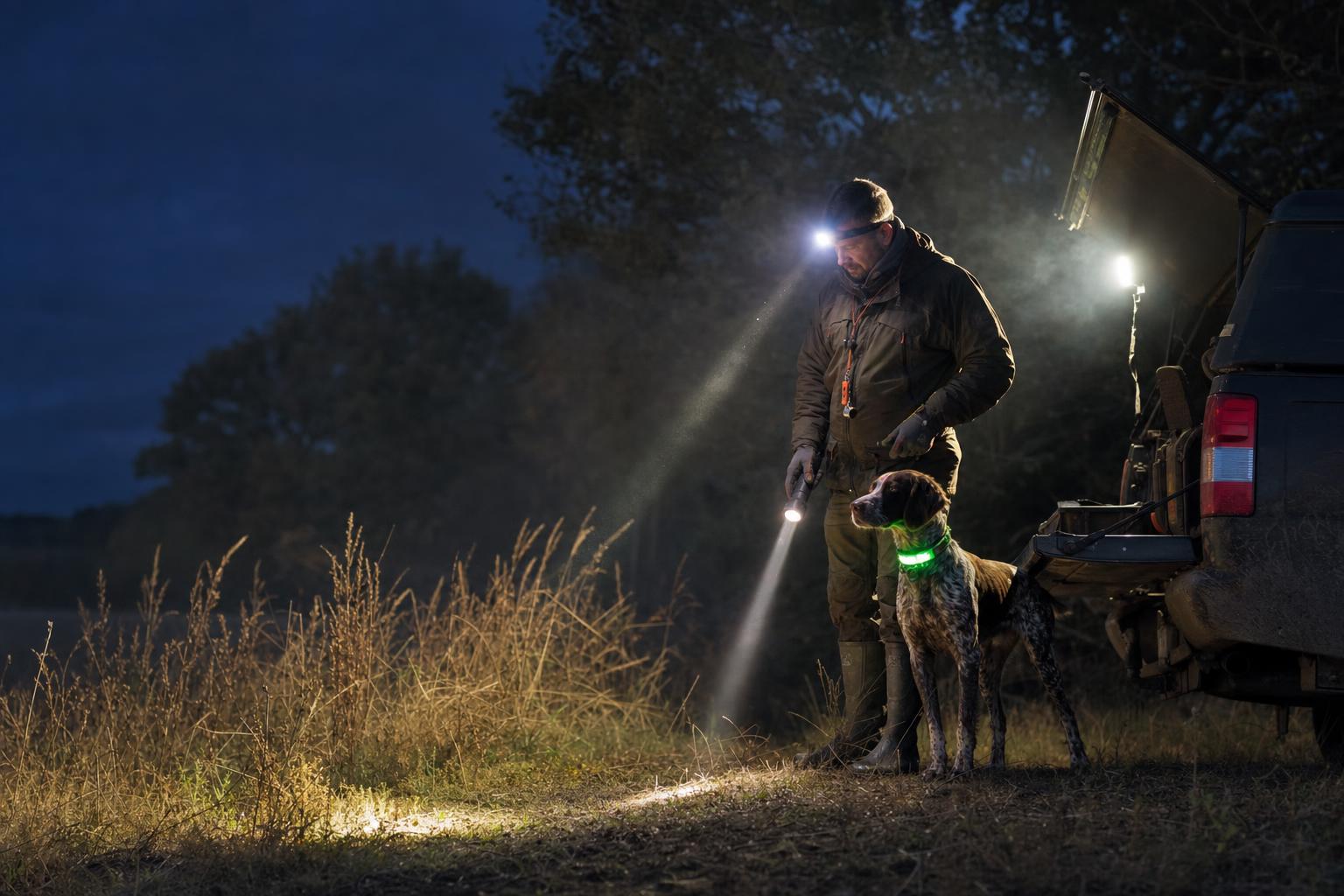
A good headlamp keeps both hands free for leads, gates, gear, and dog handling, and that alone makes it valuable. For handlers, hands-free light is hard to beat when you are climbing into a stand, crossing rough ground, dressing game, or working around a truck and dog box in the dark.
The trick is to choose a headlamp with useful beam control, not just raw brightness. High output sounds impressive on packaging, but in real night work, a light that can shift between flood and spot is far more useful. Flood helps with close chores and camp tasks. Spot gives you reach down a trail, across a field, or along a fence line. A red or green secondary mode can also be handy in some situations where you want to preserve night vision and avoid blasting everything in white light.
Comfort matters too. If the strap slides, the lamp bounces, or the controls are clumsy with gloves, you will curse it before the night is done. Look for a model that sits low, resists weather, and gives honest runtime at medium output, because that is where many handlers live for most of a night.
Handheld Lights for Distance and Detail
A headlamp is your workhorse, but a handheld light still has a place. When you need to inspect brush, scan a tree line, pick up eye shine, or study terrain at a distance, a good handheld gives you more punch and better beam control than most headlamps.
What separates a useful handheld from a gimmick is not just brightness. It is beam quality, throw, and switch design. You need a beam that cuts where you point it without blooming into a white wall in humid air. You also need a switch you can trust under stress. The dark is not the time to fumble through five flashy modes while your dog moves out of sight. Simple operation wins every time.
Dog Visibility and Collar Lighting
One of the smartest additions to modern night work is a visible collar light or illuminated collar. For dogs working near roads, stock, water, or multiple handlers, that little point of light can save precious seconds.
Color choice can help. Different colors make it easier to tell dogs apart if you are running more than one, and some handlers find certain colors easier to see against particular backgrounds. Durability is everything here. Mud, rain, brush, and cold will expose weak gear in a hurry. The collar light should mount securely, resist impact, and stay visible without becoming a distraction to the dog.
That said, visibility gear has to match the mission. In some hunting situations, you may want less visible light and more reliance on tracking collars or reflective trim. The goal is not to overlight the dog. The goal is to maintain safe awareness without interfering with the dog’s work.
Truck and Dog Box Illumination
A lot of night work starts and ends around a vehicle, and poor lighting at the truck causes more headaches than people admit. You need enough light to check paws, inspect ears, swap gear, fill water, and load dogs calmly. Fixed lights in or around a dog box can be a real improvement if they are protected and wired cleanly. Rechargeable magnetic utility lights are also worth their weight when you need fast, temporary light without digging through bags.
It is easier on the eyes, calmer on the dogs, and far better for routine tasks. Bright task light still has its place for wound checks or equipment issues, but for daily handling, softer light is often more practical.
Area Lights for Recovery and Organization
When you are changing out wet gear, sorting leads, or handling birds and equipment after dark, a compact area light can turn confusion into order. Lantern-style lights and low-glare work lights are excellent for tailgates, camp tables, and small shelter areas. What you want is broad, even light that does not murder your night vision every time you glance toward it.
That matters more than many realize. If your area lighting is too harsh, stepping back into the field becomes difficult because your eyes have to adjust all over again. Thoughtful placement and moderate output go a long way.
Battery Life, Charging, and Field Reliability
Nothing is more useless than a great light with a dead battery. For serious night work, battery planning is part of the equipment plan. Rechargeable systems are excellent today, but only if you are disciplined about charging and carrying backups.
Cold weather changes the equation. Batteries can drop off faster than expected, especially in winter conditions or long sits. Keep spares protected, keep charging habits consistent, and know the real runtime of your lights on the settings you actually use. Packaging claims are one thing. Mud, wind, and long nights are another.
Durability is just as critical. Water resistance should be considered a baseline, not a luxury. Mud, rain, sleet, and accidental drops are part of the life. A light that fails after one hard season is not field gear. It is clutter.
Matching Lighting Equipment to the Type of Work
The best lighting equipment for night work depends on what your dog is doing. A retriever handler walking levees and water edges needs stable footing, controlled beams, and dependable visibility around water. A blood-tracking team may need careful, low-angle lighting that helps reveal sign without washing out subtle ground detail. A stock dog owner checking animals at night may need broad area light, truck access lighting, and a visible dog marker more than long-distance throw. The work shapes the setup.
Build a system around your real conditions. Think about distance, terrain, weather, the dog’s range, and how much time you spend loading, walking, handling, or searching. A simple, reliable three-part setup often beats a complicated pile of gadgets every day of the week.
Common Mistakes Handlers Make After Dark
The biggest mistake is relying on brightness alone. More lumens do not automatically mean better performance. Too much light at close range can flatten terrain, create glare, and reduce your ability to read what matters. Another mistake is carrying one light and assuming that is enough. Redundancy matters in the dark. A dead main light without backup can turn an inconvenience into a dangerous situation fast.
If you cannot quickly identify where your dog is moving in relation to roads, water, brush, or other dogs, you are already behind. Finally, many people fail to test gear before the job begins. Night work is not the place to learn your switch pattern, discover a loose charging port, or realize your light burns through power on the setting you thought would last all evening.
Good dogs earn our best judgment, and after dark that judgment starts with preparation. The right lighting equipment for night work helps you move safer, handle cleaner, and stay in tune with your dog when the margin for error gets thin. It is not about buying the brightest tool on the shelf. It is about putting together a dependable system that serves the dog, the terrain, and the task at hand.
When the night is damp and still, and your dog is working honest out ahead of you, light becomes more than gear. It becomes part of how you read the field, part of how you protect your partner, and part of how you get home without trouble. That is worth taking seriously.