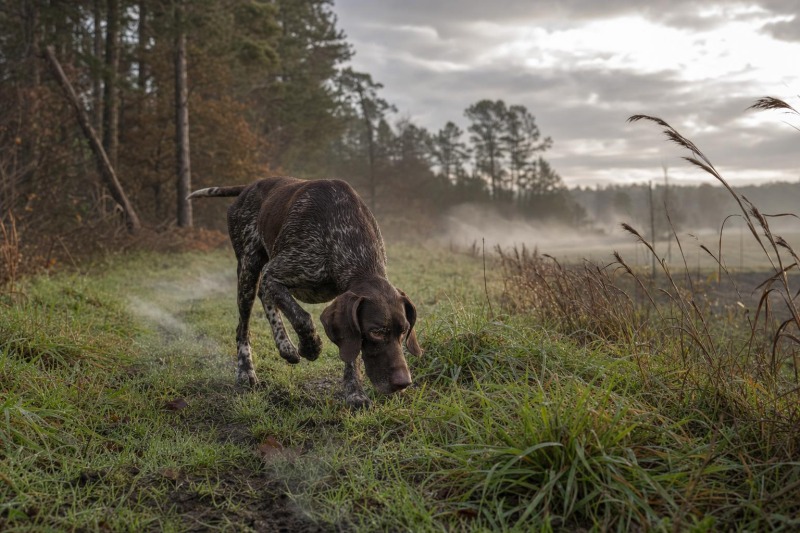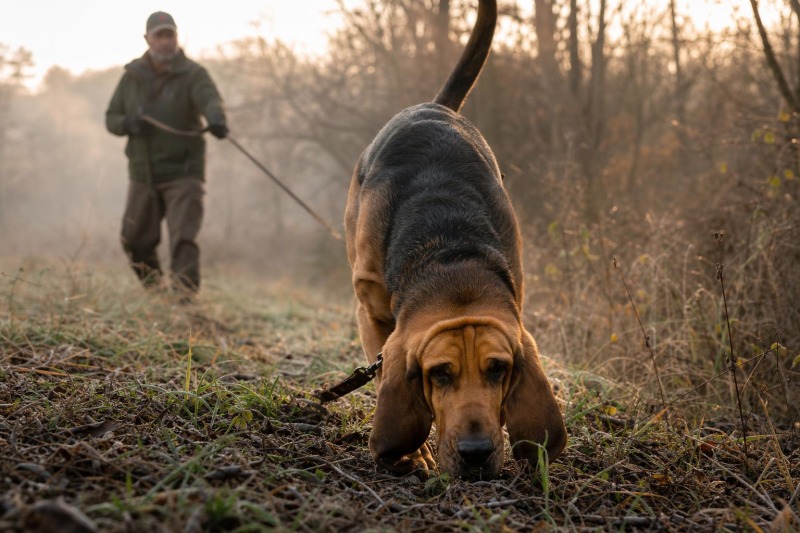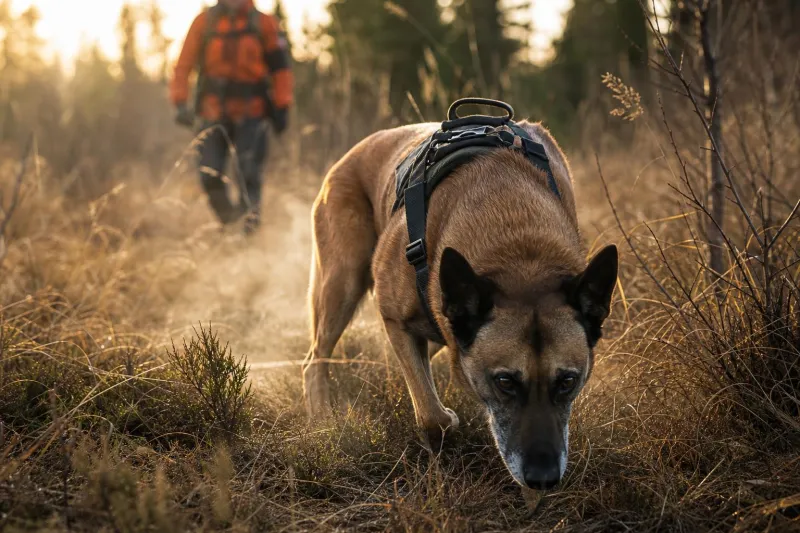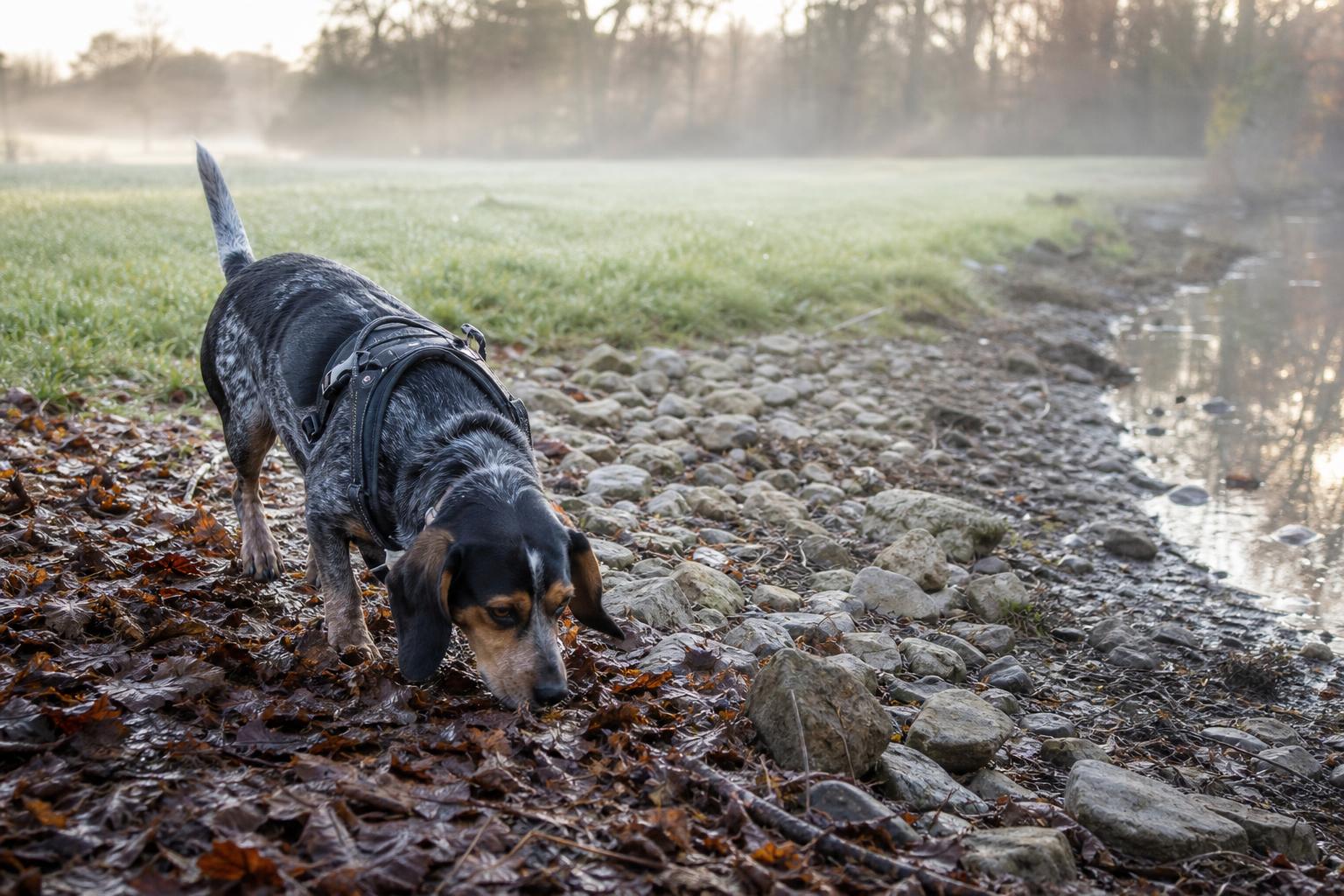
Ground conditions change the information available to a tracking dog. Vegetation, bare soil, hard surfaces, slope, and exposure can all alter the work. Judging a dog fairly means considering those changes rather than expecting the same pace everywhere.
Terrain effects on tracking are something every handler ought to understand, whether you are working a blood tracking dog, a versatile hunting dog, or a patrol-minded working dog learning scent discipline. The ground under a track, the cover around it, and the shape of the country all influence how scent is held, scattered, trapped, or lifted away. A seasoned dog learns to sort through those changes, but the handler still has to read the country with the same seriousness he reads the dog.
Why terrain matters so much in tracking
Tracking is not simply a dog smelling footsteps pressed into the earth. A track is a combination of crushed vegetation, disturbed soil, body scent, skin rafts, moisture, and tiny changes in the environment left by movement. Terrain affects each one of those factors. Soft ground may hold disturbance well. Dry rock may offer almost nothing at ground level, forcing the dog to work drifting scent. Thick cover may protect odor from wind and sun. Open spaces may let scent spread so wide that an inexperienced dog overshoots the line.
That difference matters in training and in real recovery work. If you do not understand what the terrain is doing, you can misread the dog and apply pressure at exactly the wrong time.
Open fields and pasture ground
Open country often looks simple, but it can fool a handler in a hurry. In short grass, pasture, or crop stubble, scent may start well near first light when humidity is up and the ground is holding moisture. The track can seem clean and direct. As the sun rises, especially on bright days with little cloud cover, scent may begin to lift and spread. The dog that was tracking with its nose low may suddenly cast wider, raise its head, or angle off where scent has drifted.
This is where many handlers make a mistake and assume the dog has lost the track. Sometimes the dog is not losing anything at all. It is adapting to changing scent conditions. In open terrain, wind becomes a major player. Even a modest crosswind can push scent off the actual line of travel, creating a picture that looks messy to human eyes but makes sense to a capable dog.
Pasture also brings another challenge: uniformity. To us, one stretch of grass may look just like the next. To the dog, that can mean a weaker contrast between disturbed and undisturbed ground, especially if the track is aged or the cover has sprung back. Handlers should expect wider casting and give a good dog room to solve the problem.
How to handle field tracks
Some dogs drive hard with their nose buried. Others work with their head up when scent is floating. Both can be right. The key is whether the dog is making honest forward progress and checking itself when scent fades. Patience matters here. Rushing a dog in open country often turns a manageable scent problem into a handling problem.
Timber, brush, and heavy cover
Woods and thick cover usually hold scent better than open fields, but they introduce their own complications. Shade protects odor from direct sun, and leaf litter often traps scent particles in a way bare ground does not. Under calm, damp conditions, timber can be very forgiving. A dog may move confidently along a line that would have nearly vanished in open country.
Still, heavy cover creates obstacles, and obstacles change movement. A person or wounded animal rarely travels in a ruler-straight line through briars, deadfall, saplings, and blowdowns. They bend, sidestep, crawl, hesitate, and force scent into pockets. Dogs working in these areas may appear less smooth because the actual line itself is less smooth. Add in swirling air around trunks, ridges, and brush walls, and scent can gather in one patch and vanish in the next ten yards.
He would drive twenty feet, stop cold, drift sideways, and then hook back into the line like he had a string tied to it.
Hills, draws, and broken country
Elevation changes make tracking more technical than many people realize. On slopes, scent does not just sit where it lands. Cool air often drains downhill, carrying odor into draws and low pockets. Warm air can lift scent upward as temperatures rise. A track laid across a hillside may smell stronger below the line in the morning and seem to drift differently later in the day.
Ridges can be especially tricky because wind rarely behaves in a steady, predictable way there. One side may be sheltered while the top catches every current moving through the country. A dog coming up a slope may hit scent that has pooled or rolled, then overshoot if the handler mistakes that excitement for certainty on the line itself.
Reading your dog on vertical ground
In broken terrain, changes in body language become more important than speed. Watch the tail, the breathing, the ears, and the dog’s confidence entering and leaving contour changes. A dog that hesitates near a saddle or drops into a draw may be telling you the scent picture just changed. Let the dog work. Terrain-induced scent shifts often resolve if the handler stays quiet and avoids dragging the dog where he thinks the track should be.
Swamps, creek bottoms, and wet ground
Wet terrain can be a blessing or a headache depending on how wet, how warm, and how air is moving. Moist ground often helps preserve scent, which is one reason creek bottoms and swamp edges can hold a track longer than nearby dry ridges. Mud, wet leaves, and saturated vegetation can all keep odor available close to the ground.
But standing water and marshy terrain complicate things. Water does not erase scent the way some folks imagine, yet it does change distribution. A track approaching, crossing, or skirting water may break the pattern a dog was following. Odor can cling to bank vegetation, drift along edges, or collect where movement slows. In swamp cover, the dog may also contend with strong natural odors from decaying vegetation, wildlife, and stagnant water. That can muddy the picture for a greener dog.
Handlers should be careful not to overhelp at crossings. A dog that knows its job may need a minute to hunt the exit, check the banks, and relocate where scent resumes with more certainty.
Rock, sand, roads, and bare ground
These surfaces separate trained dogs from merely enthusiastic ones. Rocky ground and hard-packed roads offer less physical disturbance, less crushed vegetation, and often less retained moisture. In plain language, they give the dog less to work with at foot level. Scent may still be present, but it is often lighter, more scattered, and more dependent on air movement.
Sand is its own case. Damp sand can hold a track surprisingly well, but dry loose sand heats quickly and lets scent dissipate fast. Gravel roads and bare dirt lanes can become difficult under sun and traffic, and they often carry competing odors from vehicles, livestock, and human activity.
This is where dogs shift from true footstep tracking to a more mixed scenting style. A smart dog may quarter slightly, lift its head more, and use drifted scent to carry the line over hard sections until it reconnects with stronger odor where cover returns. Handlers need confidence to allow that method. Too much correction on hard surfaces teaches hesitation at the exact point the dog needs initiative.
Weather and terrain always work together
No discussion of terrain effects on tracking is complete without saying this plainly: terrain never acts alone. A north-facing timbered slope after a cool night is not the same as that same slope after three hours of direct sun. A field under morning dew behaves differently than that field under dry wind. Terrain gives scent a place to land, but weather decides how long it stays useful and where it moves next.
That is why experienced handlers keep mental notes. Which areas held scent best today? Where did the dog begin to struggle? Was the problem tied to heat, exposure, wind, or surface change? Over time, those observations become as valuable as formal training drills.
Training for terrain instead of perfect conditions
If you want a dependable working dog, train across ugly country, not just easy ground. Start simple, of course, but do not stay there too long. Let the dog encounter transitions from grass to gravel, timber to field edge, creek bank to hillside. Those transitions teach problem-solving. They build a dog that understands tracking is not one picture but many.
As a handler, your job is not to force perfection. It is to recognize when the terrain is making the work difficult and to support the dog without crowding it. Good dogs develop confidence when they are allowed to solve honest scent problems on their own. That confidence pays off when the track is old, the country is rough, and there is no clean answer except the one the dog finds.
Terrain effects on tracking come down to respect. Respect for the nose, respect for the land, and respect for how quickly conditions can change under your boots. They treated it like a living thing shaped by soil, cover, wind, moisture, and time. If you learn to do the same, your dog will make a lot more sense to you, and you will help that dog succeed when the ground gets hard and the work gets real.