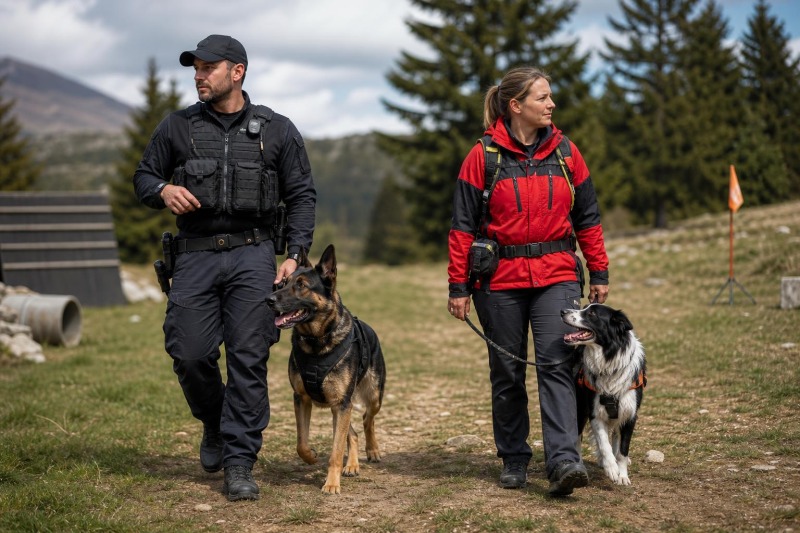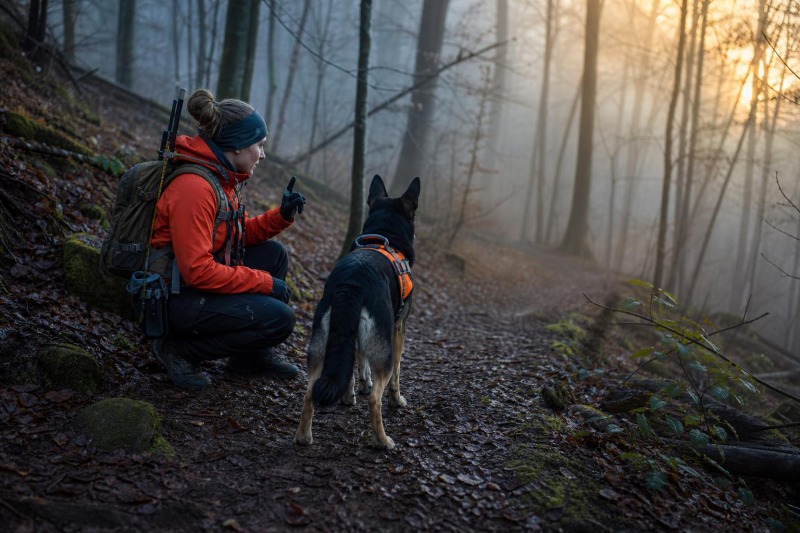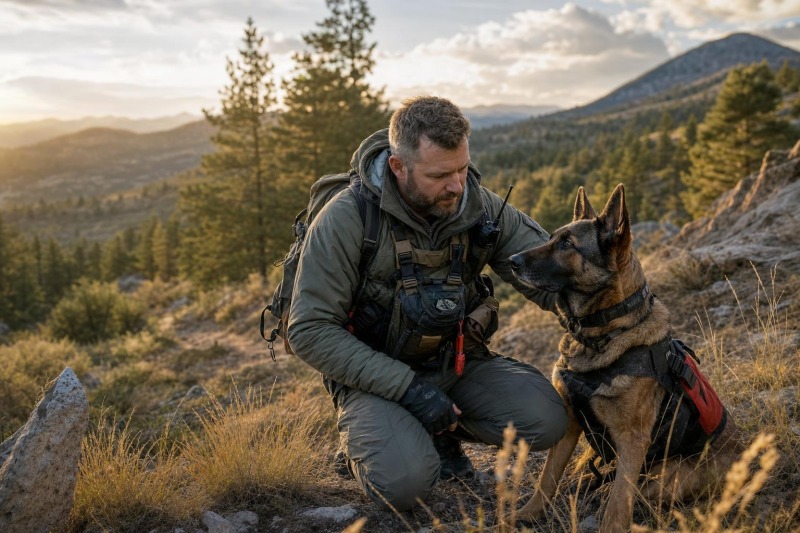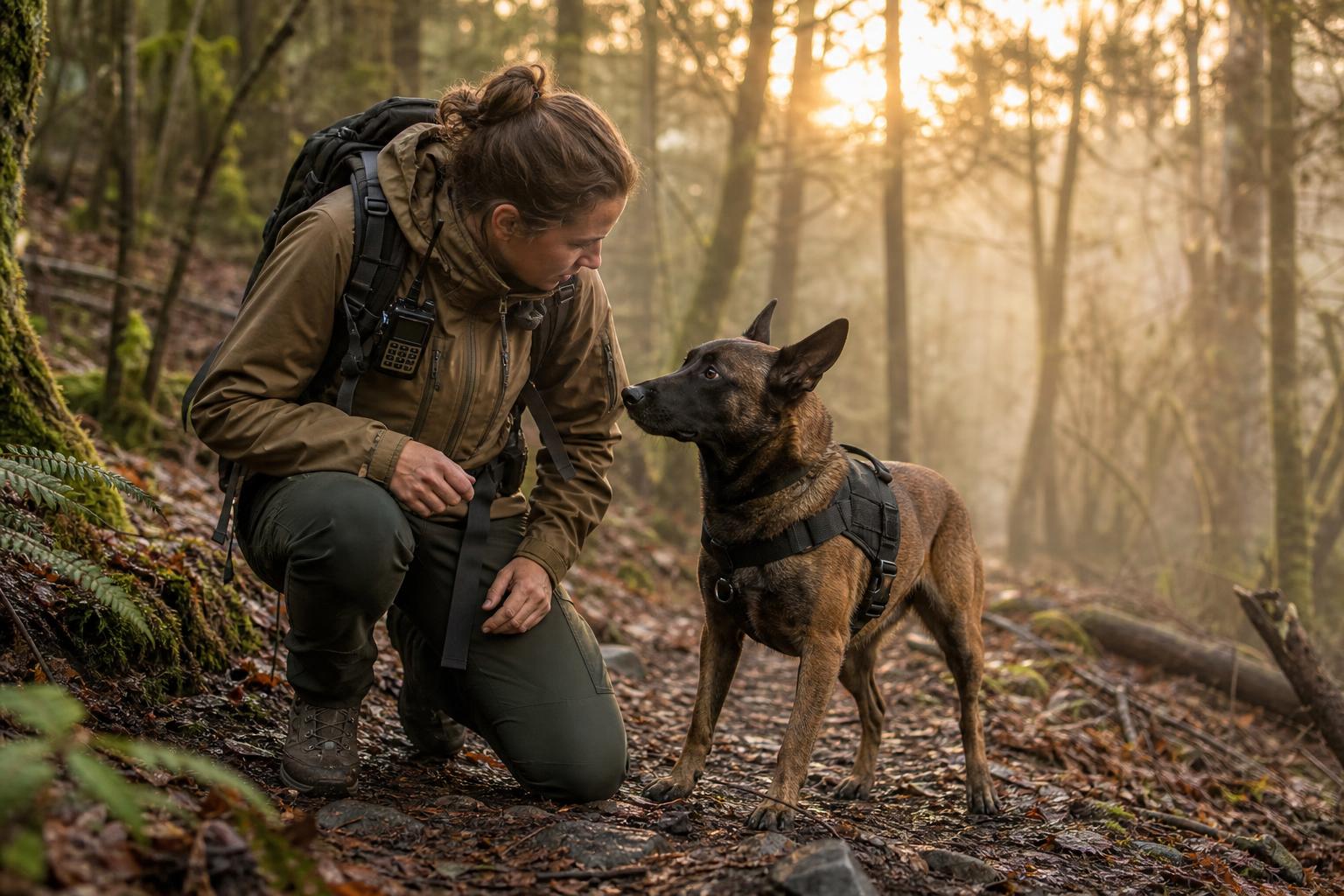
Volunteer search-and-rescue dog handling requires sustained training, team participation, and care for the dog. Searches are only part of the commitment. Navigation, communications, readiness, and the organization’s standards shape the work between callouts.
For dog owners interested in working dogs, search and rescue is one of the clearest examples of purpose-driven canine work. It asks a lot from a dog, but even more from the person at the other end of the line. A volunteer search and rescue handler is not just a dog trainer. He or she is a student of wind, scent, terrain, behavior, logistics, radio traffic, map work, and human stress. The dog may be the nose, but the handler has to be the judgment.
What Volunteer Search and Rescue Handlers Really Do
At its core, the job is simple to describe and hard to live out. A handler develops, trains, deploys, and maintains a dog capable of locating missing people. Depending on the team and region, that may mean trailing a subject through woods, airscenting a broad search area, working disaster debris, locating human remains, or helping in water recovery operations. Most of that work is done on a volunteer basis, often around full-time jobs and family obligations.
That volunteer part matters. Many handlers are not paid professionals. They buy gear, fuel trucks, attend seminars, train in all seasons, and stand ready when a callout comes. The pager or phone does not care if it is midnight, if supper is on the table, or if rain is driving sideways across a ridge. If the team is needed, the handler goes.
In the hunting world, we understand what it means to trust a dog in rough country and ask for honest work when conditions turn mean. Search and rescue takes that same trust and puts human stakes on it. That raises the standard in a hurry.
The Dog Behind the Handler
Not every good dog is cut out for search and rescue. Folks sometimes assume the right breed is the answer, but breed is only part of the picture. What really counts is nerve, health, desire, environmental stability, and the willingness to hunt with purpose. A SAR dog has to push into strange places, ignore distractions, ride quietly, work around people, and keep hunting when tired. He must be bold without being reckless and social without losing focus.
Handlers often look for dogs with strong toy drive or hunt drive because those traits can be shaped into reward-based training. The dog learns that finding a person leads to a game, praise, or another reward he values. Over time, that motivation becomes polished into reliable field behavior. You are taking natural desire and giving it direction.
They were steady. They took correction without folding, pressure without panicking, and long days without souring. In SAR, that steadiness is gold. A dog can be fast and talented, but if he cannot think clearly in a chaotic scene, he becomes a liability instead of an asset.
Temperament Matters More Than Hype
But search and rescue is not a sport built on noise and posturing. The best SAR dogs are often the ones that come out of the crate ready to work, settle when asked, and reengage without drama. Handlers need dogs that can switch gears, because deployments can involve long waits followed by sudden, demanding work.
A good volunteer handler recognizes what is in front of him. That means not forcing a dog into a role he is not built for, and not mistaking enthusiasm for suitability. Honest evaluation saves everybody time and heartache.
Training a Search and Rescue Dog Is a Long Game
If you are the sort of dog owner who likes fast results, search and rescue will test your patience. This work is built over months and years, not weekends. Early training usually starts with engagement, confidence, reward systems, and simple scent problems. From there, the challenges become more complex. Distances stretch out. Terrain gets rougher. Weather changes. Subjects age longer. The dog has to learn to solve odor problems instead of just running to a visible helper.
The handler is learning every bit as much. Reading a dog in the field is no small skill. A tail change, a head snap, a shift in breathing, a drift in casting pattern, or a sudden commitment into cover can tell a good handler more than words ever could. That kind of reading is earned by spending countless hours with the dog under many conditions.
Good training days are important, but bad training days teach their own lessons. Wind swirls. Scent pools. Heat drags a dog down. Frozen ground changes movement. A handler who only trains in ideal conditions is building a shallow foundation. Real teams train in the ugly stuff too, because missing people do not wait for perfect weather.
Certification Is Only the Beginning
Most credible SAR organizations require rigorous testing or certification before a team can deploy. That process matters because it creates accountability and a measurable standard. Still, certification should never be confused with completion. A finished search and rescue dog is a myth. Like any serious working dog, he is always either improving or slipping. Skills need maintenance. Obedience needs refreshing. Physical conditioning has to be protected. So does confidence.
They know one successful search does not make a legend, and one bad day does not make a failure. They keep training because the next call may ask more than the last one did.
The Handler’s Burden in the Field
People tend to talk about the dog, and fair enough, because the dog is remarkable. But the handler carries a heavy load. Decision-making in search work is rarely clean. You may be asked to search steep country with fading light, heavy brush, and sparse information. You may need to decide whether your dog is in odor, whether the route is safe, whether to push farther, whether to pull back, and how to communicate all that clearly to a team leader.
Then there is the emotional side. Not every mission ends the way anybody wants. Search and rescue handlers have to remain functional under stress, useful in uncertainty, and professional around families living through the worst day of their lives. That takes maturity. The dog may key off your emotional state, so composure is not just a personal virtue. It is part of the work.
Search and rescue has no room for that. The field exposes vanity in a hurry. What lasts is preparation, honesty, teamwork, and a dog that believes in its job.
Why Dog Owners Are Drawn to Search and Rescue
For many owners of high-drive dogs, SAR offers something precious: meaningful work. It gives energy a channel and intelligence a purpose. Dogs bred to solve problems and use their noses often struggle in idle suburban life. Search and rescue can provide structure, challenge, and partnership in a way few activities can.
That said, folks should go into it with eyes open. This is not a hobby you dabble in if you happen to have free time. It is a service commitment. It asks for physical effort, travel, regular training, continuing education, and the willingness to put the mission ahead of ego. If that sounds heavy, it is because it is. But for the right handler and the right dog, it can also be deeply rewarding.
There is a special satisfaction in watching a dog do exactly what he was born and prepared to do. It is the same feeling a hunter knows when a good dog hits scent, works honestly, and stays true under pressure. In search and rescue, that instinctive admiration is joined by something larger. The work matters beyond the field itself.
Choosing the Right Path Into SAR
If a reader is considering becoming a volunteer search and rescue handler, the best first step is to find a reputable local SAR unit and ask questions before buying gear or making assumptions. Every team has its own standards, culture, and operational focus. Some train specific dog disciplines. Some require a period of membership before canine work is considered. Some expect wilderness skills first and dog ambitions second.
That is a healthy approach. A strong SAR handler is a capable searcher even without the dog. Navigation, survival awareness, fitness, fieldcraft, communication, and teamwork all matter. The dog is a force multiplier, not a substitute for competence.
Prospective handlers should also take a hard look at their dog and themselves. Is the dog physically sound, environmentally stable, and motivated? Is the owner teachable, reliable, and willing to train for the long haul? There is no shame in realizing a dog is better suited for another line of work. The goal is not to force an identity. The goal is to serve well.
A Partnership Built on Trust
Volunteer search and rescue handlers are built the same way good dogs are built: through repeated exposure to honest work. Trust does not come from slogans. It comes from miles traveled together, mistakes corrected, skills sharpened, and the quiet confidence that forms when dog and handler understand each other in difficult ground.
That is what makes the work worth respecting. It is not glamorous once you get close enough to see it clearly. It is muddy, technical, expensive, time-consuming, and sometimes heartbreaking. But it is also one of the finest expressions of the working dog tradition. A well-trained dog using his nose to find the lost, guided by a handler disciplined enough to help him succeed, is a sight that reminds you what these animals are capable of when we meet them with purpose.
For dog owners interested in working dogs, few paths show the value of partnership more plainly than search and rescue. When done right, it is not just training. It is service, plain and simple, carried out by volunteers and their dogs in places where hope still has a trail to follow.