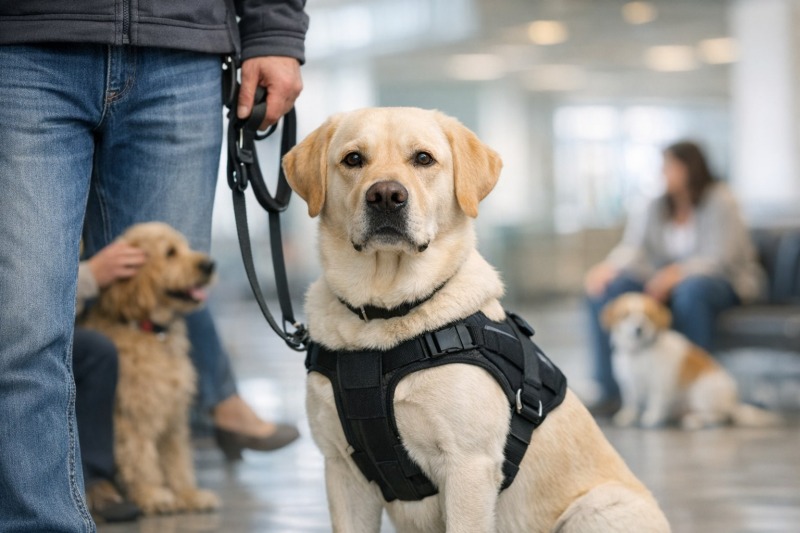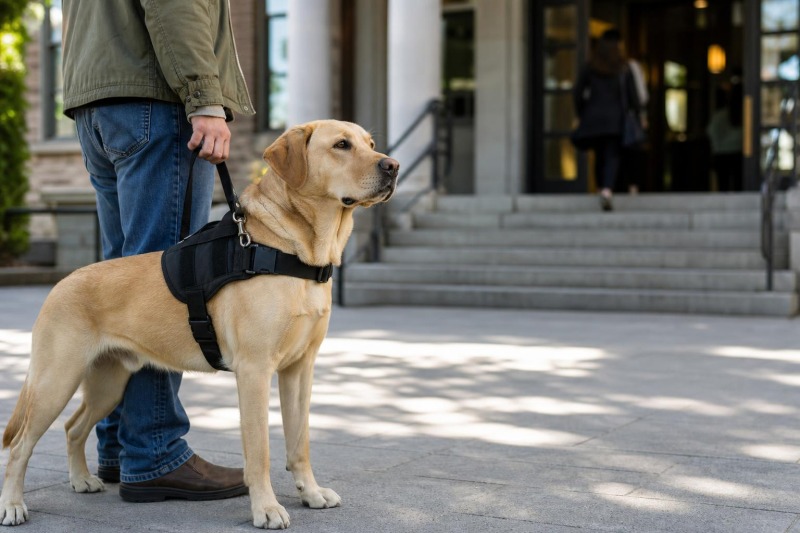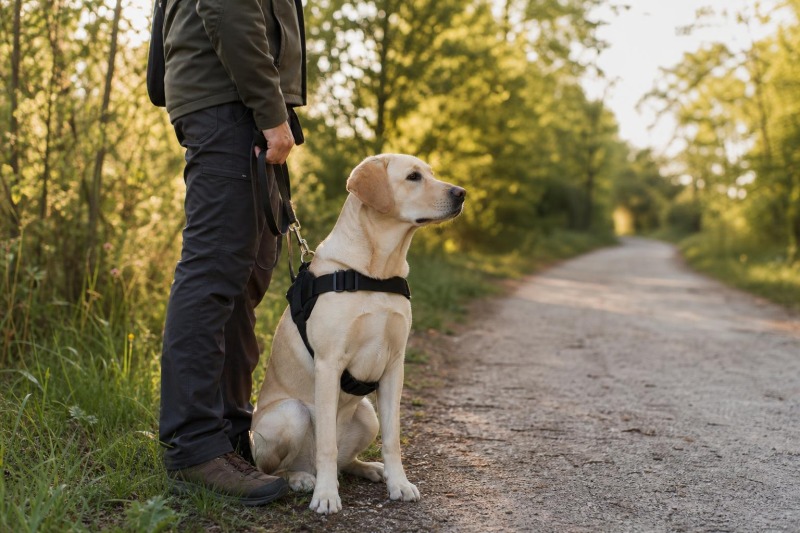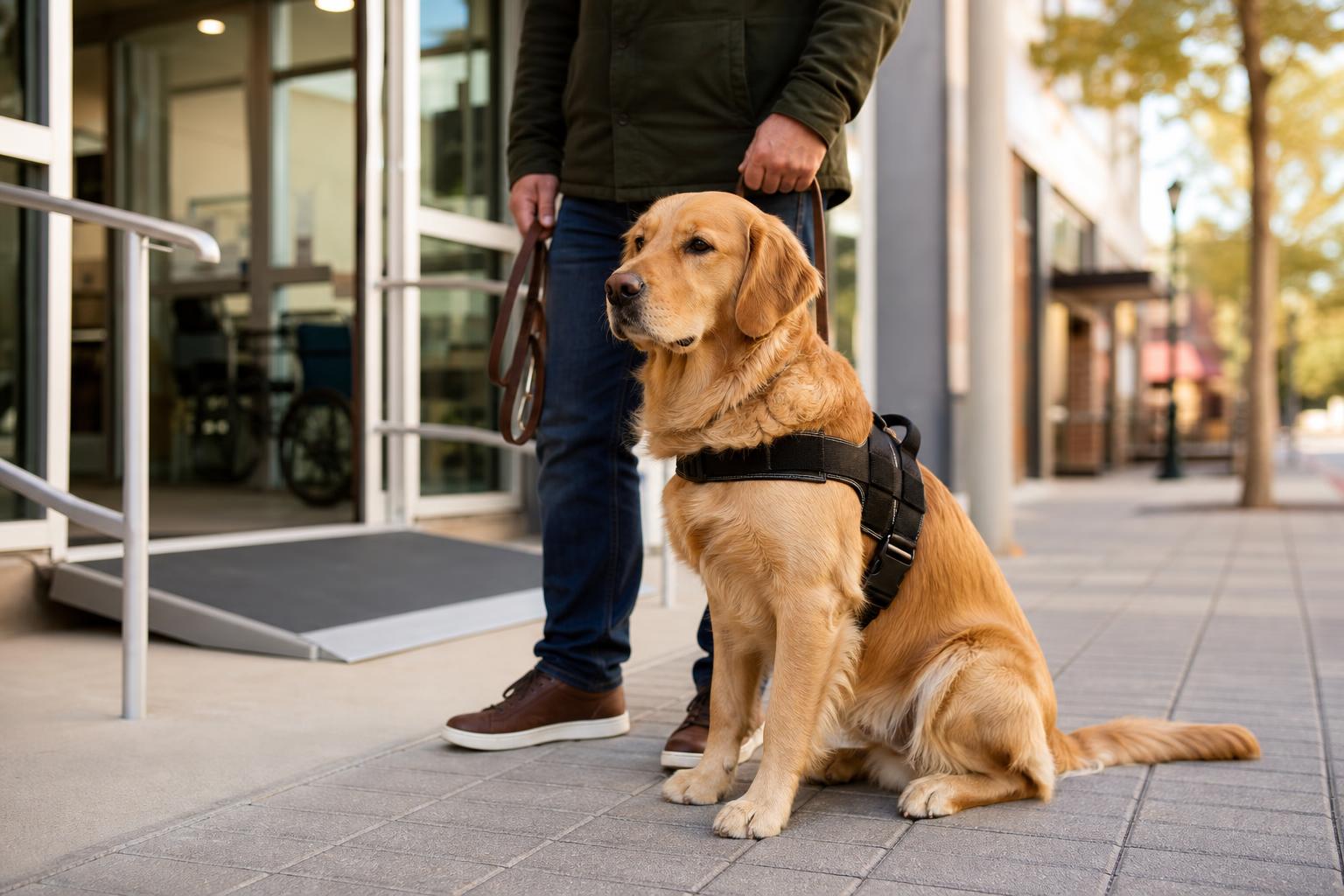
Under the Americans with Disabilities Act, a service dog is individually trained to perform work or tasks related to a person’s disability. Understanding the actual tasks and the rules applying to a particular setting is the starting point for understanding service-dog status.
Under the Americans with Disabilities Act, a service dog is a dog that has been individually trained to do work or perform specific tasks for a person with a disability. That is the heart of it, and there is no sense dancing around the definition. The dog must do something directly related to that person’s disability. A dog that offers comfort by its presence alone, no matter how sweet or calming, does not meet the legal standard for a service dog.
This is where confusion often starts. Plenty of good dogs help people feel safer, calmer, and less alone. There is real value in that. But when we are talking about what qualifies as a service dog in legal and practical terms, the line is drawn by trained, disability-related tasks. That distinction matters for dog owners, handlers, businesses, and the public.
The Legal Definition of a Service Dog
If you strip away internet chatter and the homemade vests sold online, the legal definition is fairly plain. A service dog must be trained to assist a person who has a physical, sensory, psychiatric, intellectual, or other mental disability. The dog’s work must be active and specific. Guiding a blind handler through crowded spaces qualifies. Alerting a deaf handler to alarms or voices qualifies. Retrieving medication, helping with balance, interrupting a harmful psychiatric episode, or detecting an oncoming seizure may qualify as well, provided the dog has been trained to perform those tasks.
That training is what separates a service dog from a pet with good manners. Good behavior is expected, but obedience alone is not enough. Those are highly trained dogs, but unless they are trained to perform disability-related tasks for a handler, they are not service dogs. Work matters, but the kind of work matters more.
Does the Dog Need Professional Training?
Not necessarily. A service dog does not have to come from a commercial training program to qualify. In many cases, handlers train their own dogs, sometimes with help from experienced trainers and sometimes through years of careful practice. What matters is not the logo on the leash but whether the dog can reliably perform the trained tasks needed by the handler.
That said, reliability is no small thing. Service work requires consistency in public, under distraction, and often in stressful situations. A dog that can perform one task at home but falls apart in a grocery store, doctor’s office, or airport may not be ready for the role. This is where experienced training shows its worth. In any working dog job, steadiness under pressure is what proves the dog.
What Tasks Qualify a Dog as a Service Dog?
The task requirement is where the legal standard becomes practical. The dog must be trained to take action that helps mitigate the handler’s disability. Some tasks are easy for the average person to understand. A guide dog leading a blind handler through traffic is a clear example. So is a mobility assistance dog retrieving dropped items, opening doors, or helping with transfers.
Other tasks are less visible but just as legitimate. A psychiatric service dog may be trained to interrupt self-harming behavior, remind a handler to take medication, create space in crowded environments, or wake a handler during night terrors. A medical alert dog may detect blood sugar changes or warn of a seizure before it happens. In each case, the dog is not simply being present. The dog is doing a trained job.
That point bears repeating because it gets muddied so often. Comfort is not a task by itself. Companionship is not a task by itself. A calm dog may reduce anxiety, but unless the dog has been trained to perform a specific action related to the disability, that dog does not qualify as a service dog under the ADA.
Service Dogs vs. Emotional Support Dogs and Therapy Dogs
This is where many dog owners get tripped up. An emotional support dog can be deeply important to a person’s well-being. A therapy dog can do remarkable good in hospitals, schools, and care facilities. But they are not the same as service dogs, and they do not carry the same public access rights.
An emotional support dog provides comfort through companionship. That support can be meaningful and medically recognized in some housing contexts, but emotional support alone does not make the dog a service dog. A therapy dog, on the other hand, is trained to interact with and comfort other people, not to perform disability-related tasks for one handler. Therapy dogs do fine work, but their role is different by design.
Think of it like the difference between a fine house dog, a bird dog, and a search dog. All may be talented. All may be useful in their own setting. But the work defines the category. The same principle applies here.
Do Service Dogs Need Certification or Registration?
In the United States, no official federal certification or national registry is required for a dog to qualify as a service dog. That surprises a lot of people because the internet is full of websites selling certificates, ID cards, and registrations. Those items may look official, but they are not what makes a service dog legitimate.
A real service dog is validated by training and function, not by paperwork bought online. Businesses generally may ask only two questions when it is not obvious what service the dog provides: whether the dog is required because of a disability and what work or task the dog has been trained to perform. They are not allowed to demand medical records, require special identification, or insist on proof of certification in most ordinary public settings.
Behavior and Public Access Matter Too
Even a task-trained dog must behave appropriately in public. That is part of what qualifies a dog in the real world. A service dog should be under control, housebroken, and capable of working without creating disruption. If a dog lunges, barks repeatedly, soils the floor, or acts aggressively, a business may be allowed to ask that the dog be removed, even if the dog performs a legitimate task.
That standard is fair. Any true working dog has to carry itself in a way that fits the job. In the field, a retriever that breaks early, ignores commands, or starts trouble in the blind does not stay in the lineup for long. Public access for service dogs comes with a similar expectation. Skill must be matched with discipline.
Can Any Breed Be a Service Dog?
Yes, in principle. The law does not limit service dogs to certain breeds. What matters is the individual dog’s ability, temperament, health, and trainability. Still, common sense goes a long way here. Not every dog is suited for every kind of service work. The right dog for mobility support may not be the right dog for psychiatric alert work, and the right dog for a small apartment may not be a giant breed that struggles in tight indoor spaces.
Temperament is often the deciding factor. A service dog must be stable, attentive, biddable, and resilient. The dog should be able to work around crowds, noise, movement, food, and other animals without unraveling. Those are not minor demands. They call for the same kind of natural steadiness that makes any working dog worth feeding.
How to Know if a Dog Truly Qualifies
If you are trying to sort out whether a dog qualifies as a service dog, the cleanest way to ask it is this: does the handler have a disability, and has the dog been individually trained to perform specific tasks that directly help with that disability? If the answer is yes, and the dog is under control in public, you are likely looking at a legitimate service dog.
If the dog is there for comfort alone, if the training is vague, or if the dog cannot behave safely in public, then the picture changes. That does not make the dog unimportant. It simply means the dog belongs in a different category.
For dog owners interested in working dogs, this subject is worth understanding clearly. Service dogs represent one of the finest examples of the human-canine partnership. They are not defined by sentiment or appearances. They are defined by work, reliability, and purpose. That is something anyone who respects a well-made dog can appreciate.
A true service dog earns the title the same way any dependable working dog earns respect: through trained ability applied where it matters most. The law recognizes that standard because the dog is not a decoration or a convenience. The dog is a functional aid for a person living with disability.
In a time when labels get tossed around loosely, it helps to come back to plain truth. What qualifies as a service dog is not mystery and it is not marketing. It is a dog trained to perform specific tasks for a handler with a disability, and trained well enough to do that work steadily in the world as it is. That is the real standard, and it is one worth protecting.